The government provides public education because
A) public education is a public good.
B) public education is non-rival and nonexclusive.
C) private education is rival and exclusive.
D) public education combats the negative externalities of private education.
E) public education provides positive externalities.
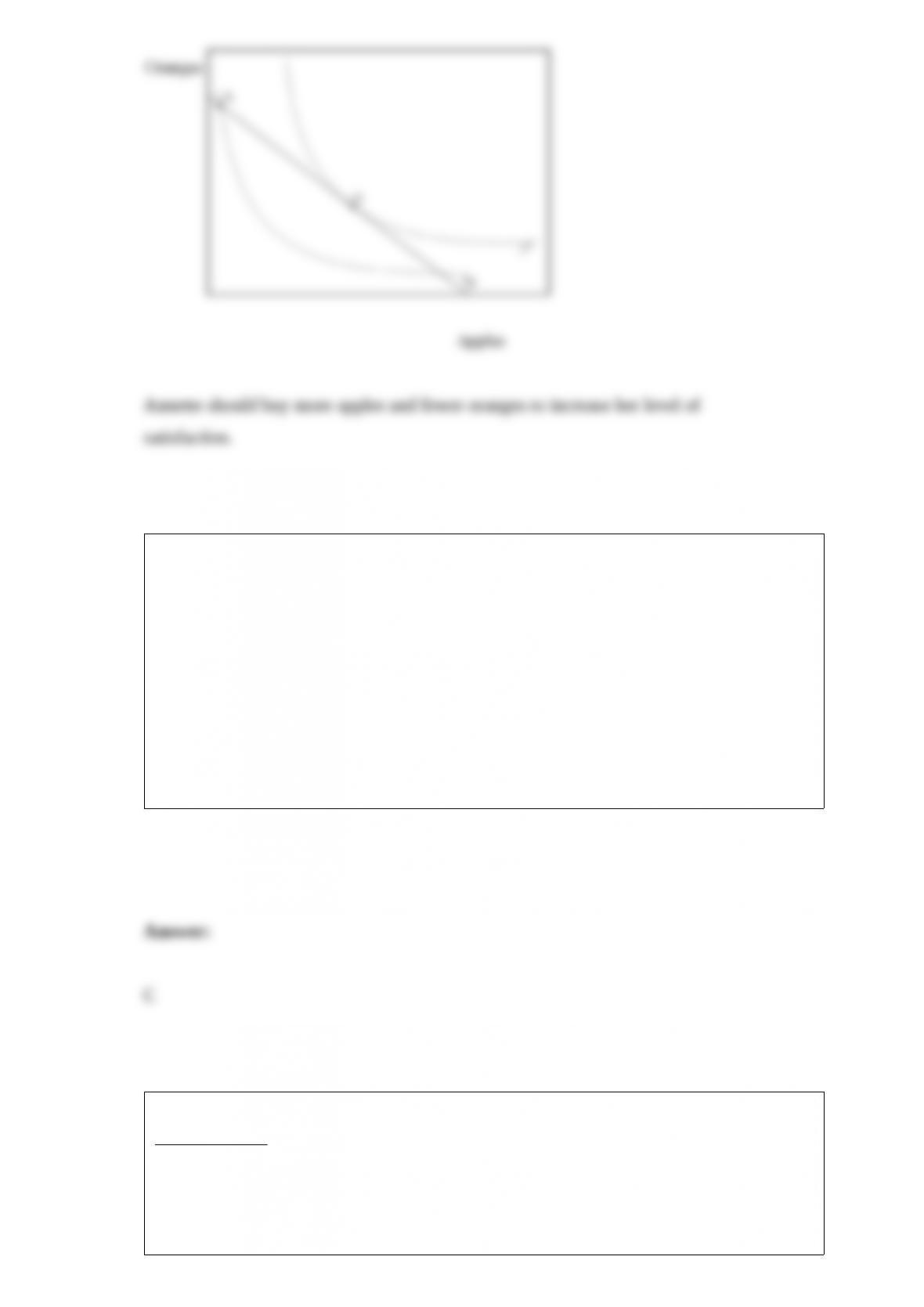
At commodity bundle A, which consists of only apples and oranges, Annette’s marginal
utility per dollar spent on apples is 10 and her marginal utility per dollar spent on
oranges is 8. Diagram a representative budget constraint and indifference curve that that
passes through bundle A given Annette’s budget is exhausted at bundle A. Is Annette
maximizing utility? Why or why not? If she is not, what could she do to increase her
level of satisfaction?
A perfectly competitive hardware manufacturer has total revenue of $85 million, total
variable costs of $45 million, and fixed costs of $10 million. What is the firm’s producer
surplus?
A) $85 million
B) $70 million
C) $40 million
D) $30 million
Scenario 10.1:
Barbara is a producer in a monopoly industry. Her demand curve, total revenue curve,
marginal revenue curve and total cost curve are given as follows:
Q = 160 – 4P TR = 40Q – 0.25Q2MR = 40 – 0.5Q TC = 4Q MC = 4

Refer to Scenario 10.1. The price of her product will be ________.
A) 4
B) 22
C) 32
D) 42
E) 72
We can approximate the real return on an investment by subtracting the inflation rate
from the nominal return on the investment. For example, an investment that returns
10% per year while inflation is 4% per year has a real (inflation adjusted) return of
approximately 6%. Which of the following outcomes is NOT possible?
A) Nominal and real returns are positive
B) Nominal return is positive, real return is negative
C) Nominal return is negative, real return is positive
D) all of these outcomes are possible
Bundling products makes sense for the seller when

A) consumers have heterogeneous demands.
B) the products are complementary in nature.
C) firms cannot price discriminate.
D) both A and C.
Use the following statements to answer this question:
I. Under the dominant firm model, the dominant firm effectively acts like a monopolist
who is facing the excess market demand that cannot be supplied by the fringe firms.
II. Under the dominant firm model, the fringe firms also act like profit maximizing
monopolists.
A) I and II are true
B) I is true and II is false
C) I is false and II is true
D) I and II are false
In the long run, new firms can enter an industry and so the supply elasticity tends to be

A) more elastic than in the short run.
B) less elastic than in the short run.
C) perfectly elastic.
D) perfectly inelastic.
In the kinked demand curve model, if one firm reduces its price
A) other firms will also reduce their price.
B) other firms will compete on a non-price basis.
C) other firms will raise their price.
D) Both A and B are correct.
E) Both B and C are correct.
What happens to the profit-maximizing cartel price and quantity if the marginal cost of
production declines?
A) The sellers are no longer price takers, so the change in marginal cost has no impact
on the cartel outcome.
B) If demand is downward sloping, the optimal cartel price should decline and the

market quantity should increase.
C) The sellers retain the same pricing strategy and capture higher per-unit profits.
D) The cartel price increases and market quantity declines.
What is the profit maximizing condition for a vertically integrated firm?
A) Net marginal revenue equals the sum of the marginal costs of the intermediate
inputs.
B) Marginal revenue equals the marginal cost of the final output.
C) Net marginal revenue equals the marginal cost of each intermediate good.
D) The sum of net marginal revenues equals the marginal cost of the final output.
A firm should hire more labor when the marginal revenue product of labor
A) equals the wage rate.
B) exceeds the wage rate.
C) is less than the wage rate.
D) Any of these can be true.
E) None of these are true.
Which price index published by the US federal government represents wholesale price
changes?
A) Consumer Price Index
B) Producer Price Index
C) GDP deflator
D) Dow-Jones Industrial Average
Use the following statements to answer this question.
I. To maximize profit, a firm will increase its advertising expenditures until the last
dollar of advertising generates an additional dollar of revenue.
II. The full marginal cost of advertising is the sum of the dollar spent directly on
advertising and the marginal production cost that results form the increased sales that
advertising brings about.
A) Both I and II are true.
B) I is true, and II is false.
C) I is false, and II is true.

D) Both I and II are false.
Many states use container redemption programs to encourage reuse of glass bottles and
other recyclable containers. Suppose a state has a current redemption program that
imposes a 10-cent per container fee, and then the state increases the fee to 15 cents per
container. What is the expected impact of this change on the optimal quantity of
unredeemed (scrapped) containers?
A) Optimal quantity increases
B) Optimal quantity decreases
C) Optimal quantity remains unchanged
D) We cannot determine the outcome of this policy change without having more
information
Left alone, with no government interference, a profit-maximizing firm will produce
emissions
A) where the MSB curve crosses the MCA curve.
B) at the vertical intercept of the MSB curve.
C) at the horizontal intercept of the MSB curve.

D) at the vertical intercept of the MCA curve.
E) at the horizontal intercept of the MCA curve.
Once the state environmental protection agency devises its new policy to protect the
environment, firms decide whether to remain in the state or move their operations to a
neighboring state. In the language of game theory, this is an example of:
A) a cooperative game.
B) a sequential game.
C) a threat.
D) the Prisoner’s dilemma.
The Happy Mountain Brewing Company sells ground organic coffee in one pound
containers through several grocery chains in the US. The firm has two divisions: the
roasting division buys raw organic coffee beans and then blends, roasts, and grinds the
beans, and the merchandising division packages and distributes the ground coffee.
a. Please draw a carefully labeled figure that illustrates the optimal transfer pricing
policy for the firm if there is no outside market and the firm is a monopoly seller (i.e.,
there are no other sellers of ground organic coffee). In particular, please show the
optimal transfer price that is paid to the roasting division, the optimal retail price
charged by the merchandising division, and the optimal amount of coffee sold.
b. Suppose poor weather conditions in South American increase the price of raw coffee
beans. How does this affect the marginal cost curve for the roasting division? Does this
also affect the marginal cost of merchandising (packaging and distribution)? How do
the optimal transfer price, retail coffee price, and quantity sold change due to this
weather problem?
Table 5.4
Refer to Table 5.4. If outcomes 1 and 2 are equally likely at Job A, then the standard
deviation of payoffs at Job A is
A) $1.

B) $10.
C) $40.
D) $50.
E) $60.
The efficient level of recycling equates the
A) marginal cost of scrap disposal to the marginal benefit from not using virgin
materials.
B) marginal cost of recycling to the marginal benefit from not using virgin materials.
C) marginal cost of scrap disposal to the marginal cost of recycling.
D) marginal private cost of disposal to the marginal cost of recycling.
E) per-unit refund from recycled materials to the marginal benefit from not using virgin
materials.
Suppose we advertise up to the point where the last dollar spent on advertising
generates an additional dollar of sales revenue (i.e, the marginal revenue of advertising
equals one). If the full marginal cost of advertising is greater than one, then we will
generate:

A) less output than the profit maximizing level.
B) more output than the profit maximizing level.
C) the profit maximizing level of output.
D) We don’t have enough information to answer this question.
Virginia Tyson is a widow whose primary income is provided by earnings received
from her husband’s $200,000 estate. The table below shows the relationship between
income and total utility for Virginia.
Income Total Utility
5,000 12
10,000 22
15,000 30
20,000 36
25,000 40
30,000 42
a. Construct the marginal utility table for Virginia. What is her attitude toward risk?
Explain your answer including a description of the marginal utility for individuals
whose risk preferences are different from Virginia’s.
b. Virginia is currently earning 10% on her $200,000 in a riskless investment.
Alternatively, she could invest in a project that has a 0.4 probability of yielding a
$30,000 return on her investment and a 0.6 probability of paying $10,000. Should she
alter her strategy and move her $200,000 to the more risky project?
Scenario 1:
This year Jacob Verytall signs a “Fifty Million Dollar” contract with the Mission City
Muckrakers, a new basketball team. He will be paid $10 million per year over the next
5 years beginning next year. The interest rate is 10%, and the Muckrakers have enough
in the bank to generate the payment stream.

In terms of this year’s dollars, this “Fifty Million Dollar” contract is worth
approximately
A) $45.4 million.
B) $37.9 million.
C) $10 million.
D) $9.4 million.
E) $7.5 million.
Under a binding price ceiling, what does the change in consumer surplus represent?
A) The gain in surplus for those buyers who can still purchase the product at the lower
price.
B) The loss in surplus for those buyers who previously purchased some units of the
good at the higher price, but these units are no longer produced at the lower price.
C) The loss in surplus for those buyers who would like the purchase the excess demand
created by the price ceiling policy.
D) Both A and B are correct.
E) Both A and C are correct.

Bob views apples and oranges as perfect substitutes in his consumption, and MRS = 1
for all combinations of the two goods in his indifference map. Suppose the price of
apples is $2 per pound, the price of oranges is $3 per pound, and Bob’s budget is $30
per week. What is Bob’s utility maximizing choice between these two goods?
A) 4 pounds of apples and 6 pounds of oranges
B) 5 pounds of apples and 5 pounds of oranges
C) 10 pounds of oranges and no apples
D) 15 pounds of apples and no oranges
E) none of the above
The marginal social costs and abatement costs of a certain type of air pollution for a
factory are given as:
MSC = -1121 + 22.5Q MCA = 879 – 17.5Q,
where Q = units of pollution per day, and MSC and MCA are measured in dollars. The
factory is located in a small town that is currently setting community standards. You
have been hired to perform the analysis requested below.
a. If the community wishes to set a pollution standard for the factory, what daily level
of pollution should be allowed?
b. As an alternative, some members of the town council favor an emissions tax for the
factory. If a tax is implemented, at what level should the tax be set?
If prices and income in a two-good society double, what will happen to the budget line?
A) The intercepts of the budget line will increase.
B) The intercepts of the budget line will decrease.
C) The slope of the budget line may either increase or decrease.
D) Insufficient information is given to determine what effect the change will have on
the budget line but we know society is worse-off.
E) There will be no effect on the budget line.

The nominal price of industrial red paint was $12 per gallon in 1993. To convert this
value to the real price of paint in 2012 dollars, we should use the:
A) Consumer Price Index.
B) Producer Price Index
C) Fed funds rate.
D) 30-day T-bill rate.
A local retailer has decided to carry a well-known brand of shampoo. The marketing
department tells them that the quarterly demand by an average man is:
Qd = 3 – 0.25P
and the quarterly demand by an average woman is:
Qd = 4 – 0.5P
The market consists of 10,000 men and 10,000 women. How may bottles of shampoo
can they expect to sell if they charge $6 per bottle?
A) 20,000
B) 33,000
C) 25,000
D) 10,000
E) none of the above
The U.S. Department of Agriculture is interested in analyzing the domestic market for
corn. The USDA’s staff economists estimate the following equations for the demand
and supply curves:
Qd = 1,600 – 125P
Qs = 440 + 165P
Quantities are measured in millions of bushels; prices are measured in dollars per
bushel.
a. Calculate the equilibrium price and quantity that will prevail under a completely free
market.
b. Calculate the price elasticities of supply and demand at the equilibrium values.
c. The government currently has a $4.50 bushel support price in place. What impact will
this support price have on the market? Will the government be forced to purchase corn
under a program that requires them to buy up any surpluses? If so, how much?