
1) Demand-pull inflation can be restrained by increasing government spending and
reducing taxes.
2) Tying agreements are contracts by which retailers agree to charge the prices that
manufacturers set on branded goods.
3) to achieve its full production potential, an economy must reach full employment.
4) The percentage share of total U.S. financial assets held by commercial banks and
thrifts has increased since 1980.
5) The marginal cost to a firm of R&D expenditures is the market interest rate the firm
must pay to obtain the needed financing.
6) if the marginal cost curve lies below the average variable cost curve, the
average-variable-cost curve must be falling.
7) toothpaste and toothbrushes are substitute goods.
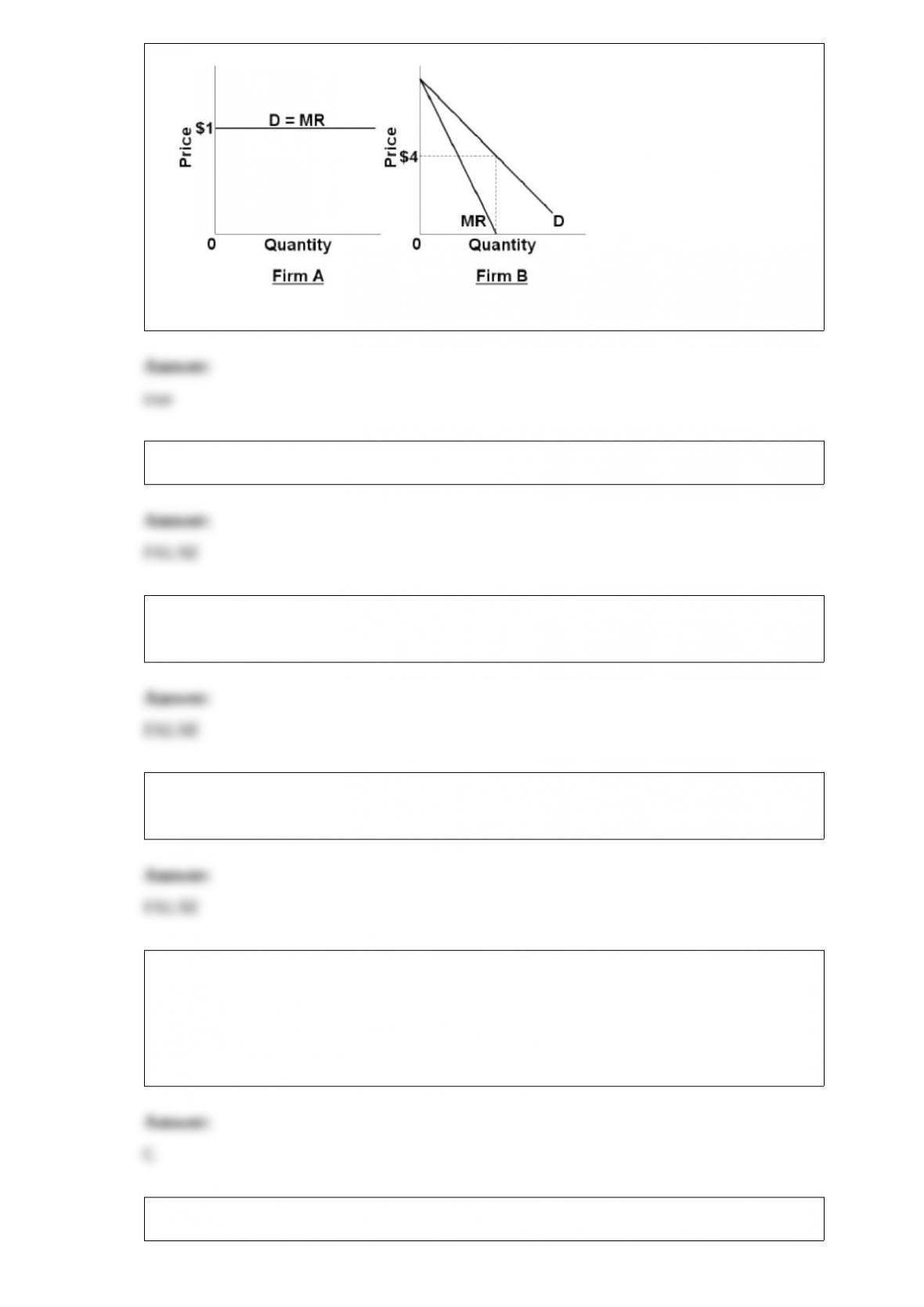
8)
refer to the above diagrams. the demand for firm a’s product is perfectly elastic.
9) Pollution is a good example of the moral hazard problem.
10) Elasticity of resource demand is measured by dividing “percentage change in
resource price” by “percentage change in resource quantity.”
11) An increase in wealth from a substantial increase in stock prices will move the
economy along a fixed aggregate demand curve.
12) Which of the following is directly illegal under the Sherman Act?
A.price discrimination
B.tying contracts
C.price fixing
D.interlocking directorates
13) The following information is for a closed economy:

Refer to the above information. The introduction of $80 billion of government spending
has:
A.lowered the multiplier from 2.5 to 2.0.
B.increased the multiplier from 2.5 to 3.0.
C.increased the multiplier from 2.0 to 2.5.
D.had no effect on the size of the multiplier.
14) The theory of creative destruction was advanced many years ago by:
A.Bill Gates.
B.John Maynard Keynes.
C.Joseph Schumpeter.
D.Adam Smith.
15) Assume a firm faces these costs: total cost of capital = $4000; price paid for labor =
$20 per labor unit; and price paid for raw materials = $8 per raw-material unit.
(a)If the firm can produce 2000 units of output by combining its fixed capital with 200
units of labor and 500 units of raw materials, then what are the total cost and average
total cost of producing the 2000 units of output?
(b)The firm now improves its production process so that it can produce 3000 units of
output by combining its fixed capital with 100 units of labor and 500 units of raw
materials. What are the total cost and average cost of producing the 3000 units of
output?
(c)Based on the data, what conclusion can you draw about the effect of process
innovation on economic efficiency?
16) A highly active role by government may be needed to promote economic growth in
low-income DVCs because of:
A.a lack of infrastructure.
B.lawlessness in the country.
C.a lack of local entrepreneurship.
D.all these reasons.
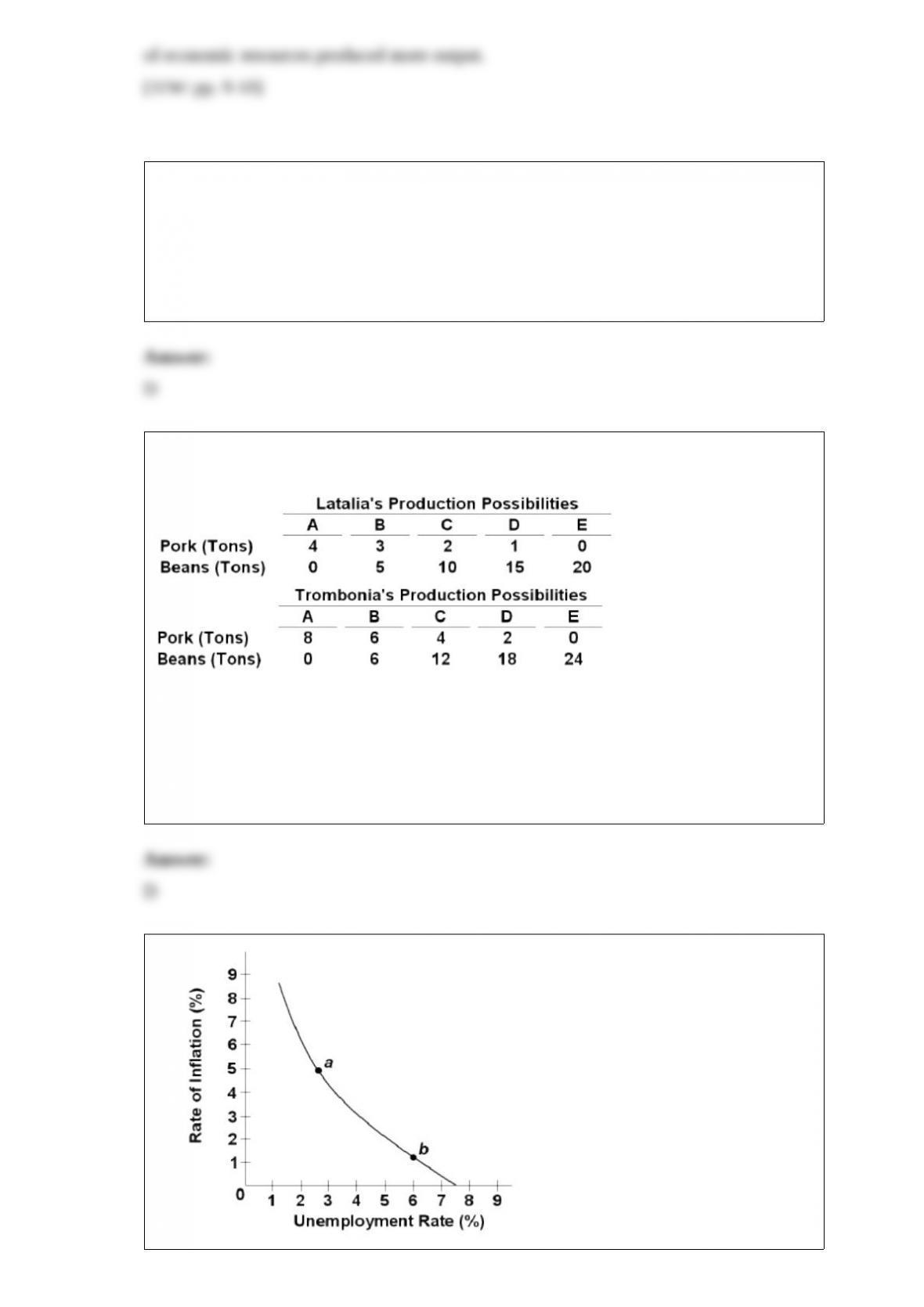
17) The following production possibilities tables for two countries, Latalia and
Trombonia:
Refer to the above tables. If these two nations specialize on the basis of comparative
advantage:
A.Trombonia will produce beans and Latalia will produce pork.
B.Trombonia will produce both beans and pork.
C.Latalia will produce both beans and pork and Trombonia will produce neither.
D.Latalia will produce beans and Trombonia will produce pork.
18)
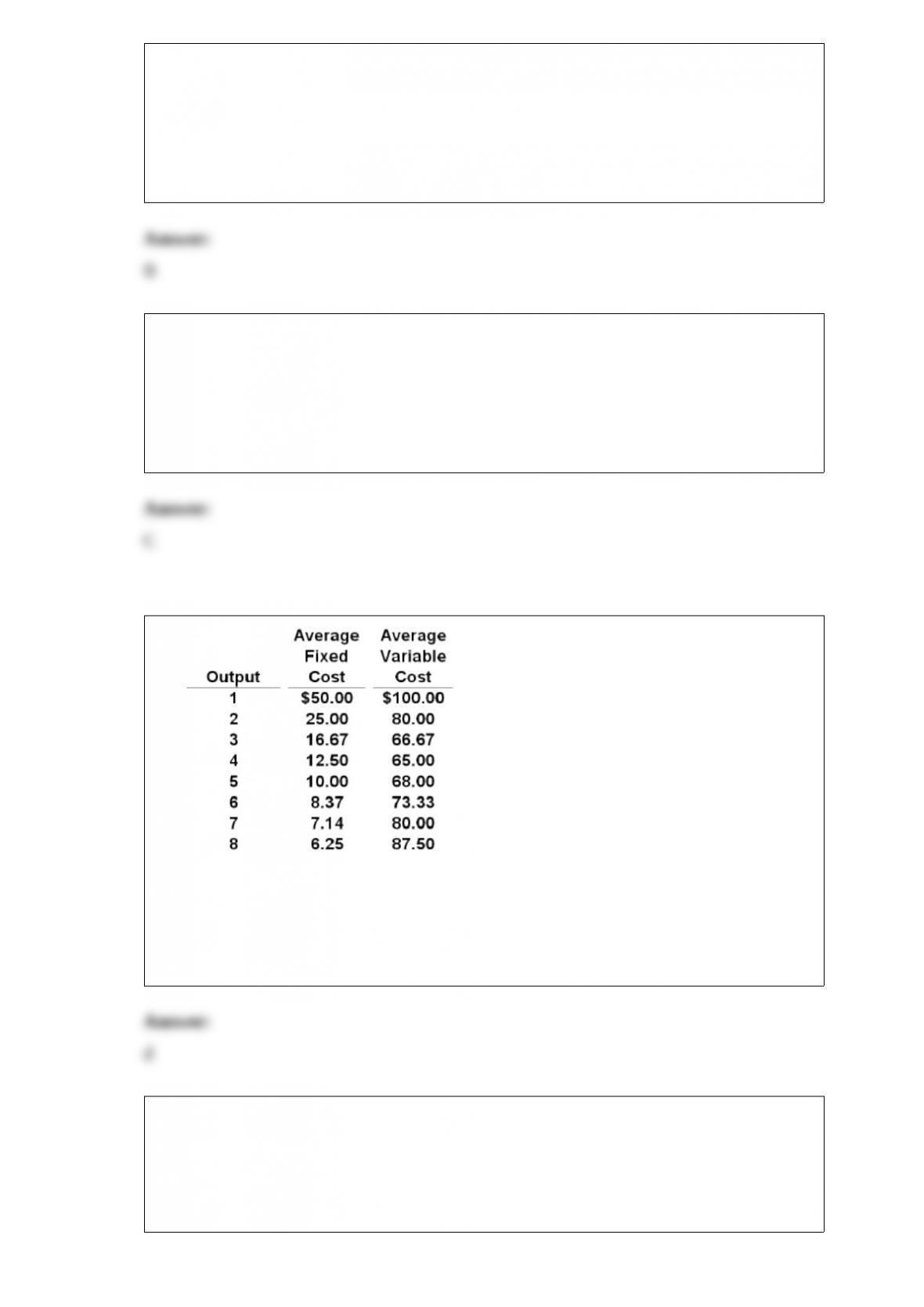
Refer to the above diagram for a specific economy. The curve on this graph is known as
a:
A.Laffer Curve.
B.Phillips Curve.
C.labor demand curve.
D.production possibilities curve.
19) The property tax may be regressive even though wealthy people own much more
taxable property than do poor people. This possibility arises because:
A.marginal and average tax rates on property tend to converge.
B.wealthy people can evade property taxes while poor people cannot.
C.property taxes on rental property and business property are shifted.
D.statutory property tax rates decline as the value of property rises.
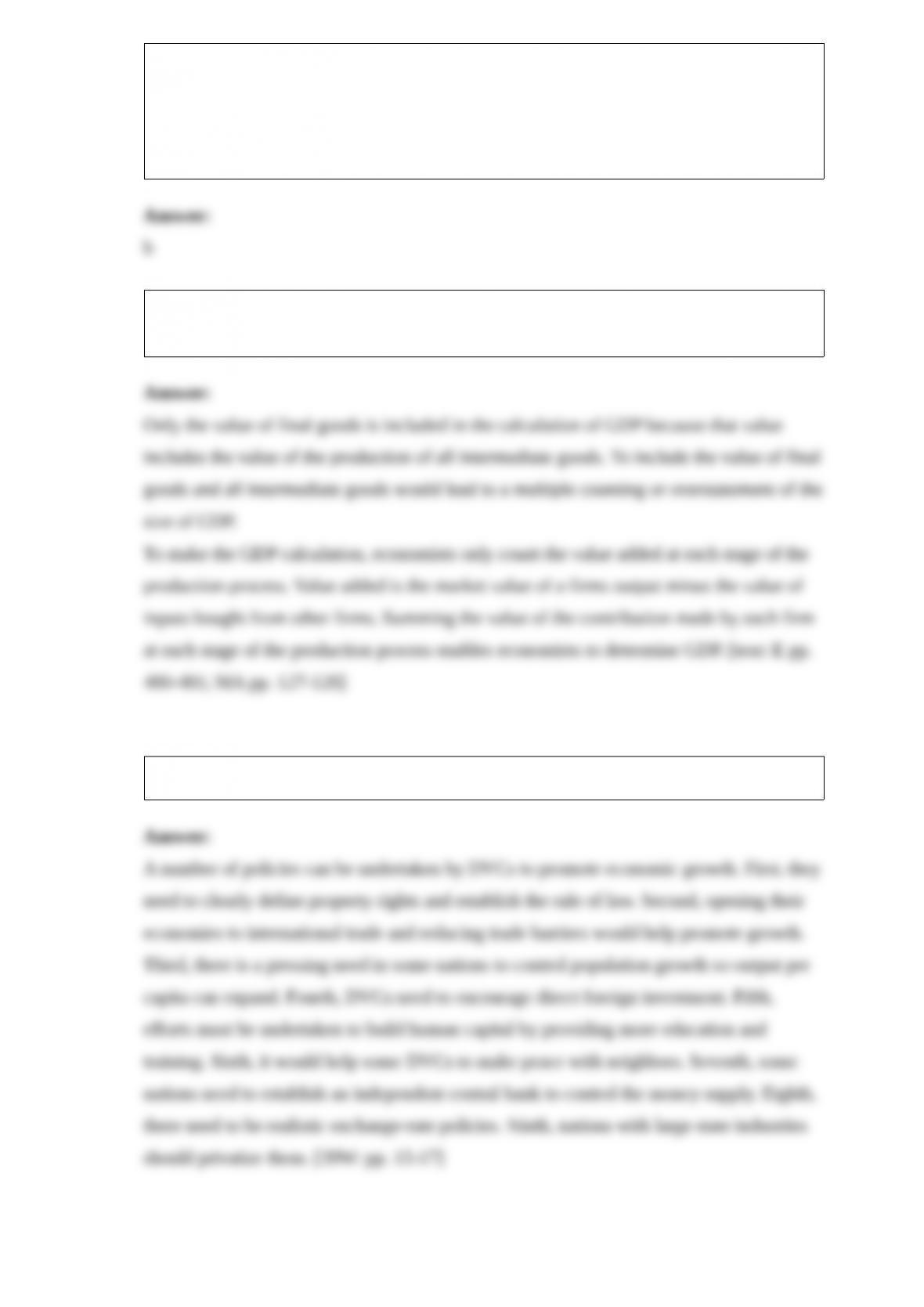
20)
refer to the above data. total fixed cost is:
a.$6.25.
b.$100.00.
c.$150.00.
d.$50.00.
21) inflation affects:
a.both the level and the distribution of income.
b.neither the level nor the distribution of income.
c.the distribution, but not the level, of income.
d.the level, but not the distribution, of income.

22) Which of the following is correct?
A.The asset demand for money is downsloping because the opportunity cost of holding
money declines as the interest rate rises.
B.The asset demand for money is downsloping because the opportunity cost of holding
money increases as the interest rate rises.
C.The transactions demand for money is downsloping because the opportunity cost of
holding money varies inversely with the interest rate.
D.The asset demand for money is downsloping because bond prices and the interest rate
are directly related.
23) increasing marginal cost of production explains:
a.the law of demand.
b.the income effect.
c.why the supply curve is upsloping.
d.why the demand curve is downsloping.
24) Answer the next four questions based on the following data using year 1 as the base
year. All dollars are in billions.
(a)Find real income in year 2.
(b)What was the percentage rise in prices between years 2 and 3?
(c)What was the percentage rise in prices between years 3 and 4?
(d)What was the increase in real income from year 3 to year 4 in percentage?
25) a pure monopolist’s short-run profit-maximizing or loss-minimizing position is such
that price:
a.equals marginal revenue.
b.may be greater or less than atc
c.will always equal atc
d.always exceeds atc
26) Why do economists worry about multiple counting and calculate only the value
added in the production process?
27) What policies might DVCs undertake to promote economic growth?

28) Since a public good is enjoyed by all members of society, willingness to pay for the
good will not diminish as the amount produced increases. Evaluate and use an example
to support your answer.
29) Assume that M is $250 billion and V is 8. If V increases by 15%, what will be the
change in nominal GDP?
30) Which tool of monetary policy is most important? Why?
31) Some economists argue that it is easier to resolve demand-pull inflation than it is
cost-push inflation. Use the aggregate demand and aggregate supply model to explain
this assertion.

32) Why is money considered to be debt?
33) What are social regulation and agency examples?
34) The possibility for gains trade is due to the fact that different countries face
different resource endowments, production costs and geographical locations. Interpret
and expand with examples.