
Which of the following is a reason why it is difficult to estimate the extent of economic
discrimination in the labor market?
A) Employers who discriminate are likely to do so in overt ways such as awarding
some workers with benefits-in-kind.
B) Ultimately, employers who discriminate cannot remain profitable.
C) Employers who discriminate pay an economic penalty.
D) Differences in wages can be attributed to many other factors as well, such as
differences in productivity and preferences.
Who controls a sole proprietorship?
A) stockholders
B) bondholders
C) the owner
D) all of these
Government imposed quantitative limits on the amount of pollution firms are allowed
to produce is an example of
A) the Pigovian method of pollution control.
B) command and control approach to pollution reduction.
C) Coasian solution to pollution reduction.
D) a tradable emission allowance system of pollution control.
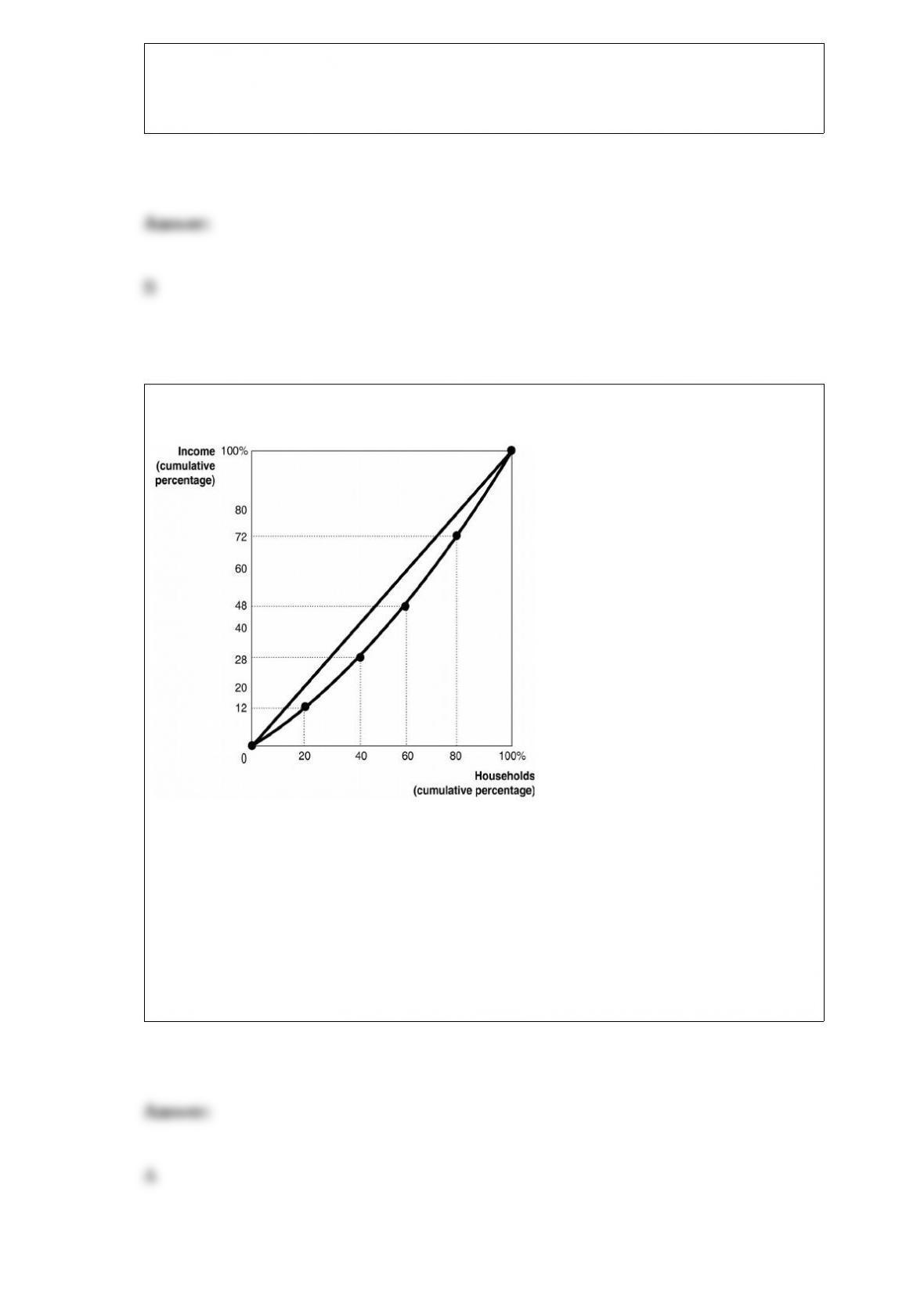
Figure 18-7
Figure 18-7 shows the Lorenz curve
for a hypothetical country. The second highest 20 percent of households
A) earn 24 percent of the society’s total income.
B) earn 28 percent of the society’s total income.
C) earn 42 percent of the society’s total income.
D) earn 72 percent of the society’s total income.

An increase in the price of MP3 players will result in
A) a smaller quantity of MP3 players supplied.
B) a larger quantity of MP3 players supplied.
C) a decrease in the demand for MP3 players.
D) an increase in the supply of MP3 players.
Productivity gains in the United States since 1990 have been ________ productivity
gains in other leading industrial nations.
A) the same as
B) lower than
C) higher than
D) more variable than
Figure 12-4
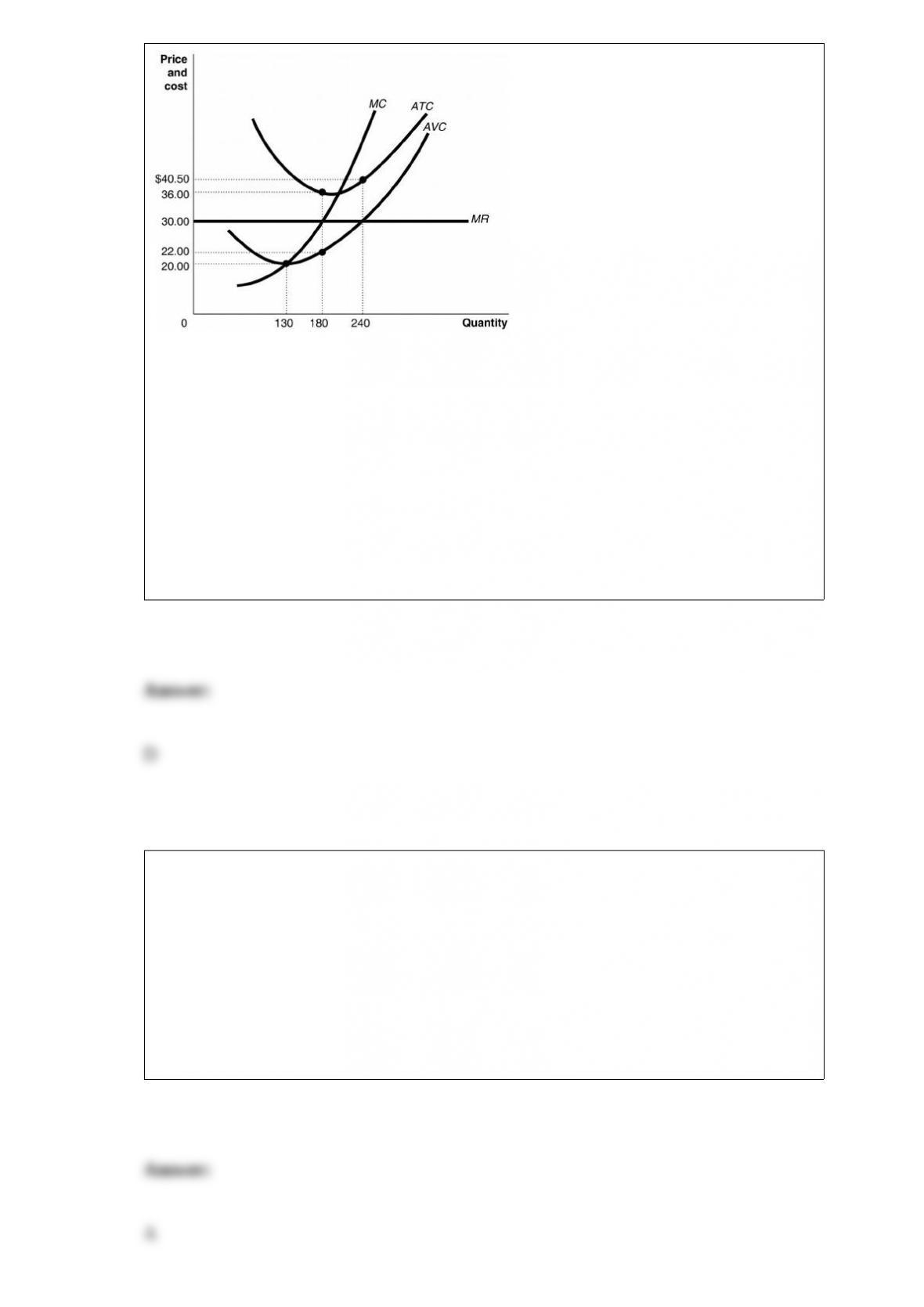
Figure 12-4 shows the cost and demand
curves for a profit-maximizing firm in a perfectly competitive market. If the market
price is $30 and if the firm is producing output, what is the amount of its total variable
cost?
A) $7,200
B) $6,480
C) $5,400
D) $3,960
Households ________ factors of production and ________ goods and services.
A) supply; demand
B) supply; supply
C) demand; supply
D) demand; demand
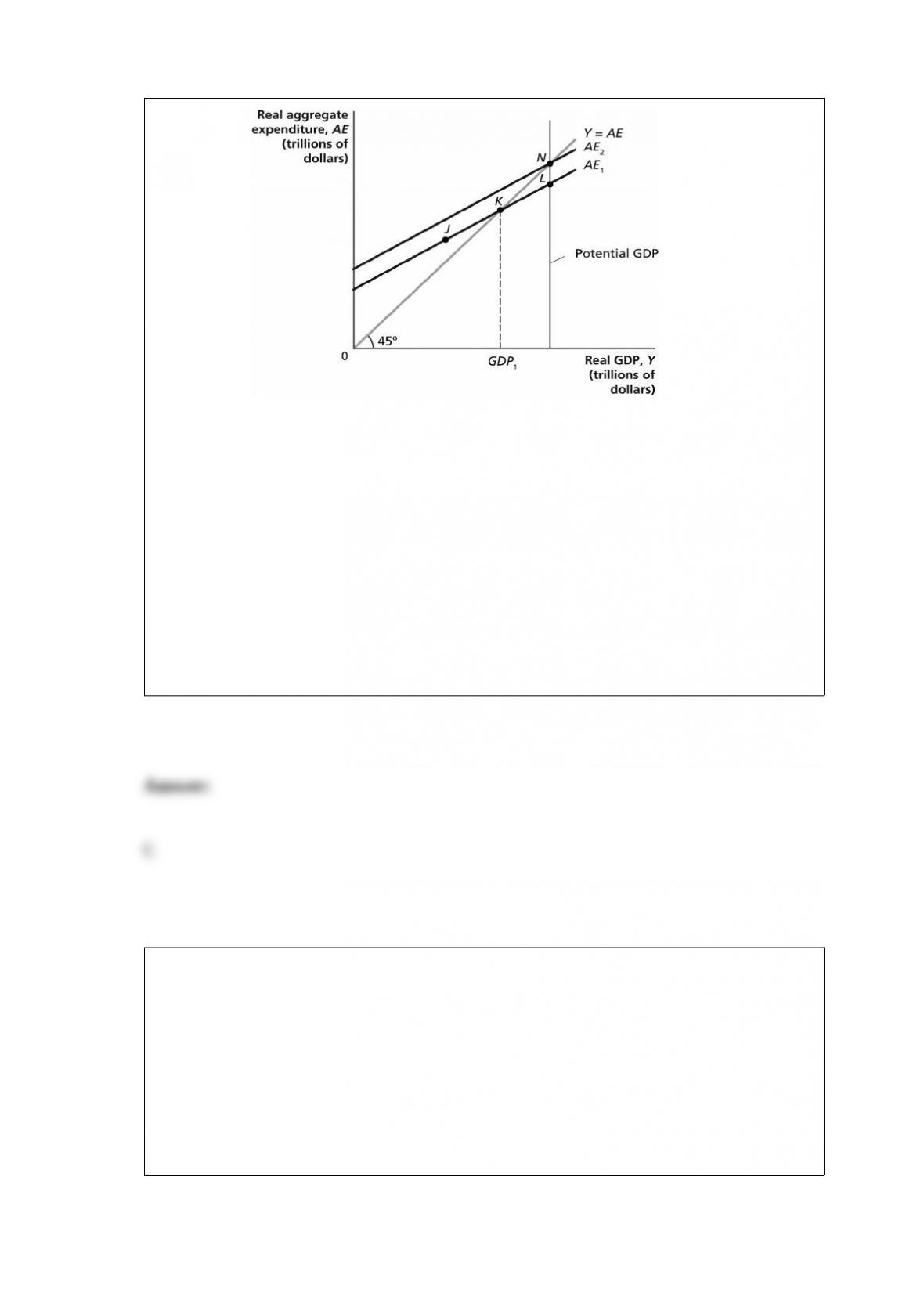
Figure 12-4
Potential GDP equals $100 billion. The economy is currently producing GDP1 which is
equal to $90 billion. If the MPC is 0.8, then how much must autonomous spending
change for the economy to move to potential GDP?
A) -$18 billion
B) -$2 billion
C) $2 billion
D) $18 billion
If net exports are equal to net foreign investment, which of the following is not true?
A) The balance of payments is zero.
B) The current account balance is equal to the negative of the financial account balance.
C) Net capital inflows are equal to imports minus exports.
D) The balance on the financial account is zero.

Firms in perfect competition are price takers because
A) one firm determines the price that all other firms in the industry will charge.
B) consumers have enough market power to set prices.
C) firms accept the price determined by the government.
D) each firm is too small relative to the market to be able to influence price.
A price-discriminating firm charges the highest price to
A) the group with the largest demand.
B) the group with the most elastic demand.
C) the group with the least elastic demand.
D) the group with demand that is unit-elastic.
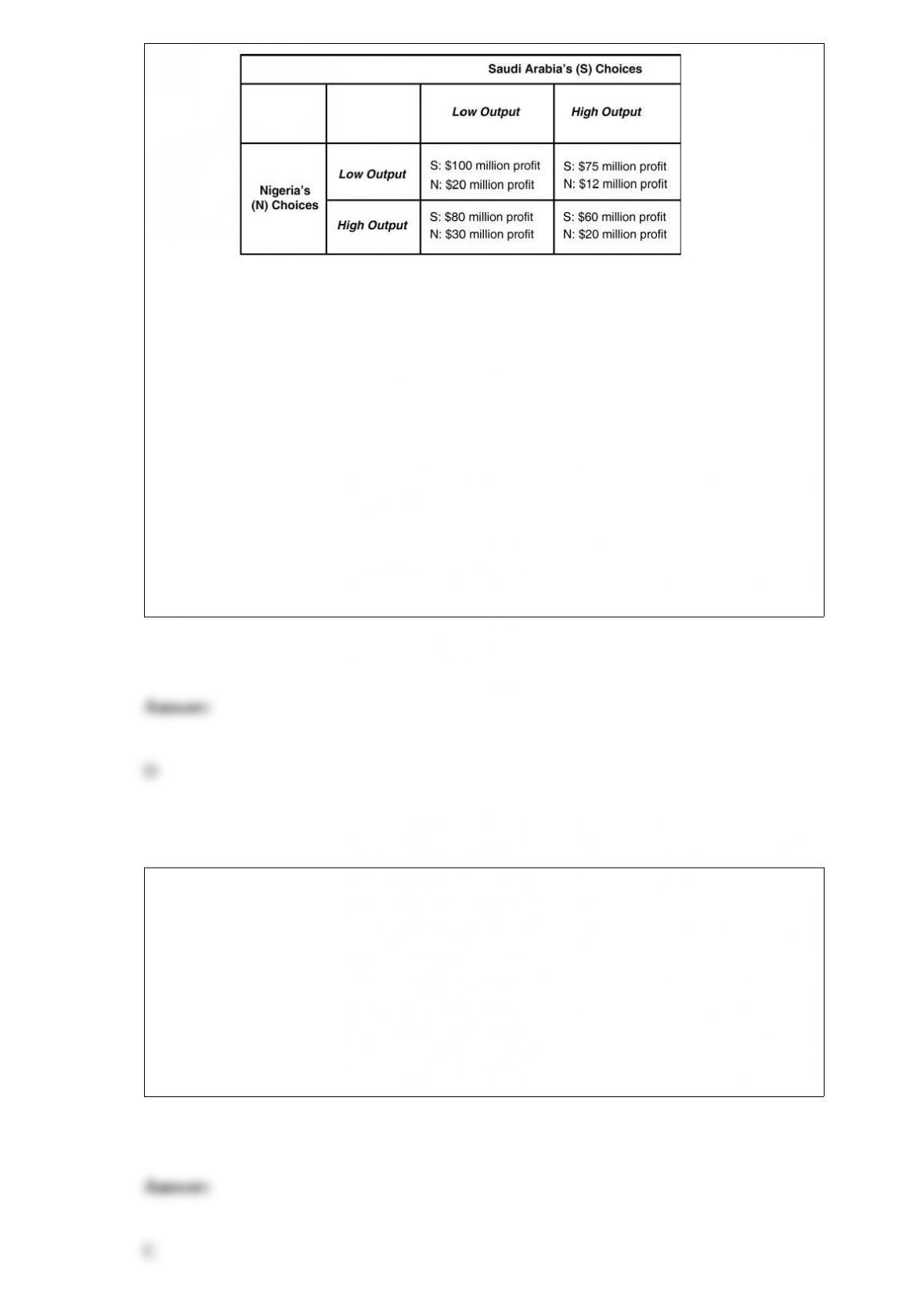
Table 14-3 Suppose OPEC
has only two producers, Saudi Arabia and Nigeria. Saudi Arabia has far more oil
reserves and is the lower cost producer compared to Nigeria. The payoff matrix in Table
14-3 shows the profits earned per day by each country. “Low output” corresponds to
producing the OPEC assigned quota and “high output” corresponds to producing the
maximum capacity beyond the assigned quota.
Is there a dominant strategy for Nigeria and, if so, what is it?
A) Yes, it has a dominant strategy depending on what Saudi Arabia does.
B) No, there is no dominant strategy.
C) Yes, the dominant strategy is to produce a low output.
D) Yes, the dominant strategy is to produce a high output.
Classifying a good as rival means
A) that the good is produced in a competitive market.
B) that there is a shortage of the good.
C) that when one person consumes a unit of the good no one else can consume it.
D) that anyone who does not pay for the good cannot consume it.

In the short run, the Federal Reserve can affect which of the following?
A) the inflation rate
B) the unemployment rate
C) the growth rate of real GDP in the economy
D) all of the above
Who won a Nobel Prize in economics for his work in the development of game theory?
A) John von Neuman
B) Oskar Morgenstern
C) John Nash
D) Howard Schultz
Some economists argue that the productivity slowdown of the mid-1970s to the
mid-1990s was due to changes in oil prices that
A) increased production costs, causing firms to reorganize production to conserve
energy, which reduced output per worker.
B) decreased production costs, causing firms to reorganize production to conserve

energy, which reduced output per worker.
C) increased production costs, causing firms to reorganize production to conserve
energy, which increased output per worker.
D) decreased production costs, causing firms to increase production, which reduced
output per worker.