
In reality, there is not one labor market, but many.
a. True
b. False
There is some agreement between the beliefs of President George W. Bush in 2001 on
the effectiveness of tax cuts with the beliefs of former President
a. Keynes.
b. Clinton.
c. Reagan.
d. Carter.
A principal benefit of inflation is that it makes economic decisions easier.
a. True
b. False

Real GDP values current output of goods and services at their current prices.
a. True
b. False
Banks are required to keep a minimum level of reserves on hand. The intent of this
regulation is
a. monetary control rather than bank safety.
b. bank safety in case of bank runs.
c. maintenance of bank profits.
d. limiting the level of bank profits.
Compared with the U.S., developing countries
a. face geographic conditions that limit productivity.

b. have universal health care that prevent the spread of diseases.
c. more political stability.
d. higher levels of educational attainment.
Production costs for a given output will be minimized when the
a. budget line and the product indifference curve meet in the vertical axis.
b. budget line crosses the product indifference curve.
c. budget line begins to bend back on itself.
d. product indifference curve and the budget line are tangent.
Most economists now agree that the Phillips curve demonstrates that there is
a. an unemployment-inflation trade-off in the long run, but not in the short run.
b. an unemployment-inflation trade-off in both the short run and the long run.
c. an unemployment-inflation trade-off in the short run, but not the long run
d. no unemployment-inflation trade-off in either the short run or the long run.

The “Taylor rule” is an example of a fixed rule for making monetary policy.
a. True
b. False
The federal government increases spending by $50 billion and the main effect is an
increase in the price level. It must be true that the economy is operating on the
a. horizontal portion of the aggregate demand curve.
b. horizontal portion of the aggregate supply curve.
c. vertical portion of the aggregate supply curve.
d. vertical portion of the aggregate demand curve.
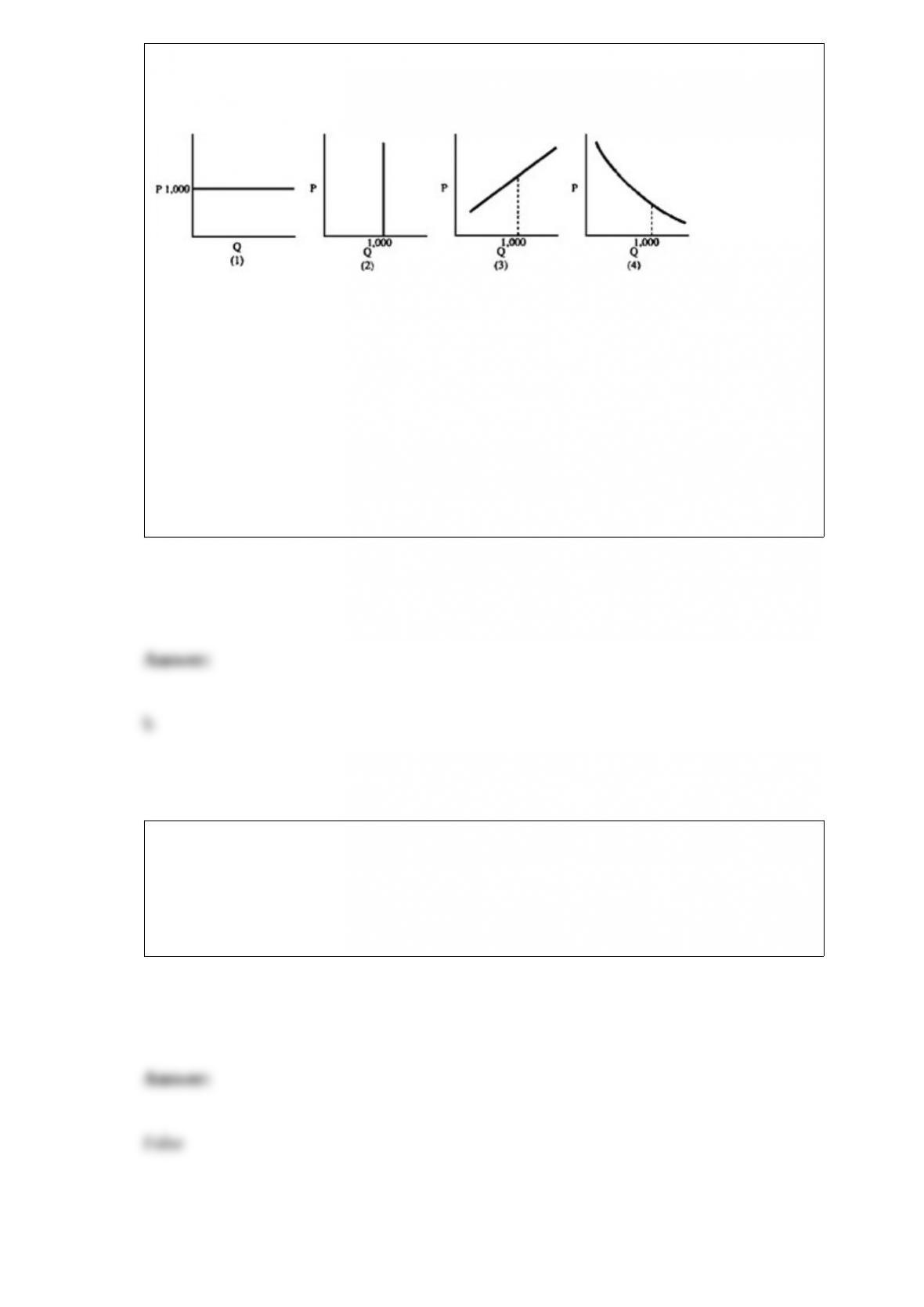
Figure 4-1
If the government has stated that it will pay whatever it must to obtain 1,000 units of
good X, which demand curve in Figure 4-1 is appropriate?
a. 1
b. 2
c. 3
d. 4
International trade can be correctly considered as an example of a zero-sum game.
a. True
b. False

A country running a balance of payments surplus in a fixed exchange rate system may
have to ____ its currency.
a. depreciate
b. devalue
c. revalue
d. appreciate
One of the principal factors behind the U.S. trade deficits of the 1990s has been
a. slow growth and recession in many important trading partners.
b. rapid growth and inflation in many important trading partners.
c. significant depreciation of the dollar.
d. rising real interest rates in the United States.
Price floors lead to market surpluses.
a. True
b. False

Data indicate that the velocity of M1 is greater than the velocity of M2.
a. True
b. False
If the price of potatoes is reduced, consumers likely:
a. significantly more potatoes
b. significantly fewer potatoes
c. roughly the same quantity of potatoes
d. an unknown quantity of potatoes; in this situation, consumers’ actions cannot be
predicted

If the reserve ratio was 10% for the bank with the balance sheet listed below, then this
bank is being
a. aggressive as indicated by a small amount of excess reserves.
b. aggressive as indicated by a large amount of excess reserves.
c. cautious as indicated by a small amount of excess reserves.
d. cautious as indicated by a large amount of excess reserves.
Under the gold standard,
a. each nation had discretion over its monetary policy.
b. trade-deficit nations had less control over their money supply than trade-surplus
nations.
c. trade-surplus nations had less control over their money supply than trade-deficit
nations.
d. no nation had control over its domestic monetary policy.

Economic fluctuations in the United States have been less extreme since the 1950s.
a. True
b. False
As a general rule, when an income tax is added to the basic macroeconomic model,
what happens to the consumption schedule?
a. It will shift downward.
b. It will shift upward.
c. It will become flatter.
d. It will become steeper.
If rational expectations are assumed, inflation can be reduced with no corresponding
increase in unemployment.
a. True
b. False

Two of the most important macroeconomic issues are unemployment and inflation.
a. True
b. False
Which of the following is most likely to result in inflation?
a. Aggregate demand and aggregate supply grow at the same rate.
b. Neither aggregate demand nor aggregate supply grows at all.
c. Aggregate supply grows more rapidly than aggregate demand.
d. Aggregate demand grows more rapidly than aggregate supply.
One aspect of bank accounting is that many liabilities of banks are

a. assets of other persons and businesses in the economy.
b. also liabilities of other persons and businesses in the economy.
c. not matched by liabilities of most other banks.
d. not actually owed to any other person or business in the economy.
The trade philosophy of the Clinton administration is best characterized as
a. protectionist.
b. mercantilist.
c. free trade.
d. strategic trade.
One reason given for the U.S. productivity slowdown in the period from 1973-1995 was
a. declining energy prices.
b. increasing energy prices.
c. increasing investment spending.
d. increasing government spending.

The profit earned from selling an asset for more than you paid for it is called
a. capital gains.
b. the real interest rate.
c. depreciation.
d. appreciation.
Which one of the following could cause a recessionary gap?
a. Interest rates are too low.
b. Consumers spend more than they earn.
c. Price levels are too high.
d. Businesses spend more than they save.

A study of New York City (NYC) tax rates concluded that taxes on the
nonmanufacturing sector should be higher since that sector has fewer alternatives.
Manufacturers are more mobile and may move to avoid higher taxes. This means that
a. nonmanufacturing firms have a more elastic demand for NYC locations.
b. manufacturing firms have an inelastic demand for the NYC locations.
c. nonmanufacturing firms have relatively inelastic demand for the NYC locations.
d. nonmanufacturing demand for NYC locations is perfectly elastic.