Holding other factors constant, if oil prices rise relative to the prices of other products,
then the real wages of oil workers will ______ and employment of oil workers will
_____.
A. increase; increase
B. increase; decrease
C. decrease; not change
D. decrease; increase
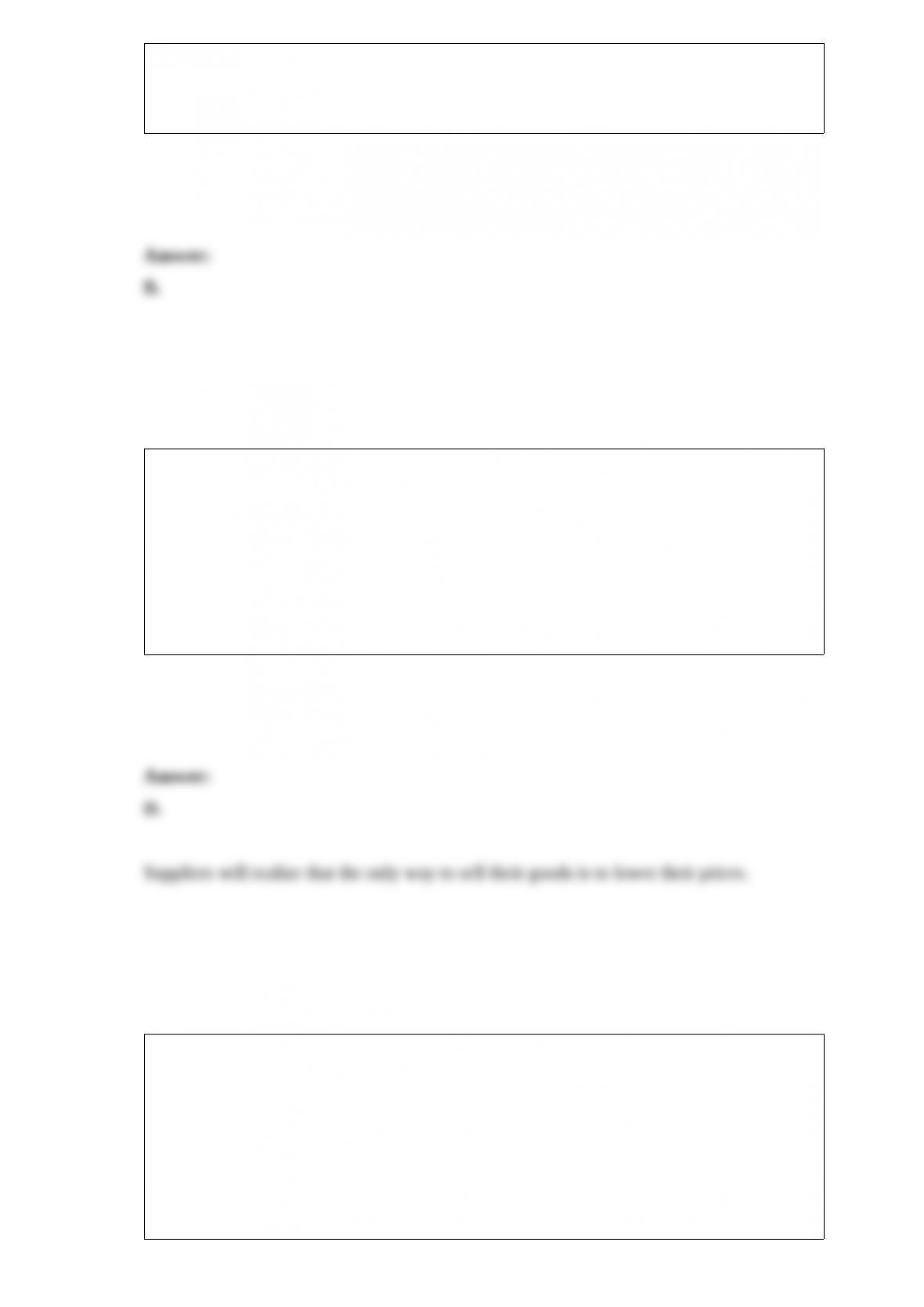
Suppose the figure below shows Annie’s demand curve for physical therapy. The
marginal cost of each visit to the physical therapist is $150.
If Annie had to pay the entire marginal cost of each visit to the physical therapist, then
she would choose to have ______ visits a year.
A. 40
B. 25
C. 10
D. 0
In a free market, if the price of a good is above the equilibrium price, then;
A. suppliers, dissatisfied with growing inventories, will raise the price.
B. demanders, wanting to ensure they acquire the good, will bid the price lower.
C. government needs to set a lower price.
D. suppliers, dissatisfied with growing inventories, will lower the price.
Grace and Will are moving to LA at the same time and both wish to find apartments to
rent. Grace is staying with her aunt for free while Will is paying to stay at a motel. If
their search costs are otherwise identical, one can predict that:
A. Grace and Will will spend the same number of days searching.
B. Will will spend more days searching than Grace.
C. Grace will spend more days searching than Will.

D. Will will have better information.
Empirical studies indicate that the maximum amount of air pollution occurs ______
levels of real GDP per person.
A. at the highest
B. at the lowest
C. at “middle-income”
D. equally at all
Suppose Sarah owns a small company that makes wedding cakes. The table below
shows how Sarah’s total cost varies depending on the number of wedding cakes she
makes each day.
When Sarah produces 2 cakes per day, her average variable cost is ______.
A. $60
B. $100
C. $110

D. $120
Shocks to _____ require the Fed to choose between inflation and output stability, while
shocks to _____ do not require the Fed to choose between inflation and output stability.
A. the stock market; aggregate demand
B. the stock market; aggregate supply
C. aggregate demand; aggregate supply
D. aggregate supply; aggregate demand
If individuals are rational, they should choose actions that yield the:
A. largest total benefits.
B. smallest total costs.
C. smallest economic surplus.
D. largest economic surplus.
In an economy where planned aggregate spending is given by PAE = 5,500 + 0.6Y –
20,000r, the interest rate is currently 2 percent (0.02). If potential output equals 8,000,
the central bank must ______ the interest rate to close the ______ gap.
A. lower; expansionary
B. lower; recessionary
C. raise; recessionary
D. raise; expansionary
Unlike the minimum wage, the Earned Income Tax Credit does not:
A. cause low-wage workers to be laid off.
B. cost the government money.
C. improve the economic well-being of the working poor.
D. increase total economic surplus.
Suppose a monopolist produces two different products. If the marginal cost of
producing one is lower than the marginal cost of producing the other, and the
monopolist charges a different price for the two goods, then the monopolist is:
A. not price discriminating.
B. imperfectly price discriminating.
C. perfectly price discriminating.
D. not maximizing its profit.
In the market for used cars, the lemons model predicts that:
A. sellers are more likely to sell low-quality cars than high-quality cars.
B. buyers are more likely to overstate their reservation price.
C. sellers are more likely to sell low-quality cars than high-quality cars.
D. sellers are more likely to understate the condition of their cars.
If consumers respond to a 10% price reduction by buying twice as much of a particular
good, we would conclude that:
A. there was excess demand at the original price.
B. there was excess supply at the original price.
C. the price elasticity of demand at the original price was greater than one.
D. the price elasticity of demand at the original price was less than one.
A market in disequilibrium would feature:
A. a stable price.
B. consumers able to purchase all they wish at the market price.
C. a stable quantity.
D. either excess supply or excess demand.
Suppose Mary is willing to pay up to $15,000 for an used Ford pick-up truck. If she
buys one for $12,000, her ______ would be ______.
A. benefit; $12,000
B. cost; $15,000
C. economic surplus; $3,000
D. economic surplus; $12,000
The duration of an unemployment spell is a measure of the:
A. income lost while unemployed.
B. length of time a spell of unemployment lasts.
C. number of times during a year a worker becomes unemployed.
D. number of workers unemployed during a specific period of time.
The decision about how much money to hold is an application of the:
A. scarcity principle.
B. principle of comparative advantage.
C. equilibrium principle.
D. cost-benefit principle.
The market for bagels contains two firms: BagelWorld (BW) and Bagels’R’Us (BRU).
The owners of the two firms decide to fix the price of bagels. The table below shows
how each firm’s profit (in dollars) depends on whether they abide by the agreement or
cheat on the agreement.
Is this game a prisoner’s dilemma?
A. No, because cheating yields the highest payoff for both firms.
B. Yes, because if both firms played their dominated strategy, they each would earn a
higher payoff than when they both play their dominant strategy.
C. Yes, because if both firms played their dominant strategy, they each would earn a
higher payoff than when they both play their dominated strategy.
D. No, because neither firm has a dominant strategy.
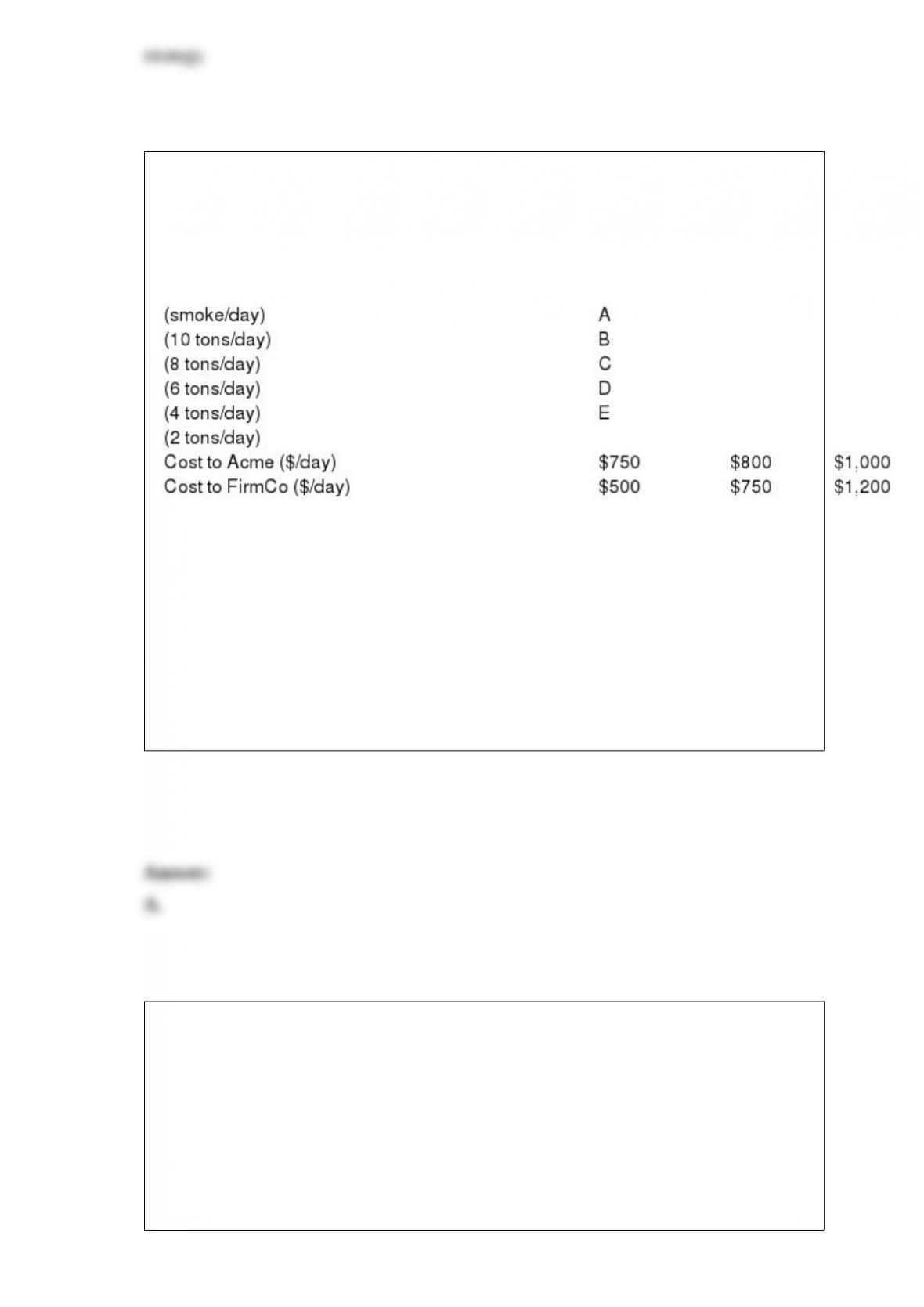
Two firms, Acme and FirmCo, have access to five production processes, each of which
has a different cost and gives off a different amount of pollution. The daily costs of the
processes and the corresponding number of tons of smoke emitted are shown in the
table below.
process
Suppose the firms are both currently using process A. If the government requires each
firm to reduce pollution by 20%, then the total cost to society of this policy will be
______ per day.
A. $300
B. $950
C. $1,550
D. $2,350
The marginal cost of providing another viewer with access to HBO is zero. Since only
people who pay for HBO can watch it:
A. fewer than the socially optimal number of people will have access to HBO.
B. more than the socially optimal number of people will have access HBO.
C. HBO will not be profitable in the long run.
D. access to HBO is nonexcludable.

Refer to the figure below. Suppose the dairy lobby convinces the government to impose
price controls in this market. If the government requires cheese to be sold for a price of
$8 per pound, then, relative to before the price controls, total consumer surplus in the
market would:
A. increase
B. decrease
C. not change
D. increase and then decrease
The use of pollution permits by the government to reduce pollution is:
A. theoretically interesting, but untried in the United States.
B. workable in theory but unworkable in practice.
C. common in several parts of the United States.
D. common in the third world.

The Federal Reserve discount rate is the rate of interest charged on loans from ______
to _____.
A. the Federal Reserve; commercial banks
B. the Federal Reserve; the U.S. Treasury
C. commercial banks; the Federal Reserve
D. the U.S. Treasury; commercial banks
Which of the following is most likely to be used efficiently?
A. A privately-owned natural resource
B. A private good that entails an external cost
C. A publicly-owned natural resource
D. A private good that entails an external benefit
A credible promise is:
A. in the promiser’s interest to keep.
B. legally enforceable.
C. made by a honest person.
D. possible to keep.
In an economy where planned aggregate spending is given by PAE = 5,500 + 0.6Y –
20,000r, the interest rate is currently 5 percent (0.05). If potential output equals 11,750,
the central bank must ______ the interest rate to close the ____________ gap.
A. reduce; expansionary
B. reduce; recessionary
C. raise; recessionary
D. raise; expansionary
Refer to the figure below. Private markets will provide _____ units of this good per day,

and the socially optimal number of units per day is ______.
A. H; F
B. H; G
C. F; G
D. G; F
If business inventories equal $40 billion at the beginning of the year and $55 billion at
the end of the year, then, assuming no other changes, GDP must have:
A. decreased by $15 billion.
B. increased by $15 billion.
C. increased by $40 billion.
D. increased by $55 billion.
Suppose that when a perfectly competitive firm produces 1,000 units of output, its total
variable cost is $1,900. If the marginal cost of producing the 1,000th unit is $1.70, and if
the market price of each unit of output is $1.70, then the firm should:
A. shut down.
B. raise its price.
C. increase output.
D. continue to produce 1000 units.
If the Federal Reserve wants to decrease the money supply, it should:
A. decrease reserve requirements.
B. decrease the discount rate.
C. decrease the interest that it pays on reserves.
D. conduct open-market sales.
The implementation of new production methods by managers, such as the “just-in-time”
inventory system, increases:
A. average labor productivity.
B. the share of the population employed.

C. the unemployment rate.
D. the quantity of human capital.