
A period in which the economy is growing at a rate significantly below normal is called
a(n):
A. expansion.
B. boom.
C. peak.
D. recession.
Refer to the figure below. If Laura and Chris are the only two consumers in this market,
then when the price of hamburger decreases from $2.50 to $2.00 per pound, the
quantity demanded in the market will ______ by ______ pound(s) per week.
A. decrease; 1.5
B. increase; 1.5
C. decrease; 1
D. increase; 1
Paper Pushers Inc. hires workers in a competitive labor market. Apart from labor, the
company has no other variable inputs. The company’s hourly output varies with the
number of workers hired, as shown in the table below.
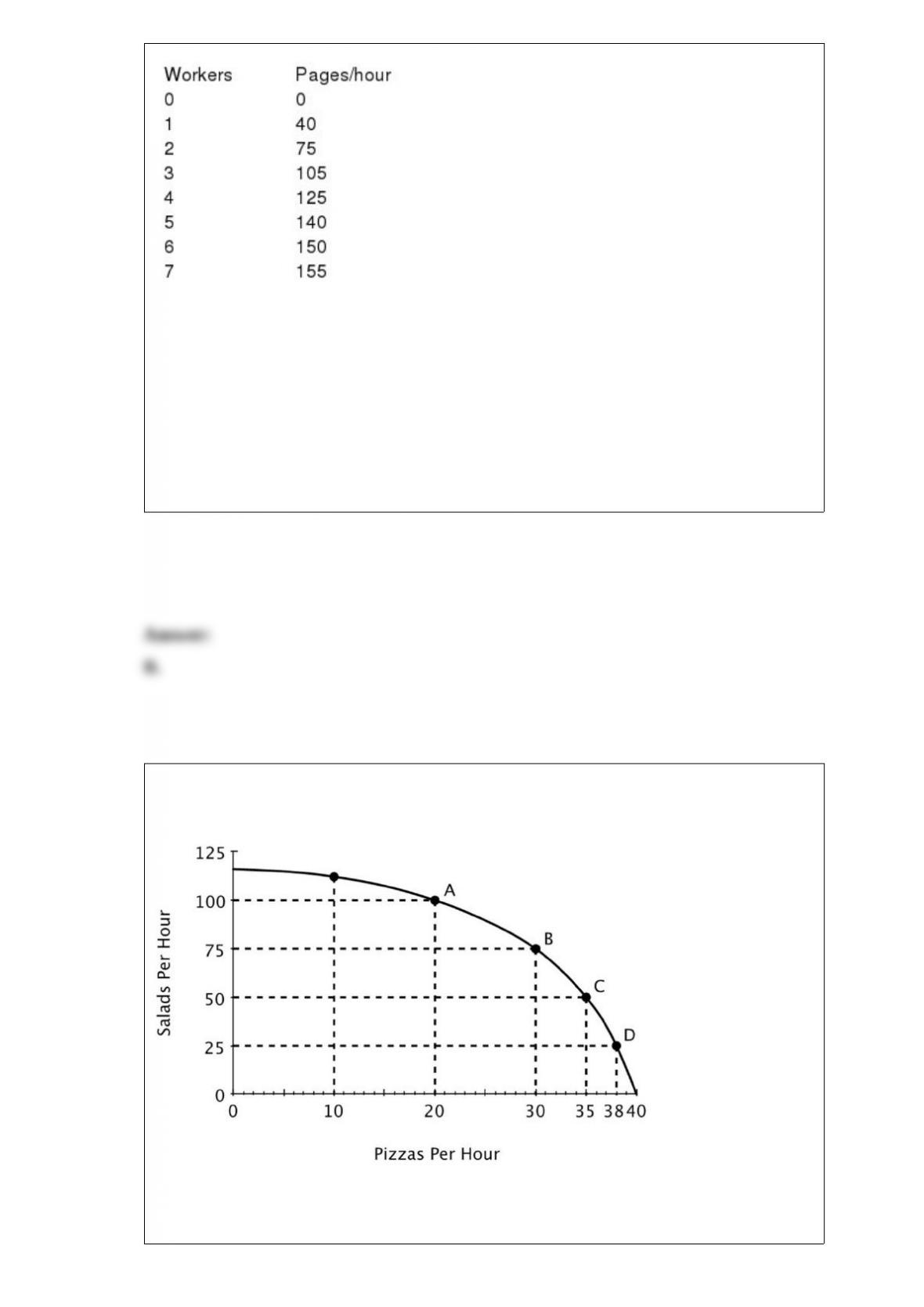
As Paper Pushers Inc. hires more workers each our, the marginal product of labor
______.
A. increases
B. decreases
C. remains constant
D. decreases and then increases
Refer to the figure below. If this restaurant makes 75 salads in one hour, then what’s the
maximum number of pizzas it can make in that same hour?
A. 0
B. 10

C. 20
D. 30
The following data show the relationship between the number of drivers who leave for
work at 8:00 a.m., their average commute time, and their marginal benefit of
commuting.
One way for the government to increase economic efficiency would be for it to:
A. require all 500 drivers to collectively decide when each should leave for work
B. subsidize gasoline consumption
C. require employers to allow workers to arrive late for work
D. charge a toll to use the highway during rush hour
Suppose your economics professor has an extra copy of textbook that he or she would
like to give to a student in the class. Which of the following schemes is the most likely
to result in an efficient outcome?
A. Randomly selecting one student to receive the textbook.
B. Auctioning off the textbook to the highest bidder.
C. Letting students take turns using the textbook.
D. Giving the textbook to the student who has the lowest midterm score.
When actual output is less than potential output, there is ____ output gap and the rate of
inflation will tend to ____.
A. an expansionary; increase
B. an expansionary; decrease
C. a recessionary; decrease
D. a recessionary; increase
Moe has a big exam tomorrow. He considered studying this evening, but decided to
hang out with Curly instead. If neither activity involves any explicit costs, and Moe
always chooses rationally, it must be true that:
A. the opportunity cost of studying is greater than the value Moe gets from spending
time with Curly.
B. the opportunity cost of studying is less than the value Moe gets from spending time
with Curly.
C. Moe gets more benefit from spending time with Curly than from studying.
D. Moe gets less benefit from spending time with Curly than from studying.
Planned aggregate expenditure (PAE) equals:
A. C +Ip+G +NX.
B. Cp+I +G +NX.
C. C +I +Gp+NX.
D. C +I +G +NXp.
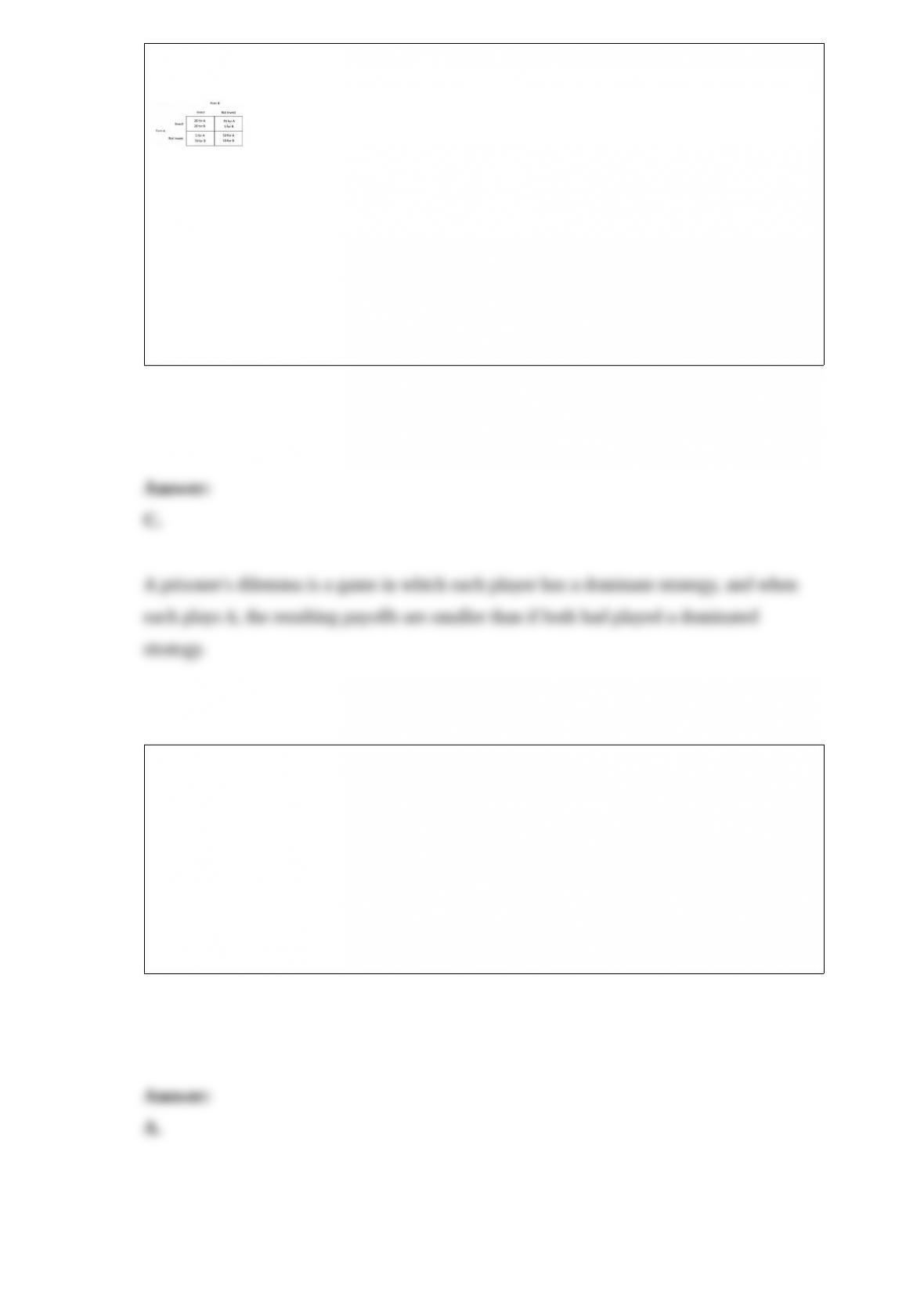
The payoff matrix below shows the payoffs (in millions of dollars) for two firms, A and
B, for two different strategies, investing in new capital or not investing in new capital.
This game is an example of a:
A. cartel.
B. credible promise.
C. prisoner’s dilemma.
D. game with multiple equilibria.
In symbolic terms where Y equals real GDP, POP equals total population, and N equals
the number of employed workers, Y/POP must equal:
A. Y/N×N/POP.
B. N/Y×POP/N.
C. Y/POP×N/POP
D. N/Y×N/POP
The income-expenditure multiplier leads to greater than one-for-one changes in output
when autonomous spending changes because:
A. the direct changes in spending change the income of producers which leads to
additional changes in spending.
B. multiple deposits are generated when new reserves are produced through fractional
reserve banking.
C. autonomous spending supports more output than induced spending.
D. planned changes in inventories signal producers to adjust the level of output.
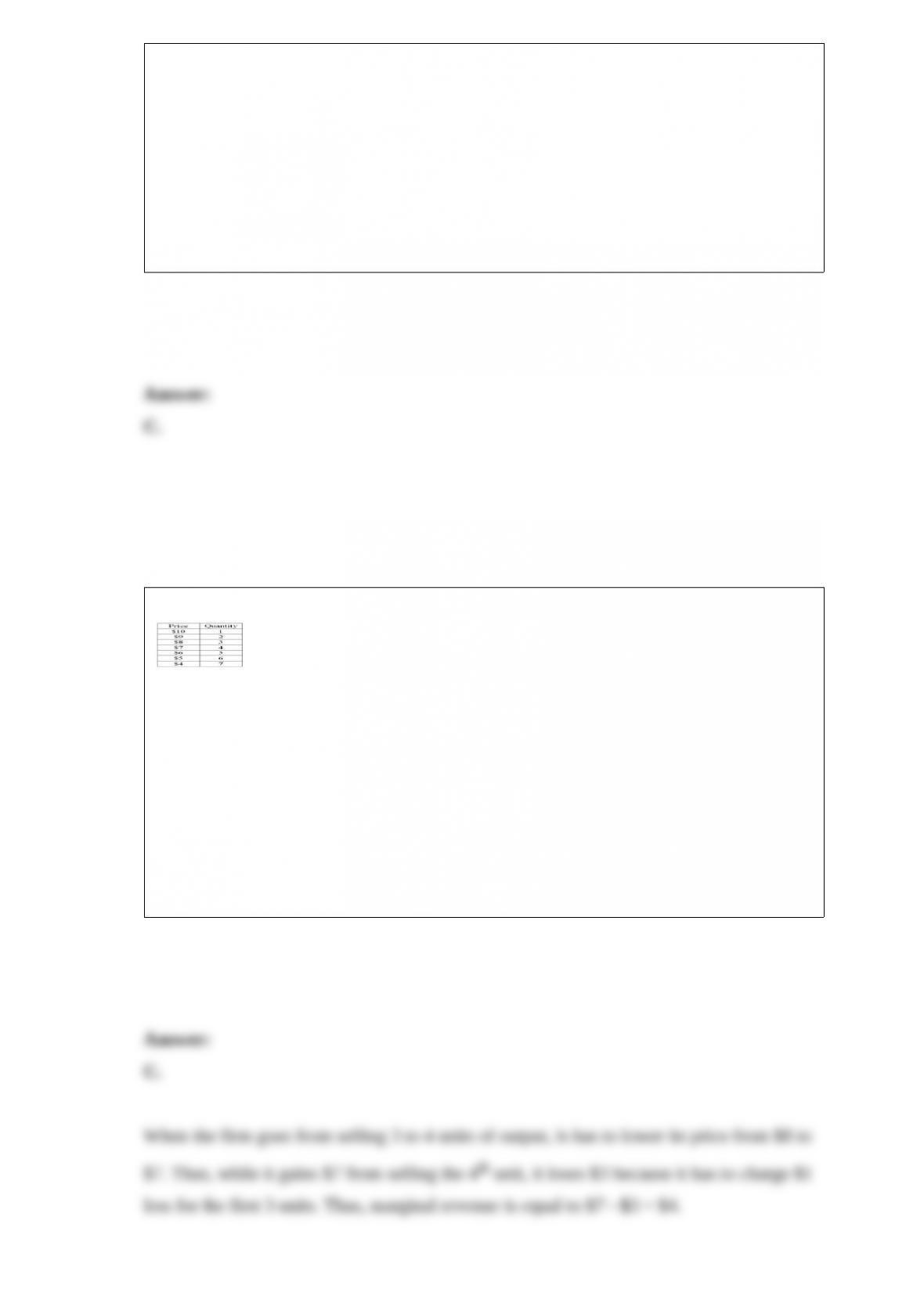
Based on the table below and the principle of diminishing returns to capital, then total
packages wrapped when a fourth machine is installed must be less than ______
packages.
A. 3,000
B. 4,000
C. 12,000
D. 15,000
Compared to taxing pollution, an advantage of auctioning pollution permits is that:
A. the largest reductions in pollution are made by the firms that can do so the most
cheaply.
B. auctioning permits raises revenue for the government.
C. it allows the public to directly reduce pollution by purchasing permits.
D. it ensures that all firms reduce pollution by the same amount.
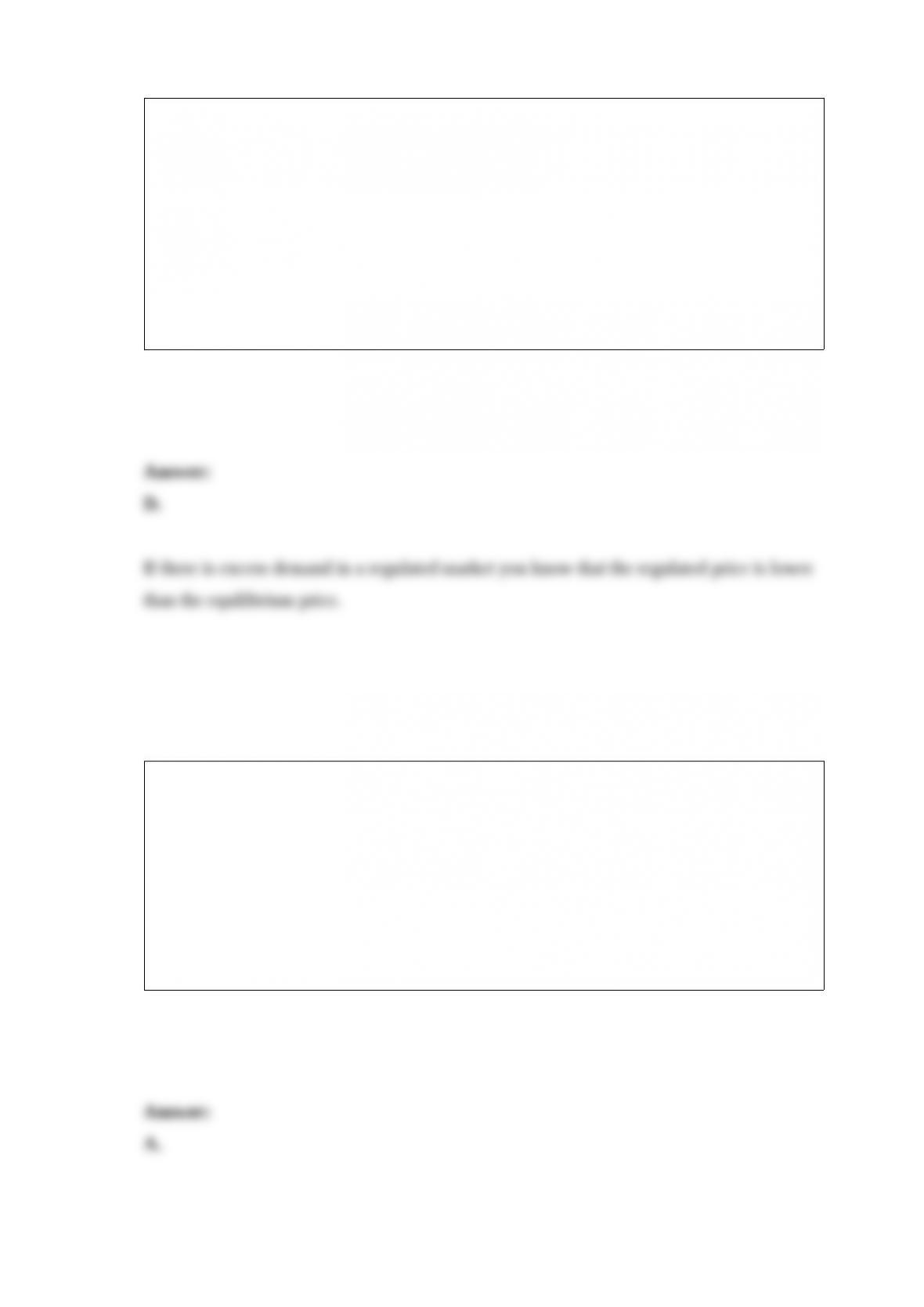
Suppose the table below describes the demand for a good produced by monopolist.
The monopolist’s marginal revenue from selling the 4th unit of output is less than $7
because:
A. marginal cost is greater than $3.
B. the consumer only pays $4 for the 4th unit.
C. it has to charge $1 less for each of the first 3 units of output.
D. demand is perfectly elastic.
Suppose one knows two facts: first, the market for prescription drugs experiences
chronic shortages and second, government sets the price for prescription drugs. One can
conclude that the:
A. government has set the price too high.
B. government has set the price above the equilibrium price.
C. buyers are hoarding prescription drugs.
D. government has set the price below the equilibrium price.
An informal definition of a recession is at least ______ consecutive quarters of
declining real GDP.
A. two
B. four
C. six
D. eight

An inflation dove is someone who:
A. easily anchors inflation expectations.
B. is not strongly committed to maintaining low inflation.
C. is committed to maintaining low inflation even at the cost of reduced output and
employment.
D. believes monetary policy is more powerful than fiscal policy.
Assume that all firms in this industry have identical cost curves, and that the market is
perfectly competitive.
In the long run, how much profit will each firm in this industry earn each week?
A. $0
B. $1,000
C. $1,500
D. $2,000
The most important challenge facing a firm in a perfectly competitive market is
deciding:
A. whether to maximize its profits.
B. how much to produce.
C. what price to charge.
D. whether to advertise.
Industries in which firms have high fixed costs and low marginal costs are likely to
have a:
A. large number of small firms.
B. small number of large firms.
C. large number of large firms.
D. small number of small firms.

Refer to the figure below. If this firm is a price taker, then when the price of each unit of
output is $30, this firm’s total cost at its profit-maximizing level of output is ______.
A. $900
B. $1,200
C. $1,600
D. $2,700
The marginal cost of collecting information:
A. rises as more information is collected.
B. falls as more information is collected.
C. is now zero because of the Internet.
D. is independent of the amount of information that has already been acquired.
Quick Buck and Pushy Sales produce and sell identical products and face zero marginal
and average cost. Below is the market demand curve for their product.
If Quick Buck and Pushy Sales decide to collude and work together as a monopolist,
then together they should produce ______ units per month and charge ______ per unit.
A. 3,000; $1
B. 4,000; $2
C. 2,000; $2
D. 1,000; $3
At a price of $20 each, the demand for t-shirts from a group’s fundraising activity is unit
elastic. Thus, the group’s total revenue from selling t-shirts ______ at a price of $20
each.
A. will equal $0
B. reaches its minimum
C. reaches its maximum
D. will equal $1

Jenny sells lemonade in front of her house in the summer. Several other kids in Jenny’s
neighborhood also run lemonade stands in the summer. Suppose that the first week of
summer, Jenny charged 25 cents for an 8-ounce cup of lemonade, her next-door
neighbor Sam charged 50 cents for an 8-ounce cup of lemonade, and Alex across the
street charged 15 cents for an 8-ounce cup of lemonade. Assuming the market for
lemonade is perfectly competitive, what is most likely to happen?
A. Everyone will start to charge 50 cents to maximize revenue.
B. A price war will break out, and all of the kids will lower their prices.
C. Each kid will keep his or her price at the original amount.
D. Eventually prices will equalize across all three lemonade stands.
In the twentieth century, average real wages have risen substantially:
A. only in the United States.
B. in industrial countries excluding the United States.
C. in industrial countries including the United States.
D. in neither the United States nor other industrial countries.

A collective good is one that, to at least some degree, is:
A. nonrival but excludable.
B. nonexcludable but rival.
C. consumed by more than one person.
D. both nonrival and nonexcludable.
Refer to the figure below. When Jeff goes from watching 3 to 4 movies a day, his total
utility:
A. increases.
B. decreases.
C. does not change.
D. gets close to zero.
Holding all else constant, a decrease in the real interest rate on U.S. assets will ______

the demand for dollars in the foreign exchange market and ______ the equilibrium
Mexican peso/U.S. dollar exchange rate.
A. increase; increase
B. increase; decrease
C. decrease; decrease
D. decrease; increase
Fran runs a doughnut shop in a tiny 3-person town. The table below shows the quantity
demand by the three townspeople at various prices.
When the price of a doughnut is 50 cents, what is the market demand for doughnuts?
A. 31 doughnuts
B. 20 doughnuts
C. 9 doughnuts
D. 5 doughnuts
Lou and Alex live together and share household chores. They like to cook some meals
ahead of time and eat leftovers. The table below shows the number of rooms they can
each clean and the number of meals they can each cook in an hour.
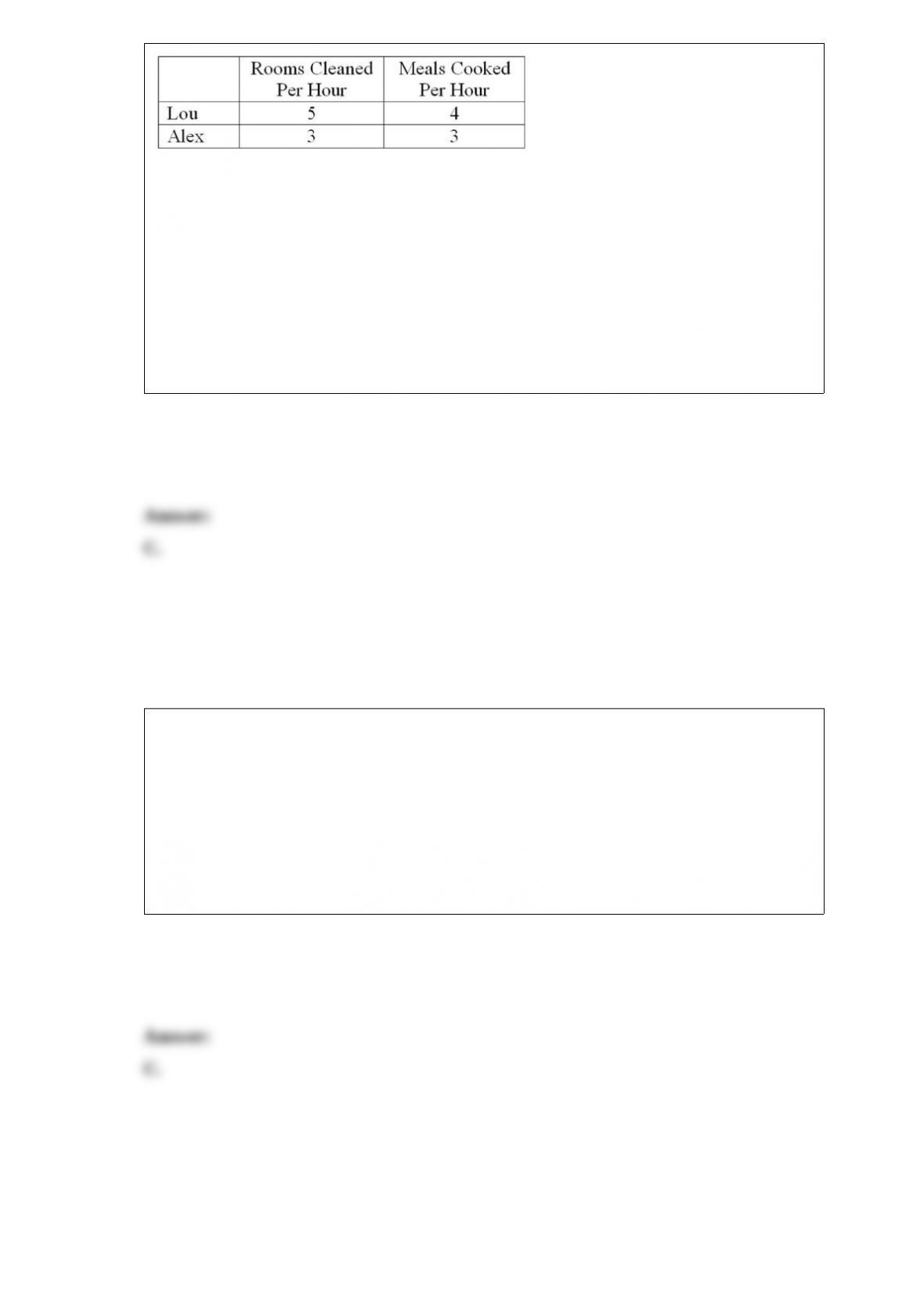
Which of the following is true?
A. Lou has both an absolute advantage and a comparative advantage over Alex in both
tasks.
B. Alex has a comparative advantage over Lou in cleaning.
C. Lou has a comparative advantage over Alex in cleaning.
D. Alex has both an absolute advantage and a comparative advantage over Lou in both
tasks.
An economy with a trade surplus must also have:
A. a trade deficit.
B. a budget surplus.
C. positive net capital outflows.
D. positive net capital inflows.

Because the Fed determines the money supply, the:
A. money supply curve is downward sloping.
B. money supply curve is upward sloping.
C. money supply curve is vertical.
D. money supply curve is horizontal.
When actual output exceeds potential output there is ____ output gap and the rate of
inflation will tend to ____.
A. an expansionary; increase
B. an expansionary; decrease
C. no; remain the same
D. a recessionary; increase