
The Japanese system of universal health insurance requires no co-payments from
residents for health services.
The principal-agent problem that exists between shareholders and managers also exists
between managers and workers.
High-income countries such as the United States spend a greater amount on services as
compared to goods.
Marginal cost is the additional cost to a firm of producing one more unit of a good or
service.

The unemployment rate is too high is an example of a positive economic statement.
If the federal budget has an actual budget surplus of $75 billion, but a cyclically
adjusted budget surplus of $50 billion, then the economy must be above potential real
GDP.
Unemployment caused by a business cycle recession is called cyclical unemployment.
If the price of peaches, a substitute for plums, increases the demand for plums will
decrease.
The only type of business that faces limited liability is a corporation.
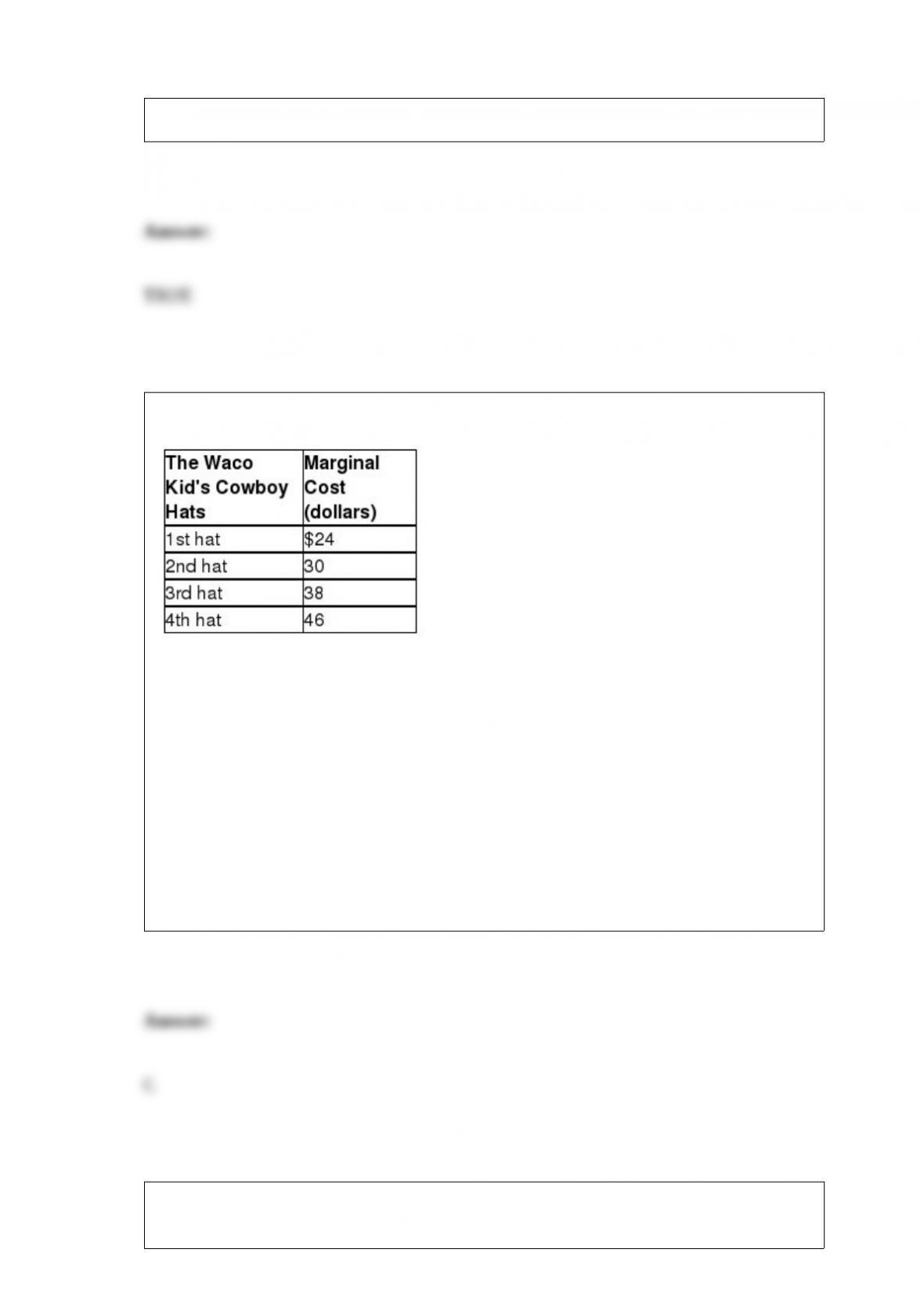
Table 4-3
The table above lists the marginal cost of cowboy hats by The Waco Kid, a firm that
specializes in producing western wear. If the price of cowboy hats decreases from $38
to $30,
A) consumer surplus will rise by $6.
B) the marginal cost of producing the third cowboy hat will fall to $30.
C) producer surplus will fall from $22 to $6.
D) producer surplus will rise from $8 to $24.
The U.S. economy has seen a faster increase in productivity since the mid-1990s as
compared to the economies of many Western European countries. Which of the

following explains this?
A) U.S. unions impose stricter work rules as compared to unions in Western European
countries.
B) U.S. government regulations impose stricter work rules as compared to government
regulations in Western Europe.
C) The United States has a higher rate of job mobility than do many Western European
countries.
D) U.S. workers can obtain unemployment insurance for a longer period of time as
compared to workers in most Western European countries.
Which type of business is the most Difficult to set up?
A) sole proprietorship
B) partnership
C) corporation
D) There is no Difference in the Difficulty of establishment.
Assume that after the record year for U.S. farm income in 2013, farmers are expected to
break even in 2014. This means that at the quantity being produced in 2014
A) MC =AVC.
B) MR =MC.

C) MR =ATC.
D) AVC =ATC.
An agreement negotiated by two countries that places a numerical limit on the quantity
of a good that can be imported by one country from another country is called
A) a non-tariff trade barrier.
B) an export quota.
C) an import quota.
D) a voluntary export restraint.
For the monopolistically competitive firm
A) Price (P) = Marginal Revenue (MR) = Average Revenue (AR).
B) P = MR > AR.
C) P = AR > MR.
D) P > MR = AR.
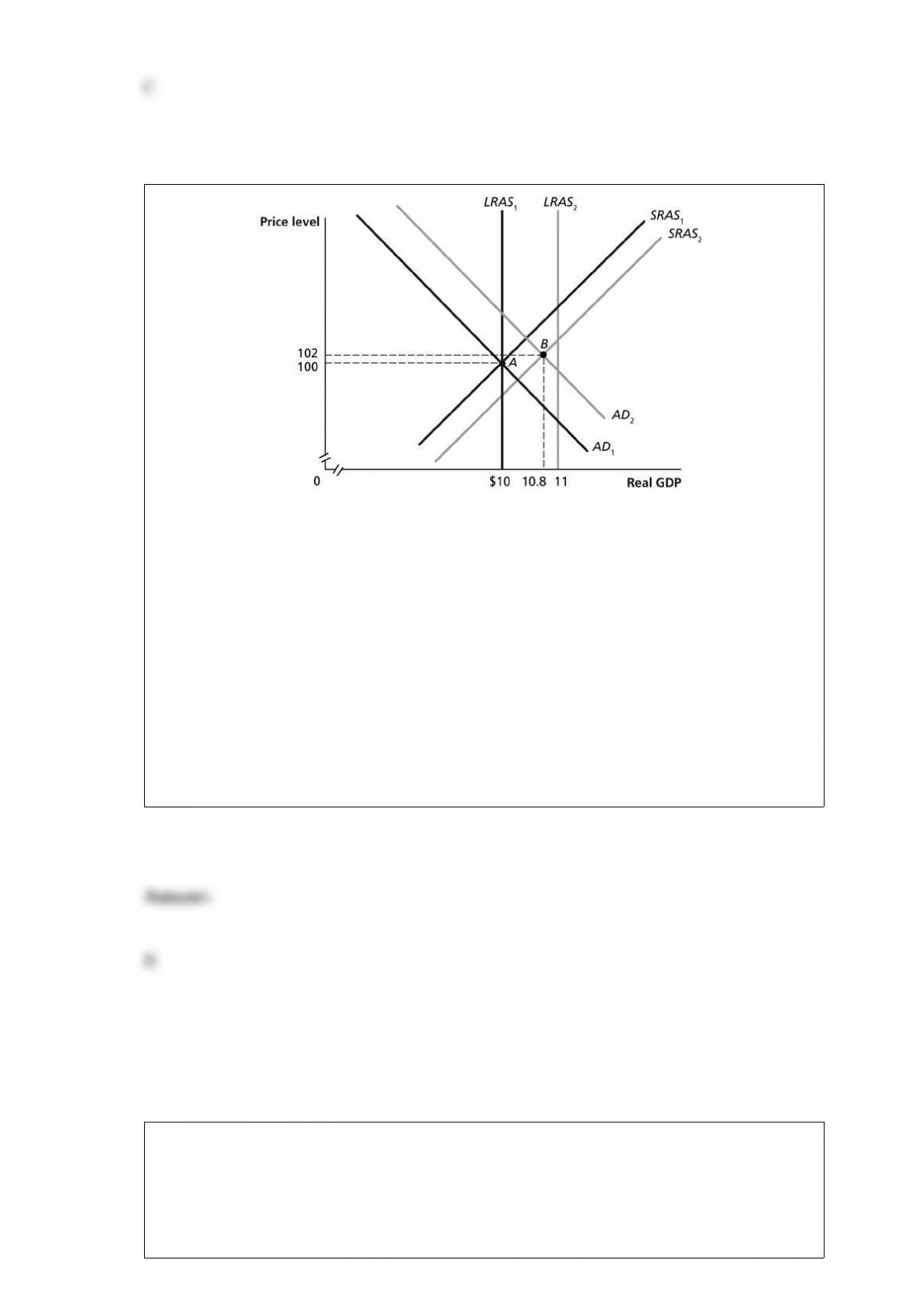
Figure 26-11
In the dynamic model of AD–AS in the figure above, the economy is at point A in year 1
and is expected to go to point B in year 2, and the Federal Reserve pursues policy. This
will result in
A) unemployment rates higher than what would occur if no policy had been pursued.
B) inflation higher than what would occur if no policy had been pursued.
C) real GDP lower than what would occur if no policy had been pursued.
D) short-term interest rates higher than what would occur if no policy had been
pursued.
If, in response to an increase in the price of chocolate the quantity of chocolate
demanded decreases, economists would describe this as
A) a decrease in demand.

B) a decrease in quantity demanded.
C) a change in consumer income.
D) a decrease in consumers’ taste for chocolate.
The tax wedge is the difference between the
A) amount of taxes needed to balance the federal budget and the actual amount of taxes.
B) amount of taxes needed to pay off the national debt and the actual amount of taxes.
C) pretax and posttax returns to an economic activity.
D) nominal and real interest rates.
Figure 16-3
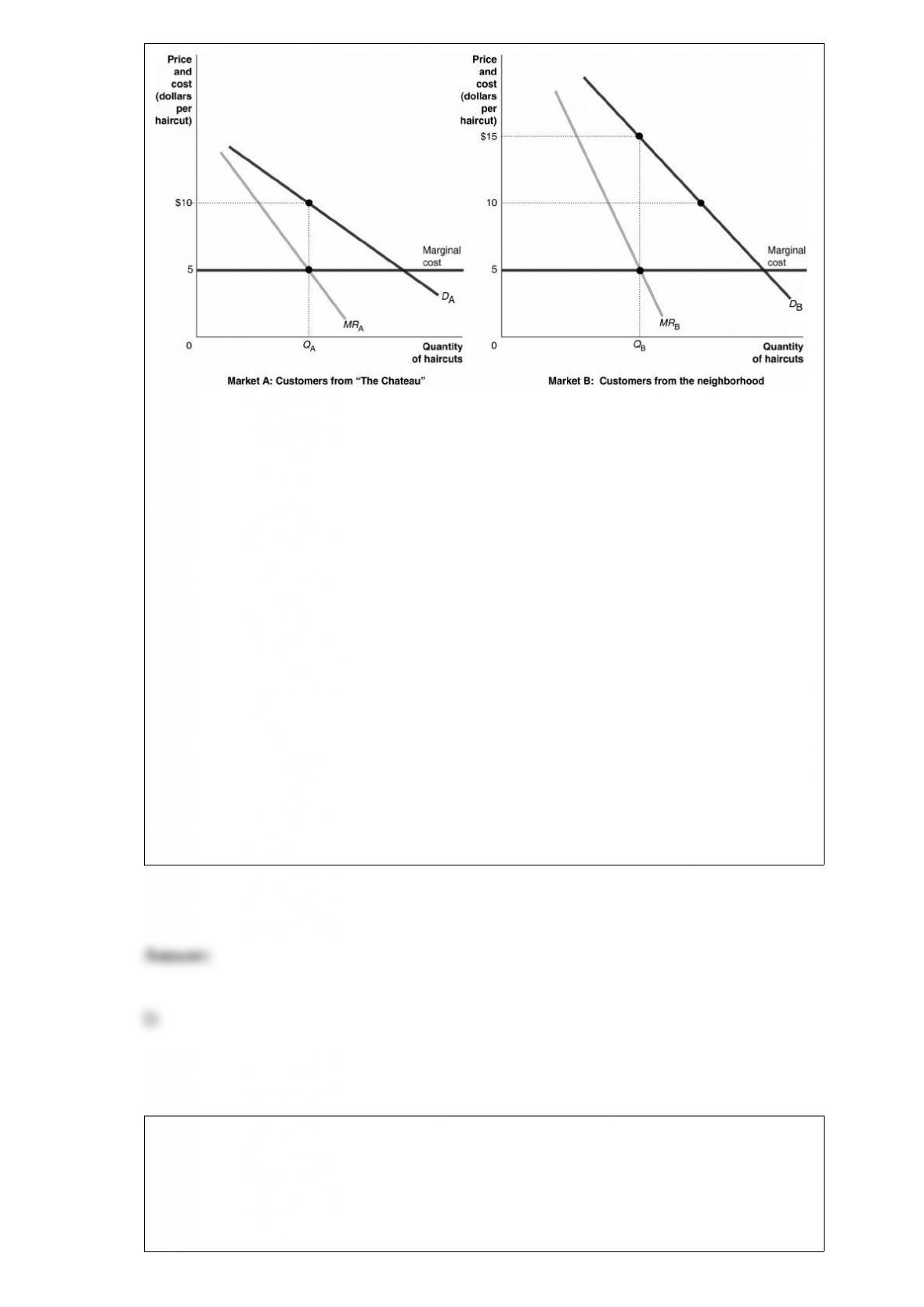
Chantal owns a hairdressing salon which caters to two main groups of customers:
residents of “The Chateau,” a retirement community, and other residents in the
neighborhood. Figure 16-3 shows the demand curves for the residents of the retirement
community, labeled Market A, and other residents in the neighborhood, labeled Market
B. The demand curves are not identical.
Suppose Chantal practices price discrimination. Which of the following statements is
true?
A) Chantal’s profits will be higher if she has uniform pricing instead of different prices
for different groups of customers.
B) By charging a higher price in market B, Chantal has transferred some of the
consumer surplus from customers in market B to customers in market A.
C) By charging different prices in markets A and B, Chantal can transfer some producer
surplus into economic profit.
D) By charging a higher price in market B, Chantal can convert some consumer surplus
into economic profit.
In the real world we don’t observe countries completely specializing in the production
of goods for which they have a comparative advantage. All of the following are reasons
for this except
A) not all goods and services are traded internationally.

B) some countries have more resources than other countries.
C) tastes for many traded goods are different in many countries because of
globalization.
D) production of most goods involves increasing opportunity costs.
Average fixed cost can be calculated using any of the formulas below except
A) TFC/Q.
B) (TC – VC)/Q.
C) (TC – VC)/Q.
D) (TC/Q) – AVC.
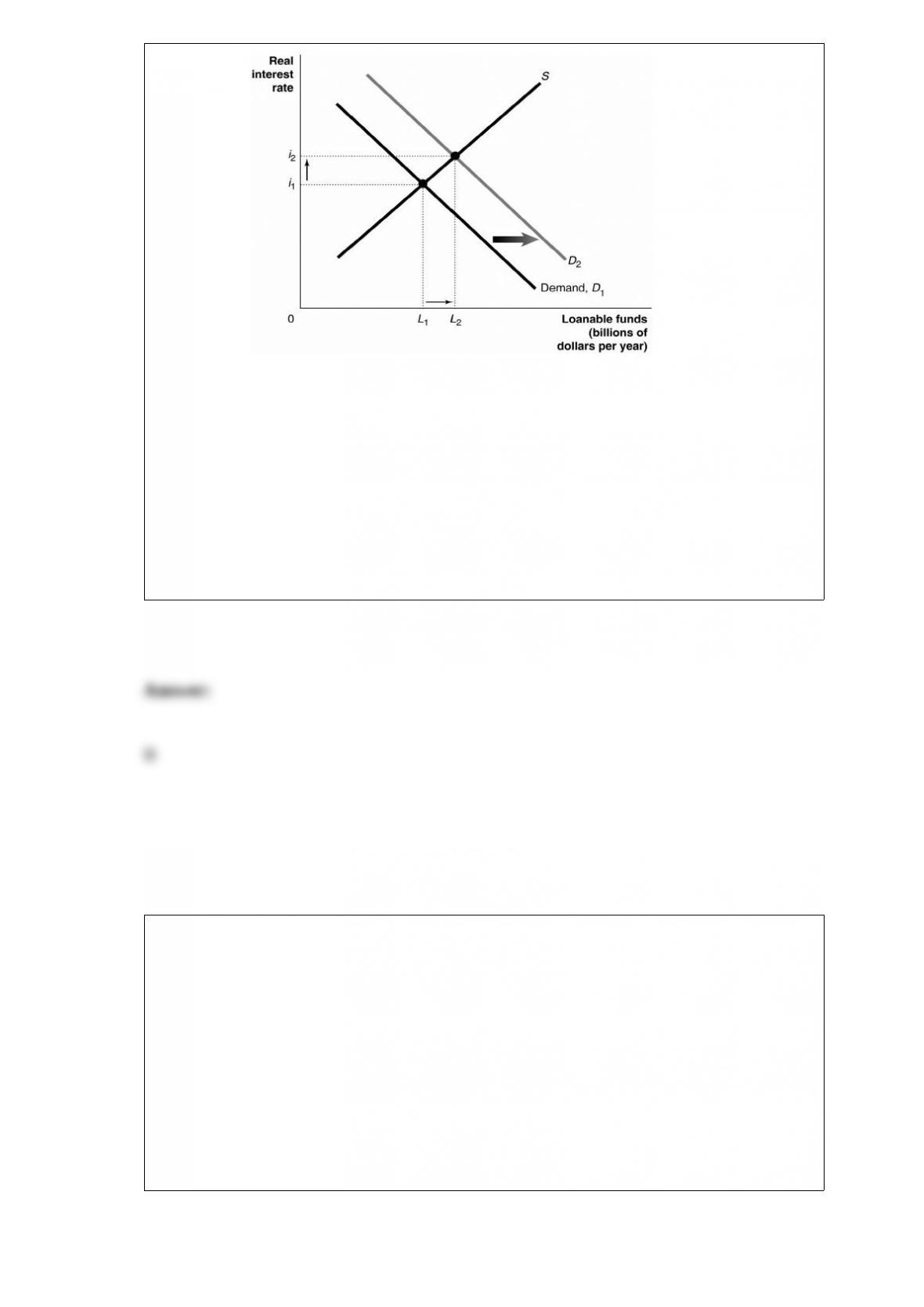
Figure 21-1
Which of the following is consistent with the graph depicted above?
A) An expected recession decreases the profitability of new investment.
B) Technological change increases the profitability of new investment.
C) The government runs a budget surplus.
D) Households become spendthrifts and begin to save less.
If the GDP deflator in the United States is 114, and the GDP deflator in Ukraine is 142,
which of the following exchange rates would the theory of purchasing power parity
predict in the long run? (The Ukrainian currency is the hryvnia.)
A) 0.80 hryvnias per dollar
B) 1.25 hryvnias per dollar
C) 2.80 hryvnias per dollar
D) 28 hryvnias per dollar

From the 1960s to 2012, transfer payments
A) have risen from about 25 percent to 46 percent of federal government expenditures.
B) remained the same percentage of total federal government expenditures.
C) have declined by half as a percentage of total federal government expenditures.
D) have grown very slowly as a percentage of total federal government expenditures.
Customer discrimination occurs when
A) a firm pays workers different wages based on irrelevant factors.
B) customers refuse to buy products produced by a racially diverse workforce.
C) customers refuse to buy products they believe to be of poor quality.
D) workers refuse to serve customers of a different race.
What is the difference between a marginal tax rate and an average tax rate? Which is
more important in determining the impact of the tax system on economic behavior?
Give two reasons why GDP does not reflect total production in an economy.
What is a Pigovian tax? What happens to deadweight loss when a Pigovian tax is
implemented?
On January 2, 1971, all cigarette advertising was banned on U.S. television and radio
stations. Did this ban likely increase or decrease the profits of cigarette companies in
1971? Briefly explain.
What is the difference between an invention and an innovation?
How do firms and households interact in markets?