
The exchange of secondhand securities
a. takes place in an oligopolistic market
b. does not provide funds to the firm that issued those securities
c. includes the initial sale when securities are issued by a firm
d. involves very few institutional investors
e. lowers the liquidity of the securities
A situation in which one party makes a contractual agreement with a second party in the
expectation that the second party will act on its behalf is known as
a. an adverse selection relation
b. a signaling relation
c. an authority relation
d. a principal-agent relation
e. a nonmarket relation
Competing-interest legislation is characterized by
a. concentrated costs and concentrated benefits
b. concentrated benefits and widespread costs

c. widespread benefits and widespread costs
d. widespread benefits and concentrated costs
e. zero costs
If MC’s Hammers, a perfectly competitive firm, finds that its total revenue is $45,000,
its fixed cost is $20,000, and its total cost is $50,000, its producer surplus is
a. zero because TC > TR
b. -$5,000
c. $25,000
d. $15,000
e. -$25,000
Critics of the current system of flexible exchange rates allege that it
a. promotes inflation
b. promotes unemployment
c. gives central banks too little discretion over their money supplies
d. restricts the growth of developing countries
e. gives too much financial power to industrial countries

The country of Bananaland has an abundant supply of banana trees and therefore must
be a modern industrial economy.
a. True
b. False
Which of the following is a result of increased real wages in the United States?
a. a decrease in the quantity of services demanded by households
b. an increase in the opportunity cost of remaining employed in the home
c. a decrease in the opportunity cost of working outside the home
d. a decline in the number of households providing labor outside the home
e. reduced use of labor-saving devices in households

Exhibit 1-1
In Exhibit 1-1, point c represents
a. x = 30, y = 60
b. x = 60, y = 30
c. c = 90
d. x + y = 60
e. x + y = 30
One reason many people make their own pickles rather than buy them is that
a. they can maintain control over the quality during production
b. the total cost of ingredients is the same as the price of store-bought pickles
c. firms do not make high-quality pickles
d. people place a high value on their time
e. firms do not produce goods that can be made at home
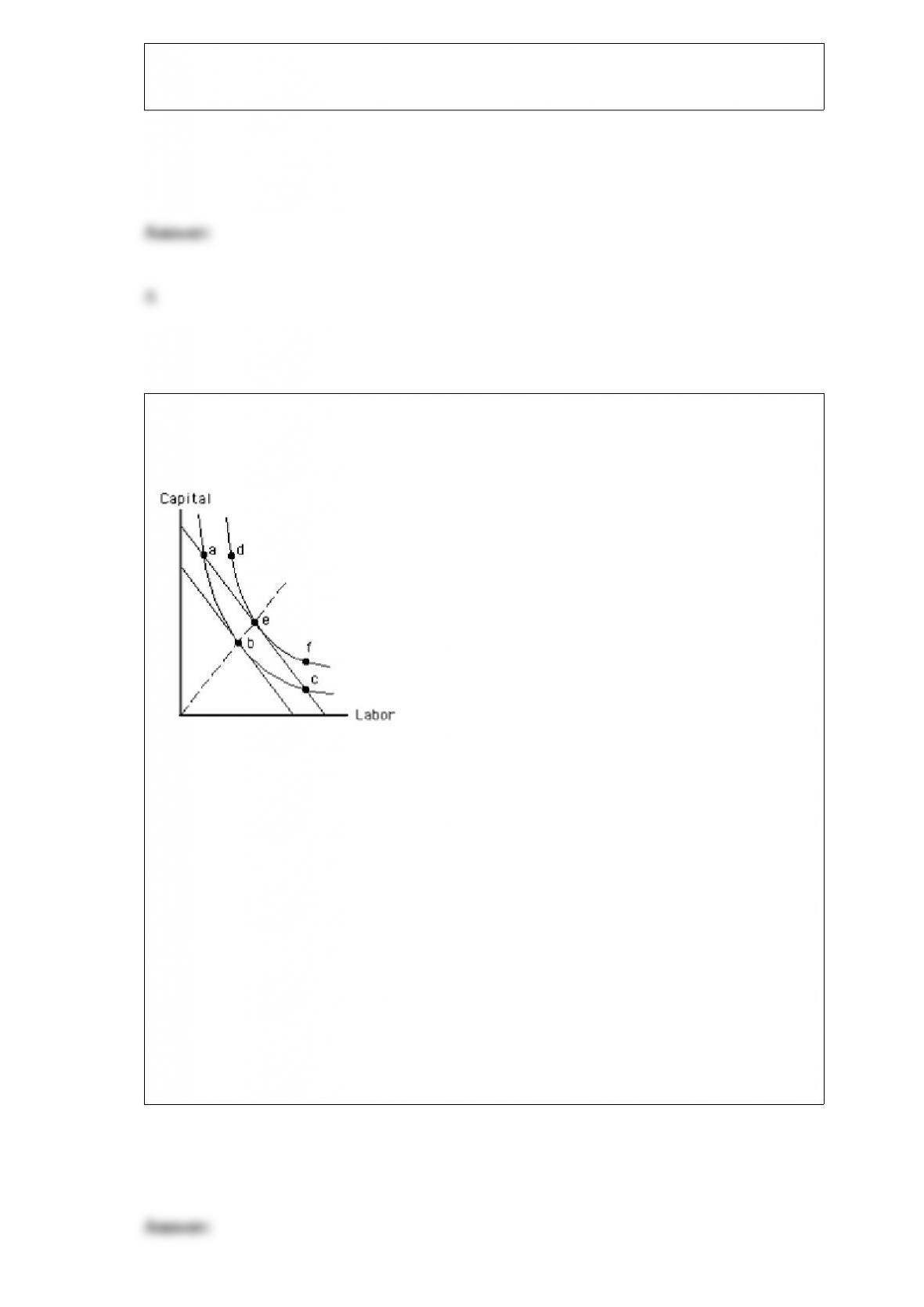
Exhibit 7-17
Which of the following is true of point c in Exhibit 7-17?
a. The MRTS of labor for capital is equal to the ratio of the wage rate to the price of
capital.
b. The MRTS of labor for capital is less than the ratio of the wage rate to the price of
capital.
c. The firm would be producing its output at the lowest possible cost.
d. The MRTS of labor for capital is greater than the ratio of the wage rate to the price of
capital.
e. The ratio of the marginal product of labor to the price of capital is equal to the ratio
of the wage rate to the price of capital.

Exhibit 9-2
In Exhibit 9-2, the marginal revenue of the fourth unit is
a. $12
b. $3
c. $4
d. -$4
e. $0
Rainforests are often cut down because
a. farmers and the government are greedy
b. the countries involved do not understand the environment
c. the countries involved are gaining short-term relief from poverty at the cost of
long-term environmental preservation
d. the countries involved are gaining long-term environmental benefits by doing so
e. cutting them down results in less erosion

The amount of time an individual is willing to sell on the labor market varies positively
with the value of leisure time.
a. True
b. False
Exhibit 20-2
U.S. trade balance -$250
U.S. goods and service balance -$240
U.S. net unilateral transfers -$30
Outflow of U.S. capital -$180
U.S. net official reserve balance $80
U.S. statistical discrepancy $30
Given the data in Exhibit 20-2, what is the inflow of foreign capital into the United
States?
a. $340

b. -$590
c. -$230
d. $280
e. $490
Which of the following resources will a producer demand another unit of so long as the
additional unit’s marginal revenue exceeds its marginal cost?
a. labor
b. capital
c. natural resources
d. entrepreneurial ability
e. All of the answers are correct.
A measure of consumer surplus in any market is
a. total expenditure on the good
b. the area above the supply curve and below the price

c. the area beneath the demand curve
d. the area beneath the demand curve and above the price
e. the market price
The social insurance system generally redistributes income from
a. rich to poor and from old to young
b. rich to poor and from young to old
c. poor to rich and from old to young
d. poor to rich and from young to old
e. consumers to producers
Household production is more likely to occur when
a. it requires many specialized resources
b. technology makes it easier than market production
c. tax avoidance is undesirable
d. less control over the final product is desirable

e. the opportunity cost of household production is high
The country of Yipi can raise its productivity by investing more in
a. both human and physical capital
b. human capital only
c. physical capital only
d. stable foreign economies
e. stocks and bonds
What is true at the profit-maximizing quantity for a nondiscriminating monopolist but
nottrue of a perfectly competitive firm?
a. Price equals marginal cost.
b. Price is greater than marginal cost.
c. Marginal revenue equals marginal cost.
d. Marginal revenue is less than marginal cost.
e. Marginal revenue is greater than average revenue.

If managers of a private corporation perform poorly, each owner has the option of
a. closing down the firm
b. selling her share of the firm
c. managing the firm herself
d. paying no taxes on the little profit she does receive
e. selling off the plant and equipment of the firm
Which of the following statements is true?
a. Foreigners owned $16.30 in U.S. assets
b. U.S. residents owned $13.8 trillion in foreign assets
c. U.S. residents owned $2.5 trillion more assets in the United States than foreigners
owned abroad
d. Foreign purchases of assets in the U.S. subtract from America’s productive capacity
e. Income from foreign-owned assets in the U.S. flows to Americans
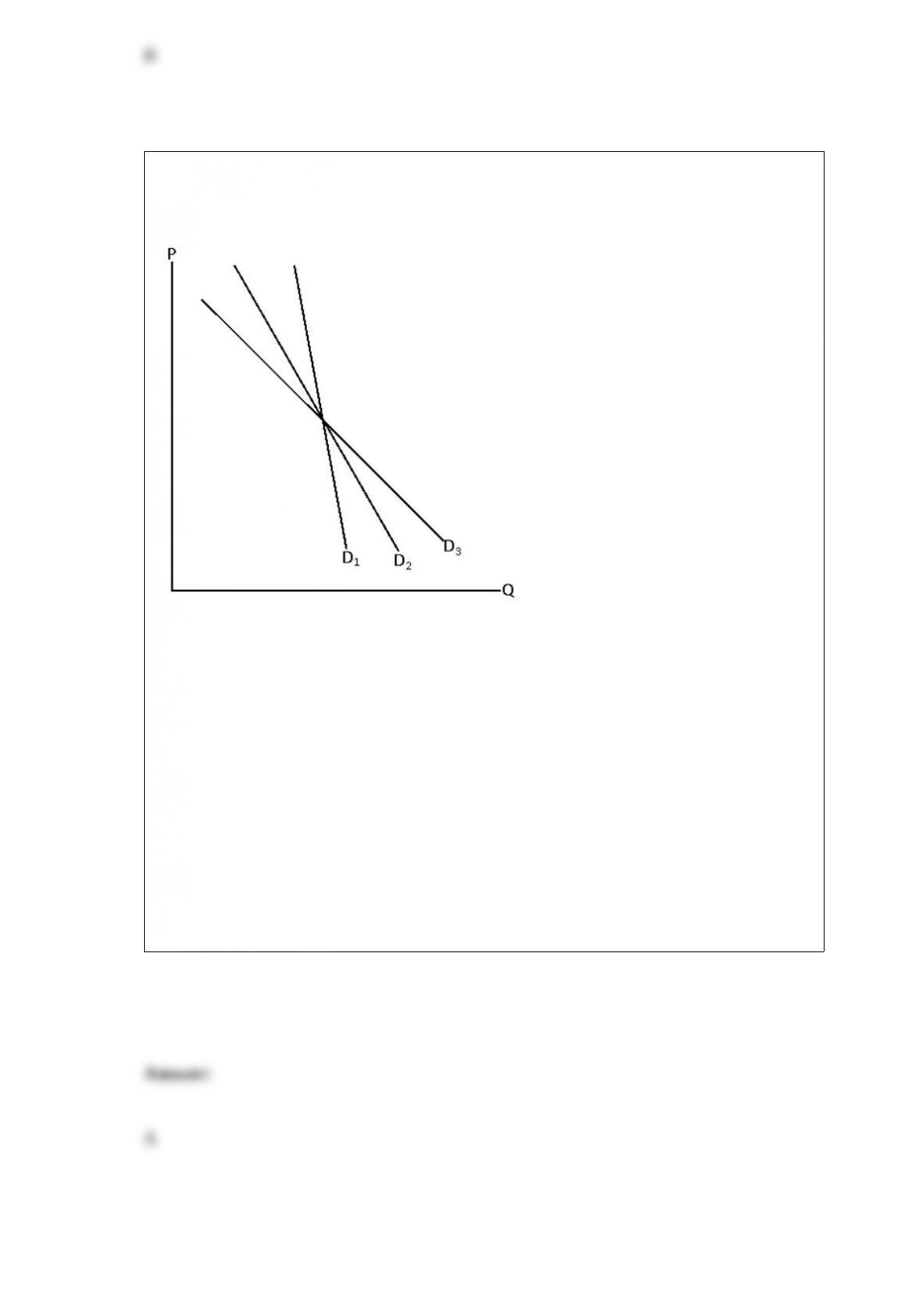
Exhibit 5-17
Consider Exhibit 5-17. Demand curves D1, D2 and D3 represent the demand for food,
apples and fruit. Which represents which?
a. D1 is apples, D2 is fruit and D3 is food
b. D1 is fruit, D2 is food and D3 is apples
c. D1 is food, D2 is apples and D3 is food
d. D1 is food, D2 is fruit and D3 is apples
e. impossible to tell without more information

Suppose the price elasticity of demand for your economics textbook is -1. If the
publisher raises the price by 5 percent,
a. revenues will rise 5 percent
b. quantity demanded will rise 5 percent
c. total revenues will not change
d. revenues will fall
e. revenues will fall 5 percent
If periodic use of a resource can be continued indefinitely, that resource is said to be
a. removable
b. renewable
c. cyclical
d. recyclable
e. part of a common pool
A tax collects $3,000 per year from a family with an income of $25,000 and takes
$4,000 per year from a family with an income of $50,000. This tax plan is

a. regressive
b. proportional
c. progressive
d. based on the ability-to-pay principle
e. impossible to determine with the information provided
Foreign investors may wish to purchase U.S. assets for all of the following reasons
except one. Which is the exception?
a. The rate of return on assets is higher in the United States than in other countries.
b. They may wish to diversify their portfolios.
c. The United States may be regarded as a relatively safer place in which to invest.
d. Governments of most other industrialized countries actively discourage foreign
investment.
e. With their increased foreign debt burdens, investment in developing countries has
become less attractive.
In game theory, if two rivals in an oligopoly can avoid a large loss by cutting price from

$40 to $35,
a. neither will cut its price
b. one will charge $40 and the other will charge $35
c. their actions will depend on their respective strategies
d. each will cut price but not all the way to $35
e. they will collude to do what’s best for both of them
Rational economic decision makers will make a change only if
a. the change is free of risk
b. there are no costs involved
c. their expectations are correct
d. there is no uncertainty about the results of the change
e. the expected marginal benefit exceeds expected marginal cost
Allocative efficiency occurs in markets when
a. marginal benefit and marginal cost for the last unit sold are equal

b. resources can be reallocated to increase the value of total output
c. goods are produced at the minimum of average total cost
d. goods are distributed evenly among consumers
e. government establishes price ceilings below the market price
The distribution of income
a. is about the same in most countries
b. tends to be more equal in developing countries than in developed countries
c. is more concentrated in the United States than in Canada or Japan
d. is more even in developing countries than in the Russia
e. is not related to a country’s level of development