
If you put $100 into a bank account that earns five percent interest per year, what is the
formula you should use to determine the account’s future value in one year?
A) Future value equals the present value divided by the rate of interest.
B) Future value equals the present value multiplied by the rate of interest.
C) Future value equals the present value multiplied by one plus the rate of interest in
decimals.
D) All of these yield the same answer.
If the price of chewing gum is represented by equation P = 25 – 0.5 QD, then the
corresponding quantity of chewing gum demanded is represented by the equation
A) QD = 2P – 0.5.
B) QD = 0.5P + 25.
C) QD = 50 -2P.
D) QD = -5 + 10P.
The market for smartphones has become very competitive. The increase in competition
in this market is an example of how the market responds to
A) decreases in the price of desktop computers (a substitute for the product).

B) increases in income.
C) changes in population.
D) changes in consumer tastes.
Robert Lucas argues that there are ________ returns to human capital, and these
productivity increases are not completely captured by individuals as they decide how
much education to purchase. As a result, the market produces ________ education and
training.
A) increasing; too much
B) decreasing; too much
C) increasing; too little
D) decreasing; too little
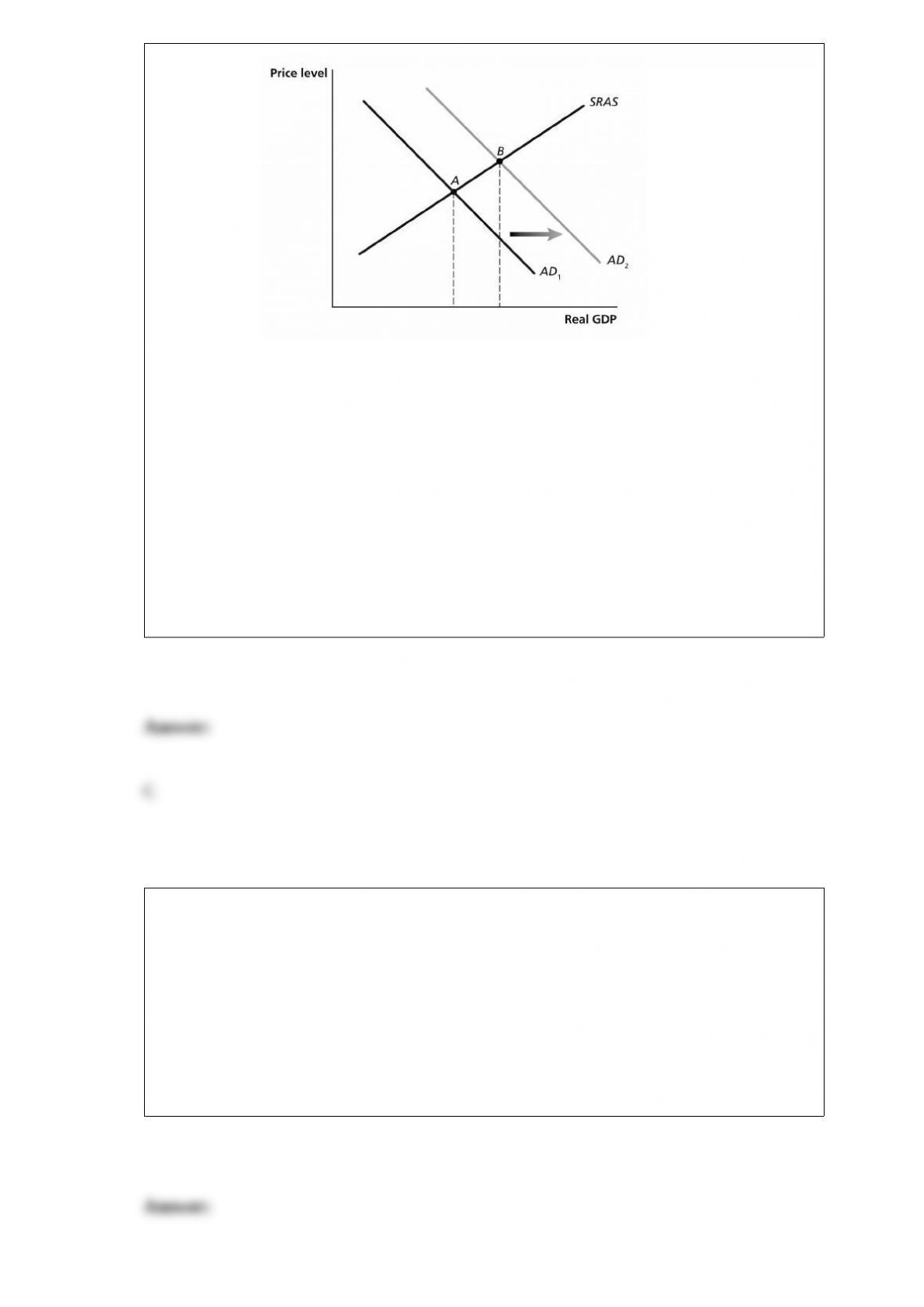
Figure 16-12
An increase in government purchases of $200 billion causes aggregate demand to shift
ultimately from AD1 to AD2. Assuming a constant price level, the difference in real
GDP between point A and point B will be ________ $200 billion.
A) equal to
B) less than
C) greater than
D) There is insufficient information given here to draw a conclusion.
Demand for a luxury item, such as a yacht, is likely to be
A) both income and price inelastic.
B) both income elastic and price elastic.
C) income elastic and price inelastic.
D) income inelastic and price elastic.
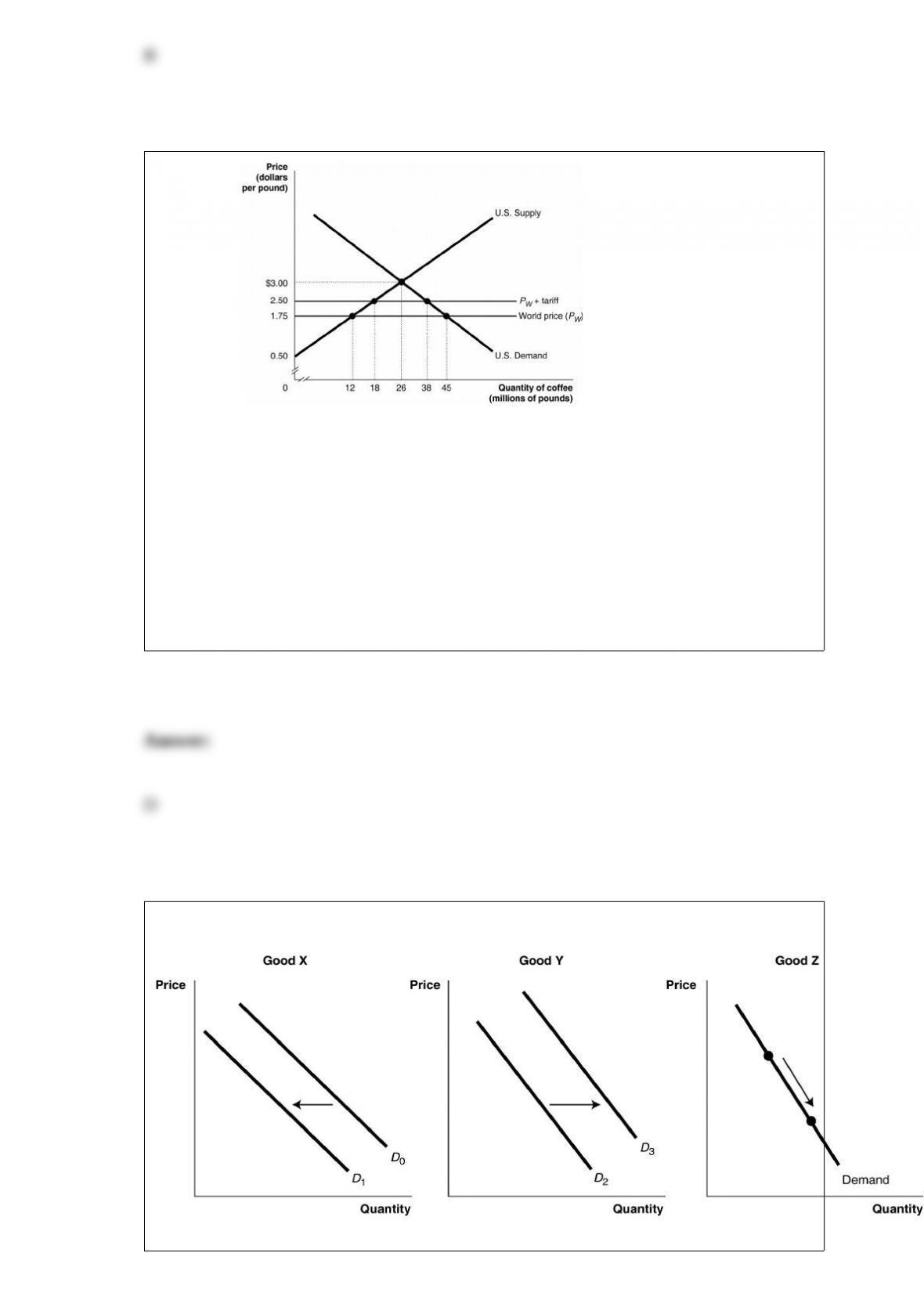
Figure 9-5 Suppose the U.S. government
imposes a $0.75 per pound tariff on coffee imports. Figure 9-5 shows the impact of this
tariff. With the tariff in place, the United States consumes
A) 18 million pounds of coffee.
B) 20 million pounds of coffee.
C) 26 million pounds of coffee.
D) 38 million pounds of coffee.
Figure 6-8
Identify the two goods which are substitutes.

A) Good X and Good Y
B) Good Y and Good Z
C) Good X and Good Z
D) It is not possible to distinguish any relationship among the goods.
Jack just told his boss that he thinks his boss is an idiot. It is likely that Jack will be
experiencing ________ unemployment in the near future.
A) permanent
B) cyclical
C) frictional
D) structural
Some economists and policymakers who are in favor of government-provided health
care believe that providing health care will
A) generate additional moral hazard.
B) create negative externalities.
C) reduce asymmetric information.
D) generate more adverse selection.
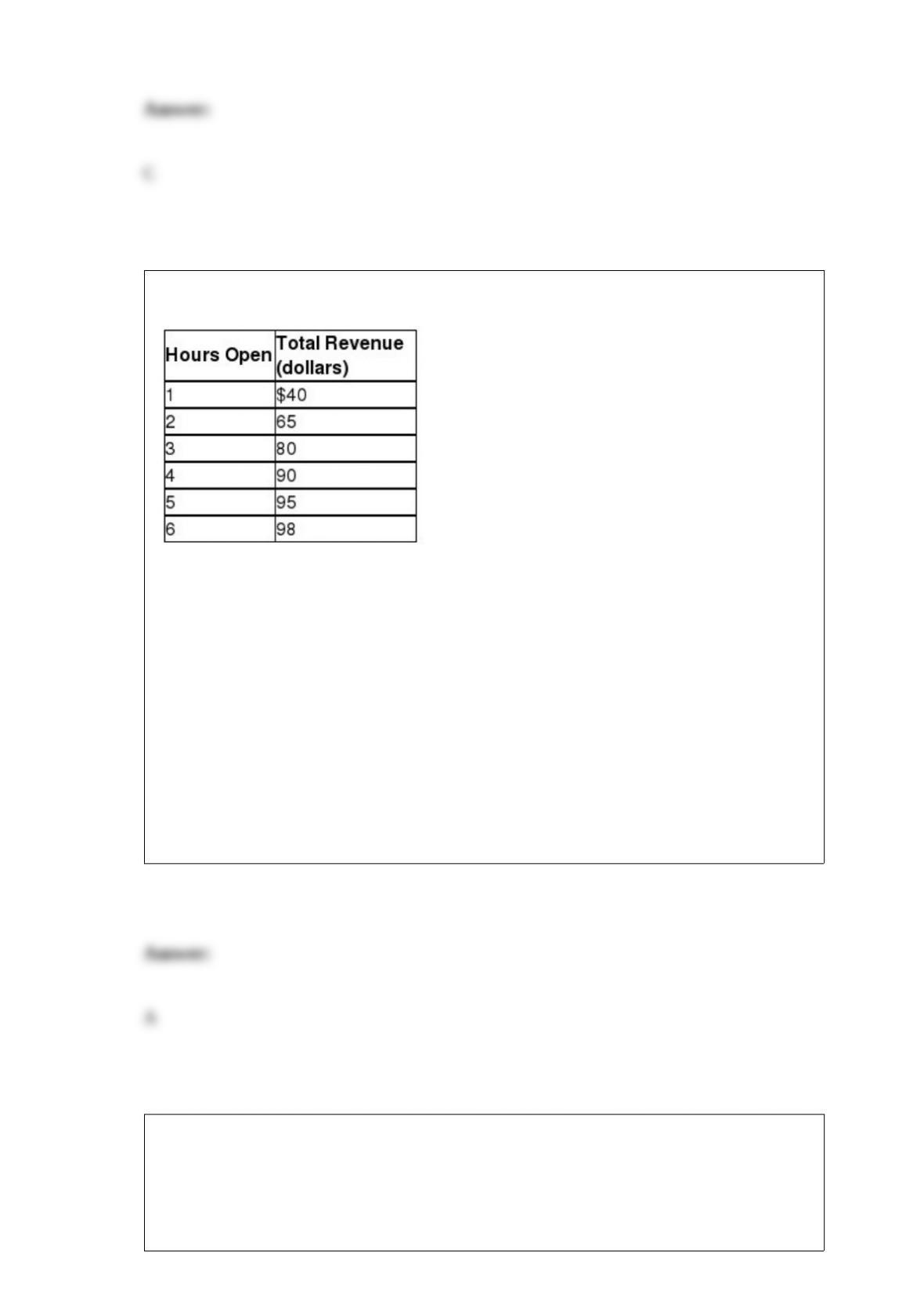
Table 1-5
Julius runs a small tailor shop in the city of Bloomfield. He is debating whether he
should extend his hours of operation. Julius figures that his sales revenue will depend
on the number of hours the tailor shop is open as shown in the table above. He would
have to hire a worker for those hours at a wage rate of $18 per hour.. What is Julius’s
marginal benefit if he decides to stay open for three hours instead of two hours?
A) $15
B) $25
C) $65
D) $80
Economists James Buchanan and Gordon Tullock are well-known for developing
A) the impossibility theorem.
B) the voting paradox.

C) the public choice model.
D) the concept of government failure.
What’s the difference between foreign direct investment and foreign portfolio
investment?
A) Foreign direct investment involves purchases of foreign stock or bonds by
individuals or firms, while foreign portfolio investment involves a firm purchasing or
building a facility in a foreign country.
B) Individuals engage in foreign portfolio investment, but only firms can engage in
foreign direct investment.
C) Foreign direct investment only takes place when governments make official
purchases or foreign investments, while foreign portfolio investment takes place when
firms, individuals, or the government purchase foreign investments.
D) Foreign direct investment can give a low-income country access to funds and
technology it would not otherwise have, but foreign portfolio investment does not
expand that access.
All of the following would be considered a positive addition to household wealth
except
A) the equity in one’s home.
B) 500 shares of Google stock.

C) the balance in your savings account.
D) a credit card balance.
Consumers benefit from monopolistic competition by
A) being able to choose from products more closely suited to their tastes.
B) paying the lowest possible price for the product.
C) paying the same price as everyone else.
D) being able to purchase high-quality products at low prices.
A production possibilities frontier with a bowed outward shape indicates
A) the possibility of inefficient production.
B) constant opportunity costs as more and more of one good is produced.
C) increasing opportunity costs as more and more of one good is produced.
D) decreasing opportunity costs as more and more of one good is produced.
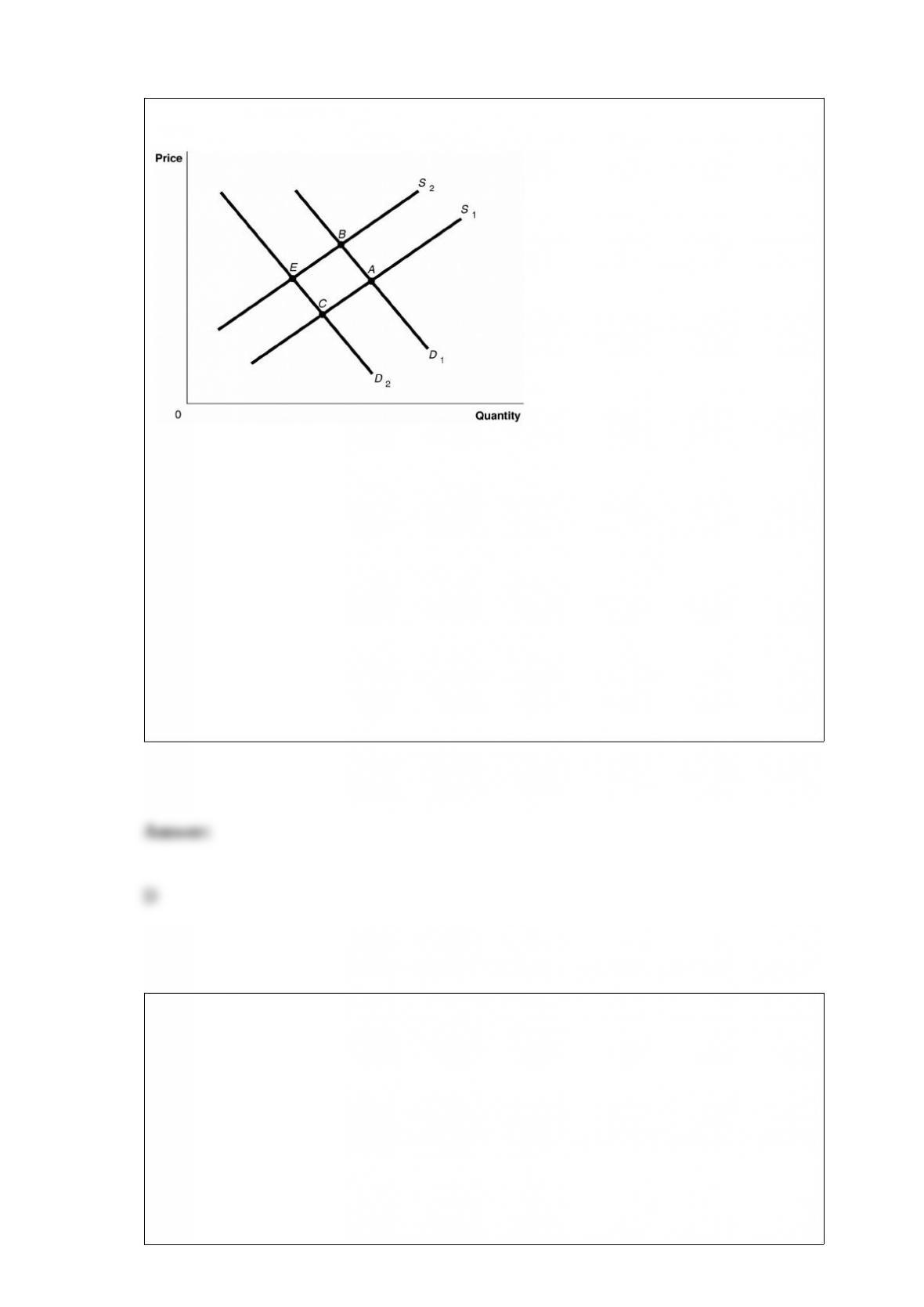
Figure 3-8
The graph in this figure illustrates an initial competitive equilibrium in the market for
sugar at the intersection of D1 and S1 (point A). If there is an increase in the price of
fertilizer used on sugar cane and there is a decrease in tastes for sugar-sweetened soft
drinks, how will the equilibrium point change?
A) The equilibrium point will move from A to B.
B) The equilibrium point will move from A to C.
C) There will be no change in the equilibrium point.
D) The equilibrium point will move from A to E.
Many economists do not believe that network externalities lock consumers into the use
of products that have technology inferior to other, similar products. These economists
believe that
A) consumers are always rational.
B) in practice, the gains from using a superior technology exceed the losses consumers
incur from switching costs.
C) there is no good evidence that switching costs exist.

D) the government will prevent products with inferior technology from being sold to
consumers.