
1) If Treasury deposits at the Fed are predicted to ________, the manager of the trading
desk at the New York Fed bank will likely conduct ________ open market operations to
________ reserves.
A) increase; defensive; inject
B) decrease; defensive; inject
C) increase; dynamic; inject
D) decrease; dynamic; drain
2) Everything else held constant, the vertical section of the supply curve of reserves is
shortened when the
A) discount rate increases
B) discount rate decreases
C) federal funds rate rises
D) federal funds rate falls
3) A defined-benefit pension
A) determines benefits by contributions and their earnings
B) fixes benefits in advance
C) links benefits to investment performance
D) fixes benefits paid out for a limited number of years
4) Everything else held constant, an increase in financial frictions________ aggregate
________.
A) increases; demand
B) decreases; demand
C) decreases; supply
D) increases; supply
5) Ranking assets from most liquid to least liquid, the correct order is
A) savings bonds; house; currency
B) currency; savings bonds; house
C) currency; house; savings bonds
D) house; savings bonds; currency

6) The evolution of the payments system from barter to precious metals, then to fiat
money, then to checks can best be understood as a consequence of the fact that
A) paper is more costly to produce than precious metals
B) precious metals were not generally acceptable
C) precious metals were difficult to carry and transport
D) paper money is less accepted than checks
7) All else equal, the ________ the coupon rate on a bond, the ________ the bond’s
duration.
A) higher; longer
B) higher; shorter
C) lower; shorter
D) greater; longer
8) The decline in stock prices from 2000 through 2002
A) increased individuals’ willingness to spend
B) had no effect on individual spending
C) reduced individuals’ willingness to spend
D) increased individual wealth
9) If the deficit is financed by selling bonds to the ________, the money supply will
________, causing aggregate demand to ________.
A) public; rise; increase
B) public; fall; decrease
C) central bank; rise; increase
D) central bank; fall; decrease
10) The time it takes for policy makers to be sure of what the data are signaling about
the future course of the economy is called
A) the data lag
B) the recognition lag
C) the legislative lag
D) the implementation lag
E) the effectiveness lag
11) An important characteristic of the modern payments system has been the rapidly
increasing use of
A) checks and decreasing use of currency
B) electronic fund transfers
C) commodity monies
D) fiat money
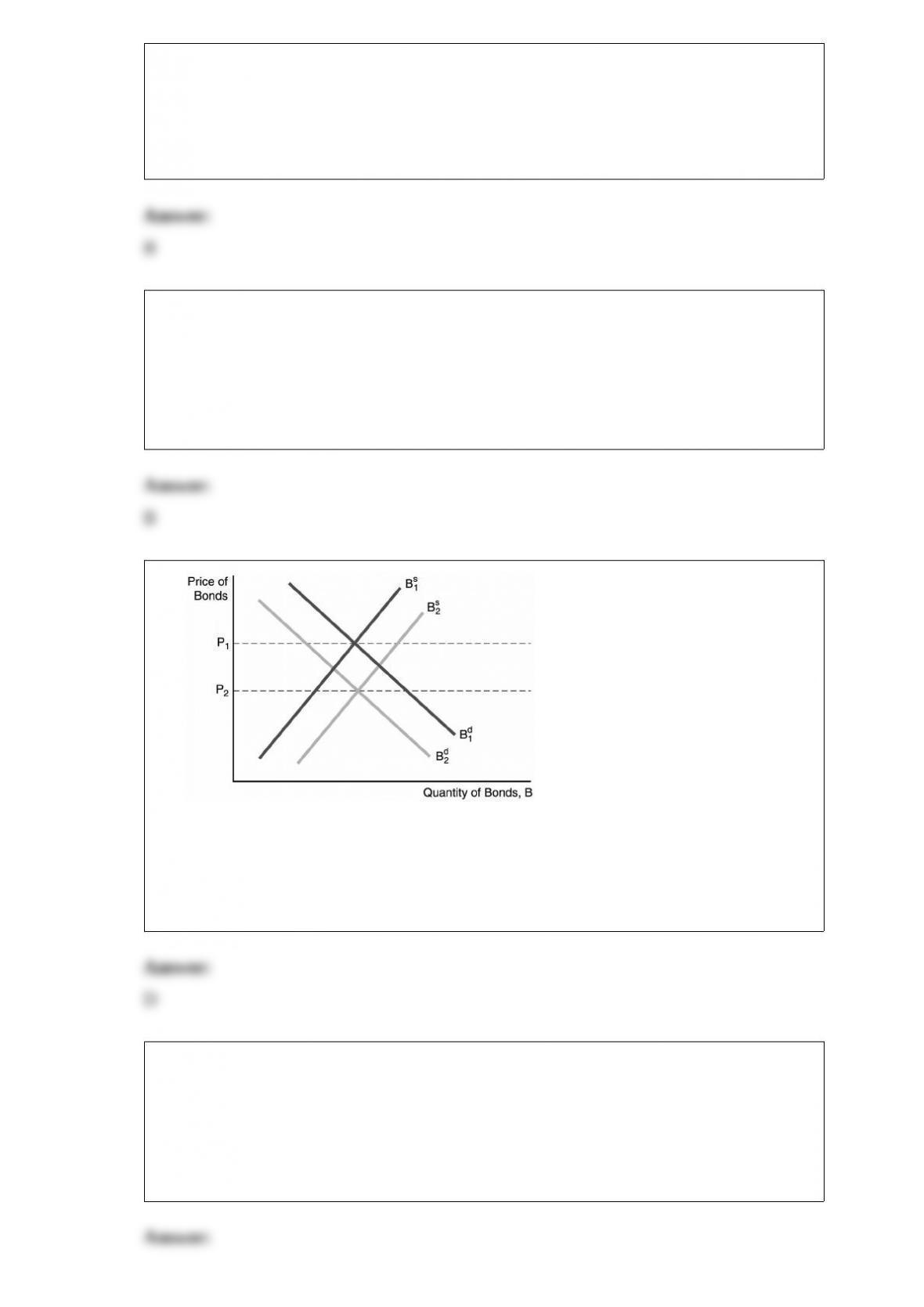
12)
In the figure above, a factor that could cause the supply of bonds to shift to the right is:
A) a decrease in government budget deficits
B) a decrease in expected inflation
C) a recession
D) a business cycle expansion
13) According to the liquidity premium theory of the term structure, a slightly upward
sloping yield curve indicates that short-term interest rates are expected to
A) rise in the future
B) remain unchanged in the future
C) decline moderately in the future
D) decline sharply in the future

14) ________ in the foreign interest rate causes the demand for domestic assets to shift
to the right and the domestic currency to ________, everything else held constant.
A) An increase; appreciate
B) An increase; depreciate
C) A decrease; appreciate
D) A decrease; depreciate
15) The business term for economies of scope is
A) economies of scale
B) diversification
C) cooperation
D) synergies
16) Banks acquire the funds that they use to purchase income-earning assets from such
sources as
A) cash items in the process of collection
B) savings accounts
C) reserves
D) deposits at other banks
17) The Phillips curve indicates that when the labor market is ________, production
costs will ________ and aggregate supply decreases.
A) easy; rise
B) easy; fall
C) tight; fall
D) tight; rise
18) The immediate (two-day) exchange of one currency for another is a
A) forward transaction
B) spot transaction

C) money transaction
D) exchange transaction
19) One factor contributing to the rapid growth of the commercial paper market since
1970 is
A) the fact that commercial paper has no default risk
B) improved information technology making it easier to screen credit risks
C) government regulation
D) FDIC insurance for commercial paper
20) A problem with the too-big-to-fail policy is that it ________ the incentives for
________ by big banks.
A) increases; moral hazard
B) decreases; moral hazard
C) decreases; adverse selection
D) increases; adverse selection
21) When money prices are used to facilitate comparisons of value, money is said to
function as a
A) unit of account
B) medium of exchange
C) store of value
D) payments-system ruler
22) Everything else held constant, when stock prices become ________ volatile, the
demand curve for bonds shifts to the ________ and the interest rate ________.
A) more; right; rises
B) more; right; falls
C) less; left; falls
D) less; left; does not change

23) The time it takes for policy makers to obtain data indicating what is happening in
the economy is called
A) the data lag
B) the recognition lag
C) the legislative lag
D) the implementation lag
E) the effectiveness lag
24) Macroprudential supervision policies try to prevent a leverage cycle by changing
capital requirements so that they ________ during an expansion and ________ during a
downturn.
A) increase; decrease
B) increase; increase
C) decrease; increase
D) decrease; decrease
25) A decrease in the riskiness of corporate bonds will ________ the yield on corporate
bonds and ________ the yield on Treasury securities, everything else held constant.
A) increase; increase
B) decrease; decrease
C) increase; decrease
D) decrease; increase
26) If the yield curve has a mild upward slope, the liquidity premium theory (assuming
a mild preference for shorter-term bonds) indicates that the market is predicting
A) a rise in short-term interest rates in the near future and a decline further out in the
future
B) constant short-term interest rates in the near future and further out in the future
C) a decline in short-term interest rates in the near future and a rise further out in the
future
D) a decline in short-term interest rates in the near future and an even steeper decline
further out in the future

27) In the early 1990s, M2 growth underwent a dramatic ________, which some
researchers believe ________ be explained by traditional money demand functions.
A) surge; cannot
B) surge; can
C) slowdown; cannot
D) slowdown; can
28) Privatization of the Social Security system is being considered due to
A) the desire to reduce taxes
B) demands to reduce the retirement age
C) reduced life expectancy
D) underfunding of the system
29) Duration analysis involves comparing the average duration of the bank’s ________
to the average duration of its ________.
A) securities portfolio; non-deposit liabilities
B) assets; liabilities
C) loan portfolio; deposit liabilities
D) assets; deposit liabilities
30) The discount rate is kept ________ the federal funds rate because the Fed prefers
that ________
A) below; banks can monitor each other for credit risk
B) below; the Fed can monitor banks for credit risk
C) above; banks can monitor each other for credit risk
D) above; the Fed can monitor banks for credit risk
31) When the economy slips into a recession, normally the demand for bonds
________, the supply of bonds ________, and the interest rate ________, everything
else held constant.
A) increases; increases; rises
B) decreases; decreases; falls
C) increases; decreases; falls

D) decreases; increases; rises