
The marginal benefit and marginal private cost curves for aphrodisiacs are given as
follows:
MB = 200 – Q MPC = Q
In addition to private costs, there is a marginal external cost of $10 per unit of output.
What is the efficient level of output?
A) 0
B) 55
C) 95
D) 100
E) none of the above
Over the past several decades, low-productivity and high-productivity workers in the
US and other countries have tended to invest in their own human capital by completing
more years of college than earlier generations. Which of the following reasons does
NOT help to explain this trend?
A) The cost of education for low-productivity workers has declined due to the
emergence of online and other nontraditional programs.
B) The earnings gap between workers with and without education has grown larger over
time.
C) The cost of education for high-productivity workers has increased over time.
D) The benefit associated with increased education has increased over time.
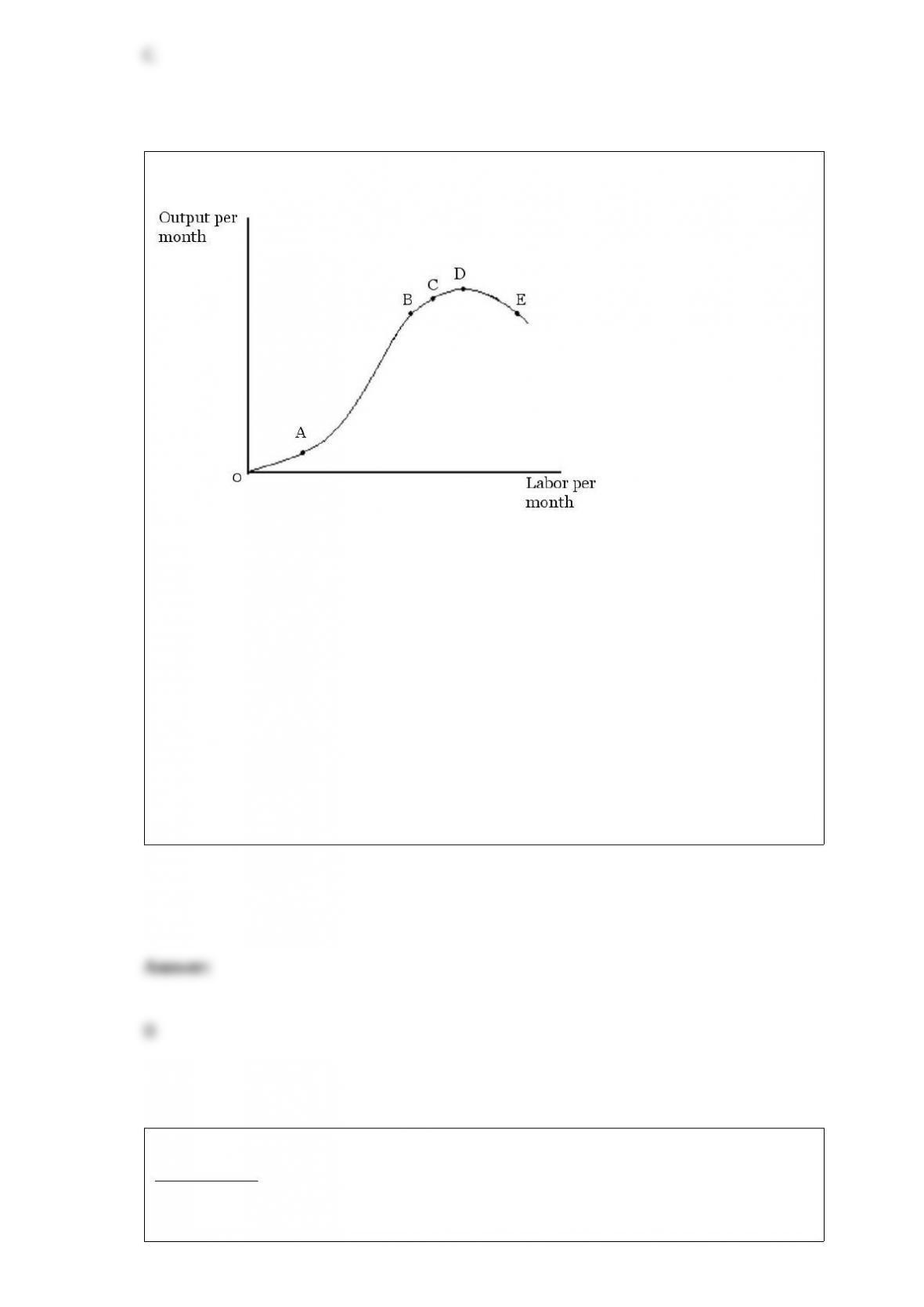
Figure 6.1
Refer to Figure 6.1. At which point on the total product curve is the average product of
labor the highest?
A) point A.
B) point B.
C) point C.
D) point D.
E) none of the above
Scenario 5.9:
Torrid Texts, a risk-neutral new firm that specializes in making college textbooks more

interesting by inserting contemporary material wherever possible, is planning for next
year’s production and must decide how many paper producers to contract with. It knows
fairly well what the general demand for textbooks is, but is uncertain how faculty will
react to this new material. If faculty react very negatively, the firm expects course
orders to be down. The executives at Torrid believe that the likelihood of a positive
faculty response is 75%. The table below contains profit information under the different
possible outcomes.
Producers Faculty Reaction Expected
Contracted Negative Positive Profit
1 $3 million $30 million $23.25 million
2 $1 million $60 million $45.25 million Refer to Scenario 5.9. Without additional
information, Torrid Texts would
A) contract with one paper producer in order to guarantee it avoids the worst outcome,
$1 million.
B) contract with two paper producers because $60 million is greater than $30 million.
C) contract with two paper producers because $61 million is greater than $33 million.
D) contract with two paper producers because $45.25 million is greater than $23.25
million.
E) not be able to come to any decision on how many producers to contract with.
Software companies continually work to develop new features of their products that
make it easier for users to interact and share their work. As more of these features are
embedded in the software, what happens to the individual demand curve for the
software products?
A) Demand curve becomes more elastic due to the bandwagon effect
B) Demand curve becomes less elastic due to the snob effect
C) Demand curve shifts, but its degree of elasticity does not change

D) There is no change in the individual demand curve
How do online auction sites like Ebay attempt to overcome the asymmetric information
problems associated with goods that the buyer cannot personally inspect before
purchase?
A) The online auction firm only allows high-quality merchandise to be sold at their site.
B) The previous performance (reputations) of the buyer and seller are posted for public
review.
C) Buyers can take receipt of any goods before they have to pay the seller.
D) all of the above
The Genetron Electric Company provides electric power service to a three state region
in the US. The annual demand for electric power in this region is Q = 4500 – 100P
where quantity (Q) is measured in millions of kilowatt hours (kWh) and the price (P) is
cents per kWh. The firm operates in a decreasing cost industry.
a. If the firm’s marginal cost curve crosses the demand curve at P = 4 (i.e., 4 cents per
kWh), what is the quantity demanded at this price? Why wouldn’t the firm want to
operate under marginal cost pricing?
b. If the firm’s average cost curve crosses the demand curve at P = 5, what is the
quantity demanded at this price? What are the firm’s profits under average cost pricing?
c. Suppose Genetron uses a block pricing scheme with prices P1 = 15, P2 = 10, and P3
= AC. What quantity levels are associated with the first, second, and third blocks of
annual electricity demanded?
The bonus of a plant manager in a vertically integrated firm is based on the following
formula:
Bonus = 10,000 – 0.5(Qf – Q)
where Qf is feasible production and Q is actual production. The value for Qf is provided
by the plant manager at the beginning of the year. With this scheme, the plant manager
has an incentive:

A) to underestimate Qf.
B) to overestimate Qf.
C) to reveal the true Qf and make Q as small as possible.
D) to reveal the true Qf and make Q as large as possible.
If price is between AVC and ATC, the best and most practical thing for a perfectly
competitive firm to do is
A) raise prices.
B) lower prices to gain revenue from extra volume.
C) shut down immediately, but not liquidate the business.
D) shut down immediately and liquidate the business.
E) continue operating, but plan to go out of business.
The demand for books is: Qd = 120 – P
The supply of books is: Qs = 5P
If P = $25, which of the following is true?

A) There is a surplus equal to 30.
B) There is a shortage equal to 30.
C) There is a shortage, but it is impossible to determine how large.
D) There is a surplus, but it is impossible to determine how large.
As you move rightward on a marginal cost of abatement curve, emissions are
A) falling, and the cost of eliminating the marginal unit falls.
B) rising, and the cost of eliminating the marginal unit falls.
C) falling, and the cost of eliminating the marginal unit rises.
D) rising, and the cost of eliminating the marginal unit rises.
E) rising, and the cost of eliminating the marginal unit is constant.
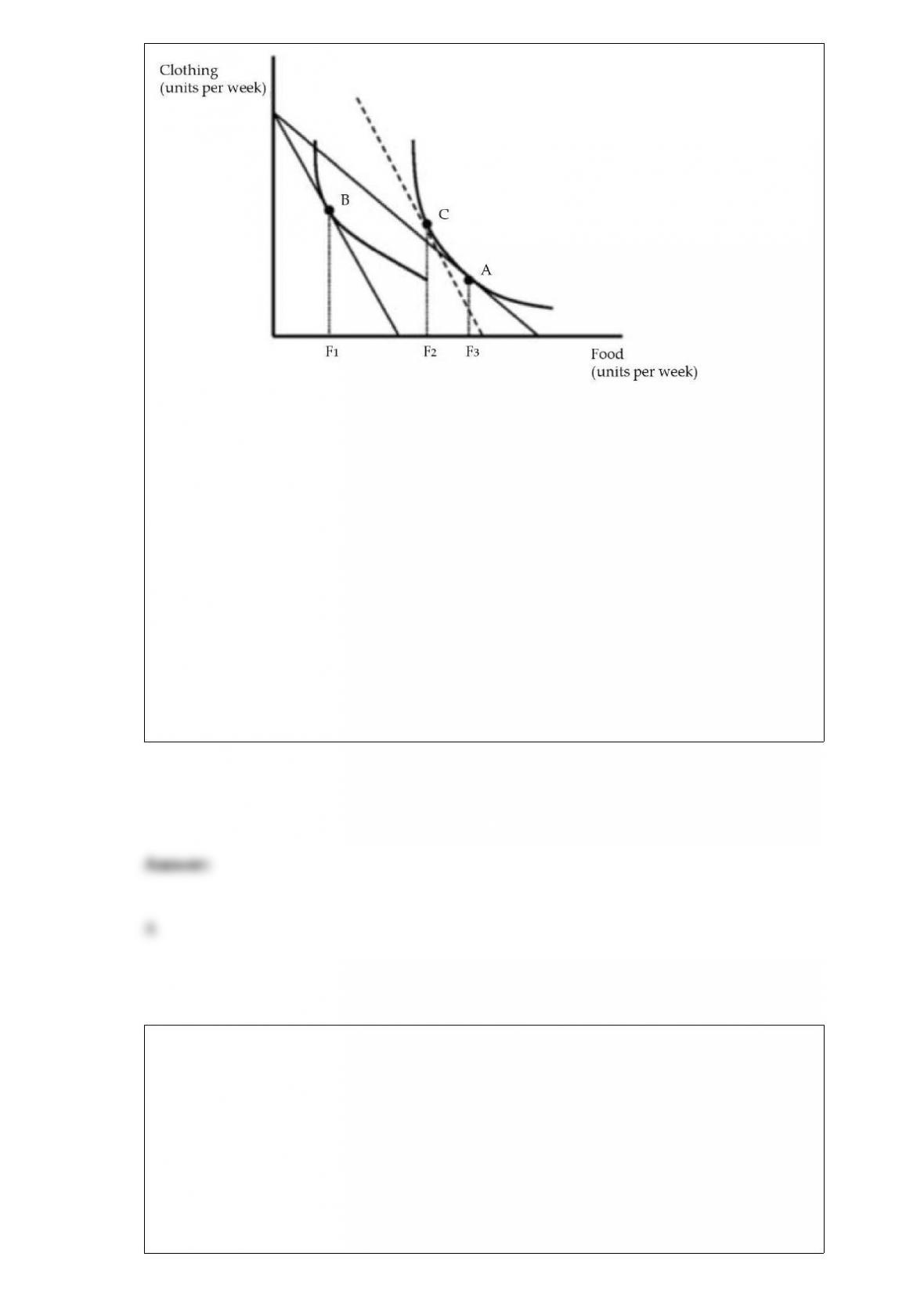
Figure 4.1
A consumer’s original utility maximizing market basket of goods is shown in Figure 4.1
as point A. Following a price change, the consumer’s utility maximizing market basket
changes is at point B.
Based on Figure 4.1, food is:
A) a normal good.
B) an inferior good, but not a Giffen good.
C) a Giffen good.
D) none of the above
The battery packs used in electric and hybrid automobiles are one of the largest cost
components for manufacturing these cars. As the price of these batteries decline, we
expect that the:
A) supply curve for electric and hybrid autos will shift rightward.
B) supply curve for electric and hybrid autos will shift leftward.
C) demand curve for electric and hybrid autos will shift rightward.

D) demand curve for electric and hybrid autos will shift leftward.
Under a transferable emissions permit system with n possible polluters, the government
enforces the total amount of emissions allowable at X units by
A) setting a different fee for each firm so that each firm chooses to emit X/n units.
B) setting the same fee for each firm so that each is forced to emit X/n units.
C) setting a different standard for each firm, with X/n being the average.
D) setting the same standard for each firm at X/n.
E) issuing X permits.
A firm will avoid producing additional emissions whenever the fee is
A) less than the MSB.
B) greater than the MSB.
C) less than the MCA.
D) greater than the MCA.
E) equal to the distance between MSB and MCA.

Joe owns a coffee house and produces coffee drinks under the production function q =
5KL where q is the number of cups generated per hour, K is the number of coffee
machines (capital), and L is the number of employees hired per hour (labor). What is
the average product of labor?
A) AP = 5
B) AP = 5K
C) AP = 5L
D) AP = 5K/L
Asymmetric information problems arise
A) in horizontally integrated firms, but not vertically integrated firms.
B) in vertically integrated firms, but not horizontally integrated firms.
C) in both vertically and horizontally integrated firms.
D) only in firms that do not have the advantage of either horizontal or vertical
integration.
E) only when a single firm is both horizontally and vertically integrated.

Ronny’s Pizza House operates in the perfectly competitive local pizza market. If the
price of pizza cheese increases (ceteris paribus), what is the expected impact on
Ronny’s profit-maximizing output decision?
A) Output increases to cover the higher input cost
B) Output increases because the marginal cost curve shifts upward
C) Output decreases because the marginal cost curve shifts upward
D) Output decreases because the price of pizza must also increase
If managers do not choose to maximize profit, but pursue some other goal such as
revenue maximization or growth,
A) they are more likely to become takeover targets of profit-maximizing firms.
B) they are less likely to be replaced by stockholders.
C) they are less likely to be replaced by the board of directors.
D) they are more likely to have higher profit than if they had pursued that policy
explicitly.
E) their companies are more likely to survive in the long run.

As the price of good X increases from $5 to $8, quantity demanded falls from 100 to
80. Based upon this information we can conclude that the demand for X is
A) elastic.
B) inelastic.
C) unit inelastic.
D) insufficient information for judgment.
A freeze in Florida’s orange growing regions will:
A) result in a sharp increase in the price of oranges in the short run because demand and
supply are highly inelastic.
B) result in a sharp increase in the price of oranges in the short run because demand and
supply are highly elastic.
C) result in a sharp decrease in the price of oranges in the short run because demand is
highly inelastic and supply is highly elastic.
D) result in little change in the price of oranges in the short run because supply is
infinitely elastic.

If the factor supply curve facing a monopolist is the market supply curve, and if the
market supply curve is an upward sloping straight line, the marginal expenditure curve
A) lies below the market supply curve.
B) lies above the market supply curve.
C) is the market supply curve.
D) crosses the market supply curve at the market wage rate.
E) either A or B is possible.
The market for an industrial chemical has a single dominant firm and a competitive
fringe comprised of many firms that behave as price takers. The dominant firm has
recently begun behaving as a price leader, setting price while the competitive fringe
follows. The market demand curve and competitive fringe supply curve are given
below. Marginal cost for the dominant firm is $0.75 per gallon.
QM = 140,000 – 32,000P
QF = 60,000 + 8,000P,
where QM = market quantity demanded, and QF = the supply of the competitive fringe.
Quantities are measured in gallons per week, and price is measured as a price per
gallon.
a. Determine the price and output that would prevail in the market under the conditions
described above. Identify output for the dominant firm as well as the competitive fringe.
b. Assume that the market demand curve shifts rightward by 40,000 units. Show that the
dominant firm is indeed a price leader. What output (leader and follower) and market
price will prevail after the change in demand?
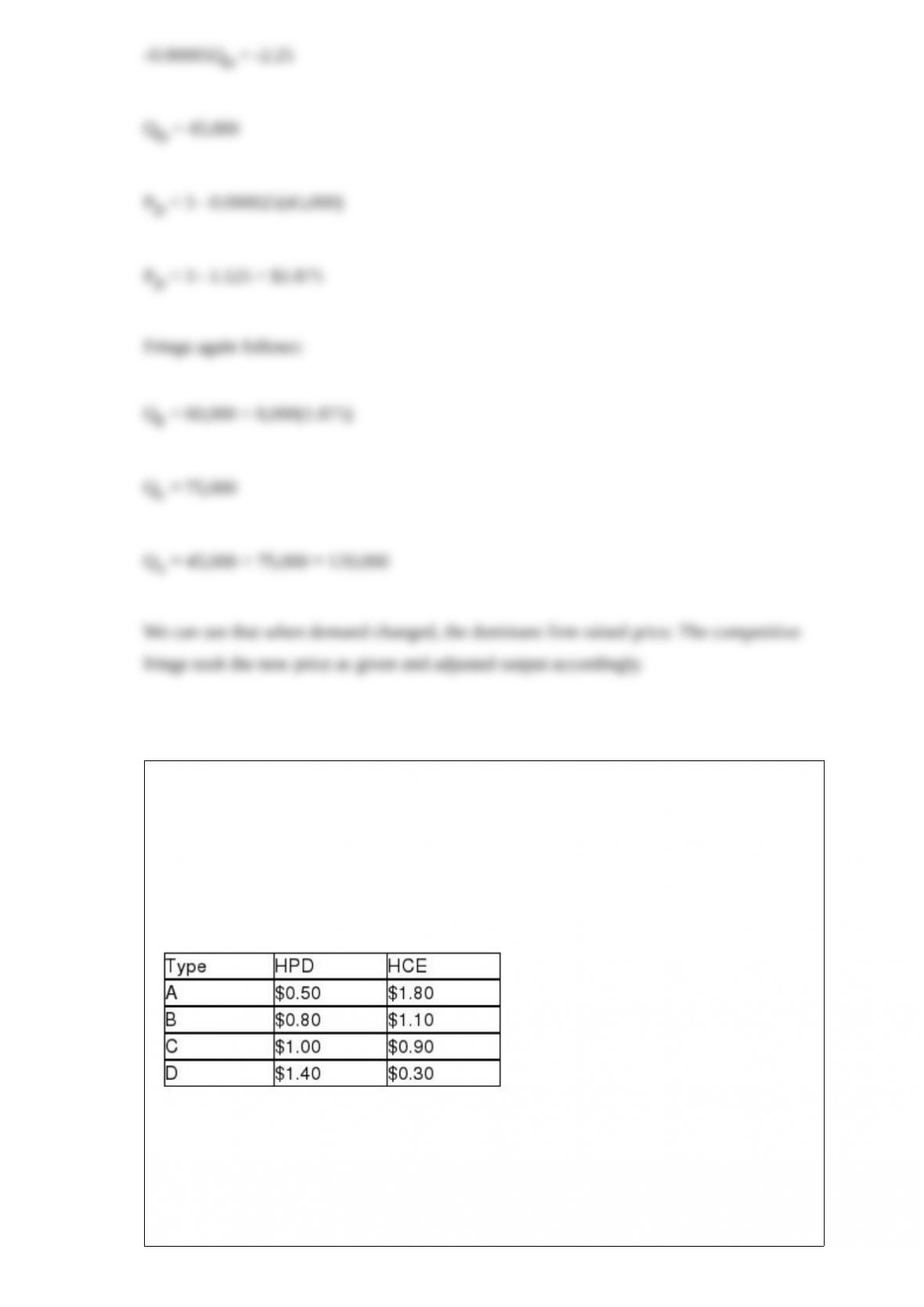
Your company sells health food products, and you have recently developed a new
high-protein drink (HPD) as well as a high-carbohydrate energy bar (HCE). As the
product manager for the firm, you are responsible for setting the pricing policy for the
new products. You are considering a bundled package that includes both products, and
you assume the marginal cost of production is zero for planning purposes. You have
identified four basic types of consumers who may buy these new products, and their
reservation prices for the two new products are provided in the following table:
a. Suppose you sell the two products separately, and each buyer is expected to purchase
one unit of the product per day. Which prices for HPD and HCE maximize daily
revenue? What is your daily revenue from selling both products to the four customers
under separate pricing?
b. If you offer the two products under a pure bundling strategy, what is the revenue
maximizing bundle price? What is the daily sales revenue from the pure bundling
scheme?
c. Please develop a mixed bundling strategy that generates higher daily sales revenue
than the pure bundling strategy. What is the daily sales revenue generated under mixed
bundling?
Scenario 14.4:
John’s firm is a competitor in your product market and a monopsonist in the labor
market. The current market price of the product that your firm produces is $2. The total
product and marginal product of labor are given as:
TP = 100L – 0.125L2 MP = 100 – 0.25L
where L is the amount of labor employed. The supply curve for labor and the marginal
expenditure curve for labor are given as follows:
L = PL -5 MEL = 2L + 5
Refer to Scenario 14.4. Suppose that the price of the product rises to $5, the number of
workers hired
A) will decrease.
B) will increase.
C) will not change.
D) cannot be determined without knowing the wage rate.
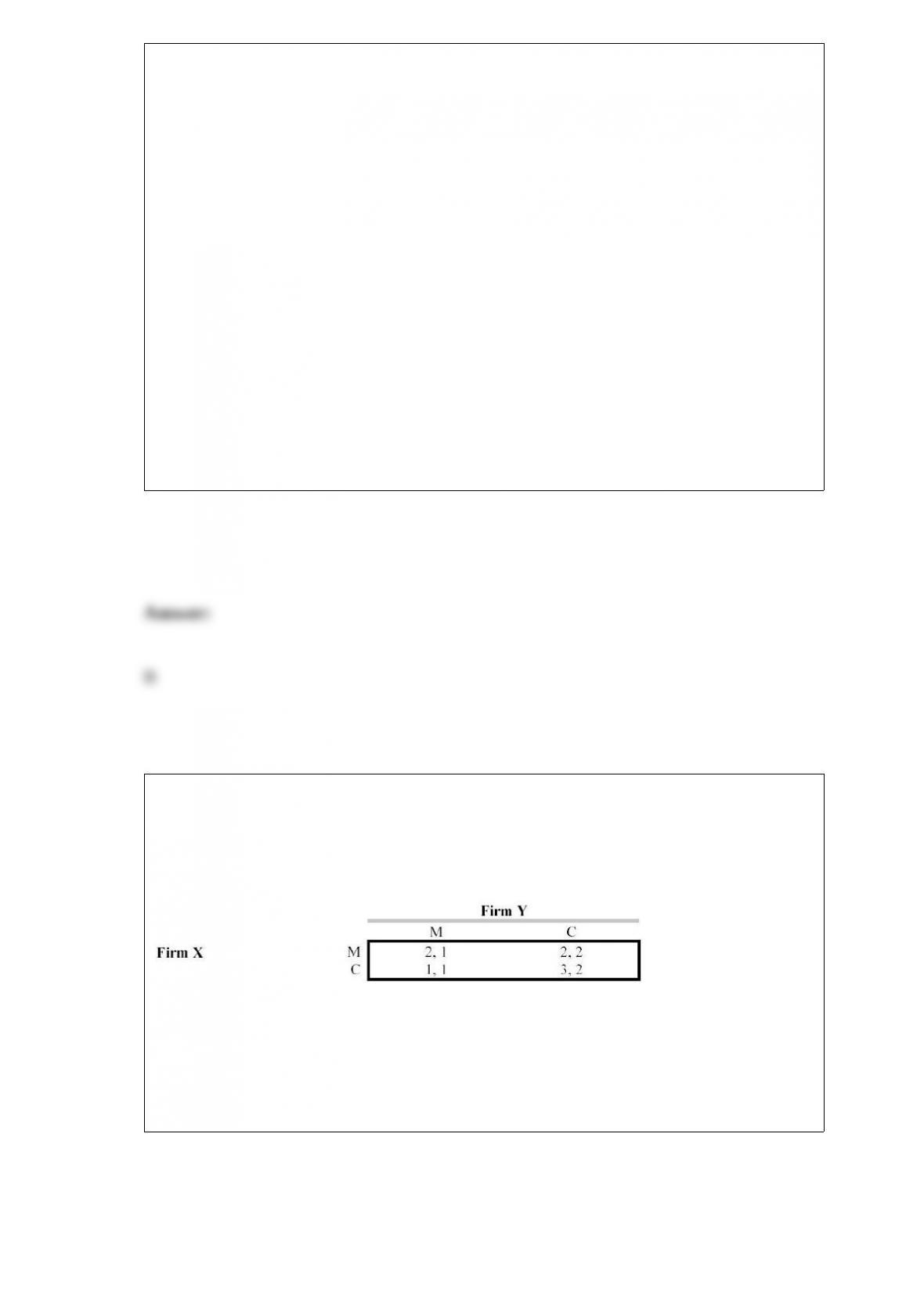
Consider two firms, X and Y, that produce super computers. Each can produce the next
generation super computer for the military (M) or for civilian research (C). However,
only one can successfully produce for both markets simultaneously. Also, if one
produces M, the other might not be able to successfully produce M, because of the
limited market. The following payoff matrix illustrates the problem.
a. Find the Nash equilibrium, and explain why it is a Nash equilibrium.
b. If Firm X were unsure that the management of Firm Y were rational, what would
Firm X choose to do if it followed a maximin strategy? What would both firms do if
they both followed a maximin strategy?

Grocery store chains advertise more than convenience stores because:
A) the advertising elasticity of demand is smaller for grocery store chains than for
convenience stores.
B) convenience stores have more elastic demand for their products than grocery store
chains.
C) the advertising elasticity of demand for convenience stores is near zero and is much
smaller than for grocery store chains.
D) all of the above
E) none of the above

Which of the following algebraic forms for a demand curve yields an isoelastic demand
curve?
A) Q = a – b log(P) + c log(I)
B) Q = a – bP + cI
C) log(Q) = a – b log(P) + c log(I)
D) log(Q) = bP + cI
Suppose your instructor gave hats with your school’s logo to half of your economics
classmates. She then asked these students to value the hats, and the average response
was $9 per hat. Under the endowment effect, we should expect that the average value
assigned by the economics students who did NOT receive the hats to be:
A) higher.
B) lower.
C) the same.
D) We cannot answer this question without knowing more about the risk preferences of
the students.
Bill’s utility function takes the form U(I) = exp(I) where I is Bill’s income. Based on
this utility function, we can see that Bill is:

A) risk averse
B) risk neutral
C) risk loving
D) He can exhibit two or more of these risk behaviors under this utility function.
Which of the following statements concerning utility as a measure for well being are
false?
A) There is generally a positive relationship between income and utility.
B) It is possible to determine which of two individuals is made happier by consuming a
particular market basket.
C) Utility is an abstract representation of an individual’s degree of happiness.
D) Cross country studies suggest that citizens in wealthier countries are happier than
citizens in poorer countries.
If the law of diminishing returns applies to labor then
A) the marginal product of labor must eventually become negative.
B) the average product of labor must eventually become negative.

C) the marginal product of labor must rise and then fall as employment rises.
D) the average product of labor must rise and then fall as employment increases.
E) after some level of employment, the marginal product of labor must fall.
Use the following two statements to answer this question:
I. If utility is ordinal, a market basket that provides 30 utils provides twice the
satisfaction of a market basket that provides 15 utils.
II. When economists first studied utility it was believed that utility was cardinal, but it
was later discovered that ordinal preferences are sufficient to explain how most
individual decisions are made.
A) Both I and II are true.
B) I is true, and II is false.
C) I is false, and II is true.
D) Both I and II are false.
Suppose your firm has a U-shaped average variable cost curve and operates in a
perfectly competitive market. If you produce where the product price (marginal
revenue) equals average variable cost (on the upward sloping portion of the AVC

curve), then your output will:
A) exceed the profit-maximizing level of output.
B) be smaller than the profit-maximizing level of output.
C) equal the profit-maximizing level of output.
D) generate zero economic profits.
The demand for books is: Qd = 120 – P
The supply of books is: Qs = 5P
If P = $15, which of the following is true?
A) There is a surplus equal to 30.
B) There is a shortage equal to 30.
C) There is a surplus, but it is impossible to determine how large.
D) There is a shortage, but it is impossible to determine how large.