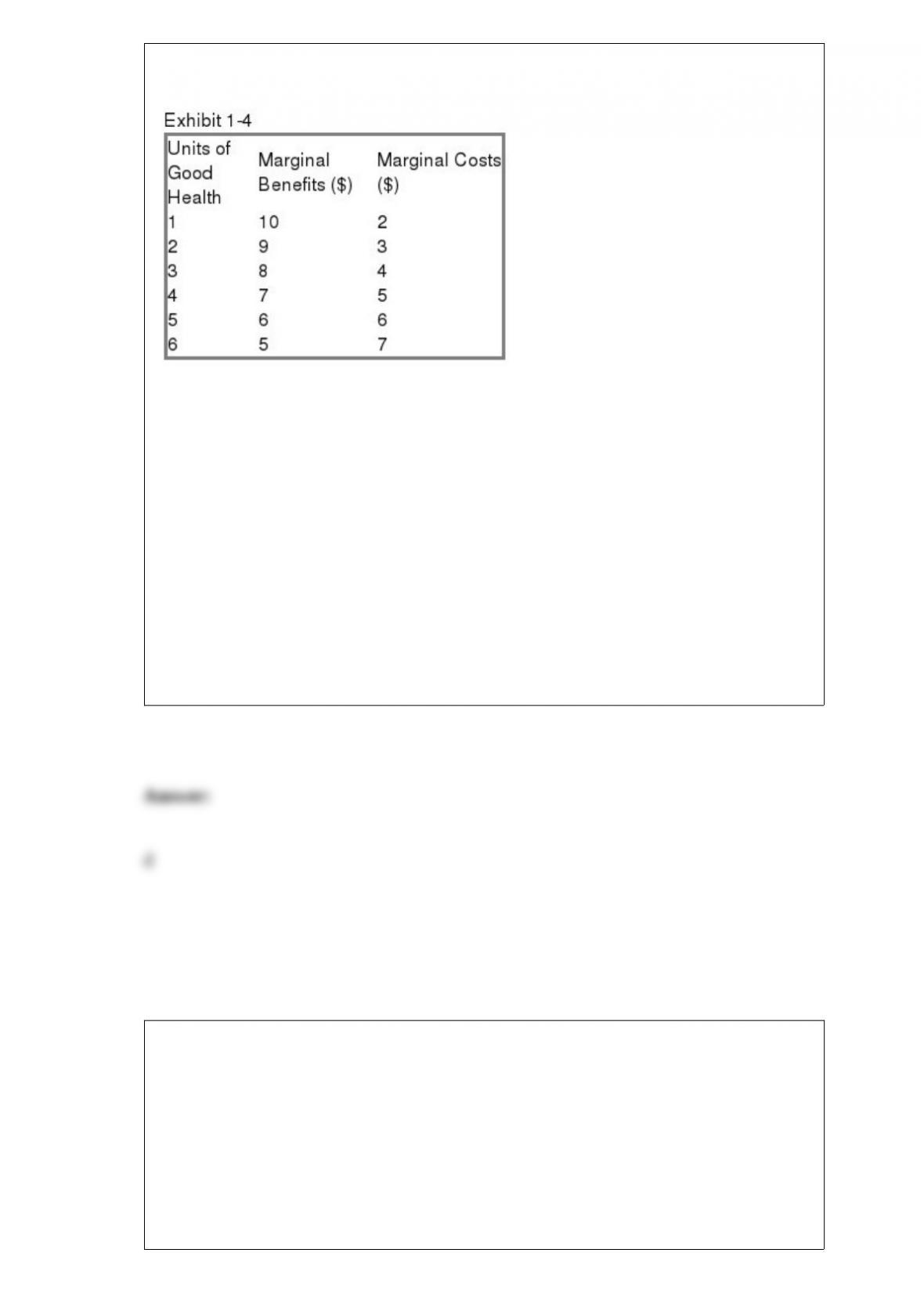
If the student whose marginal benefits and costs of good health are noted in this table,
how many units of good health should the student obtain in order to maximize her net
benefits of good health?
a. 2 units
b. 3 units
c. 4 units
d. 5 units
e. 6 units
Don receives 100 utils from consuming two oranges. The utility he derives from
consuming the second orange equals 30 utils. The information provided
a. is consistent with the law of diminishing marginal utility.
b. is inconsistent with the law of diminishing marginal utility.
c. is sufficient to determine the quantity of oranges Don will consume.

d. lends support to the inferiority of oranges as consumer goods.
Jessica paid $2,300 for a bond with a face value of $2,000. She will be paid $300
annually as long as she holds on to the bond, until the bond’s maturity date. The coupon
rate of the bond is
a. 15.0 percent.
b. 7.5 percent.
c. 13.0 percent.
d. 80.0 percent.
Suppose that unit costs are the same at both 100 units of output and 150 units of output.
Unit costs are higher at output levels less than 100 units and at output levels greater
than 150 units. It follows that minimum efficient scale exists
a. somewhere between 100 and 150 units.
b. at 100 units.
c. at 150 units.
d. at less than 100 units.
e. at greater than 150 units.

The Sherman Act of 1890 was passed with the intent of
a. establishing the Federal Trade Commission (FTC) to deal with “unfair methods of
competition.”
b. preventing monopolization and/or conspiracy in the restraint of trade.
c. spelling out the conditions under which mergers would be considered
anti-competitive.
d. dealing with false and deceptive advertising.
e. declaring interlocking directorates illegal.
The supply of loanable funds curve is
a. upward sloping.
b. downward sloping.
c. perfectly elastic.
d. perfectly inelastic.

If a good is perfectly inelastic in a given price range, it will be perfectly inelastic at all
prices.
a. True
b. False
A private equity firm is a group of investors that buys up the publicly traded stock of a
large corporation and then takes the corporation private.
a. True
b. False
Keisha can produce the following combinations of X and Y: 100X and 20Y, 50X and
30Y, or 0X and 40Y. The opportunity cost of one unit of Y for Keisha is
a. 5 units of X.
b. 0.2 units of X.
c. 3 units of X.
d. 1/2 unit of X.
e. none of the above

A negative externality can be internalized by
a. persuasion.
b. the imposition of a tax.
c. the assignment of property rights.
d. a voluntary agreement.
e. all of the above
Suppose a Mexican consumer wants to buy an American television for $500 and an
American wants to buy a Mexican raincoat for 700 pesos. If the exchange rate is $0.10
= 1 peso, then the price of the television in pesos will be __________ and the price of
the raincoat in dollars will be __________.
a. 5000 pesos;$70
b. 50 pesos;$7,000
c. 500 pesos;$7
d. 5 pesos;$7,000

The natural monopolist might have an incentive to decrease cost under
a. price regulation.
b. profit regulation.
c. output regulation.
d. a and b
Suppose the marginal revenue product of individuals who work in the union sector is
greater than that of individuals who work in the nonunion sector. Normally, we would
expect labor to move from the nonunionized sector to the unionized sector-from where
it is worth less to where it is worth more. But if this cannot happen, owing to the
supply-restraining efforts of the union, then
a. wages in the nonunion sector will rise.
b. wages in the union sector will fall.
c. there will be a misallocation of labor—not all labor will be employed where it is most
valuable.
d. workers in the union sector will move to the nonunion sector.