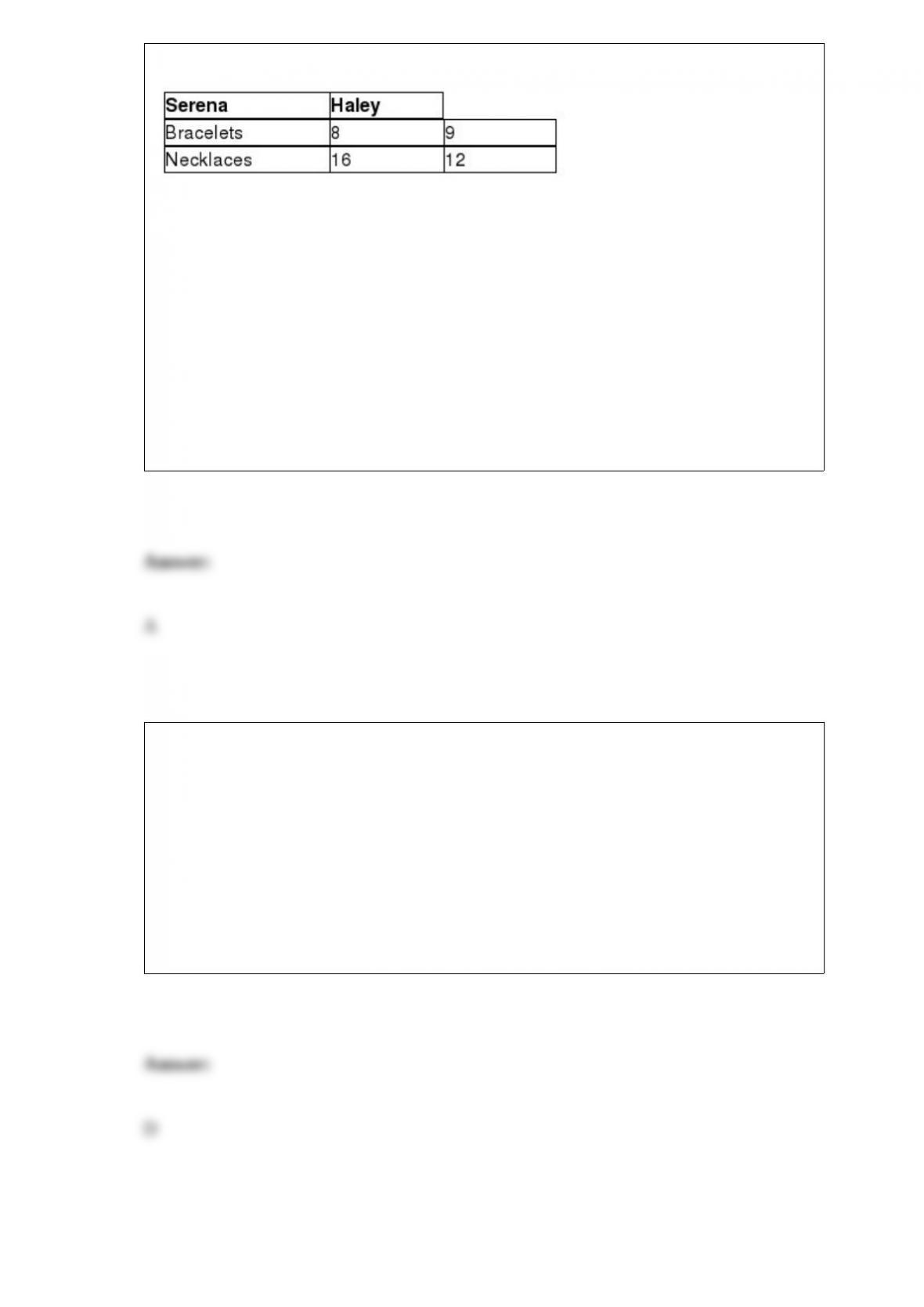
Table 2-6
Table 2-6 shows the output per week of two jewelers, Serena and Haley. They can either
devote their time to making bracelets or making necklaces.
What is Serena’s opportunity cost of making a bracelet?
A) 2 necklaces
B) 1/2 of a bracelet
C) 1/2 of a necklace
D) 3/4 of a bracelet
All of the following would be considered a positive addition to household wealth
except
A) the equity in one’s home.
B) 500 shares of Google stock.
C) the balance in your savings account.
D) a credit card balance.
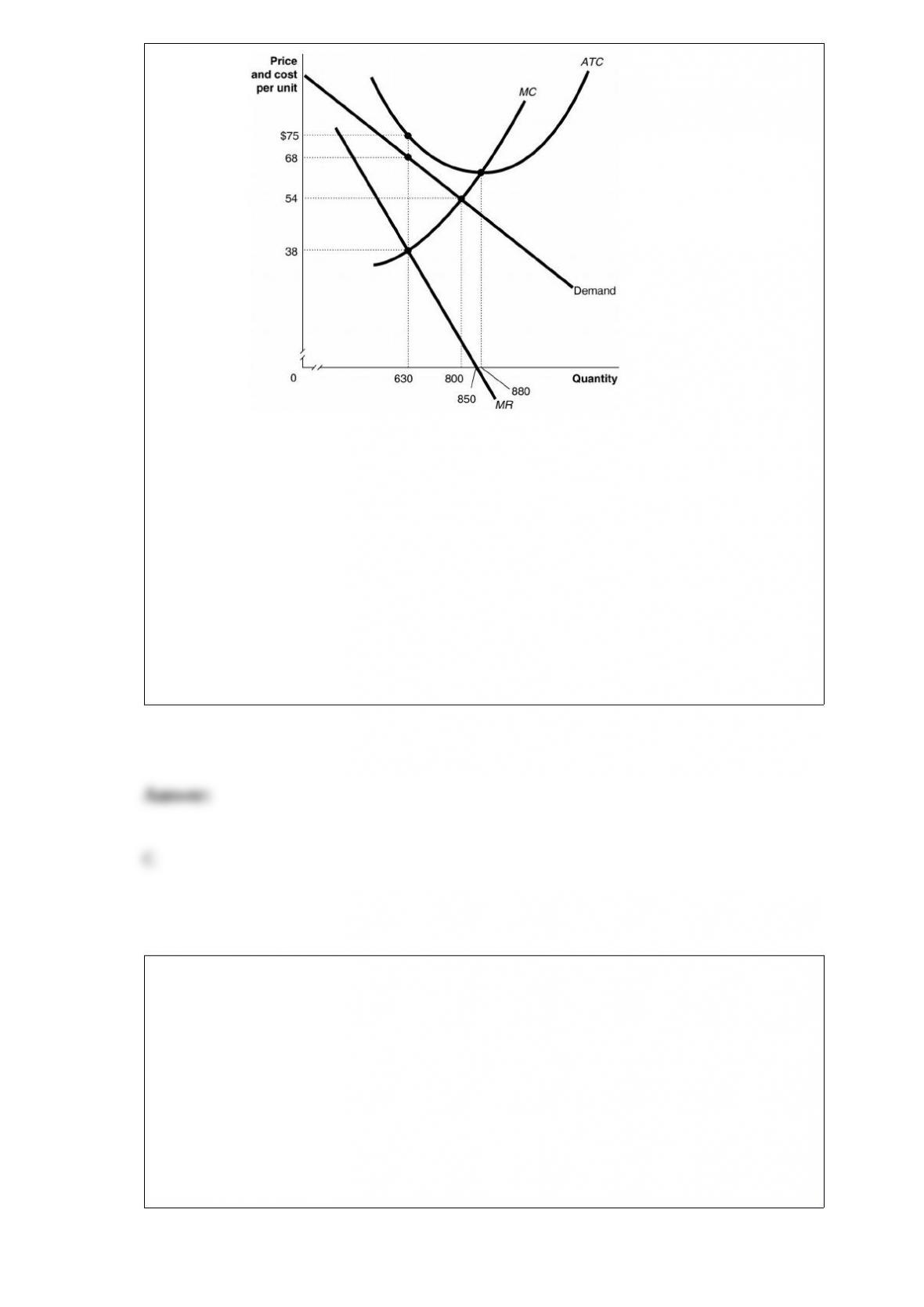
Figure 15-3 Figure 15-3 above shows
the demand and cost curves facing a monopolist.
Suppose the monopolist represented in the diagram above produces positive output.
What is the price charged at the profit-maximizing/loss-minimizing output level?
A) $38
B) $54
C) $68
D) $75
If net foreign investment in the United States is negative, how must national saving and
domestic investment be related?
A) Domestic investment and national saving must also be negative.
B) Domestic investment must be greater than national saving.
C) Domestic investment must be less than national saving.
D) Domestic investment can be greater than or less than national saving.

If the Fed is using policy to combat inflation, what is likely to happen in the foreign
exchange market and to the foreign exchange value of the dollar?
A) The demand for the dollar will increase and the foreign exchange value of the dollar
will rise.
B) The demand for the dollar will decrease and the foreign exchange value of the dollar
will rise.
C) The demand for the dollar will increase and the foreign exchange value of the dollar
will fall.
D) The demand for the dollar will decrease and the foreign exchange value of the dollar
will fall.
For many years the Aluminum Company of America (Alcoa) controlled most of the
world’s supply of high quality bauxite, the ore needed to produce aluminum. What type
of entry barrier was responsible for Alcoa’s position in the aluminum industry?
A) ownership of a key input
B) a government-imposed barrier
C) a patent on the manufacture of aluminum
D) economies of scale
Which of the following is a true statement about the multiplier?
A) The formula for the multiplier overstates the real world multiplier when we take into
account the impact of changes in GDP on imports, inflation and the interest rate.
B) The larger the MPC, the smaller the multiplier.
C) The multiplier is the ratio of the change in spending to the change in GDP.
D) The multiplier makes the economy less sensitive to changes in autonomous
expenditure.
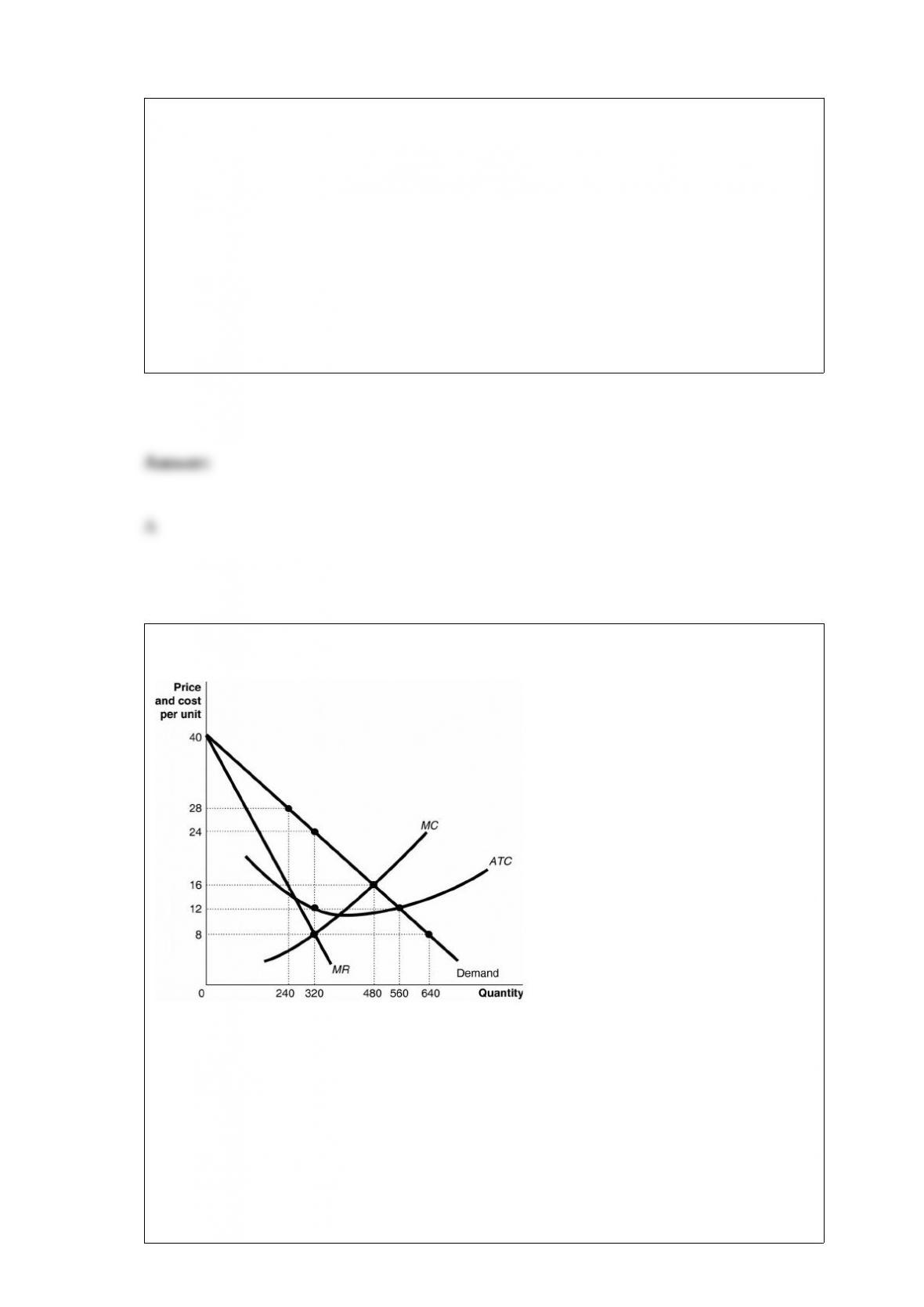
Figure 16-5
Suppose the firm represented in the diagram decides to use a two-part pricing strategy
such that it charges a fixed fee and a per-unit price equal to the competitive price. (This
is also called an optimal two-part tariff.) What is the per-unit price it should charge, if
any?
A) It should not charge a price per unit; just a flat fee to consume as much of the
product as desired.
B) It should charge a range of prices from $40 to $12.

C) $12
D) $16
If a consumer receives 20 units of utility from consuming two candy bars, and 25 units
of utility from consuming three candy bars, the marginal utility of the third candy bar is
A) 25 utility units.
B) 20 utility units.
C) 5 utility units.
D) unknown as more information is needed to determine the answer.
The rate at which a firm is able to substitute one input for another while keeping the
level of output constant is called the
A) opportunity cost of inputs.
B) marginal rate of technical substitution.
C) input trade-off rate.
D) isoquant substitution rate.

An office supply store sells a ream of printer paper at a fixed price of $4.50. Which of
the following is a term used by economists to describe the money received from the sale
of an additional ream of paper?
A) marginal revenue
B) gross earnings
C) pure profit
D) marginal costs
E) net benefit