
The protection of the earth’s ozone layer is an example of a public good.
If the opportunity cost of 1 wristwatch is 4 wall clocks in Japan and 2 wall clocks in
Germany, it makes sense for Japan to produce wristwatches.
If a person has a comparative advantage in some activity, she must have an absolute
advantage in that activity as well.
If a company’s total costs per day increase from $200 to $400 by adding another
worker, but its additional benefits are $300, it is sensible to add that additional worker.

Protection can give new industries a chance to get a foothold so that they can later
compete in the international market after they become more productive through
learning by doing.
Slope is calculated as a change in the variable on the horizontal axis divided by a
change in the variable on the vertical axis.
Economic analysis includes commuting time as part of the cost of traffic congestion.

Cartels are unstable and will tend to fall apart due to cheating on the agreement.
If marginal cost is below average cost, marginal cost must be rising.
If a person has an absolute advantage in some activity, she must have a comparative
advantage in that activity as well.
Economic costs include only the implicit costs to a firm.

The Clean Air Act of 1990 established a system of marketable pollution permits for
SO2.
The difference in price between hardback books and paperbacks is primarily explained
by differences in production costs.
The average-cost pricing policy provides a greater incentive for a regulated monopolist
to reduce its production cost.
According to one rule of thumb, a four-firm concentration ratio of greater than 40

percent for the industry is considered to be an oligopoly.
What matters to people is the face value of money or income.
Absolute advantage is when one producer has greater productivity compared to another
producing the same product.
Normative economics questions, “What ought to be?” Positive economics predicts the
consequences of alternative actions, answering the questions, “What is?” or “What will
be?”

According to studies, used pickup trucks less than 10 years old that are being sold are
less reliable than those not being sold.
The law of supply states that there is a positive relationship between price and quantity
supplied, ceteris paribus.
A network externality acts as a barrier to entry.

Jerry has a guitar that he is willing to sell for $150. If someone offers him $175, his
producer surplus is $25.
A public good is any good that is produced by the government.
If the slope of a demand curve is constant, then so is the elasticity on that demand
curve.
Recall the application of how the European Union has a cap-and-trade system for CO2
allowances. The demand of allowances is determined by different factors such as level
of economic activity, fuel prices, and the weather.

If a natural monopoly is allowed to choose the profit maximizing price it will most
likely be lower than if it is regulated.
A policy that establishes a maximum price decreases the quantity supplied or leaves it
unchanged, while a policy that establishes a minimum price increases the quantity
supplied or leaves it unchanged.
One of the key economic questions is “where should products be produced?”

According to the output effect, a decrease in the wage will decrease production costs, so
the price of final goods will decrease and the demand for labor will decrease.
Suppose that the market price of sugar is 25 cents per pound and a farmer’s marginal
cost of producing sugar is 28 cents per pound. The farmer should increase her sugar
production.
Recall the Application about how changes in supply affect the price of gasoline,
suppose that the price elasticity of demand for gasoline is 0.20 and the price elasticity
of supply for gasoline is 0.70. What will happen to the equilibrium price if the demand
goes down by 30%?
A) The equilibrium price will increase by 3%.
B) The equilibrium price will decrease by 3%.
C) The equilibrium price will increase by 33.33%.
D) The equilibrium price will decrease by.33.33%
Higher input prices in large firms might lead to:
A) horizontal marginal cost curves.
B) downward-sloping marginal cost curves.
C) downward-sloping long-run average cost curves.
D) upward-sloping long-run average cost curves.
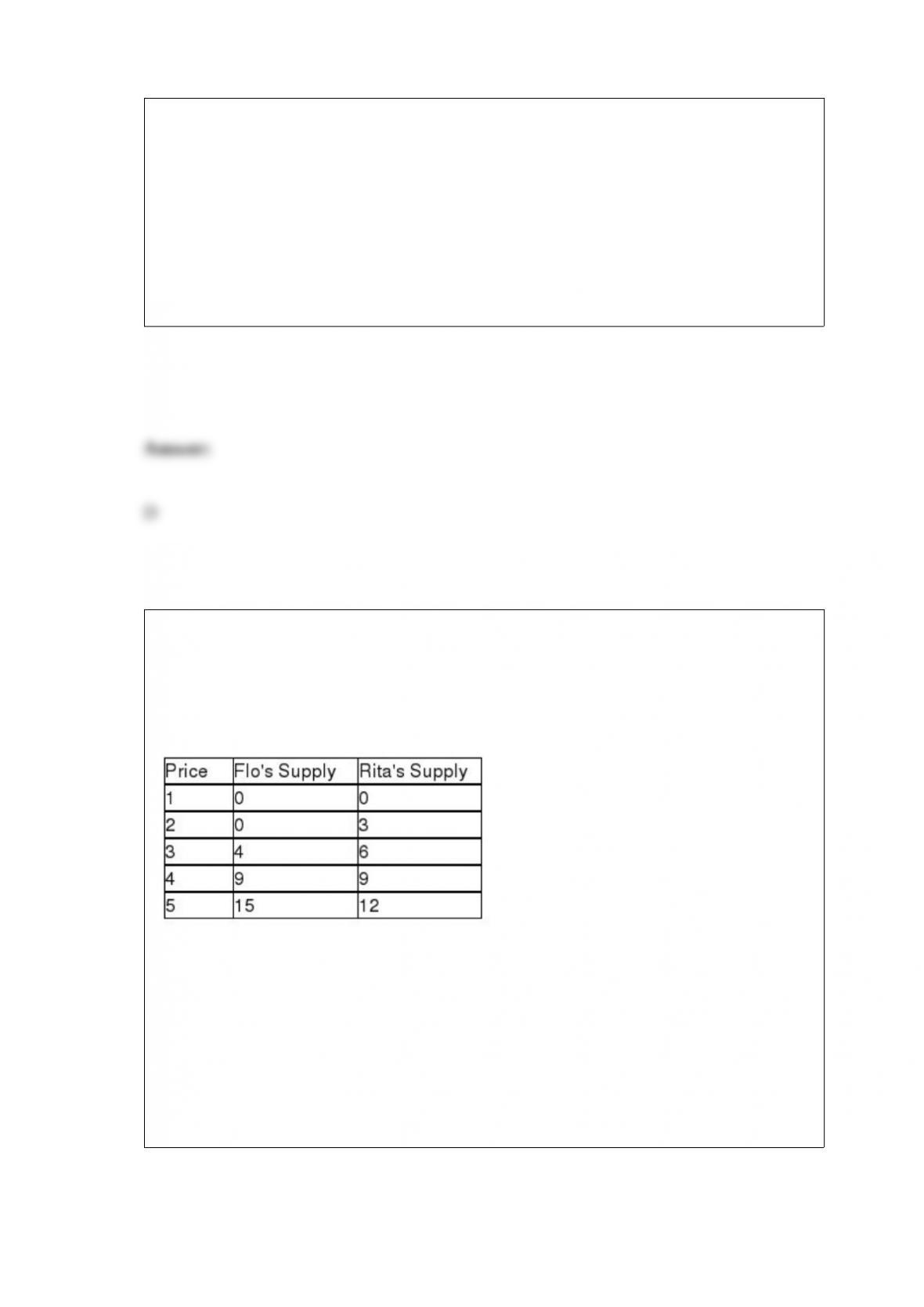
Refer to Table 4.1, which shows Flo’s and Rita’s individual supply schedules for frozen
latte-on-a-stick. Assuming Flo and Rita are the only suppliers in the market, what is the
market quantity supplied at a price of $2?
Quantity of Frozen Latte-On-A-Stick Supplied
Table 4.1
A) 0
B) 2
C) 3
D) 5

Recall the Application about the value of trees in residential neighborhoods to
answer the following question(s).
Recall the Application. The benefits from planting trees in residential neighborhoods,
including improved air quality and aesthetics, go to the property owner as well as the
neighbors. This implies that trees provide:
A) only private benefits.
B) only social benefits.
C) both private and social benefits.
D) only public benefits, but not private or social benefits.
The manager of HDG Computers reports that if output expands in the long run then
average costs will rise. This is an example of:
A) economies of scale.
B) diseconomies of scale.
C) minimum efficient scale
D) constant returns to scale.

If Maria spends a fixed dollar amount per week on movie rentals regardless of changes
in the price, Maria’s demand for movie rental can be considered:
A) elastic.
B) unit elastic.
C) inelastic.
D) There is no sufficient information to determine the price elasticity.
Labor costs account for approximately ________ of total production costs.
A) three-fourths
B) half
C) one-fourth
D) one-third

According to the Application, the number of men who accepted a particular loan offer
from the mass mailings ________ when the offer letter included the picture of a
________.
A) increased; man rather than the picture of a woman
B) increased; woman rather than the picture of a man
C) decreased; either a man or a woman
D) was unaffected; either a man or a woman
Suppose Jackie can buy either video games or DVDs. If the prices of both goods
double, and Jackie’s income also doubles, what will happen to Jackie’s budget line?
A) It will shift out.
B) It will shift in.
C) It will not change.
D) It will swivel so that the slope is twice as steep.
In the final two decades of the twentieth century, average per capita global income:
A) increased by approximately 35 percent.

B) remained relatively unchanged.
C) decreased by approximately 6 percent.
D) increased by more than 75 percent.
The individual supply curve for labor is the relationship between the wage and the
quantity of labor that:
A) all workers are willing to provide.
B) any given worker is willing to provide.
C) all firms are willing to employ.
D) any given firm is willing to employ.
How can governments intervene in trade?
A) by producing cheaper products
B) by helping reduce economic uncertainty
C) by not buying products from competing countries
D) all of the above

The free-rider problem implies that:
A) each person will pay the full cost of the public good.
B) nobody wants the public good.
C) everybody will pay a portion of the cost of the public good.
D) each person will try to benefit from the public good without paying for it.
Which of the following is true if a firm has indivisible inputs?
A) The long-run average cost curve is downward sloping at lower levels of output.
B) The long-run fixed cost curve is downward sloping at lower levels of output.
C) The long-run total cost curve is downward sloping at lower levels of output.
D) The long-run marginal cost curve is downward sloping at lower levels of output.

A command-and-control policy is one in which:
A) the government commands each firm to produce no more than a certain level of
pollution.
B) the government controls the firm’s advertising policy.
C) the government forces the firm to use particular pollution-control technologies.
D) Both A and C are correct answers.
An insecure monopolist can:
A) always deter entry by lowering the price of output.
B) deter entry in the short run but not the long run.
C) deter entry in the long run but not the short run.
D) deter entry if the minimum entry quantity is relatively large.
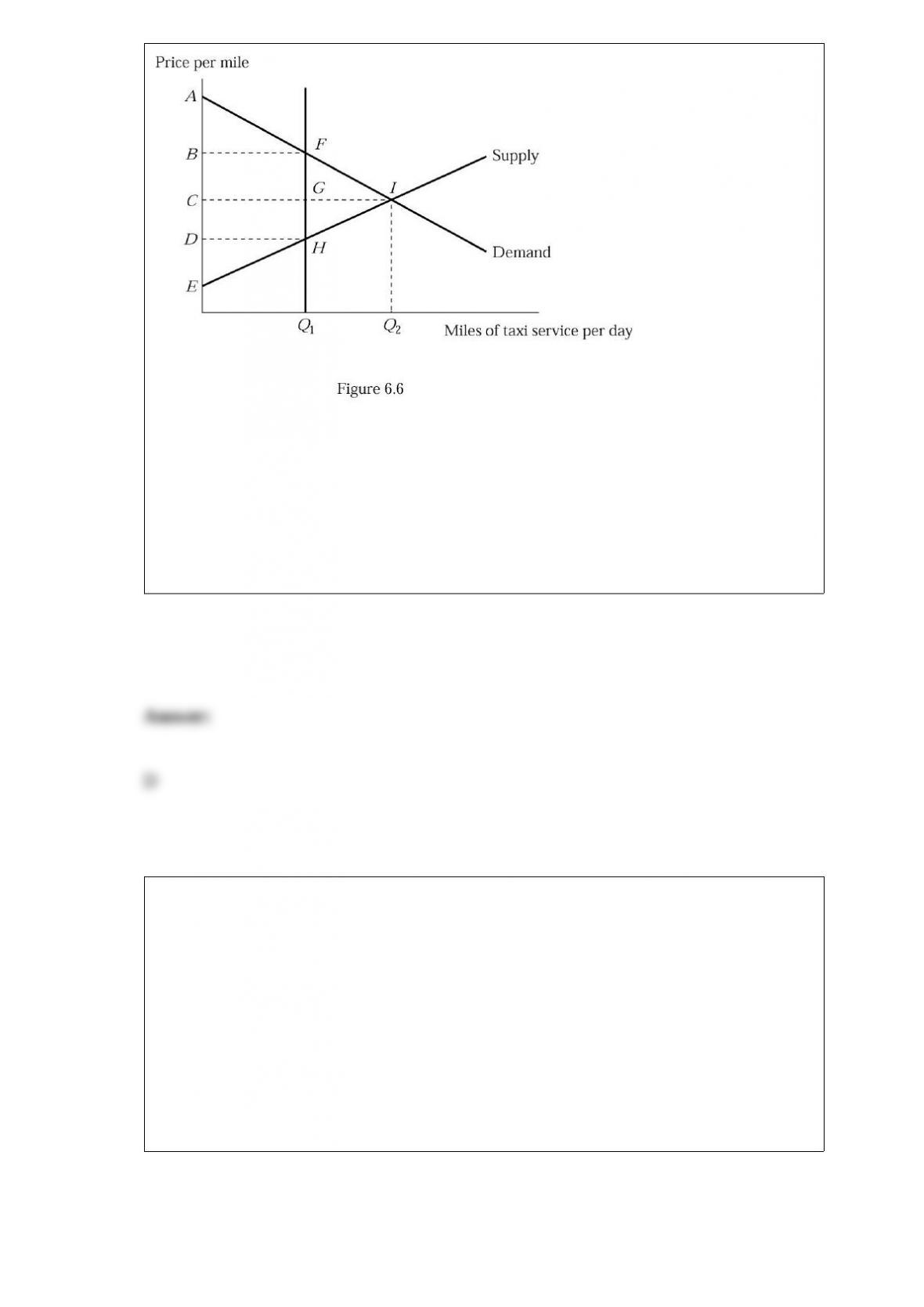
Refer to Figure 6.6, which shows a market for taxi medallions. If the number of
medallions is reduced from to , the producer surplus is represented by:
A) area ABF.
B) area ACFG.
C) area DEH.
D) area BEFH.
A firm scaled down its operation by reducing all inputs by 50% and experienced a
more-than-50% decrease in output. If all input prices remain unchanged, the firm’s
long-run average cost exhibits:
A) economies of scale at the current output level.
B) diseconomies of scale at the current output level.
C) a constant long-run average cost at the current output level.
D) diminishing marginal returns at the current output level.

Which of the following situations is most likely to generate the largest output effect
from a decrease in the price of one of a firm’s inputs?
A) The demand for a firm’s product is inelastic.
B) The demand for a firm’s product is elastic.
C) The inputs used in production are highly substitutable.
D) The inputs used in production are highly complementary.
An example of a good that is rival in consumption is:
A) flowers planted on the side of the highway.
B) a floral display at a large university’s graduation ceremony.
C) a scientific discovery that allows florists to grow flowers to which no one is allergic.
D) none of the above
A supply curve is defined as the relationship between:
A) the price of a good and the quantity that consumers are willing to buy.
B) the price of a good and the quantity that producers are willing to sell.
C) the income of consumers and the quantity of a product that consumers are willing to
buy.
D) the income of consumers and the quantity of a product that producers are willing to
sell.
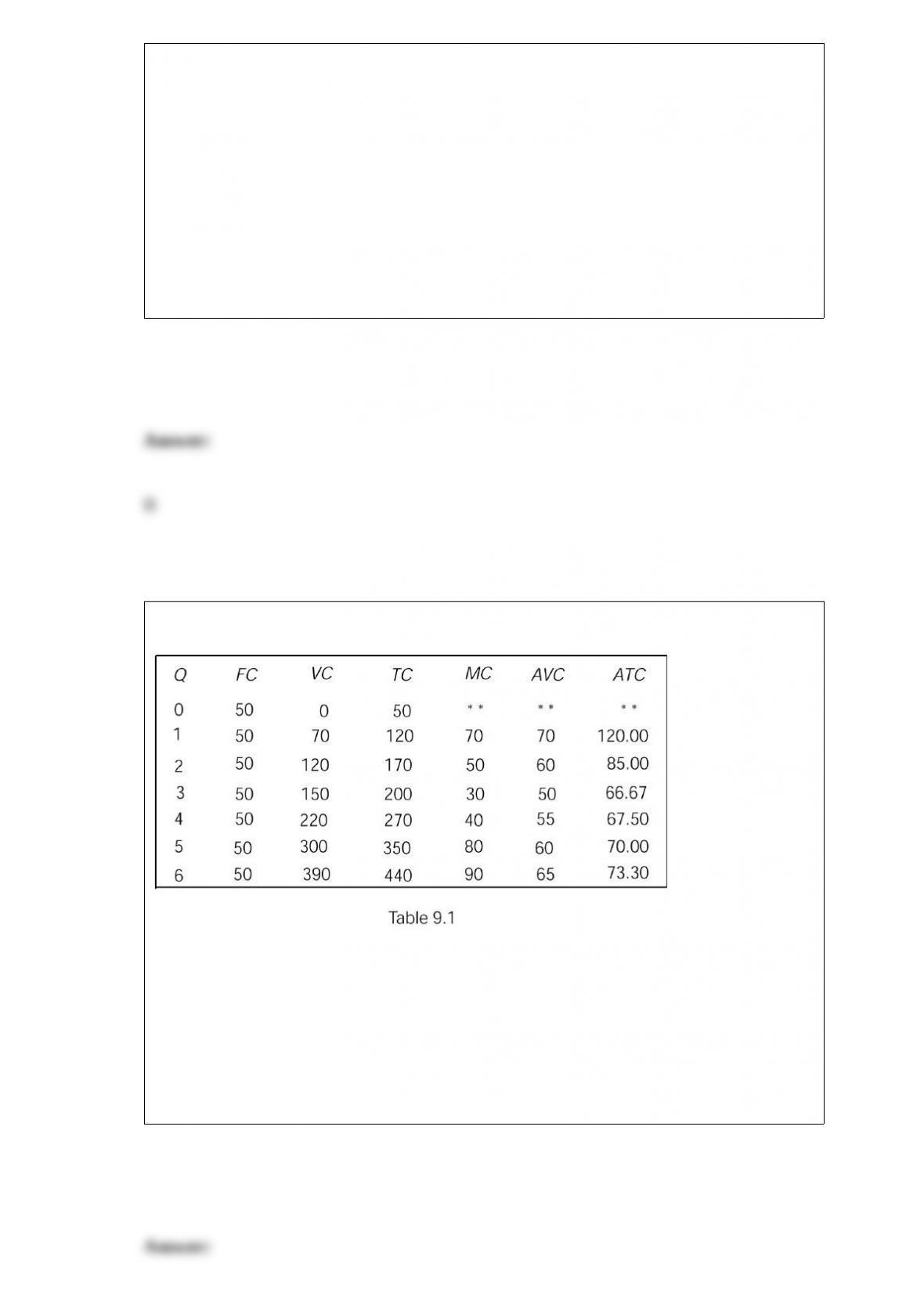
Refer to Table 9.1. The shutdown point for this firm is a price of:
A) $50.
B) $60.
C) $55.
D) $65.

If the first copy cost of a music video is $223,000 and the marginal cost is $0, then as
the firm produces an infinite quantity of the video, the average total cost of producing
the video will approach:
A) zero.
B) $1.00.
C) $2,230.
D) $1 million.
Under current WTO rules, a country can adopt:
A) any environmental standard it chooses, even if it discriminates against foreign
producers.
B) any environmental standard it chooses as long as it does not discriminate against
foreign producers.
C) only WTO-approved environmental standards.
D) only the same environmental standards as its immediate geographic neighbors.
Recall the application about the short-run and long-run elasticity of supply of milk. If
the price of milk increases by 20%, in the short run the quantity of milk supplied will
increase by only 2% and in the long run it will increase by 50 %. Why is supply more
price-elastic in the long run?
A) Dairy farmers can expand existing facilities and build new ones, so farmers are more
less responsive to a higher price.
B) Dairy farmers can expand existing facilities and build new ones, so farmers are more
responsive to a higher price.
C) Dairy farmers can squeeze just a little more output from their existing production
facilities.
D) none of the above
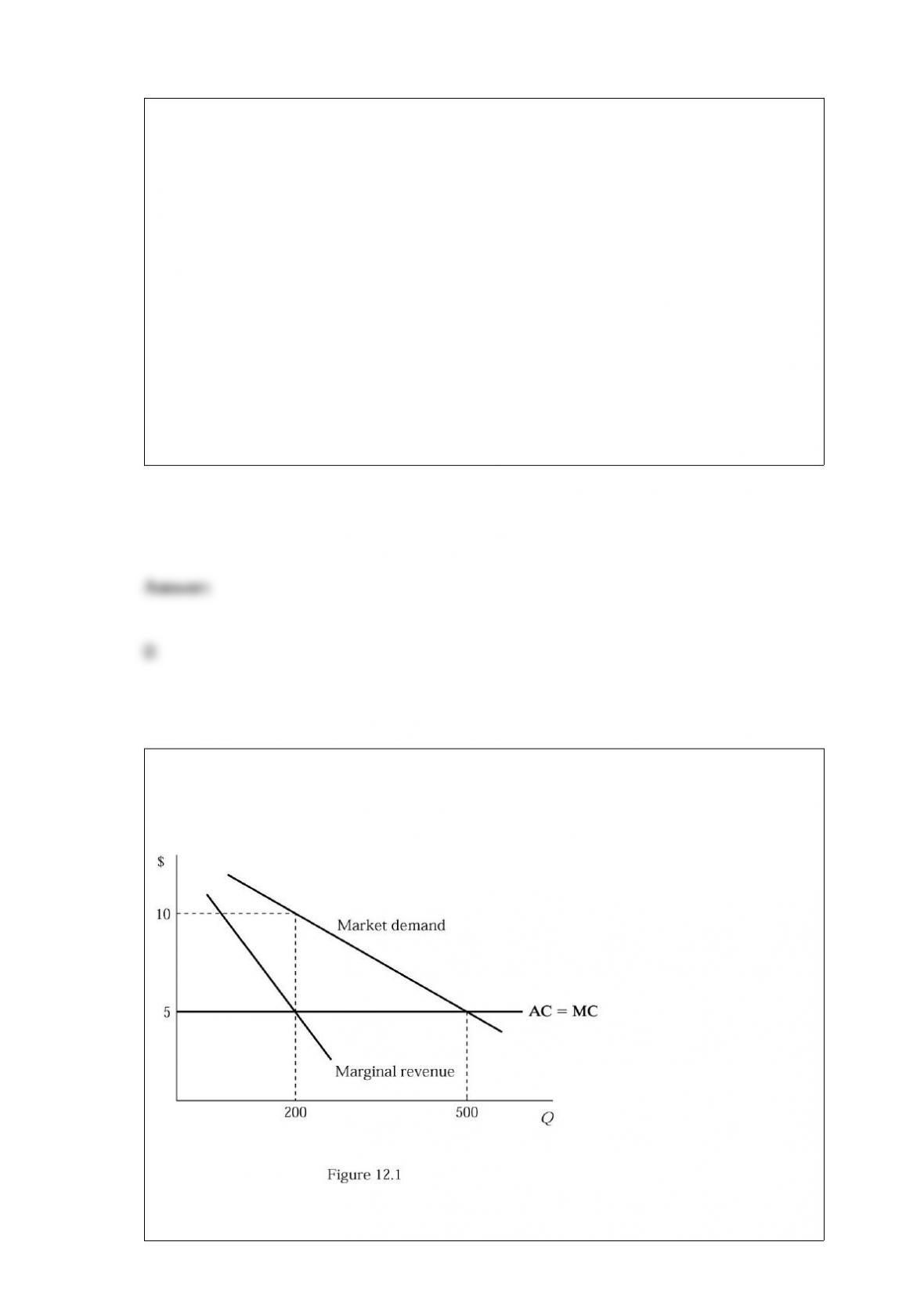
Figure 12.1 shows a successful price-fixing arrangement (cartel) between two identical
firms. If the cartel collapses and the two firms compete against each other, the price will
be ________ and the quantity will be ________.
A) higher; greater

B) higher; smaller
C) lower; greater
D) lower; smaller
Suppose that the price elasticity of supply is 1.25 and the quantity supplied increases by
10%. Other things being equal, the percentage change in the price should be:
A) a 0.8% increase in the price.
B) an 8% increase in the price.
C) a 1.25% increase in the price.
D) a 12.5% increase in the price.
Because resources are limited:
A) only the very wealthy can get everything they want.
B) firms will be forced out of business.
C) the availability of goods will be limited but the availability of services will not.
D) people must make choices.

Given their skills and education, steelworkers earn higher incomes than they would in
other occupations. This is partly because:
A) steel workers face the higher risk of getting injured or killed.
B) it is costly to acquire skills necessary for jobs at steel mills.
C) few people have skills and knowledge required for jobs at steel mils.
D) all of the above
Firms in a trust:
A) act as a single firm.
B) act in their own self-interests.
C) trust each other.
D) do not allow a small number of trustees to make decisions for participating firms.

A market failure could be caused by:
A) imperfect production.
B) many firms competing against each other for customers.
C) profit.
D) imperfect competition.
The ability of one person or nation to produce a good at a lower absolute cost than
another is called a(n):
A) market advantage.
B) comparative advantage.
C) absolute advantage.
D) specialization advantage.
Table 15.3 shows the preferred budget for a new performance center and the number of
voters in a community who prefer that budget. If Dawn proposed $6 million while Terry
proposed $9 million, whose budget will be selected if everyone votes?
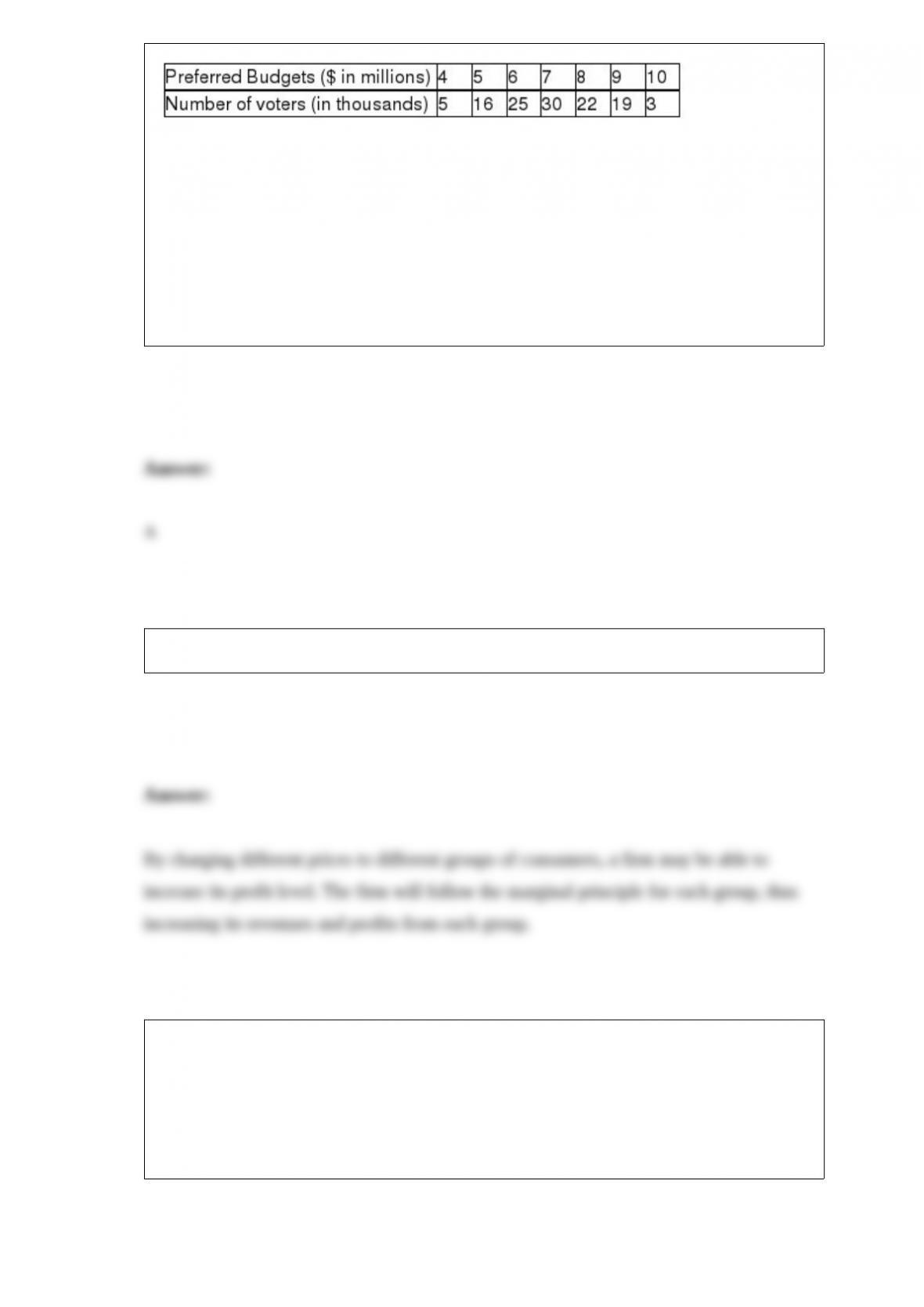
Table 15.3
A) Dawn’s
B) Terry’s
C) It is a tie.
D) The outcome cannot be predicted.
Explain why a firm may choose to price discriminate.
Recall the Application about the manufacture of fake killer whales used to scare
sea lions off the Washington coast to answer the following question(s).
Recall the Application. What is the indivisible input and what are its implications for
economies or diseconomies of scale?
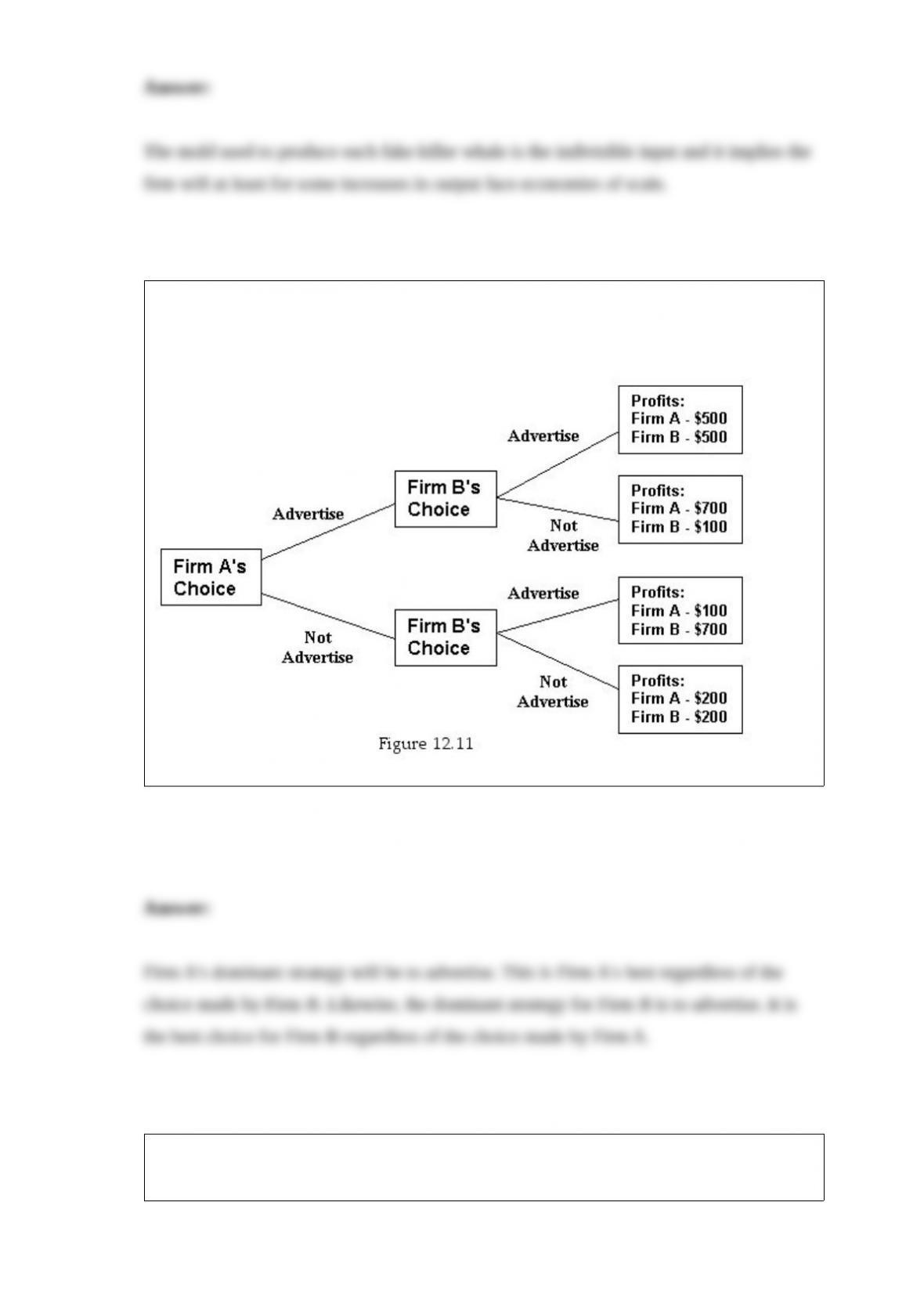
Refer to Figure 12.11. What is Firm A’s dominant strategy? What is Firm B’s dominant
strategy? Explain.
Describe the changes in the variables that will cause supply for a product to decrease,
shifting the supply curve up and to the left.
When is it a good decision to hire a celebrity endorser of your product?
Explain why women, on average, earn less than men in the United States.
A surplus occurs when producers are willing to sell more than consumers are willing to
buy. This is called an ________.
What is a cartel?
List three alternative ways in which the government can correct for pollution generated
by a firm.
What entices a second firm to enter a market that was previously a single price
monopoly?
If the price elasticity of supply is .5, then a 10% increase in price will result in how
much of a percentage change in quantity supplied? Will quantity supplied increase or
decrease?
Should a monopolist charge the highest price for its good that anyone in the market will
pay?
Billy’s income elasticity of demand for ground beef is -0.5 and his income elasticity of
demand for pork chops is 1.2. Is ground beef a normal or inferior good? Explain. What
about pork chops?
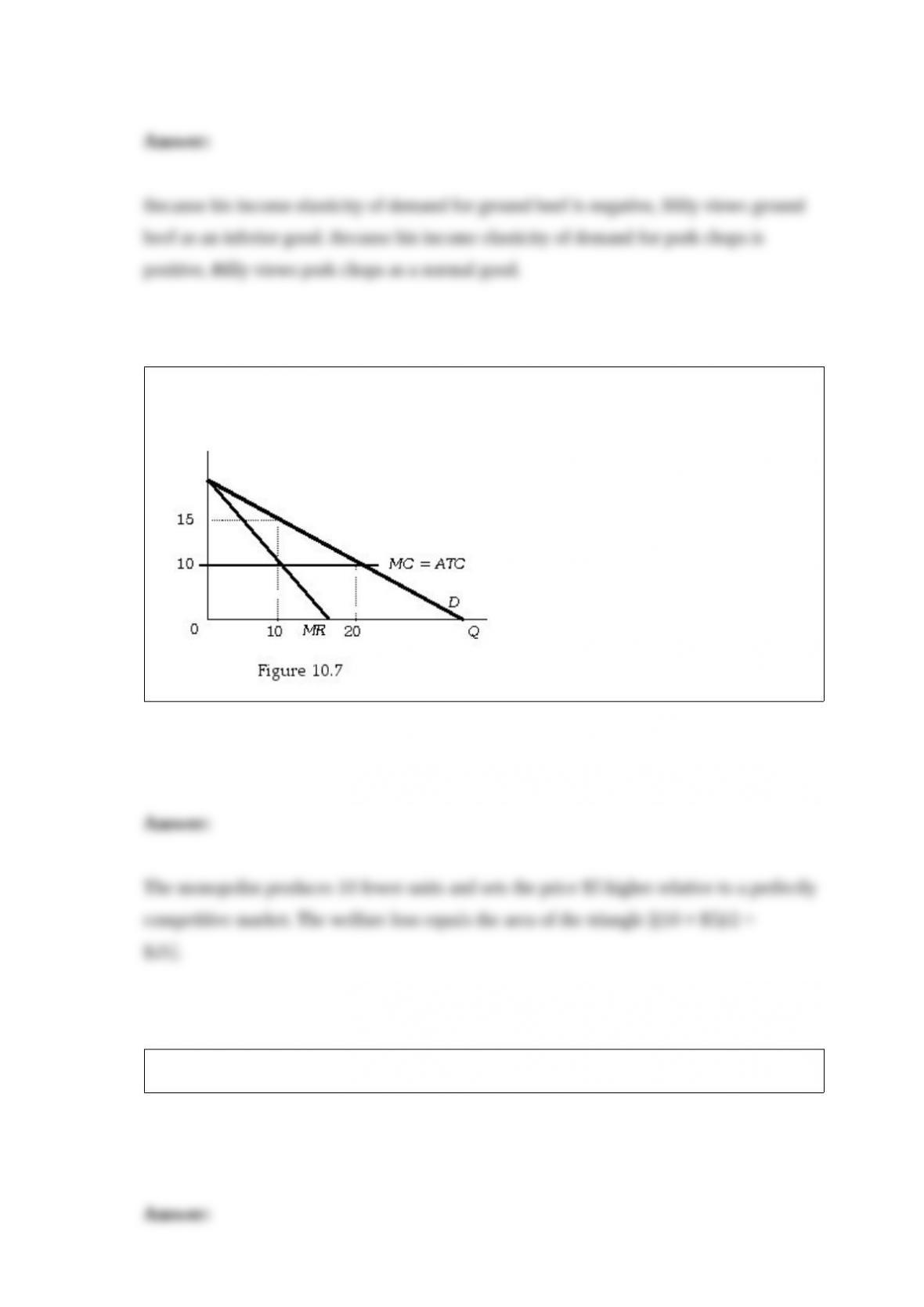
Figure 10.7 shows the demand and cost conditions for a monopolist. How large is the
deadweight loss due to monopoly?
How might other firms in an oligopoly interpret your drop in price?
Why does wind power have economies of scale?
Suppose that you currently work 20 hours a week at $10 per hour and your employer
tells you he must reduce your wage to $8 per hour. Using the concept of income and
substitution effects, explain how you might react.
The price of a new smartphone falls from $500 to $450. The quantity of smartphones
demanded rises from 1500,00 per year to 200,000 per year. Use the midpoint formula to
calculate the price elasticity of demand for new smartphones. Is the demand elastic,
inelastic, or unit elastic?
What are the sources of external costs from automobiles?
What happens to total revenue associated with a linear demand curve as price falls?