
1) in 2006, some 45 million americans did not have health insurance.
2) The demand for labor is a derived demand whereas the demand for capital is not.
3) macroeconomics explains the behavior of individual households and business firms;
microeconomics is concerned with the behavior of aggregates or the economy as a
whole.
4) Innovation is the first discovery of a new product or production process; invention is
the first successful commercial introduction of the product or process.
5) The economic benefits of forests include provision of wildlife habitats, erosion
prevention, and oxygen production.
6) Granting property rights to forest land tends to increase the rate at which the land is
deforested.
7) in a competitive market the equilibrium price and quantity occur where:
a.the downsloping demand curve intersects the upsloping supply curve.
b.the upsloping demand curve intersects the downsloping supply curve.
c.consumers and suppliers bargain to a mutually acceptable price.
d.quantity demanded exceeds quantity supplied or vice versa.
8) Examples of low-income developing countries are:
A.Switzerland, New Zealand, and Australia.
B.Germany, Austria, and Italy.
C.Sudan, Bangladesh, and Ethiopia.
D.Mexico, South Korea, and Brazil.
9) Which item below will affect the U.S. balance on goods and services, but not affect
its balance of trade in goods?
A.an increase in U.S. goods exports
B.a decrease in U.S. exports of services
C.an increase in foreign purchases of U.S. assets
D.an increase in net transfers
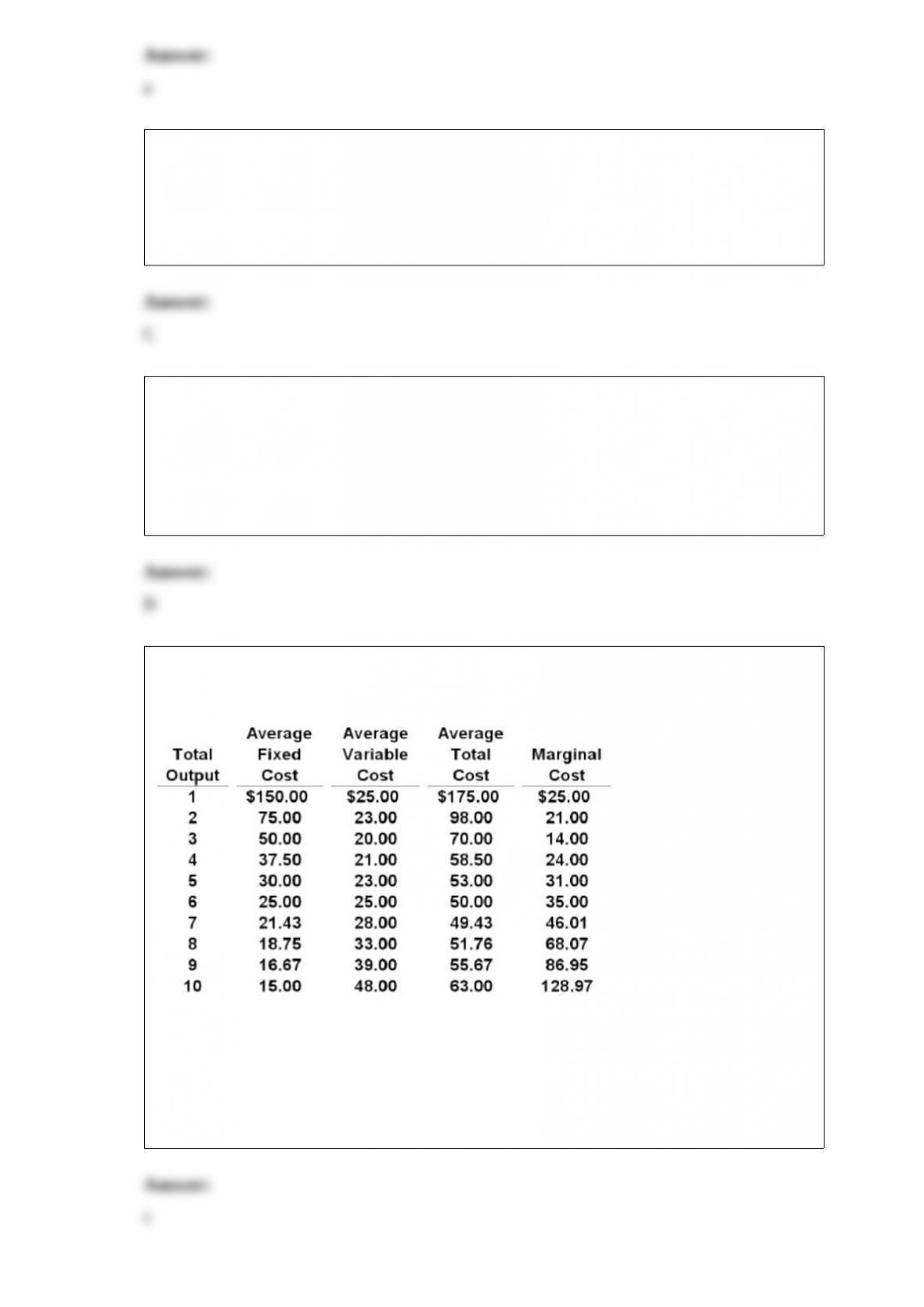
10) the following cost data for a firm that is selling in a purely competitive market.
refer to the above data. if the market price for this firm’s product is $86.95, it will
produce:
a.9 units at an economic profit of zero.
b.6 units at a loss of $90.
c.9 units at an economic profit of $281.52.
d.8 units at an economic profit of $130.48.

11) A rightward shift of the traditional Phillips Curve would suggest that:
A.the productivity of labor increased.
B.the rate of inflation is now higher at each rate of unemployment.
C.cost-push inflation decreased.
D.the rate of inflation is now lower at each rate of unemployment.
12) A conglomerate merger:
A.can extend the line of products sold, extend the territories in which products are sold,
or combine totally unrelated products.
B.is defined as a merger involving two firms that previously had a buyer-seller
relationship.
C.is defined as a merger involving two firms producing the same or similar products
and selling them in the same geographical market.
D.is illegal, per se.
13) Measured in terms of farm employment and the number of farms, agriculture has
been:
A.a declining industry.
B.an expanding industry.
C.a stable industry.
D.a volatile industry.
14) The U.S. Justice Department would most likely block a merger between:
A.Walt Disney and Coca Cola.
B.Sony and Home Depot.
C.Wal-Mart and Subway Sandwiches.
D.Boeing and Airbus.
15) A shortcoming of the aggregate expenditures model is that it does not:
A.account for cost-push inflation.
B.explain how demand-pull inflation can arise.
C.explain how cyclical unemployment can arise.
D.detail the components of aggregate spending.
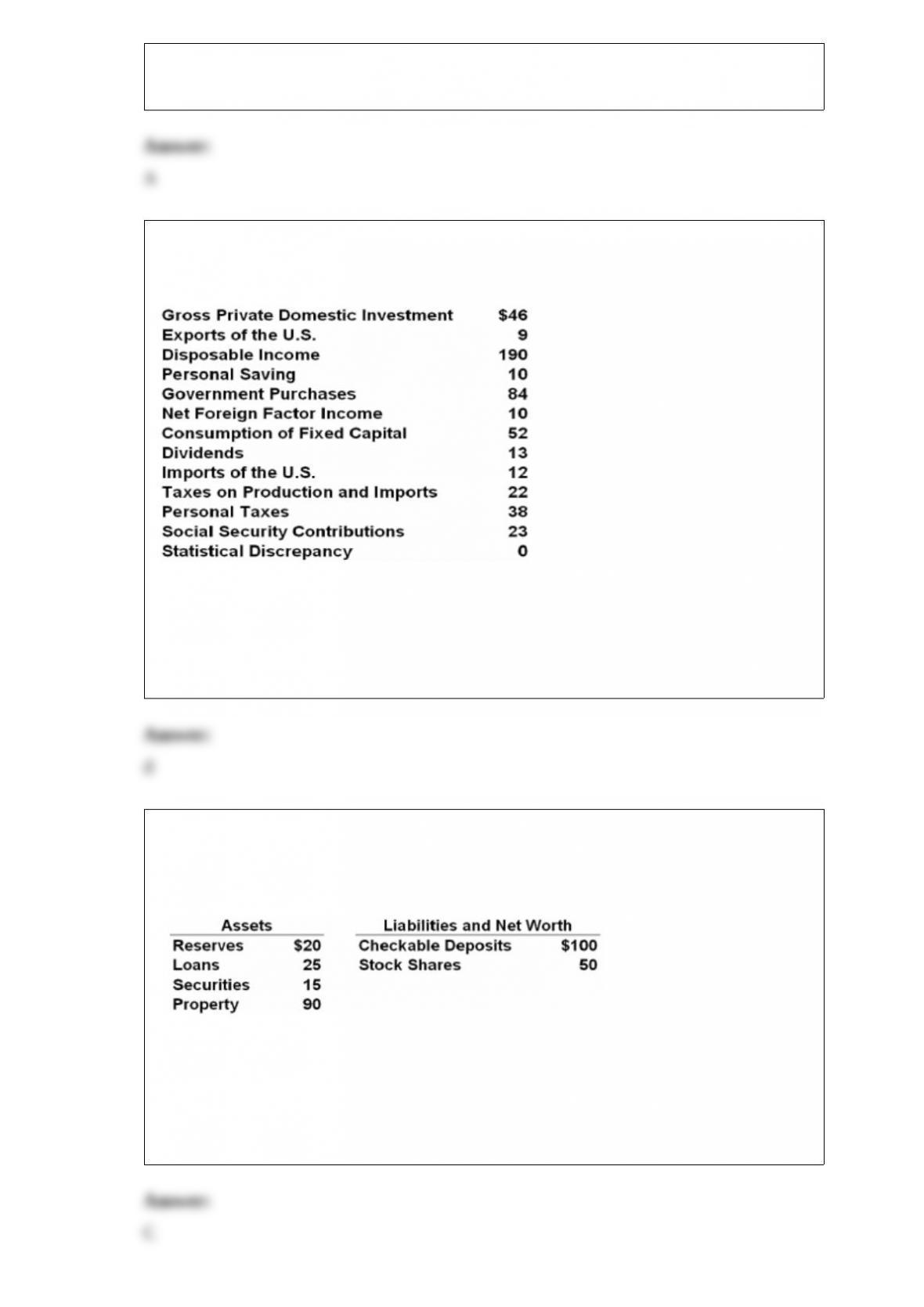
16) answer the next question(s) on the basis of the following data. all figures are in
billions of dollars.
refer to the above data. personal income is:
a.$184.
b.$221.
c.$149.
d.$228.
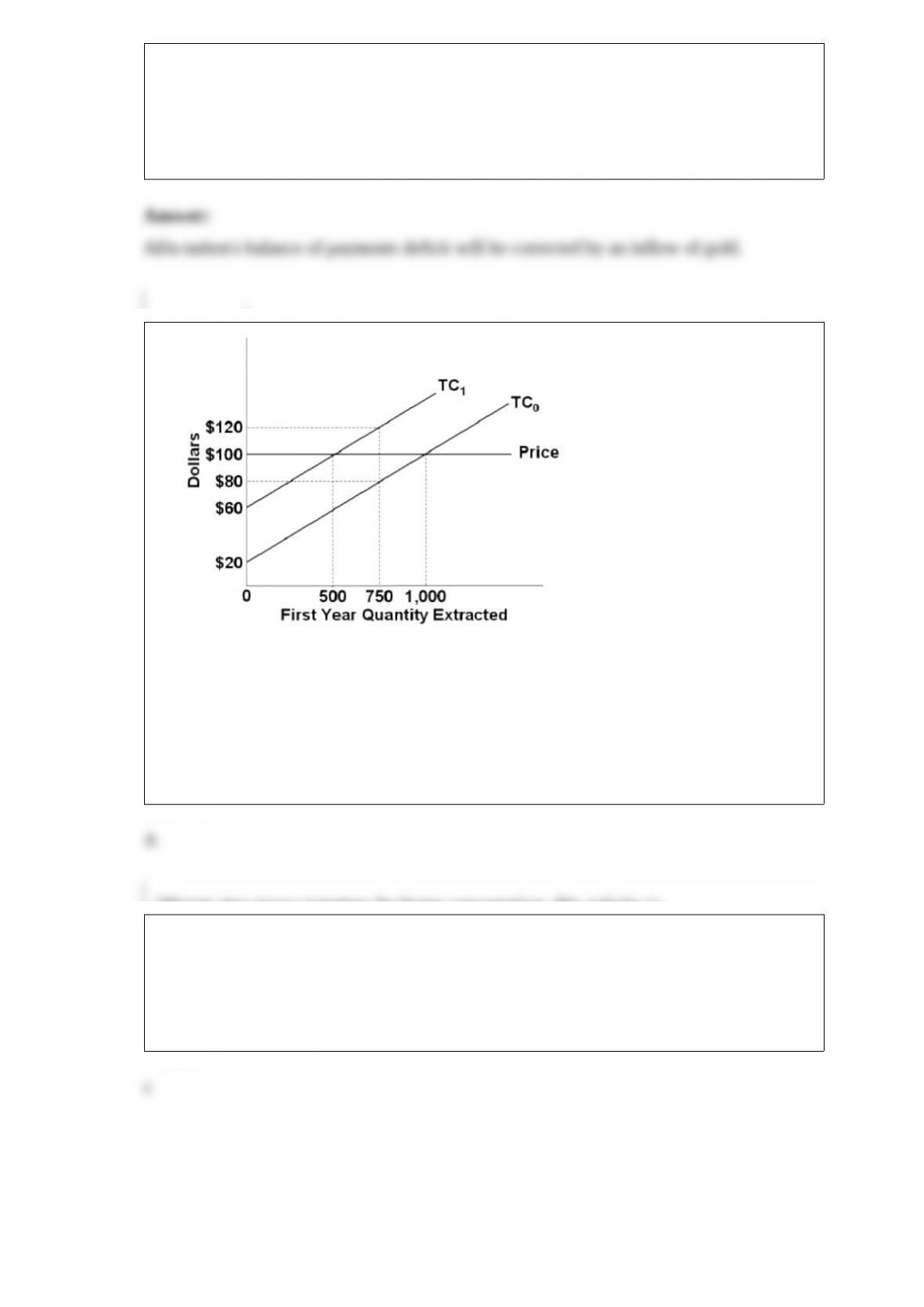
17) The following balance sheet for the First National Bank of Bunco. All figures are in
millions.
Refer to the above data. If this bank has excess reserves of $6 million, the legal reserve
ratio must be:
A.10 percent.
B.12 percent.
C.14 percent.
D.20 percent.
18) Under an international gold standard:
A.a nation’s exchange rate is virtually fixed.
B.domestic output and the price level will fall in those nations receiving international
gold flows.
C.a nation’s balance of payments surplus will be corrected by an outflow of gold.
19)
Refer to the diagram above, assuming that the firm represented is operating on curve
TC1. If the current price of the resource rises by $20, the optimal quantity extracted in
the first year will:
A.increase by 250
B.increase by 500
C.decline by 250
D.remain unchanged
20) tom atoe grows tomatoes for home consumption. this activity is:
a.excluded from gdp in order to avoid double counting.
b.excluded from gdp because an intermediate good is involved.
c.productive but is excluded from gdp because no market transaction occurs.
d.included in gdp because it reflects production.
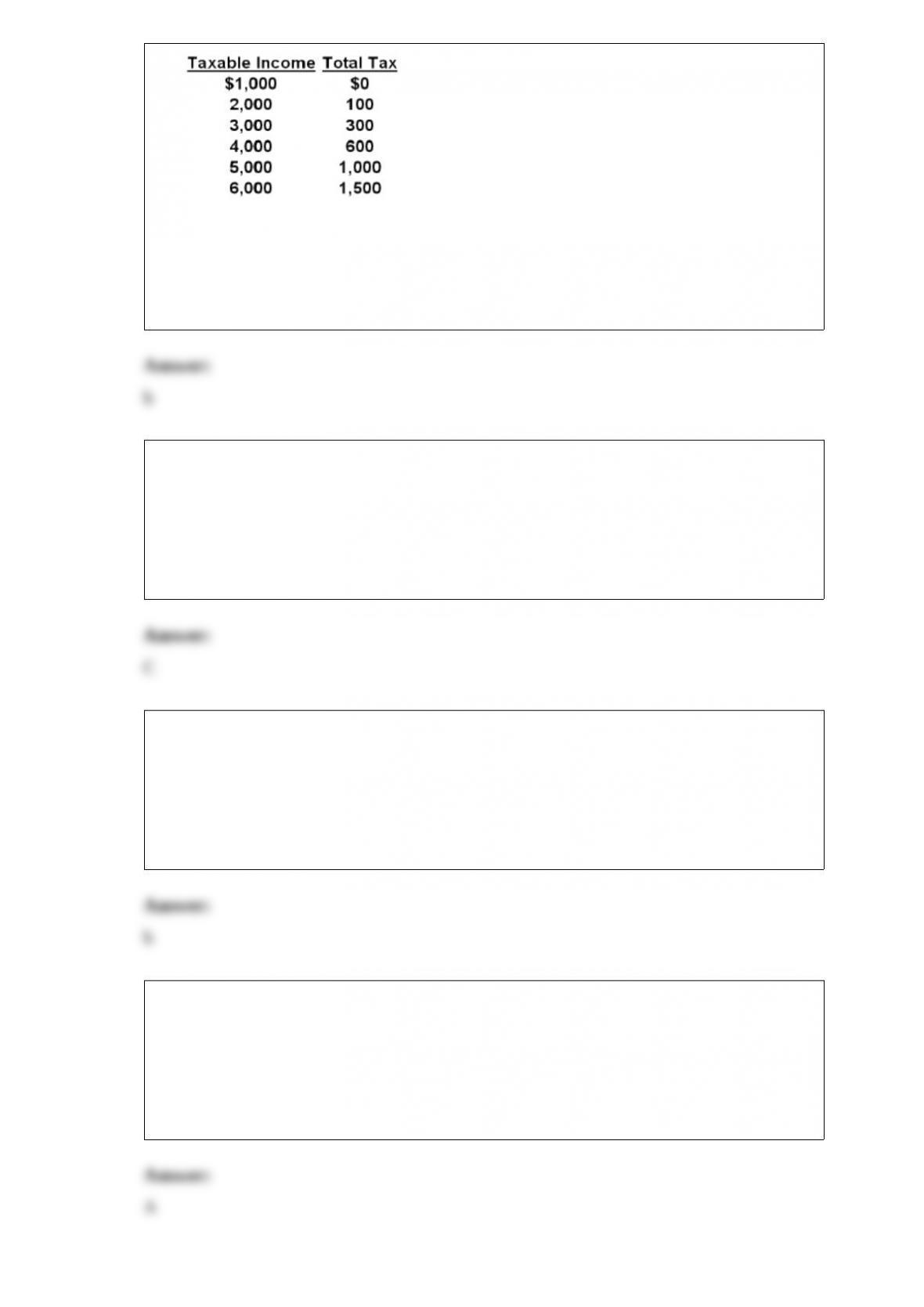
21)
refer to the above data. if your taxable income is $4000, your average tax rate will be:
a.20 percent.
b.15 percent.
c.10 percent.
d.5 percent.
22) In which of the following pairs of antitrust cases did the firms prevail against the
antitrust charges leveled against them?
A.the Alcoa case and the Microsoft case
B.the U.S. Steel case and the Alcoa case
C.the DuPont cellophane case and the U.S. Steel Case
D.the U.S. Steel case and the Microsoft Case
23) economics may best be defined as the:
a.interaction between macro and micro considerations.
b.social science concerned with how individuals, institutions, and society make optimal
choices under conditions of scarcity.
c.empirical testing of value judgments through the use of logic.
d.use of policy to refute facts and hypotheses.
24) Senator A agrees to vote for Senator K’s state project in exchange for Senator K
voting for Senator A’s state project. This is an example of:
A.logrolling.
B.the paradox of voting.
C.the principal-agent problem.
D.the median voter model.
25) if the price elasticity of demand for a product is unity, a decrease in price will:
a.have no effect upon the amount purchased.
b.increase the quantity demanded and increase total revenue.
c.increase the quantity demanded, but decrease total revenue.
d.increase the quantity demanded, but total revenue will be unchanged.
26) How are technological advance and capital formation related?
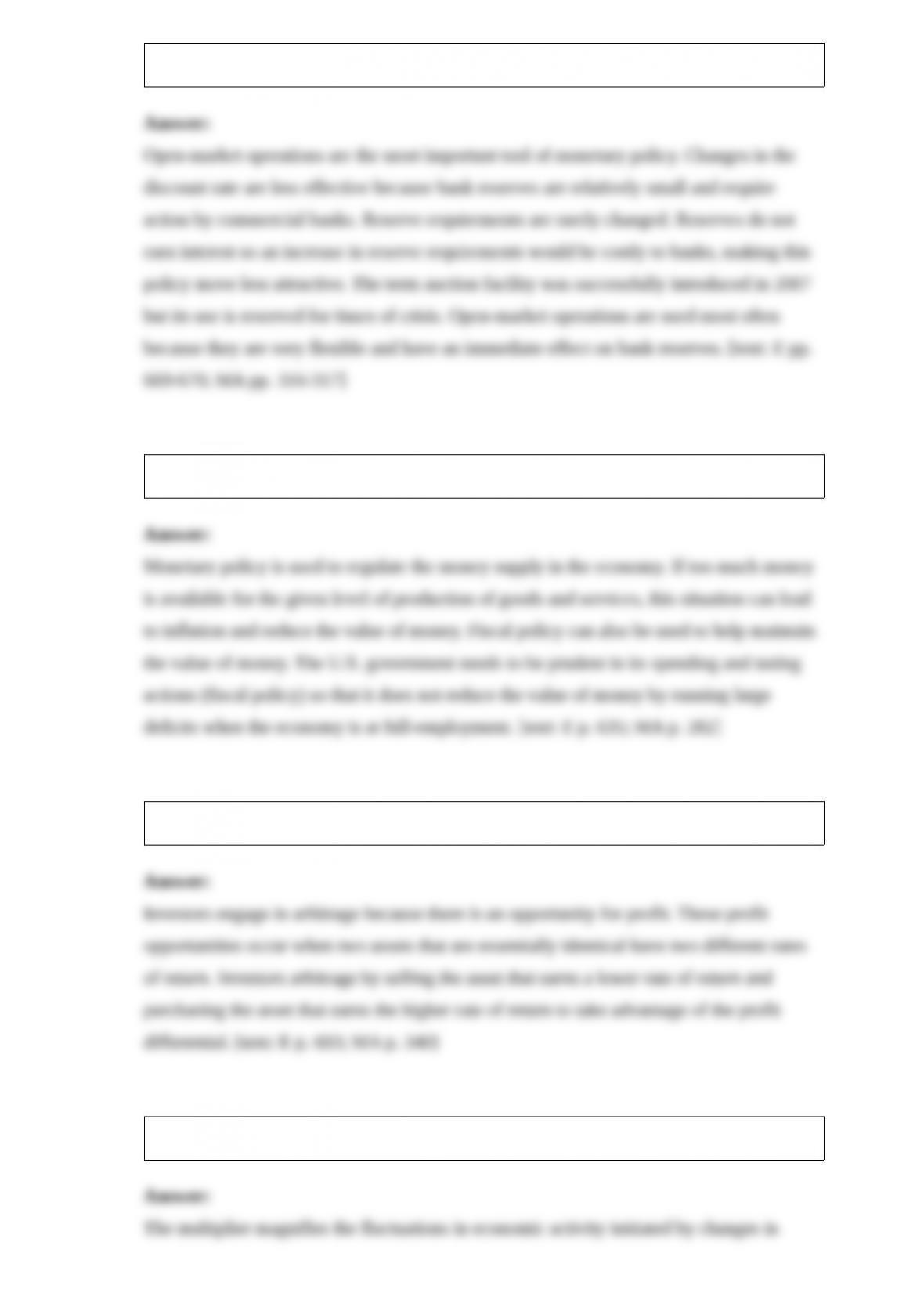
27) Assume the following information is relevant for an advanced economy over a
three-year period. Describe in detail the macroeconomic situation faced by this society.
Is cost-push inflation evident? What corrective policies would you recommend and
why?
28) Which tool of monetary policy is most important? Why?
29) Explain what policies are used to stabilize the value of money.
30) Why do investors engage in arbitrage?
31) Explain the economic impact of an increase in the multiplier.
32) What are the three basic criticisms of foreign aid to DVCs?
33) Describe the two extreme views on illegal immigration and their employment
effects. Why are these two views misleading?
34) Explain and evaluate this statement: Because there is no sure definition of the limits
to progression, no firm basis of its reasonable use, and no protection against its
unconscionable abuse, those who uphold the system as a revenue device are playing
into the hands of the group that would use progressive taxation as the means of
destroying private capitalism and ushering in the collectivist state.
35) Identify at least two non-economic reasons used by critics to support their concerns
about illegal immigration.