
The endowment effect is the tendency of people to be unwilling to sell a good they
already own even if they are offered a price greater than they would be willing to pay to
buy the good if they did not already own it.
When a monopolistically competitive firm cuts its price to increase its sales, it
experiences a loss in revenue due to the income effect and a gain in revenue due to the
substitution effect.
Members of management serving on the board of directors of a corporation are referred
to as outside directors.
Most U.S. currency held outside the U.S. banking system is held by foreigners.

If the price of peaches, a substitute for plums, decreases the demand for plums will
increase.
Peanut butter and jelly are complements. If the price of peanut butter increases, the
demand for jelly will increase.
If a country has an absolute advantage in producing a product, it may not have a
comparative advantage in producing that product.
If the demand curve for a product shifts to the left and the supply curve for the product
shifts to the left, the equilibrium quantity will decrease.
Olive oil producers want to sell more olive oil at a higher price. Which of the following
events would have this effect?
A) an increase in the price of olive oil presses
B) a decrease in the cost of transporting olive oil to markets
C) an increase in the price of land used to plant olives
D) Research finds that consumption of olive oil reduces the risk of heart disease.
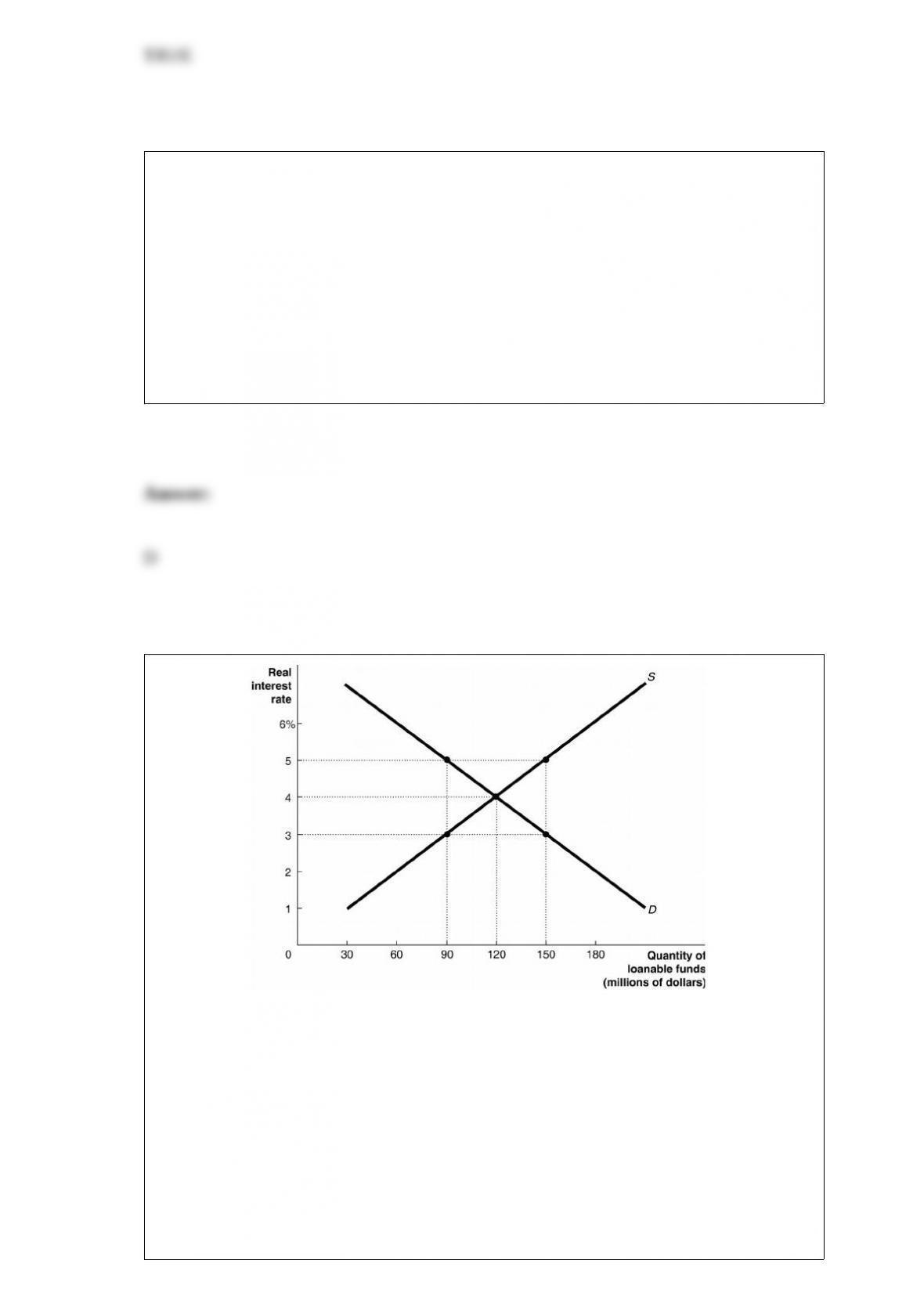
Figure 21-6
The loanable funds market is in equilibrium, as shown in the figure above. As a result
of an increase in the government budget deficit, the ________ for loanable funds will
________, thereby ________ the equilibrium real interest rate and ________ the
equilibrium quantity of loanable funds.
A) demand; rise; increasing; decreasing
B) supply; rise; decreasing; increasing
C) demand; fall; decreasing; decreasing
D) supply; fall; increasing; decreasing
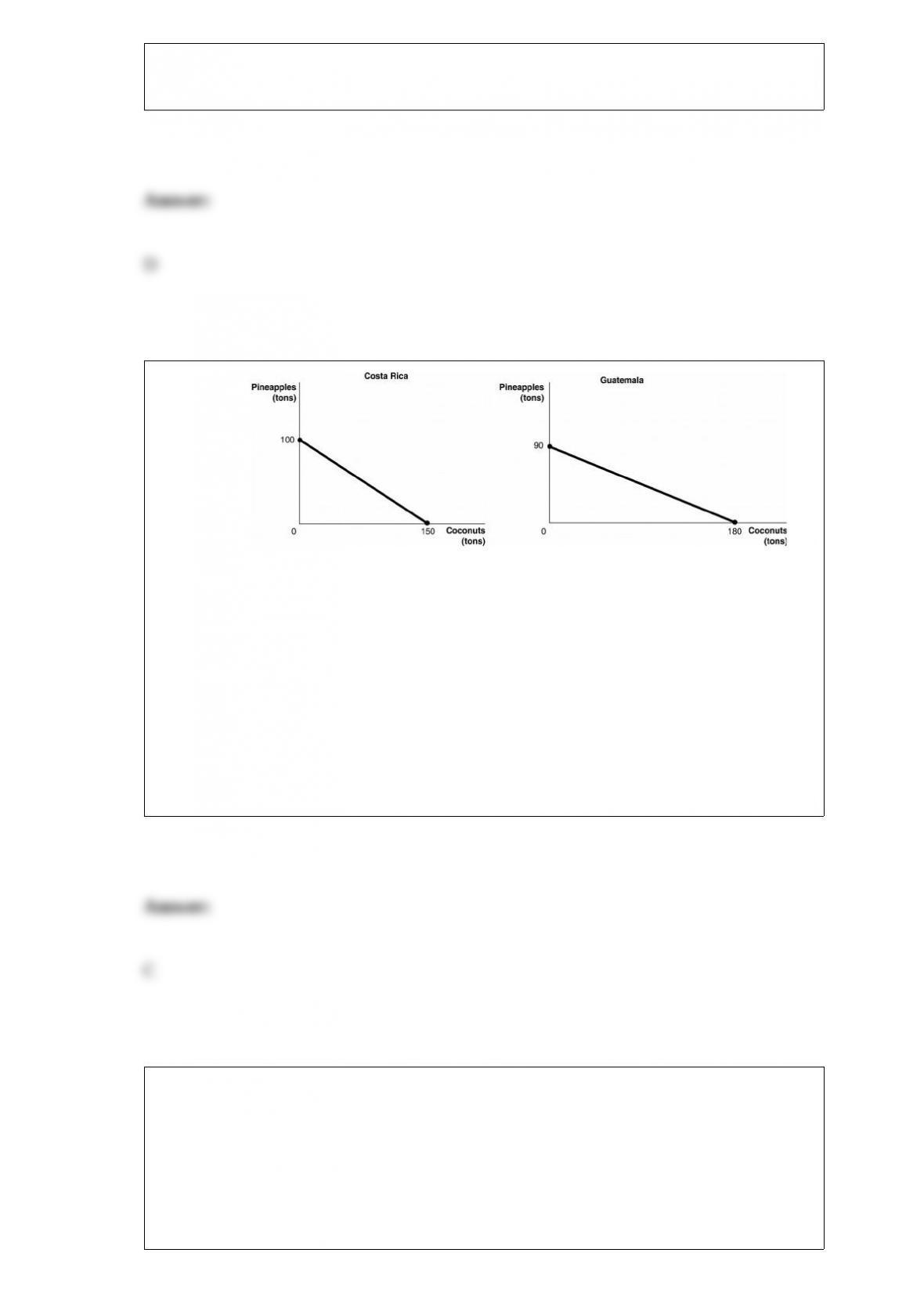
Figure 2-14
Figure 2-14 shows the production possibilities frontiers for Costa Rica and Guatemala.
Each country produces two goods, pineapples and coconuts. Which country has a
comparative advantage in the production of pineapples?
A) Guatemala
B) They have equal productive abilities.
C) Costa Rica
D) neither country
Demand in factor markets differs from demand in product markets in that
A) the demand for a factor of production is difficult to determine.
B) the demand for a factor of production is influenced by workers’ productivity and by
the producers’ expected sales revenues, not by tastes and preferences of consumers.

C) demand for a factor of production is based on the tastes and preferences of firms.
D) demand for a factor of production is based on the tastes and preferences of resource
owners.
An example of an intermediate good would be
A) the bread that goes into a sub sandwich that is sold by Quiznos.
B) the soda pop sold by Quiznos.
C) a sub sandwich sold by Quiznos.
D) the potato chips sold by Quiznos.
Following a decrease in government spending, as the price level falls we would expect
the level of interest rates to ________ and investment to ________.
A) decrease; decrease
B) decrease; increase
C) increase; decrease
D) increase; increase

Diminishing marginal product of labor occurs when adding another unit of labor
A) decreases output.
B) changes output by an amount smaller than the output added by the previous unit of
labor.
C) increases output by an amount larger than the output added by the previous unit of
labor.
D) decreases output by an amount smaller than the output added by the previous unit of
labor.
In recent years the cost of producing organic produce in the U.S. has decreased largely
due technological advancement. At the same time, more and more Americans prefer
organic produce over conventional produce. Which of the following best explains the
effect of these events in the organic produce market?
A) The supply curve has shifted to the left and the demand curve has shifted to the
right. As a result there has been an increase in the equilibrium quantity and an uncertain
effect on the equilibrium price.
B) Both the supply and demand curves have shifted to the right. As a result, there has
been an increase in the equilibrium quantity and an uncertain effect on the equilibrium
price.
C) Both the supply and demand curves have shifted to the right. As a result, there has
been an increase in both the equilibrium price and the equilibrium quantity.
D) The supply curve has shifted to the left and the demand curve has shifted to the
right. As a result, there has been an increase in the equilibrium price and an uncertain
effect on the equilibrium quantity.
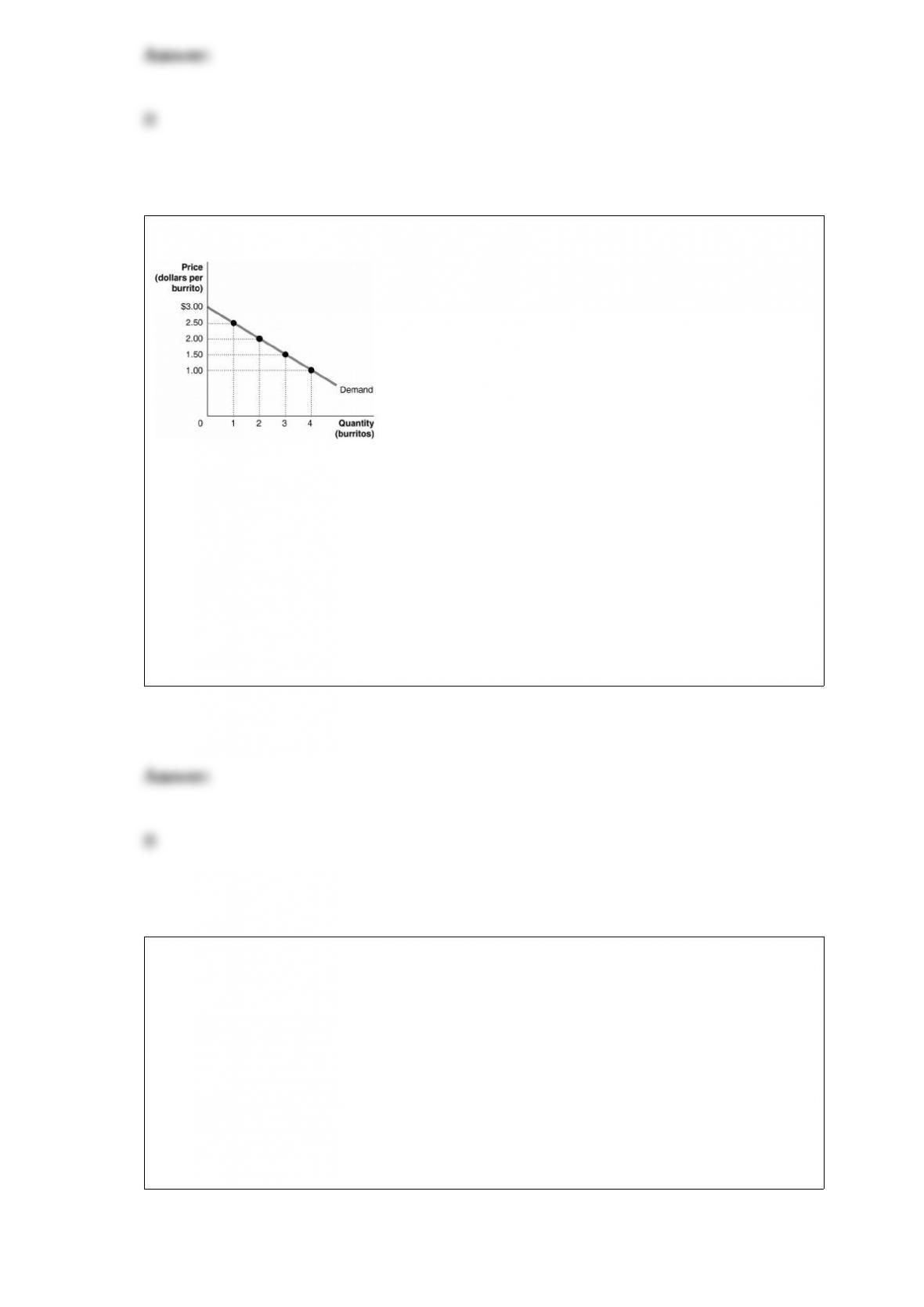
Figure 4-1
Figure 4-1 shows Arnold’s demand curve for burritos.
If the market price is $2.00, what is Arnold’s consumer surplus?
A) $0.50
B) $1.00
C) $1.50
D) $3.00
GDP in a country grew from $10 billion to $14 billion over the span of 5 years. The
percentage change in GDP was
A) 4%.
B) 7%.
C) 10%.
D) 40%.

Marty’s Bird House suffers a short-run loss. Marty can reduce his loss below the
amount of his total fixed costs by continuing to produce if his revenue
A) exceeds his implicit costs.
B) exceeds his nonmonetary opportunity costs.
C) exceeds his variable costs.
D) exceeds his marginal costs.
Assume that a perfectly competitive market is in long-run equilibrium. Suppose as a
result of a health hazard associated with the industry’s product, demand decreases
drastically. What is the immediate result of this event?
A) The market price falls, and the typical firm suffers an economic loss.
B) The market supply increases to offset the fall in demand.
C) The typical firm’s average total cost curve shifts downward.
D) The typical firm’s marginal cost curve shifts to the left.
What are the two effects that explain the Law of Demand? Briefly explain each effect.
Is nominal GDP measured in terms of quantity or in terms of dollars? If dollars, the
value of the dollar from what period? Is real GDP measured in terms of quantity or in
terms of dollars? If dollars, the value of the dollar from what period?
Use the dynamic aggregate demand and aggregate supply model and start with Year 1 in
a long-run macroeconomic equilibrium. For Year 2, graph aggregate demand, long-run
aggregate supply, and short-run aggregate supply such that the condition of the
economy will induce the president and the Congress to conduct expansionary fiscal
policy. Briefly explain the condition of the economy and what the president and the
Congress are attempting to do.
In a corporation, what are “inside directors” and “outside directors”?
Suppose that last year the unemployment rate was 5 percent and the inflation rate was
2.5 percent. If the natural rate of unemployment is 5 percent, how do you expect
inflation to change?
Give three reasons why the U.S. economy is more stable since 1950.
Briefly describe changes in life expectancy, average height, and infant mortality in the
United States since 1850.
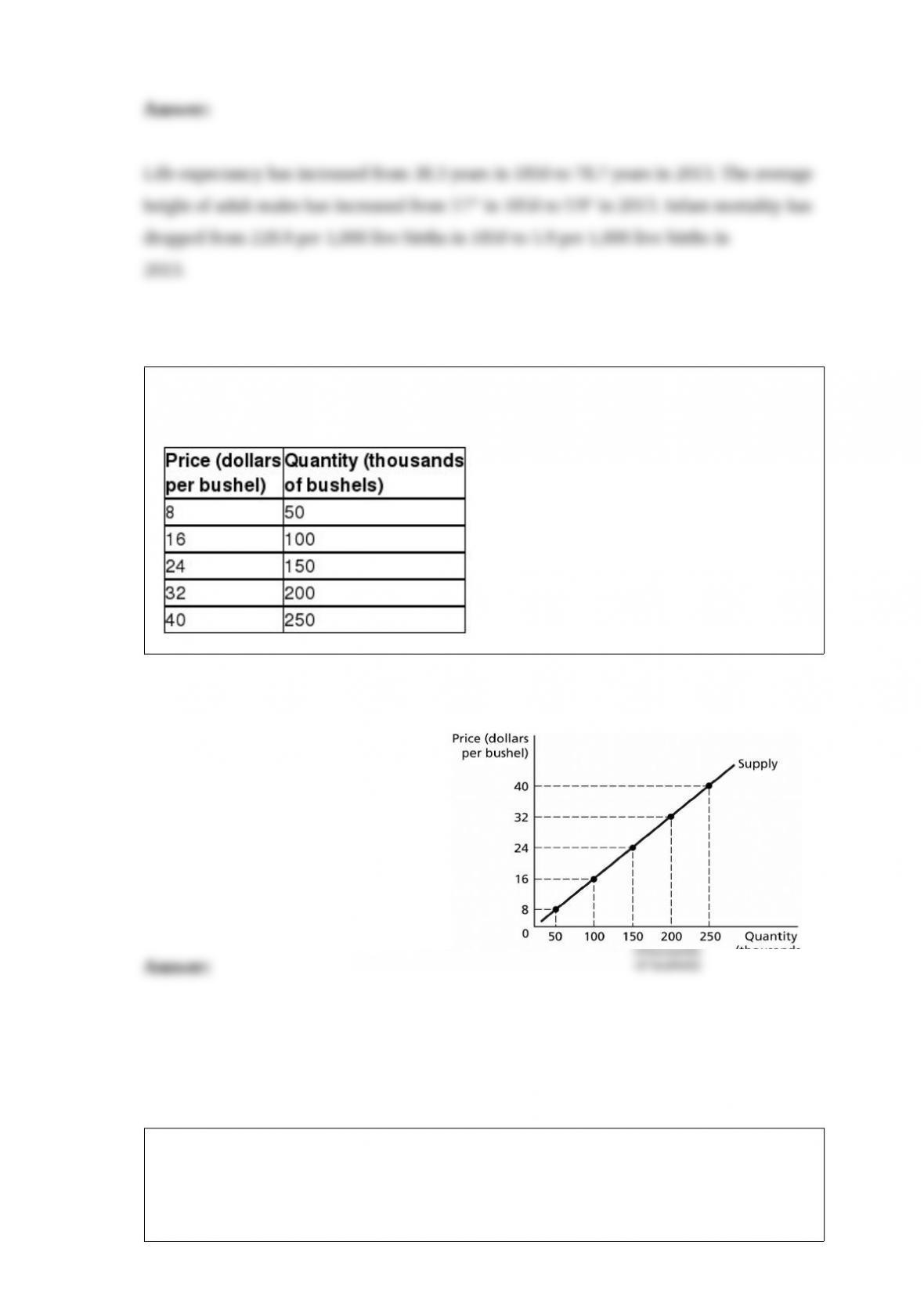
Use the following supply schedule for cherries to draw a graph of the supply curve. Be
sure to label the supply curve and each axis, and show each point on the supply curve.
Examples of comparative advantage often begin with two countries that each produce
the same two goods. Each country is then shown to have a comparative advantage in
producing the good it can produce at a lower opportunity cost, and specializes in the
production of the good for which it has a comparative advantage. How do these
examples prove that both nations are made better off as a result of trade than they would
be without trade?
What is destabilizing speculation? What role did it play in the collapse of the Bretton
Woods system?