
Consider this quote from an article in the Wall Street Journal: “The stock of educated
workers isn’t increasing fast enough to keep up with rising demand…. Employers are
paying the typical four-year college graduate [without graduate school] 75% more than
they pay high-school grads. Twenty-five years ago, they were paying 40% more.
Employers insist on ever better-educated, skilled workers. “
Source: David Wessel, “Lack of Well-Educated Workers Has Lots of Roots, No
Quick Fix,” Wall Street Journal, April 19, 2007, Page A2.
Which of the following best explains the rapid increase in the wage differential between
college graduates and high school graduates?
A) The demand for college educated workers shifted to the right while the supply of
college educated workers shifted to the left.
B) The supply of high-school educated workers shifted to the right faster than the
demand for college educated workers shifted to the right.
C) The demand for college educated workers shifted to the right faster than the supply
of college educated workers shifted to the right.
D) The demand for high-school educated workers shifted to the left faster than the
supply of college educated workers shifted to the right.
A tariff
A) makes domestic consumers worse off.
B) makes both domestic producers and consumers worse off.
C) makes everyone better off.
D) makes domestic producers worse off.
After Suzie, owner of Suzie’s Sweet Shop, hires her 8th worker the average product of
labor declines. Which of the following statements must be true?
A) The marginal product of the 8th worker is negative.
B) The marginal product of the 8th worker is less than the average product of labor
before the 8th worker was hired.
C) Suzie’s profits would be greater if she did not hire the 8th worker.
D) The average product of labor is negative.
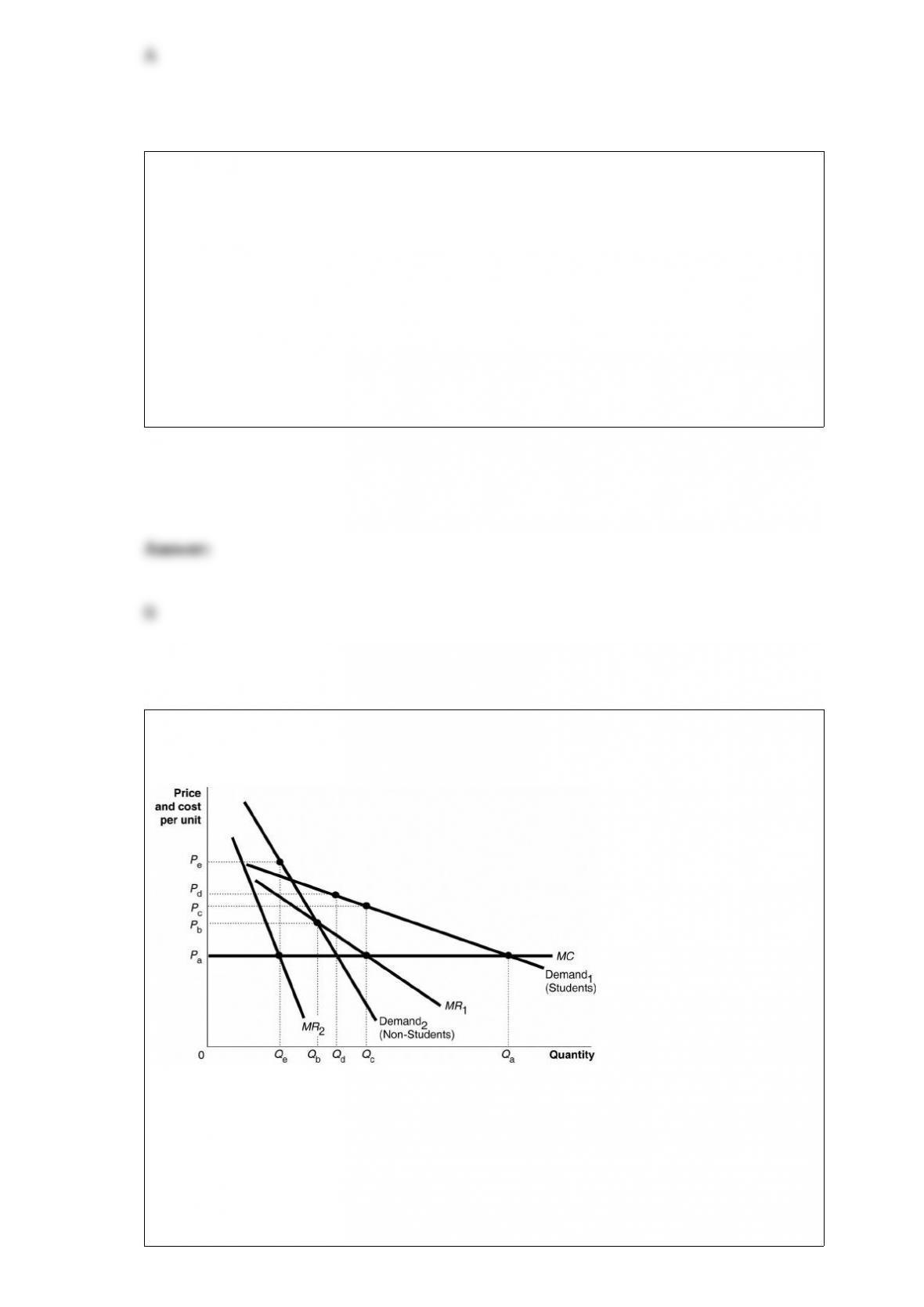
Figure 16-2
Plato Playhouse, a theatre company in the university town of Wegg, caters to two
groups of customers: students and the non-student population. Figure 16-2 shows the
demand curves for the two groups of customers.
Refer to Figure 16-2. Suppose Plato Playhouse charges a single price of Pd for each
performance. Which of the following statements is true?

A) The company is selling more than the profit-maximizing quantity in the non-student
market and less than the profit-maximizing quantity in the student market.
B) The company is selling less than the profit-maximizing quantity in the non-student
market and more than the profit-maximizing quantity in the student market.
C) The company is selling less than the profit-maximizing quantity in both markets but
it is maximizing its revenue.
D) The company is selling less than the profit-maximizing quantity in both markets.
When members of Congress vote to pass new legislation, they will
A) always vote for the alternative favored by a majority of the voters.
B) fail to consistently represent the underlying preferences of voters.
C) always vote for the alternative favored by a plurality of the voters if there is no
majority position.
D) always fail to represent the underlying preferences of voters.
Based on the current rate of growth, health care spending as a percentage of GDP
through Medicare, Medicaid, and other U.S. government programs is expected to
A) stabilize within the next 20 years.
B) account for a majority of spending as a percentage of GDP within 5 years.
C) slow down during this decade.
D) more than double over the next 40 years.
If the price of music downloads was to decrease, then
A) the demand for MP3 players would decrease.
B) the demand for MP3 players would increase.
C) the supply of MP3 players would increase.
D) the quantity demanded of MP3 players would decrease.
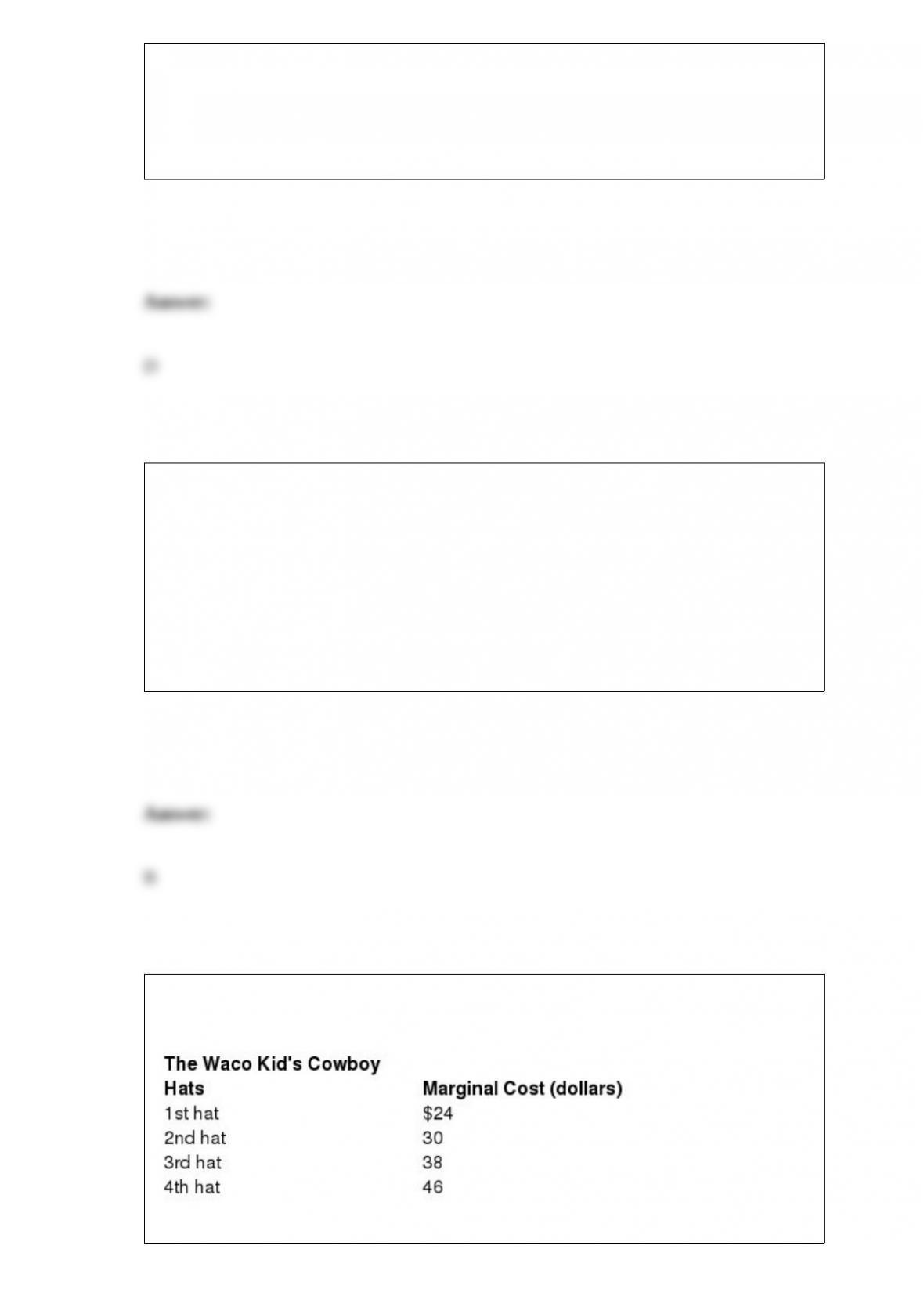
Table 4-3
Refer to Table 4-3. The table above lists the marginal cost of cowboy hats by The Waco

Kid, a firm that specializes in producing western wear. If the market price of cowboy
hats is $50, how many hats will be produced?
A) 0
B) 1
C) 2
D) 4
For people who live near a bus route, a subway station, or a commuter rail line, public
transportation provides a substitute to driving their own cars. So, for these people, the
cross-price elasticity of demand between gasoline and public transportation is
A) positive.
B) negative.
C) zero.
D) infinity.
Article Summary
Based on resale prices for tickets for the 2013 Super Bowl in New Orleans, face-value

prices for the most expensive tickets to the 2014 game are expected to more than
double, with significant price increases for lesser-valued tickets as well. Evidence
indicates that sports teams are more interested in maximizing attendance instead of
ticket revenue, since greater attendance means more spending on items such as parking
and concessions. Higher ticket prices in secondary markets seem to verify that teams
are charging less than they could be if their goal was to maximize ticket revenue.
Source: Patrick Rishe, “Super Bowl XLVIII Pricing: A Lesson In Demand Elasticity,”
Forbes, September 19, 2013.
Refer to the Article Summary. The idea that sports teams could charge more for tickets
and still increase revenue indicates that tickets are being priced in the ________ portion
of their demand curve.
A) elastic
B) inelastic
C) unit elastic
D) perfectly elastic
Between 1980 and 2011, income inequality in the United States has increased in part
due to expanding international trade. How does expanding international trade contribute
to income inequality?
A) It increases the demand for a wide array of products which in turn increases prices
beyond the reach of average income individuals.
B) It allows producers to exploit workers and reduce the wages they are willing to pay
workers.
C) Domestic firms can now hire low-skilled workers anywhere in the world, putting
U.S. workers in competition with foreign workers. This has caused the wages of
unskilled workers to be depressed relative to the wages of other workers.
D) It reduces the cost of producing goods and therefore lowers the value of labor’s
services.

Which of the following is a reason why airline yield management is an effective method
to increase revenue?
A) because airlines have invested heavily in developing computer models that identify
optimal pricing strategies in the various market segments
B) because airlines have successfully induced customers to reveal their resources and
preferences by offering them different versions of the product such as business class
and coach plane tickets
C) because a ticket is a contract to transport a specific person, and is not transferable
D) because airlines have a monopoly in long-distance carriage
Assume that emissions from electric utilities contribute to pollution in the form of acid
rain. Which of the following describes how this affects the market for electricity?
A) The equilibrium in the market is not efficient; the marginal benefit from electricity is
greater than the marginal social cost.
B) A deadweight loss occurs; at equilibrium the additional social cost of production is
greater than the additional benefit to consumers.
C) The equilibrium in the market is not efficient; because of the cost of the acid rain,
economic efficiency would be greater if more electricity were produced.
D) The equilibrium in the market is not efficient; consumer surplus is equal to producer
surplus.
The Mass Rapid Transit (MRT) System in Hong Kong has been running significant
losses. Transport Ministry officials have argued over whether to raise fares to combat
the losses. One argument against a fare increase is that it will aggravate traffic
congestion on the streets during peak commuter hours. Suppose that the current fare is
$4 and the government is considering raising it to $6. Officials estimate that this
reduces the number of rides purchased from 10,000 to 8,000 per day.
a. What is the estimated elasticity of demand for MRT rides?
b. What does this elasticity of demand suggest to you about what will happen to total
revenue earned by the transit system?
c. Last year, the MRT system incurred a loss of $50,000 per day. Do you think the fare
increase will resolve the deficit problem as well as Ministry officials anticipate?
Explain.
Consider an industry that is made up of nine firms each with a market share (percent of
sales) as follows:
a. Firm A: 30%
b. Firm B: 20%
c. Firms C, D and E: 10% each

d. Firms F, G, H and J: 5% each
What is the value of the four-firm concentration ratio and how is the industry
categorized?
A) 50%; monopolistic competition
B) 70%; oligopoly
C) 75%; oligopoly
D) 80%; strongly oligopolistic
Which of the following is the correct way to describe equilibrium in a market?
A) At equilibrium, demand equals supply.
B) At equilibrium, quantity demanded equals quantity supplied.
C) At equilibrium, market forces no longer apply.
D) At equilibrium, scarcity is eliminated.
Letters are used to represent the terms used to answer this question: price (P), quantity
of output (Q), total cost (TC) and average total cost (ATC). Which of the following
equations is equal to a firm’s average profit?
A) P – ATC
B) (P – ATC) Q
C) (P Q) – TC
D) P – TC
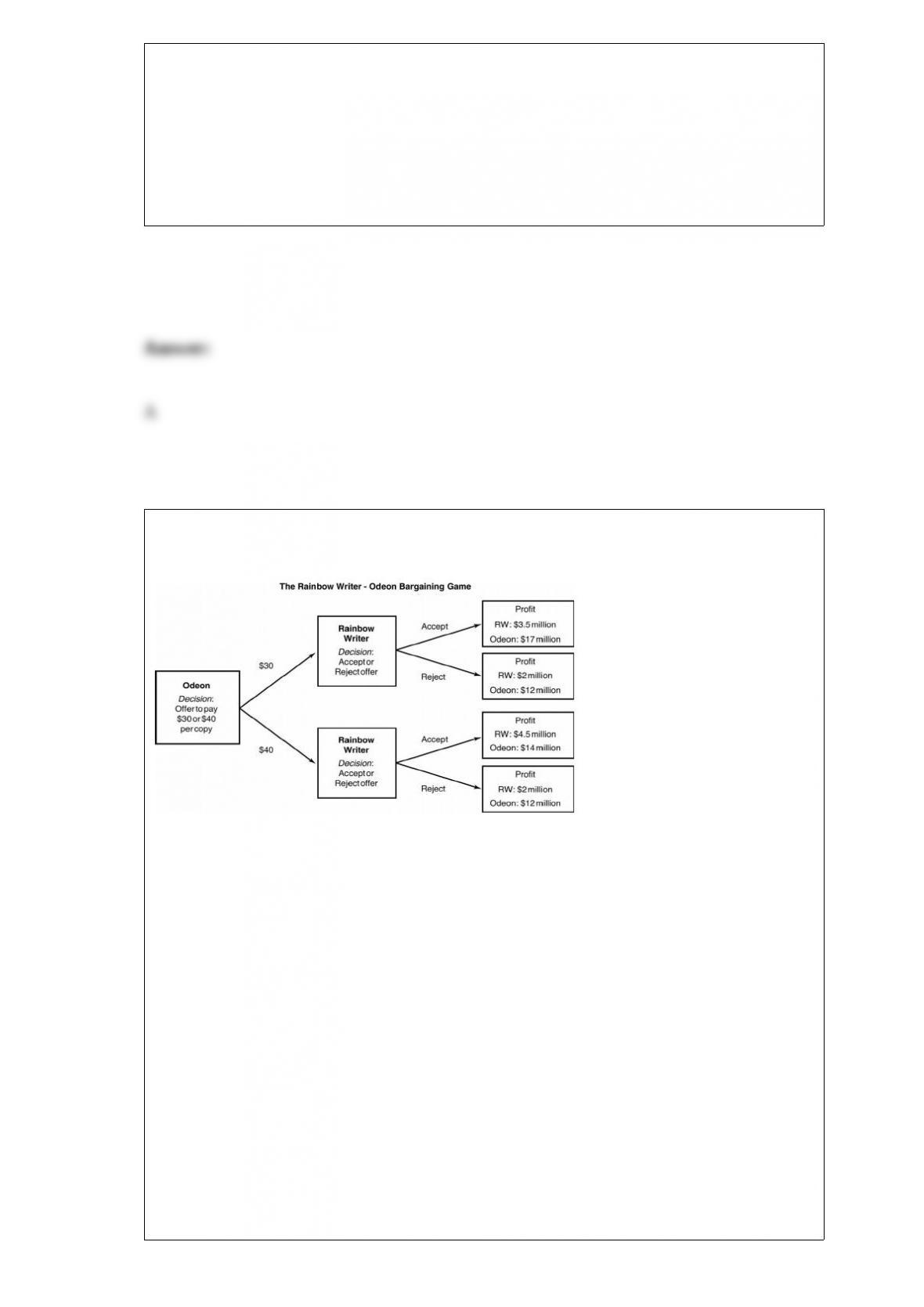
Figure 14-4
Rainbow Writer (RW) is a small online company selling a highly rated software
package for printing color labels directly onto CDs. The firm currently earns a profit of
$2 million per year selling its package exclusively on its Web site. Odeon, the producer
of the most popular software package for editing and burning CDs and DVDs, has
expressed interest in bundling Rainbow Writer’s product into its own package. Odeon
expects that bundling would further boost its sales and allow it to sell the new bundled
product at a higher price, thus raising its profits beyond its current profit of $12 million.
Figure 14-4 shows the decision tree for the Rainbow Writer-Odeon bargaining game.
Refer to Figure 14-4. How will Rainbow Writer respond to Odeon’s two possible
offers?
A) Rainbow Writer will reject either offer.
B) Rainbow Writer will only accept an offer of $30 per copy of the software package.
C) Rainbow Writer will only accept an offer of $40 per copy of the software package.

D) Rainbow Writer will accept either offer.
If the United States and other developed nations pay the cost of reducing public
emissions, developing nations such as China could benefit from the reduction while not
contributing to it. In this sense, one can think of reducing carbon emissions as being
like a
A) public good.
B) private good.
C) quasi-private good.
D) quasi-public good.
If Canada imports fishing poles from Mexico and Mexico imports bacon from Canada,
which of the following would explain this pattern of trade?
A) Mexico has a lower opportunity cost of producing bacon than Mexico and Mexico
has a comparative advantage in producing fishing poles.
B) The opportunity cost of producing fishing poles in Canada is higher than the
opportunity cost of producing bacon in Mexico.
C) Mexico must have an absolute advantage in producing fishing poles and Canada
must have an absolute advantage in bacon.

D) Mexico has a higher opportunity cost of producing fishing poles than Canada, and
Canada has a higher opportunity cost of producing bacon.
Since 1972, the world price of oil has been largely determined by OPEC, which
controls about 75 percent of the world’s proven oil reserves. Since 1972 the price of oil
has
A) fluctuated. OPEC’s situation is an example of a prisoner’s dilemma.
B) risen slowly, but steadily. Members of OPEC fear that if they raise the price of oil
too quickly this will lead oil-buying nations to accuse OPEC of price gouging, which is
illegal under international law.
C) steadily fallen through the 1970s, then risen continually in the years since then.
OPEC’s actions are an example of implicit collusion.
D) been tied by OPEC to the rate of inflation in the United States. If, for example, the
rate of inflation is 5 percent in one year, OPEC will raise the price of oil by 5 percent
the next year.
If a monopolist’s marginal revenue is $25 a unit and its marginal cost is $25, then
A) to maximize profit the firm should increase output.
B) to maximize profit the firm should decrease output.
C) to maximize profit the firm should continue to produce the output it is producing.
D) Not enough information is given to say what the firm should do to maximize profit.
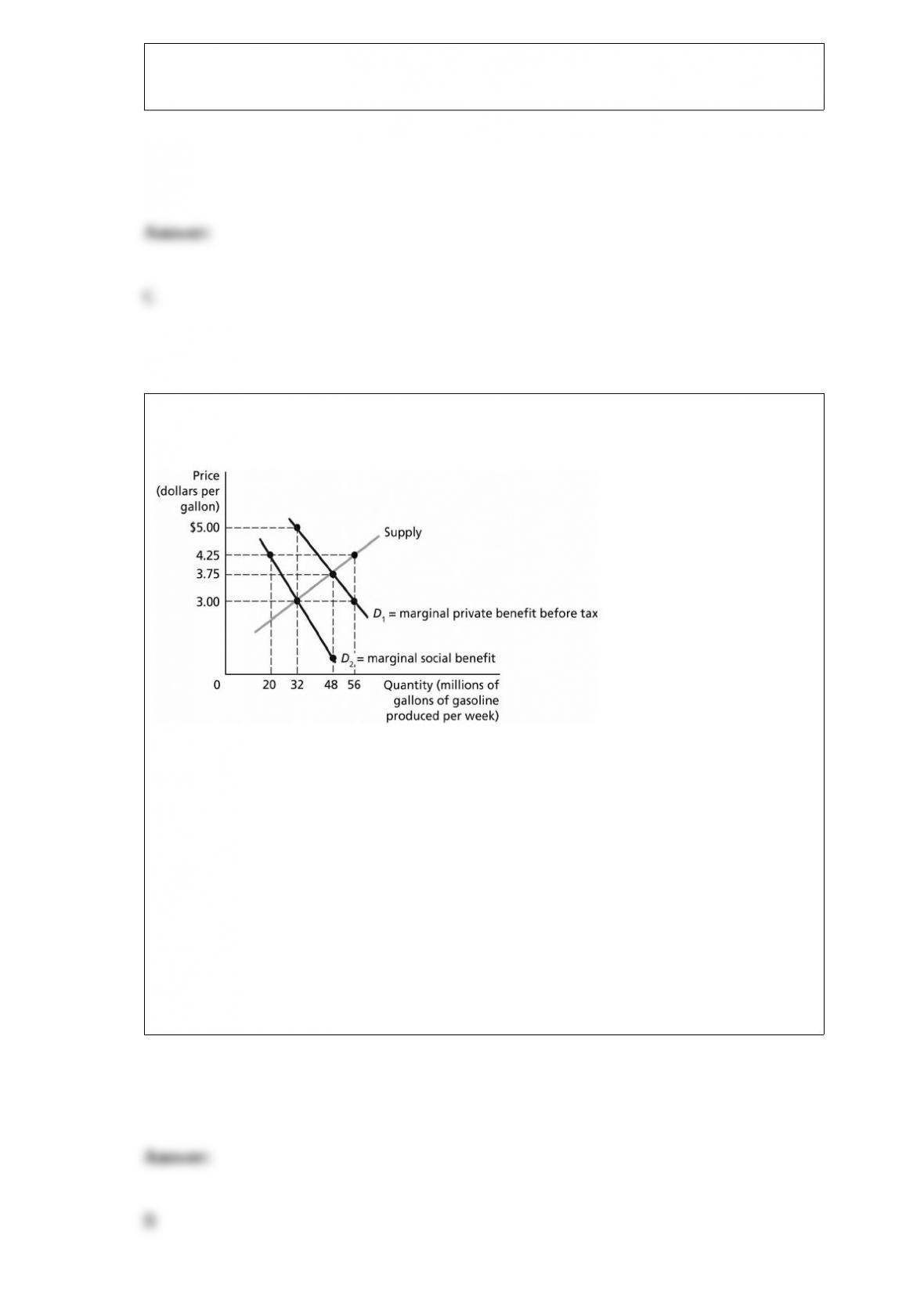
Figure 5-13
Figure 5-13 illustrates the market for gasoline before and after the government imposes
a tax to bring about the efficient level of gasoline production.
Refer to Figure 5-13. The efficient equilibrium quantity of gasoline is ________
million gallons per month.
A) 20
B) 32
C) 48
D) 56

The DeBeers Company of South Africa was able to block competition through
A) economies of scale.
B) ownership of an essential input.
C) government-imposed barriers.
D) differentiating its product.
The health care system in Canada is referred to as ________, and is a system in which
the government provides national health insurance to all Canadian residents.
A) an out-of-pocket system
B) a single-payer health care system
C) a universal health insurance system
D) socialized medicine
Goods and services purchased abroad and brought into a country are called ________.
A) gross domestic products
B) exports
C) gross national products
D) imports
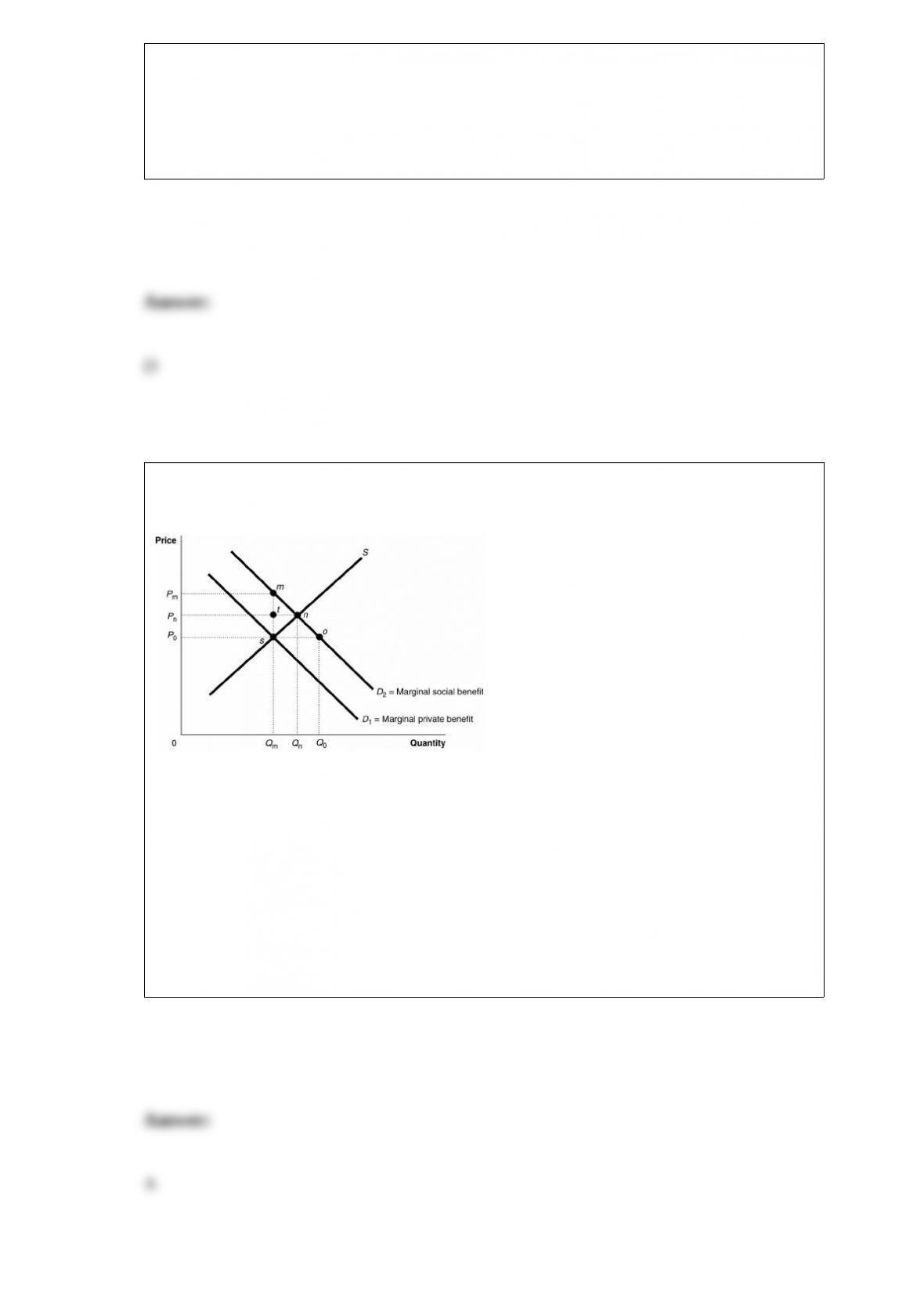
Figure 5-3
Refer to Figure 5-3. The private profit maximizing output level is
A) Qm.
B) Qn.
C) Qo.
D) Qo– Qm.
In the world oil market, oil is supplied up to the point where
A) the marginal cost of the last barrel is just equal to the price buyers are willing to pay
for that last barrel.
B) the marginal cost of the last barrel is zero.
C) the marginal cost of the last barrel is the greatest distance from the price buyers are
willing to pay for that last barrel.
D) the marginal cost of the last barrel is at a maximum.
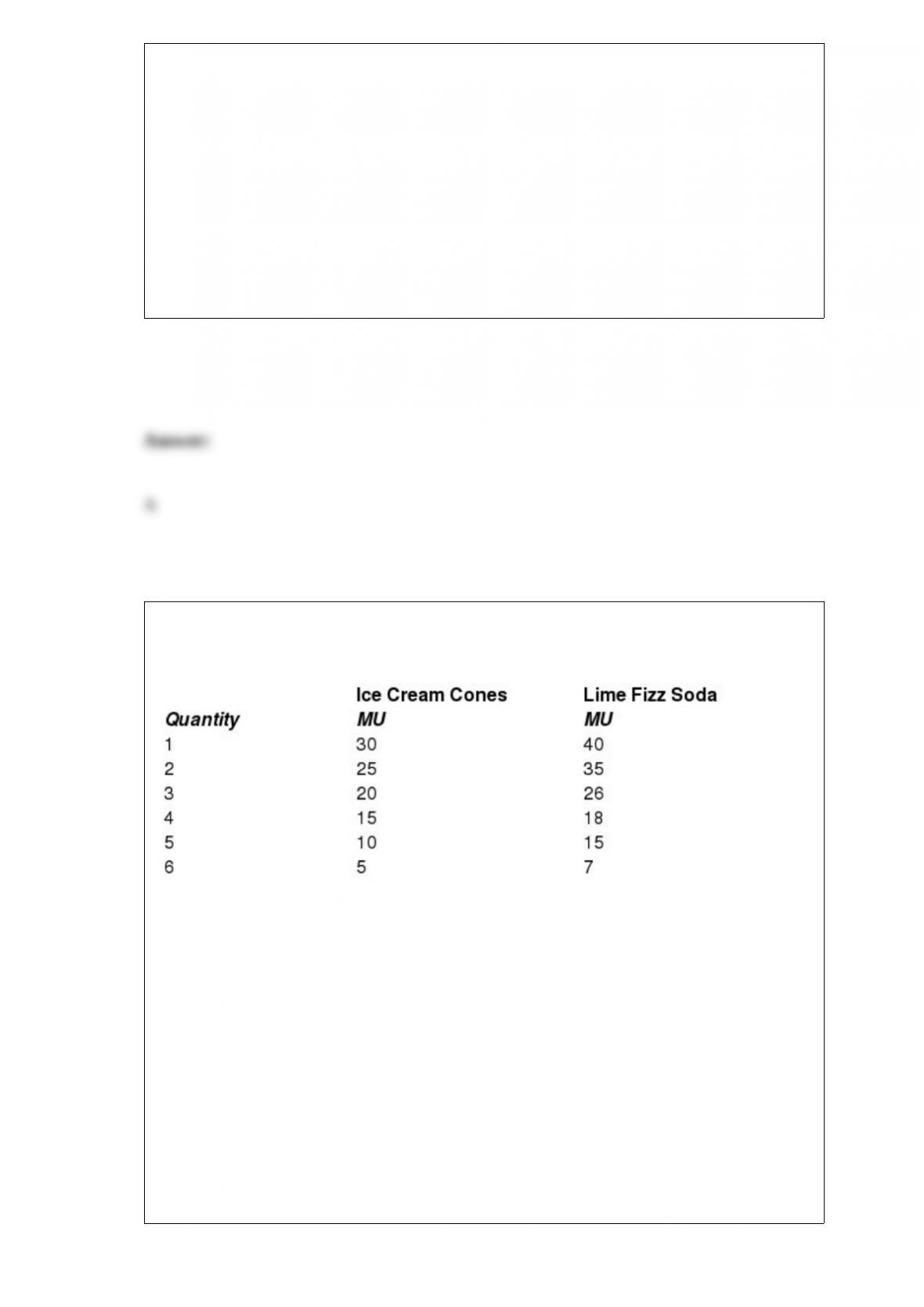
Table 10-3
Refer to Table 10-3. The table above shows Lee’s marginal utility from consuming ice
cream cones and cans of Lime Fizz Soda. Select the phrase that completes the following
statement. “We can determine the number of ice cream cones and cans of Lime Fizz
Soda Lee should consume to maximize his utility
A) if we know what Lee’s income is.”
B) if we know what Lee’s income is and the price of an ice cream cone and the price of
a can Lime Fizz Soda.”
C) by adding up the marginal utilities for ice cream cones and Lime Fizz Soda.”
D) if we know the values of the marginal utility per dollar for ice cream cones and Lime
Fizz Soda.”

Which of the following displays these two characteristics: rivalry and nonexcludability?
A) a public good
B) a private good
C) a quasi-public good
D) a common resource
Under the Patient Protection and Affordable Care Act (ACA), residents who do not
have health insurance will not be allowed to seek employment.
Which of the following costs will not change as output changes?
A) marginal cost
B) total variable cost
C) average variable cost
D) average fixed cost
E) total fixed cost
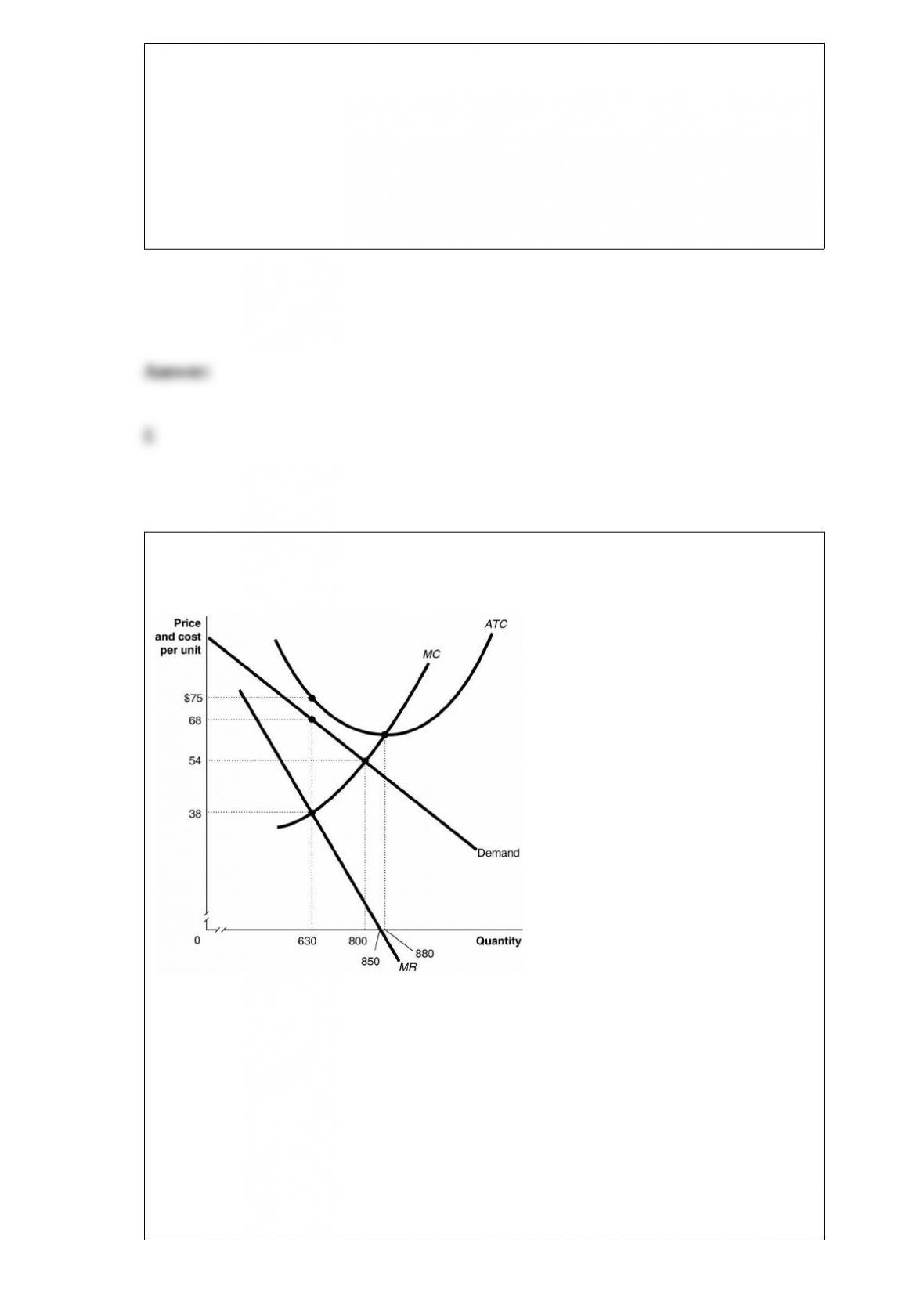
Figure 15-3
Figure 15-3 above shows the demand and cost curves facing a monopolist.
Refer to Figure 15-3. What happens to the monopolist represented in the diagram in the
long run?
A) It will raise its price at least until it breaks even.
B) If the cost and demand curves remain the same, it will exit the market.
C) The government will subsidize the monopoly to enable it to break even.

D) It will be forced out of business by more efficient producers.