
Cap and Trade is a system aimed at correcting for externalities by
a. imposing taxes.
b. establishing tradable permits.
c. placing quotas on specific firm’s output.
d. limiting exports.
If firms must pay full liability for accidents plus punitive damages, then
a. the private costs of firms’ activities will be equal to the social costs.
b. firms will have an incentive to make efficient choices.
c. social welfare will be higher than if no punitive damages were assessed.
d. firms will undertake less activity than would be socially optimal.
Excise Subsidy
The following questions refer to the accompanying diagram which shows the effects of
an excise subsidy given to firms. The initial price and quantity are P0 and Q0,
respectively. After the subsidy is granted, the equilibrium quantity is Q1, firms receive
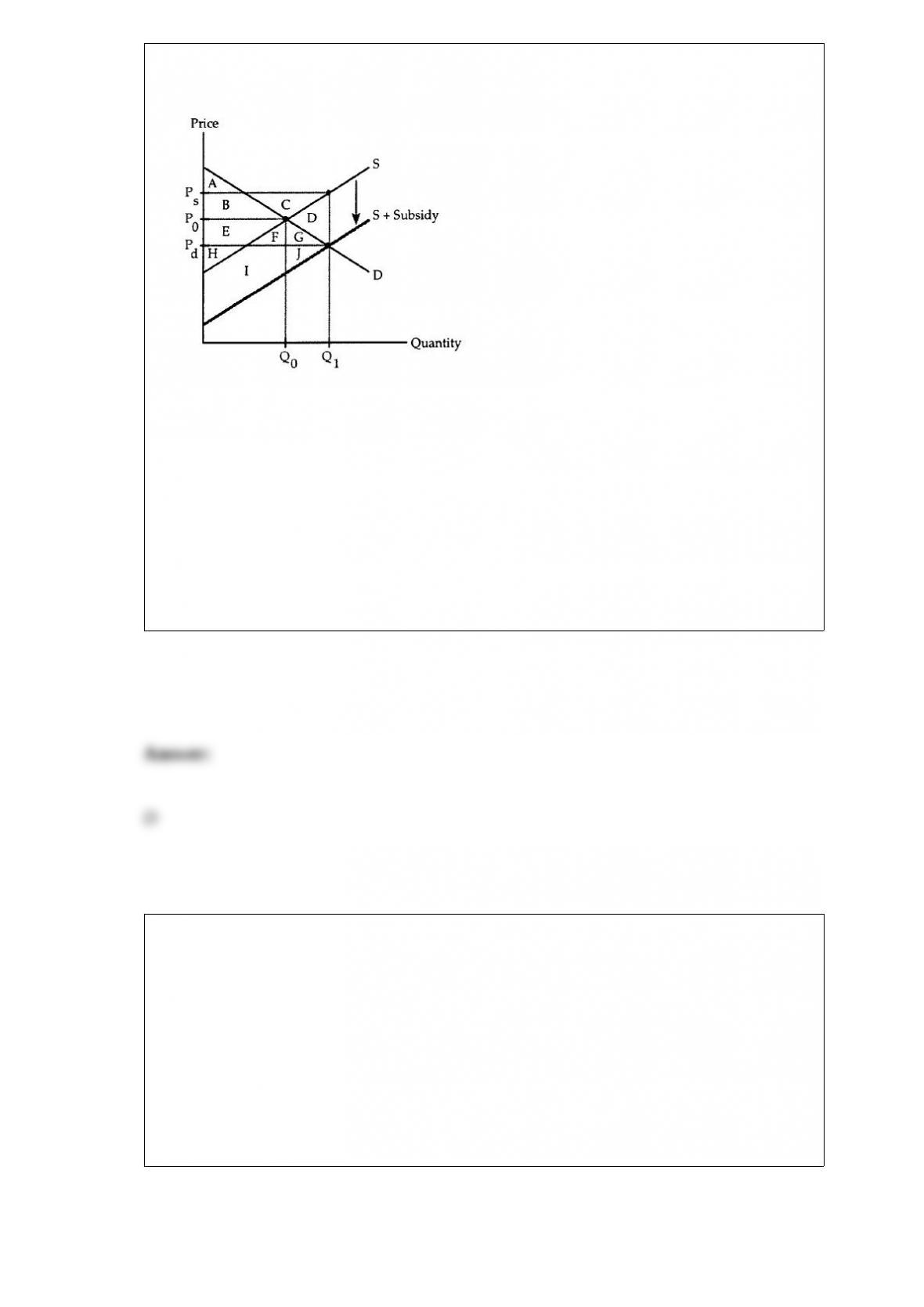
the price Ps, and consumers pay the price Pd.
The deadweight loss created by the subsidy is represented by
a. area F + G.
b. area D + G + J.
c. area C.
d. area D.
What do we call a person who attempts to earn profits in the futures markets by
predicting future changes in supply or demand?
a. An investor.
b. A speculator.
c. A risk-preferring individual.
d. A contractor.
An industry is likely to be an increasing-cost industry when
a. all firms are identical.
b. it represents a negligible fraction of the total demand for inputs.
c. industry expansion permits the development of supporting subindustries.
d. some firms are more efficient than others.
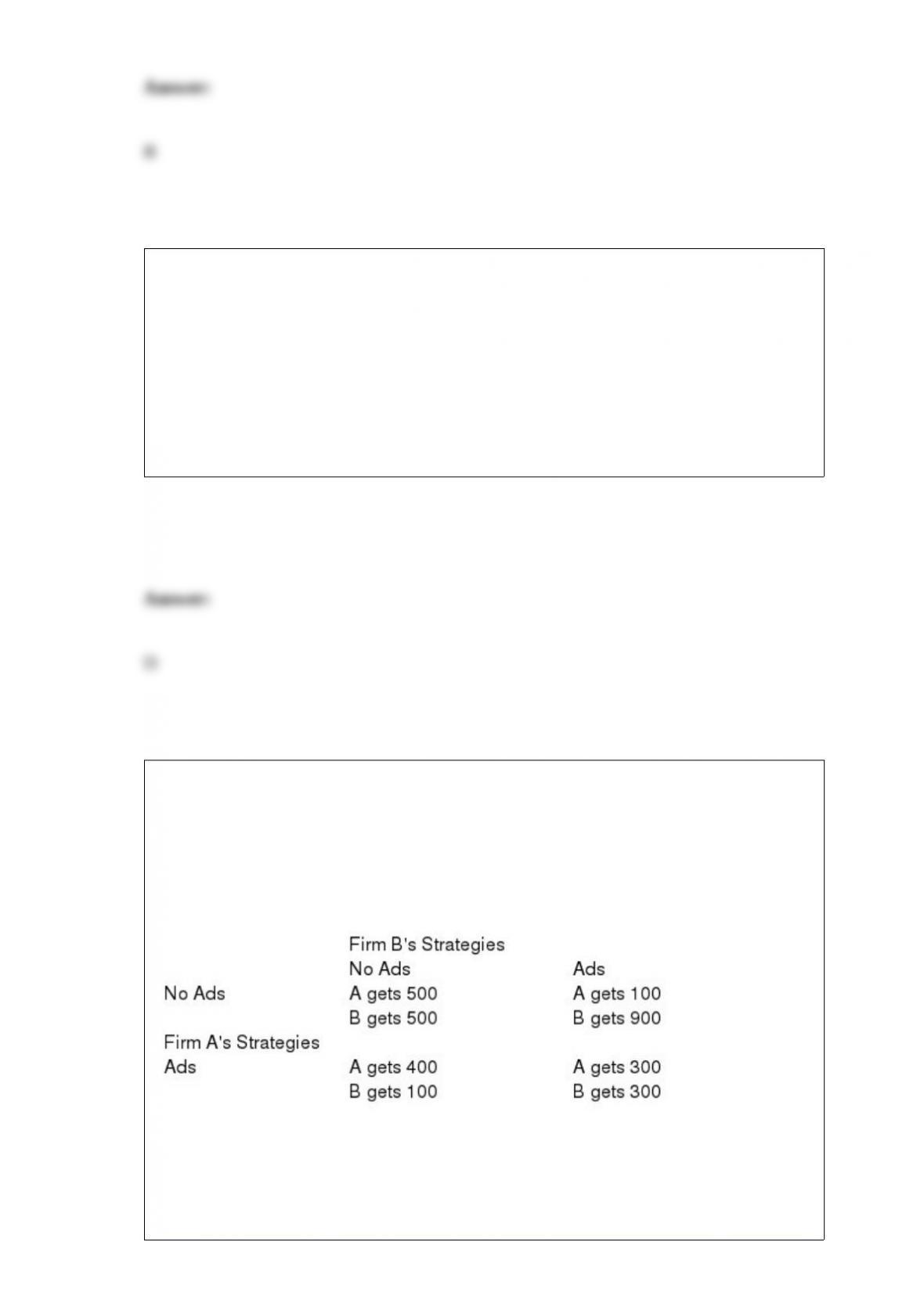
Game Matrix III
The following questions refer to the game matrix below. Each firm has a choice of
advertising, Ads, or not advertising, No ad. The profits each gets depend upon which it
chooses.
In this game,
a. Firm A’s dominant strategy is to advertise.

b. Firm A’s dominant strategy is not to advertise.
c. Firm B’s dominant strategy is to advertise.
d. Firm B has no dominant strategy.
Suppose the government increases the annual cost of the liquor permit that a tavern
needs to serve alcohol. What effect will this increased cost have on the tavern’s
production and pricing decisions?
a. None-the tavern will maintain its current prices.
b. The tavern will raise its prices to cover the higher cost.
c. The tavern will scale back its operations.
d. The tavern will cut its prices to increase its sales.
Consider a price ceiling imposed on a monopoly. For what quantities will the
monopoly’s new marginal revenue curve be horizontal at the ceiling price?
a. For quantities where the demand curve lies above the ceiling price.
b. For quantities where demand is elastic.
c. For quantities where marginal cost is rising.
d. Marginal revenue will be constant and equal to the ceiling price for all quantities.
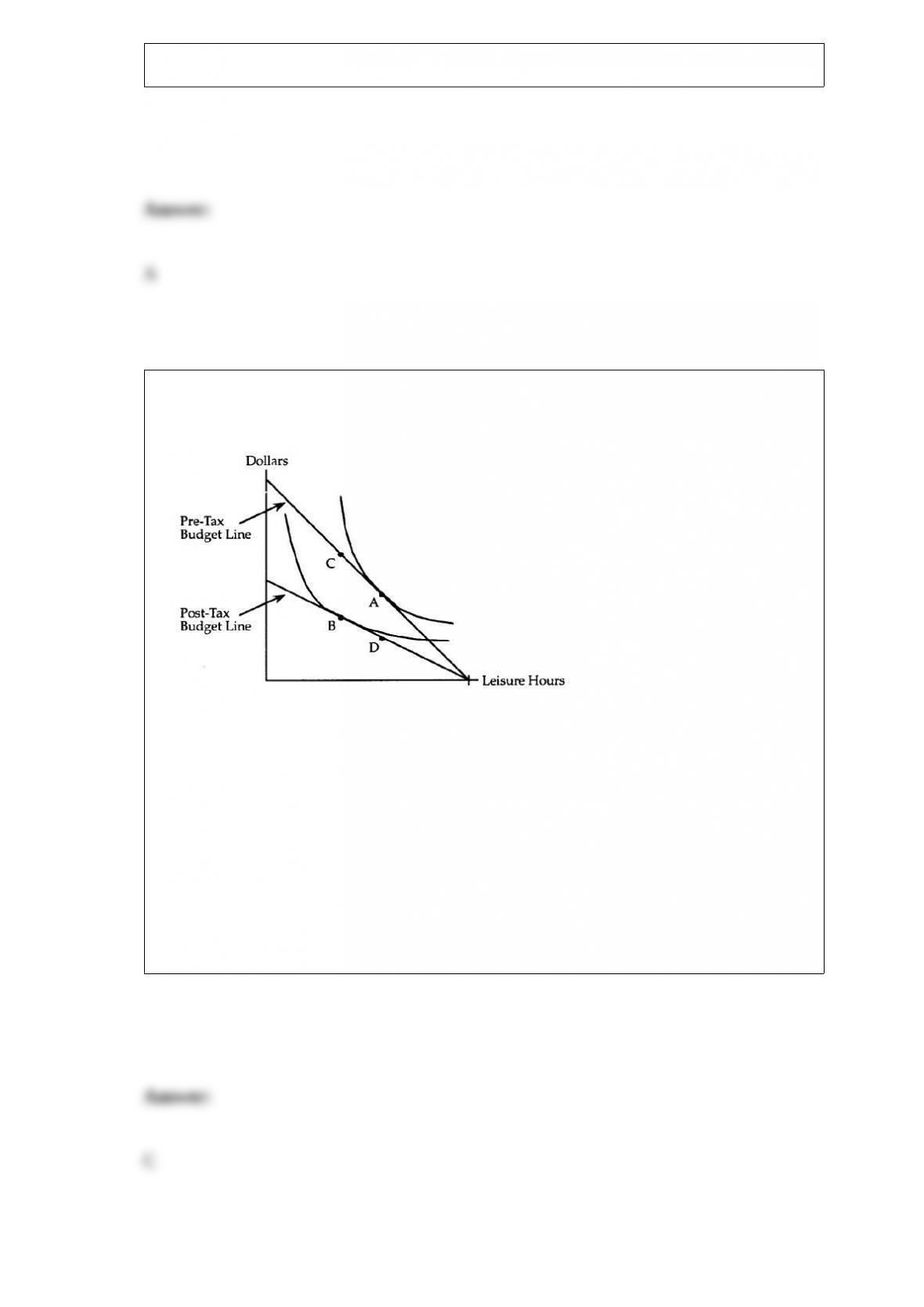
The accompanying diagram shows the effect of levying an income tax on the consumer.
The pre-tax optimum is at point A, and the post-tax optimum is at point B.
To measure the amount of tax money collected by the government, one uses the vertical
distance between points
a. A and B.
b. A and D.
c. B and C.
d. B and D.

When a monopsony hires an additional worker, it must pay the new worker’s wages and
it bids up the wages of all workers. This fact implies that the monopsony’s
a. marginal labor cost is greater than the wage rate.
b. demand curve for labor is perfectly elastic at the going market wage.
c. marginal revenue product of labor is equal to the wage rate.
d. labor usage is greater than that of a firm that is competitive in the labor market.
One theory that predicts sustained wage and rent differentials is based on the idea that
your accumulation of human capital raises the productivity of the other workers and the
physical capital in your locale. In this situation, human capital accumulation creates
a. a signaling equilibrium.
b. external benefits.
c. compensating differentials.
d. intertemporal substitutions.
Consider a two-person, two-strategy game in which only pure strategies are played.
Such a game must have at least one
a. Nash equilibrium.

b. player with a dominant strategy.
c. Pareto-optimal outcome.
d. outcome that is both a Nash equilibrium and Pareto optimal.
When a consumer is impatient, his indifference curves for current and future
consumption
a. are everywhere steeper than 45°.
b. must be straight lines.
c. are flatter than the budget line at the endowment point.
d. have absolute slopes greater than 1 along the 45° line.
Shareholders with diversified portfolios will encourage
a. social decision-makers to be risk-neutral.
b. corporate decision-makers to be risk-neutral.
c. corporate decision-makers to be risk-preferring.
d. individual entrepreneurs to be risk preferring.

Monopoly Problem. Consider a monopoly with constant marginal costs of $20.
Consumers in the market for this monopoly’s product have demand of Q = 100 – 2P.
Howe much consumer surplus will there be when this monopolist charges its profit
maximizing price.
a. $225
b. $450
c. $900
d. $1800
Game Matrix II
The following questions refer to the game matrix below. Player A can play the strategies
“High” and “Low,” and Player B can play the strategies “Odd” and “Even.”
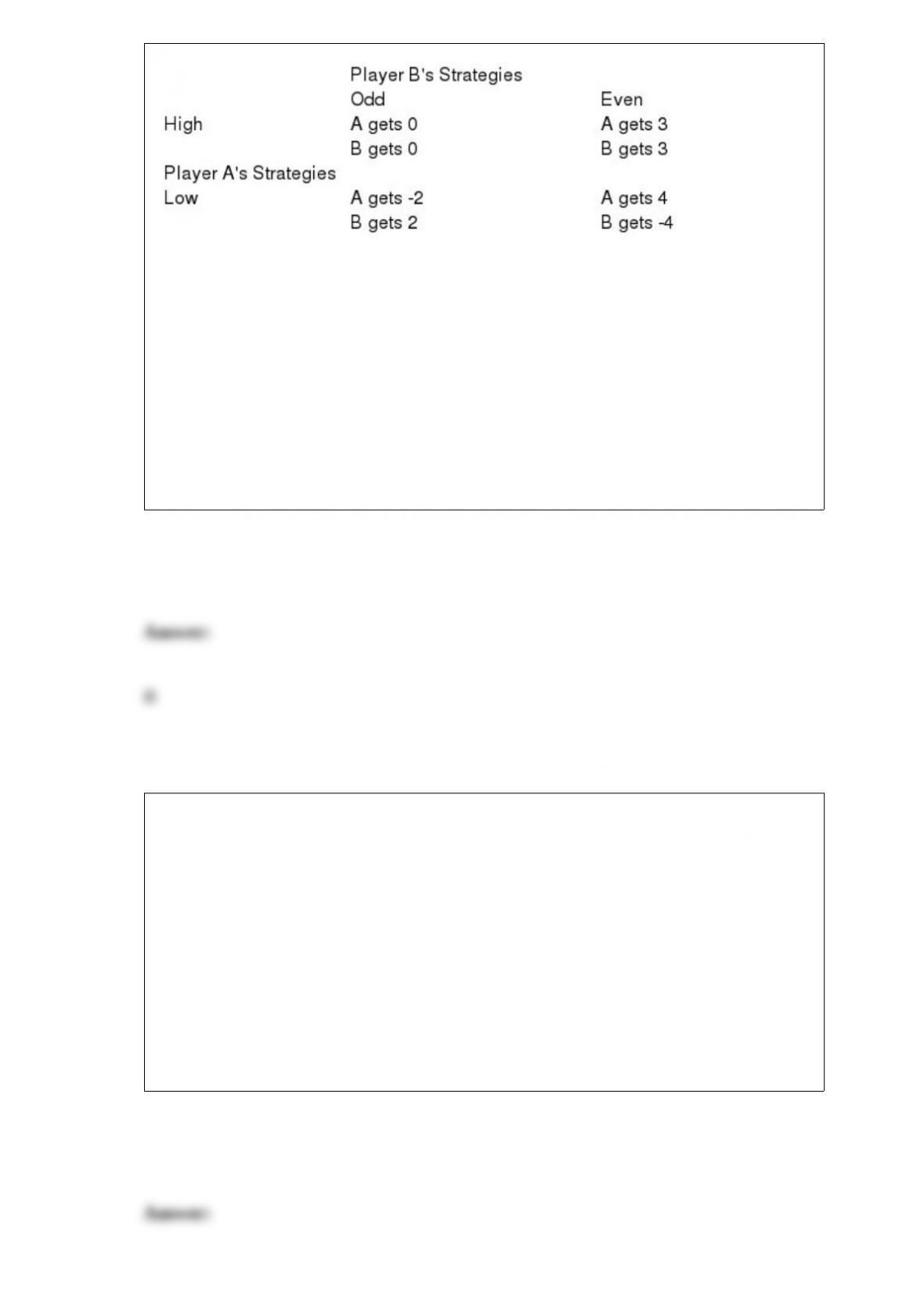
When would the upper left-hand corner be the likely outcome of this game?
a. When the game is played sequentially, with A being the first player.
b. When the game is played sequentially, with B being the first player.
c. When the players choose their strategies simultaneously.
d. The upper left-hand corner would never be the likely outcome, because the upper
right-hand corner makes both player better off.
If a natural monopolist were to sell at the price where marginal cost equals demand,
then it would be earning
a. zero economic profits, like a competitive firm in the long-run.
b. negative profits and would not be able to survive.
c. positive profits but not would not need to worry about government intervention to
regulate it.
d. positive profits but would still need to worry about possible government intervention
to regulate it.
A firm has MR = 40 and MC = 10 + Q and has $200 in fixed costs.
If the wage rate rises, then the firm’s long-run marginal costs change, which in turn
affects the firm’s output level and its employment of labor. This phenomenon is known
as
a. the substitution effect.
b. the scale effect.
c. the regressive-factor effect.
d. the factor-price effect.

A competitive firm’s shutdown price is equal to the minimum value of the firm’s
a. marginal cost.
b. average cost.
c. average variable cost.
d. fixed and sunk costs.
Which model highlights the effects of market power obtained from product
differentiation?
a. The contestable market model.
b. The Cournot model of oligopoly.
c. The Bertrand model of oligopoly.
d. The monopolistic competition model.
Industries often lobby against the removal of regulations because

a. the regulations often enforce a de facto cartel agreement.
b. their customers would be made worse off without government-proscribed standards.
c. the largest firms could then dominate the industry.
d. deregulation would cause higher entry prices for new firms.
An inferior good is one for which
a. the compensated demand curve fails to be downward sloping.
b. higher prices have relatively little effect on the quantity demanded.
c. the income elasticity is positive but less than 1.
d. increases in income result in lower quantities demanded.
Comparing a market basket A to other market baskets, we can say that for a typical
consumer, A is preferred to baskets to the
a. southwest but less preferred to baskets to the northeast.
b. northeast but less preferred to baskets to the southwest.
c. northwest but less preferred to baskets to the southeast.

d. southeast but less preferred to baskets to the northwest .
Universities tend to set tuition high and then, through financial aid, effectively charge
each student a different price for education. Financial aid statements allow the
university to determine the student’s financial status and set an appropriate price to
charge the student. This situation is an example of
a. first-degree price discrimination.
b. second-degree price discrimination.
c. third-degree price discrimination.
d. a two-part tariff.
Horizontal Merger
The following questions refer to the accompanying diagram, which shows the effects of
a horizontal merger. Before the merger, the firm behaves competitively producing Q0
and charging P0. The merger lowers the firm’s marginal cost and gives the firm enough
market power to switch to the monopoly equilibrium.
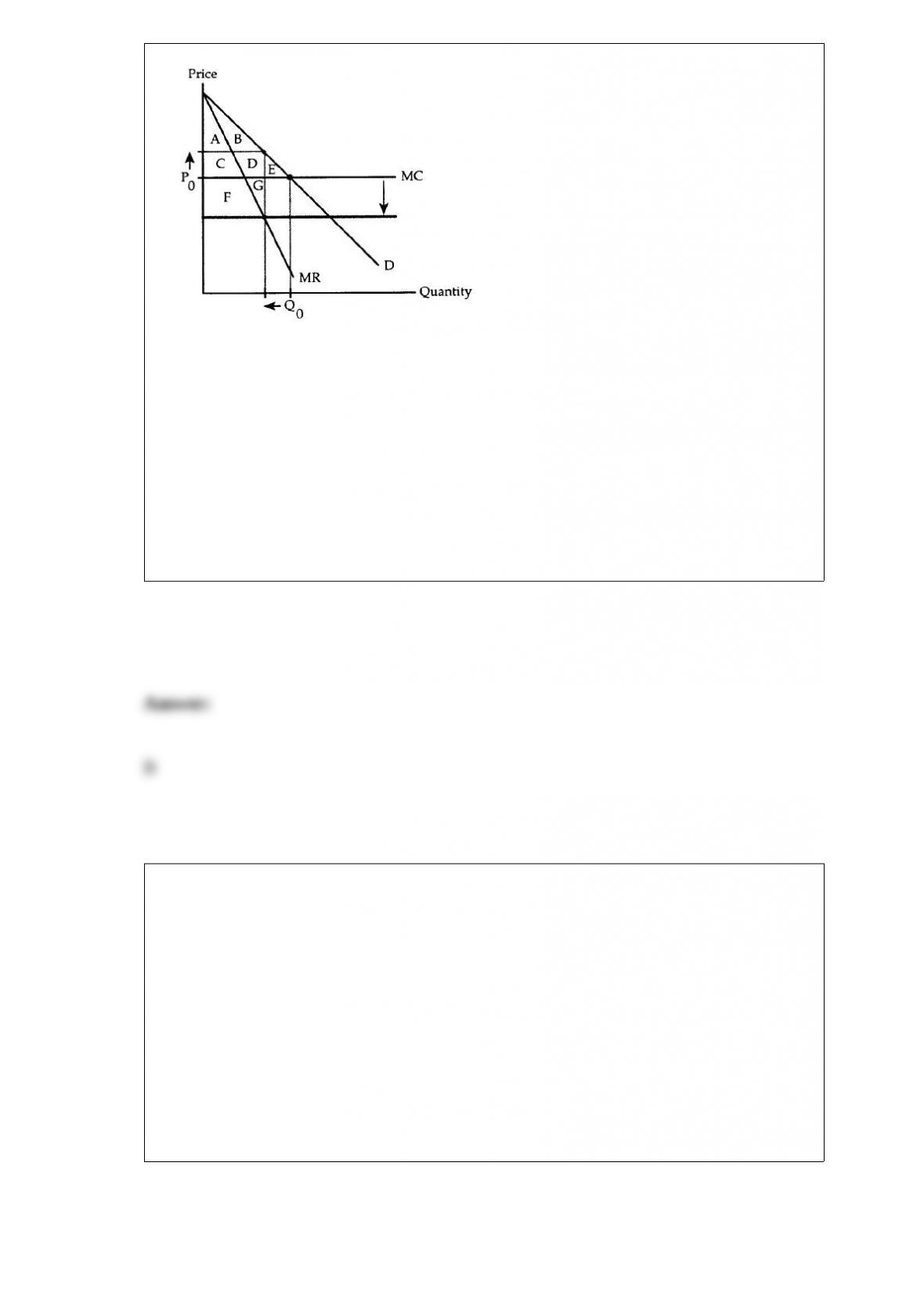
After the merger, producer’s surplus is equal to
a. area A + C + F.
b. area C + D + F + G.
c. area C + D + E – F – G.
d. area C + D.
The significant difference between adverse selection problems and moral hazard
problems is
a. that adverse selection refers to bad luck, moral hazard refers to bad behaviors.
b. that adverse selection applies to markets for goods, moral hazard applies to markets
for services.
c. only identifiable after an action has been taken.
d. that in adverse selection one group of people starts out at a higher risk, while in
moral hazard problems, people incur additional risks.

Pollutants
The following questions refer to the situation below. A chemical plant’s production adds
pollutants to a stream which irrigates a farm’s crops. The pollutants damage the farm’s
crops, increasing the firm’s costs by $800 per month. The crop damage may be
eliminated in two ways: the chemical plant can install a new filtering system costing
$300 per month, or the farm can install a new irrigation system costing $600 per month.
Suppose transactions costs are zero. Also suppose the chemical plant is not liable for the
farm’s crop damages and can continue to pollute the stream. What will be the result of
private bargaining between the farm and the chemical plant?
a. The chemical plant will pay the farm $800 per month in crop damages.
b. The farm will bear the $800 per month cost of crop damages.
c. The chemical plant will install the new filtering system.
d. The farm will install the new irrigation system.
Land in California is quite fertile and capable of growing large amounts of tobacco,
while the land in New England is relatively rocky, of poorer quality, and capable of
growing only smaller tobacco crops. Nevertheless, New England is a larger producer of
tobacco than is California. Use the concepts of cost and comparative advantage to
resolve this apparent contradiction.
Costs that are independent of the firm’s level of output are called
a. fixed costs.
b. marginal costs.
c. opportunity costs.
d. sunk costs.
The relative price of a pineapple today in terms of pineapples tomorrow is given by
a. 1 – r
b. r
c. 1 + r
d. 1/(1 + r)
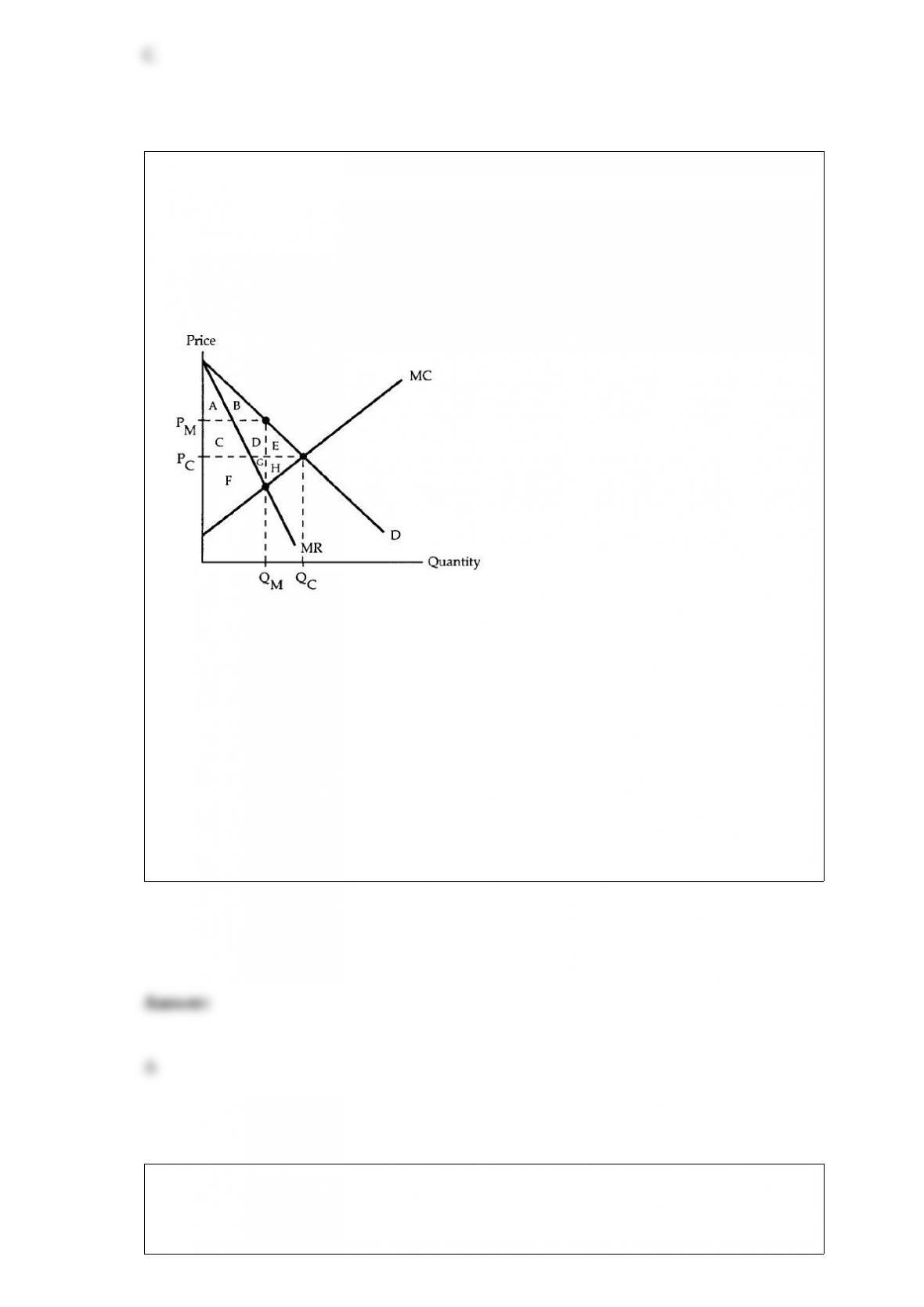
Market Diagram
The following questions refer to the accompanying market diagram. PC and QC are the
equilibrium price and quantity if the firm behaves competitively, and PM and QM are
the equilibrium price and quantity if the firm is a simple monopoly.
Of the surplus that consumers lose because there is a monopoly (and not perfect
competition), how much is lost to the monopoly itself?
a. Area C + D
b. Area E + H
c. Area A + B
d. Area C + D + E
Suppose a duopoly is operating in a market where demand is linear and marginal costs
are constant. We can conclude that the total output supplied by the duopoly is

a. 1/3 of the perfectly competitive output.
b. 1/2 of the perfectly competitive output.
c. 2/3 of the perfectly competitive output.
d. equal to the competitive output.
The (ordinary) demand curve for a normal good must be downward sloping.
A limitation of game theory is that it only considers situations in which there are two
players while there are usually many players in real world games.
A truck is an input in producing transportation services and an output of a truck factory.

If marginal cost exceeds marginal revenue, then a reduction in output will create higher
profits.
Most economic explanations can be reduced to the idea that human behavior is
primarily a matter of taste.
When a game is played sequentially, the first player will have an advantage over the
second player.
Suppose there are only two goods (bread and wine) and only two countries (England
and Portugal). In England, the cost of producing 1 bottle of wine is 3 loaves of bread.
What is the cost of producing 1 loaf of bread in England? Under what circumstances
will England specialize in bread production and purchase its wine from Portugal?
Explain.
When relative prices are measured in terms of dollars, the term dollar refers to
currency.
Efficiency is the only criterion by which economists judge policies.

In the long run, a competitive firm that experiences decreasing returns must earn
negative profits after all factor shares are paid out.
Since mowing ones lawn is not done at their workplace, it is viewed as a use of their
leisure time and thus (somewhat paradoxically) falls into the category of leisure.
The price of a bond can be expressed as its Face Value minus its Discount.
In an Edgeworth box economy, a competitive equilibrium must lie on the contract curve

within the region of mutual advantage.
A fair coin is to be flipped. If it lands heads, a person receives $5.00. If it is tails, they
receive $5.00. A risk neutral person would not be willing to pay $5.00 to flip the coin
since $5.00 is the expected value.
An ordinary demand curve contains both substitution and income effects, while a
compensated demand curve contains only income effects.
The price of good X is $2.00 and the price of good Y is $1.00. Last year, the price of
good X was $1.00 and the price of good Y was $2.00. If a consumer has $100, draw
there their budget line for each year (label them accordingly). Add as many indifference
curves as needed to show a situation in which the consumer is no better or worse off
this year than they were last year. Be sure to label their optimal baskets for both years.
Explain why what you have drawn is correct.
Marginal Cost measures the slope of the total cost and total variable cost curves.
If a rise in supply and a rise in demand occur at the same time, then we know that the
price must also rise.
There is no reason for a competitive firm to stay in business if it is making zero profits.