
Growth accounting estimates the:
A) increase in the population rate over time.
B) increase in the inflation rate over time.
C) contribution of each major factor in the aggregate production function to economic
growth.
D) contribution of the technology factor in the aggregate production function to
economic growth.
The short-run aggregate supply curve is:
A) upward sloping.
B) vertical.
C) horizontal.
D) downward sloping.
Assume that the banks do not hold any excess reserves and the reserve ratio is 20%. If
Sarah deposits $5,000 in cash in her checking account, the money supply can
potentially increase by:
A) $20,000.
B) $25,000.
C) $5,000.
D) $1,000.
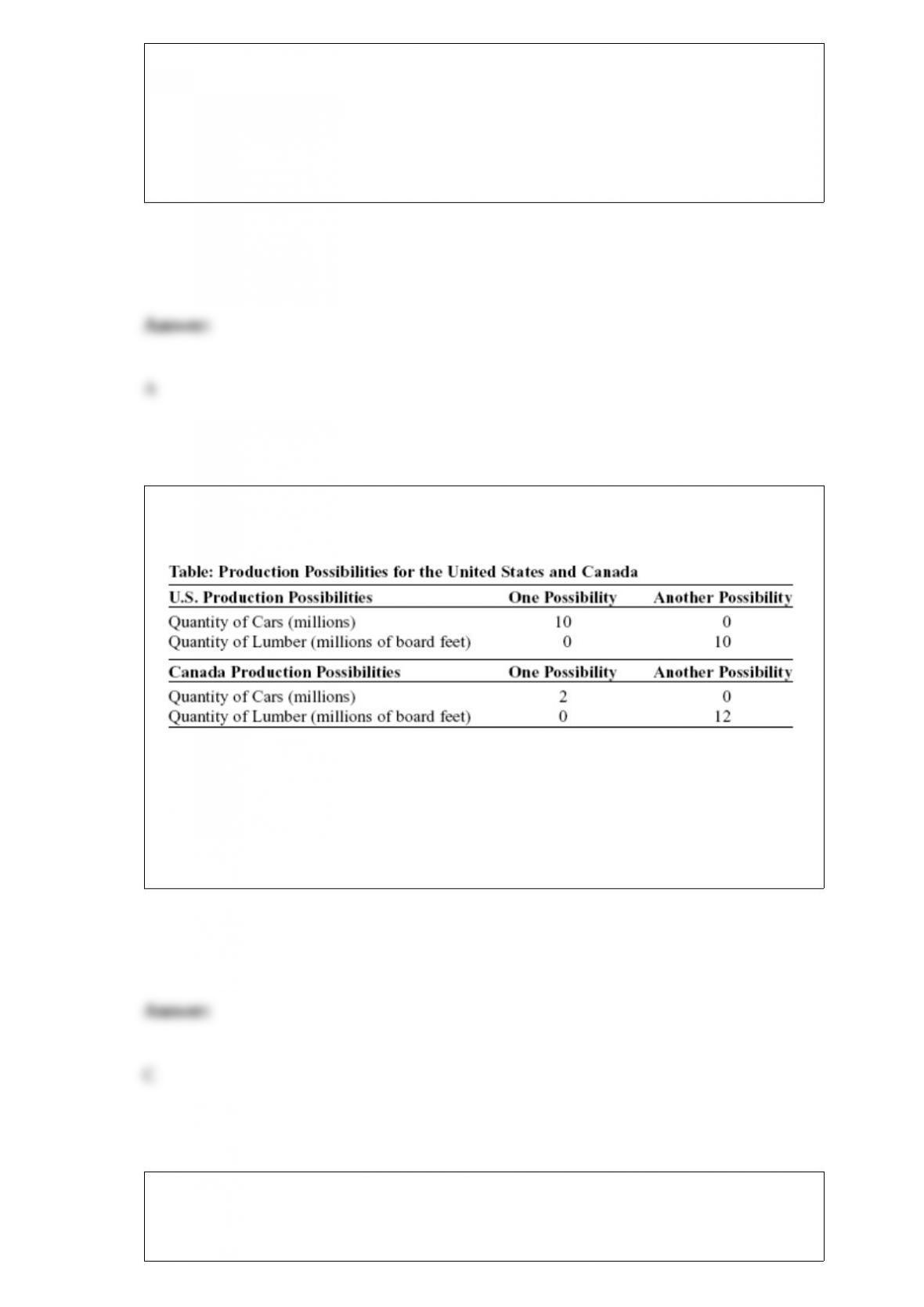
Look at the table Production Possibilities for the United States and Canada. _____ has
(have) an absolute advantage in producing cars.
A) Both the United States and Canada
B) Neither the United States nor Canada
C) The United States
D) Canada
Milton Friedman was a leader and major proponent of:
A) monetarism.

B) classical economics.
C) Keynesian economics.
D) rational expectations theory.
Julie is getting ready for final exams. She has three exams during the first three days of
the exam period. To prepare, she has outlined a schedule that includes reviewing for her
first exam on one day, her next exam on the following day, and her third exam on the
third day. On each day, she has also allocated some time when she can watch TV or
basically do nothing. Which best explains why Julie provides some time for leisure?
A) Julie is not that smart and cannot study that long.
B) Julie is slacking off and will most likely fail all of her finals.
C) Julie realizes that there are benefits to leisure time that outweigh the costs of
constant studying.
D) Julie does not understand the importance of studying.
Monetary policy is similar among wealthy countries because the central banks of most
countries:
A) try to keep inflation between 2% and 3% per year.
B) try to keep inflation between 5% and 6% per year.

C) try to keep inflation between 0% and 2% per year.
D) are trying to establish a single global currency.
All of the following are sources of state and local revenue EXCEPT:
A) social insurance taxes.
B) property taxes.
C) sales taxes.
D) income taxes.
Assume the marginal propensity to consume is 0.8 and potential output is $800 billion.
If actual real GDP is $700 billion, which of the following policies would bring the
economy to potential output?
A) Decrease taxes by $100 billion.
B) Increase taxes by $100 billion.
C) Decrease taxes by $25 billion.
D) Decrease government transfers by $25 billion.
In an economy with no taxes or imports, if the marginal propensity to consume
increases, the marginal propensity to save will also increase.
A) True
B) False
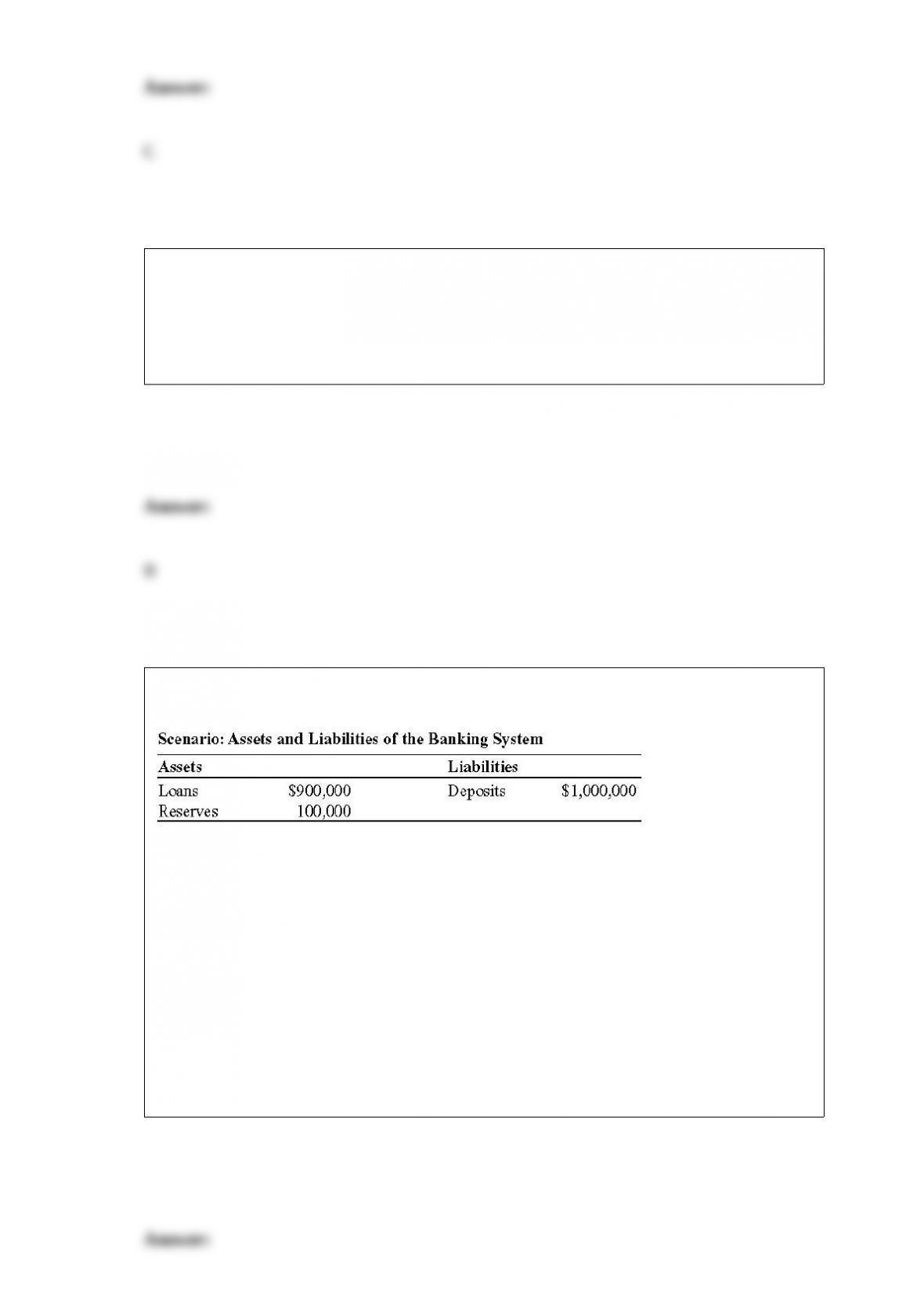
Look at the scenario Assets and Liabilities of the Banking System. If the reserve ratio is
9% and the banking system does NOT want to hold excess reserves, how much more
can be added to the money supply?
A) about $667,000
B) about $111,000
C) $250,000
D) $1 million

According to the classical model of the price level, the short-run aggregate supply curve
is:
A) flat.
B) negatively sloped.
C) vertical.
D) unstable.
Suppose residents of Montana operate on their production possibility frontier, and they
want to increase production of both wheat and fly-fishing rods. According to the
production possibility frontier, this cannot happen without new resources or
technological improvement.
A) True
B) False
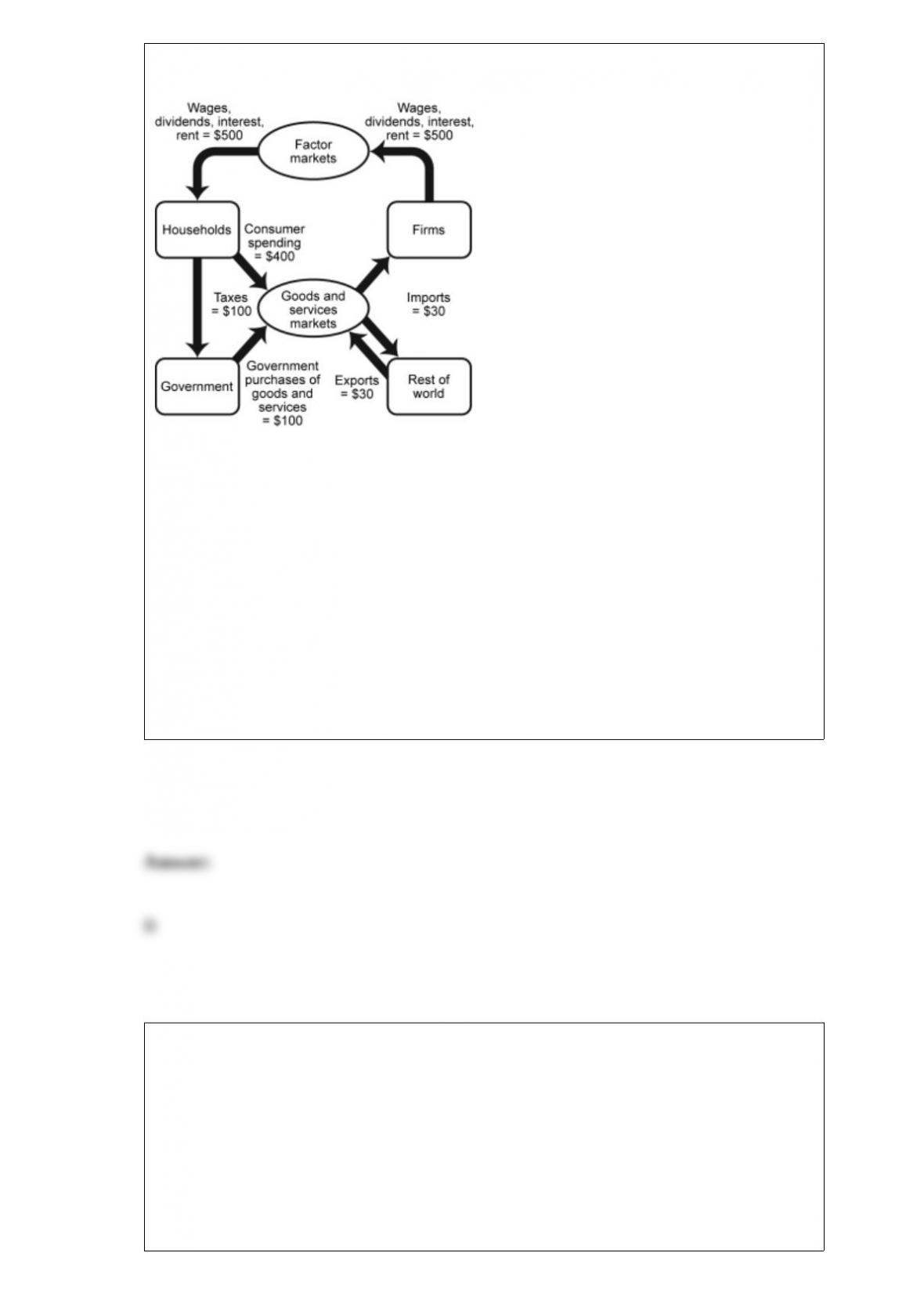
Figure: Circular-Flow Model
Look at the figure Circular-Flow Model. If the circular-flow model is in equilibrium
(the sum of money flowing into each box is equal to the sum of the money flowing out
of it) and there is an increase in investment spending, which of the following is likely to
happen?
A) a decrease in the nominal GDP
B) an increase in the nominal GDP
C) an increase in the unemployment rate
D) a decrease in the inflation rate
The phrase gains from trade refers to the:
A) profits obtained from sales of a good or service.
B) increase in total output that is realized when individuals specialize in particular tasks
and trade with each other.
C) gains that one obtains by taking advantage of an uninformed buyer and selling at a
higher than average price.

D) gains that one obtains by taking advantage of a temporary discount, or sale price.
Fiscal austerity is expansionary fiscal measures, such as increases in government
spending and decreases in taxes, designed to reduce unemployment.
A) True
B) False
Crowding out means:
A) private savings decreases when the government borrows money.
B) private investment decreases when the government borrows money.
C) there are too many players in the financial markets.
D) some bondholders will be squeezed out of the market.

The Taylor rule:
A) provides guidance for setting a federal funds rate target.
B) says that interest rates often should be negative.
C) provides guidance on timing of monetary policy with fiscal policy.
D) refers to a discretionary fiscal policy rule.
For most goods, purchases tend to rise with increases in buyers’ incomes and to fall
with decreases in buyers’ incomes. Such goods are known as:
A) inferior.
B) direct.
C) normal.
D) indirect.
The primary cause of the banking crises that occurred between 1970 and 2007 in poor
countries was_____. The primary cause in wealthy countries was _____.
A) too much government regulation; too much government regulation
B) too-high capital requirements; the purchase of too much government debt

C) too-low capital requirements; too-high capital requirements
D) corruption; real estate bubbles
Suppose the banking system does NOT hold excess reserves and the reserve ratio is
20%. If Sam deposits $500 cash in his checking account, the banking system can
increase the money supply by:
A) $5,000.
B) $2,000.
C) $2,500.
D) $400.
Refer to the table Balance of Payments. The country’s balance of payments on current
account is:

A) $355 billion.
B) “$395 billion.
C) $375 billion.
D) “$355 billion.
If actual output growth is 5% when potential output growth is 5%, then the
unemployment rate will:
A) not change.
B) rise.
C) fall.
D) be zero.
The _____ the future payment, the _____ its present value, all other things held
constant.
A) less; the more uncertain is
B) more; less

C) more; more
D) sooner; less
A beneficial technological change is developed in the production of cranberries. At the
same time, scientists discover that cranberries have significant health benefits. This will
result in:
A) an increase in both the equilibrium price and quantity in the cranberry market.
B) an increase in the equilibrium quantity and an uncertain effect on the equilibrium
price of cranberries.
C) a decrease in both the equilibrium price and quantity in the cranberry market.
D) a decrease in the equilibrium price and an uncertain effect on the equilibrium
quantity of cranberries.
Because classical economists stressed the long run, they:
A) perceived the economy as being mostly self-adjusting.
B) favored the use of fiscal policy over monetary policy.
C) expected the government to purge the rot from the system.
D) favored the use of monetary policy over fiscal policy.
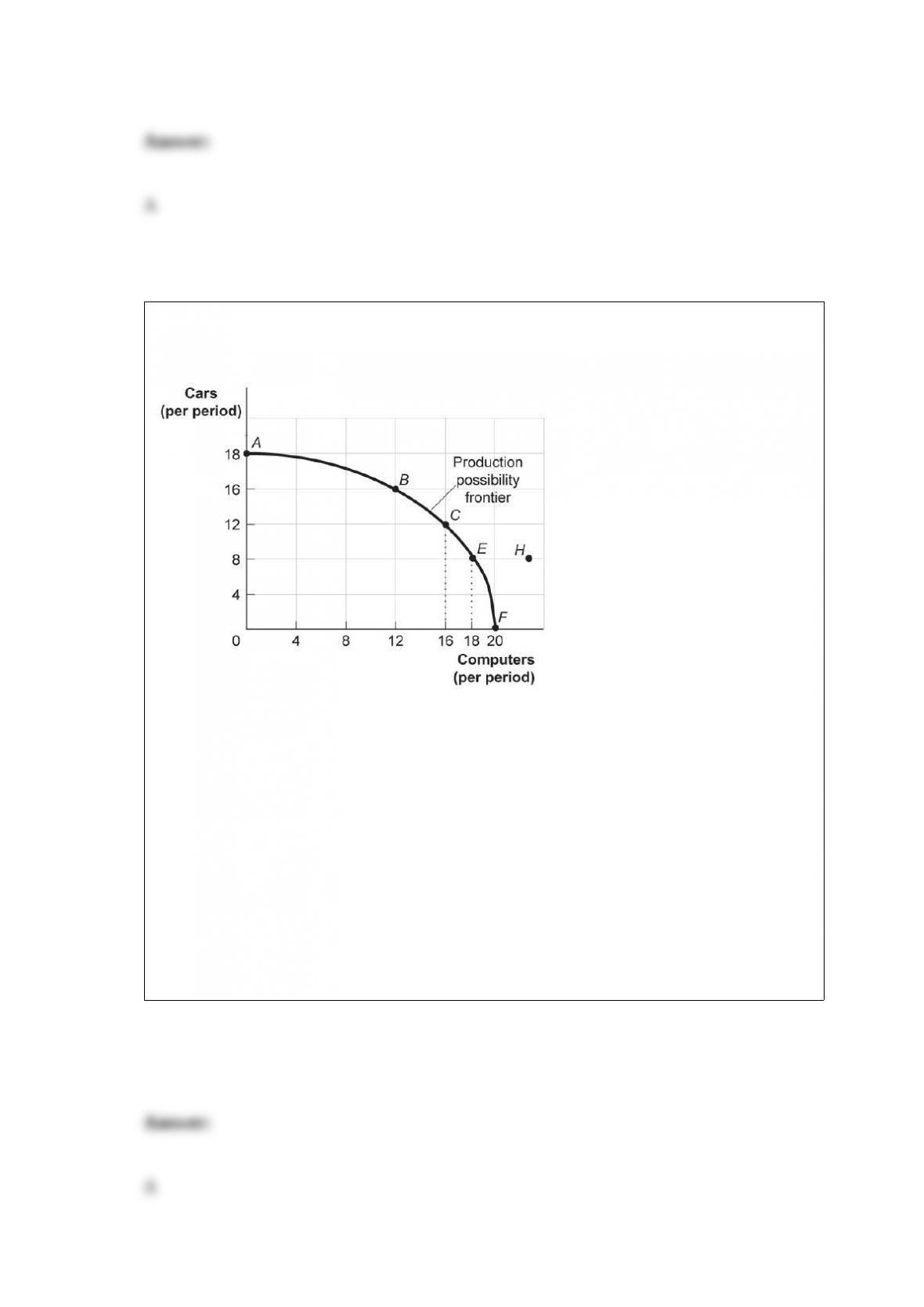
Figure: Production Possibility Frontier
Look at the figure Production Possibilities Frontier. Points A, B, E, and F:
A) indicate combinations of cars and computers that society can produce using all of its
resources efficiently.
B) show that the opportunity cost of cars increases as more cars are produced but that of
more computers decreases as more computers are produced.
C) indicate that society wants computers more than cars.
D) indicate constant opportunity costs for cars and increasing opportunity costs for
computers.

Between 1993 and 2013, the Mexican peso fell against the U.S. dollar by almost
three-fourths of its original value. However, economists have concluded that this did
not result in a corresponding fall in the price of Mexican products expressed in dollars.
What explains this apparent paradox?
A) Interest rates in the United States were increasing.
B) Inflation in the United States was moving up steadily.
C) The inflation rate in Mexico over that same period was higher than that of the United
States.
D) The real exchange rate had fallen.
The long-run Phillips curve is vertical at the nonaccelerating inflation rate of
unemployment (NAIRU) because an unemployment rate _____ the NAIRU will lead to
_____ inflation.
A) below; ever-accelerating
B) equal to; zero
C) above; ever-accelerating
D) below; ever-decelerating
The fact that two variables always move together over time:

A) does not prove that one of the variables is dependent on the other.
B) proves that one of the variables is dependent on the other.
C) proves that changes in one variable cause changes in the other.
D) is often illustrated or depicted using either a pie chart or a bar chart.
When you buy a ticket to the rodeo, you are using money as mainly a(n):
A) expander of economic activity.
B) store of value.
C) factor of production.
D) medium of exchange.