1) because of their large-scale level of production, pure monopolists overallocate
resources to their industry by producing beyond the p = mc output.
2)
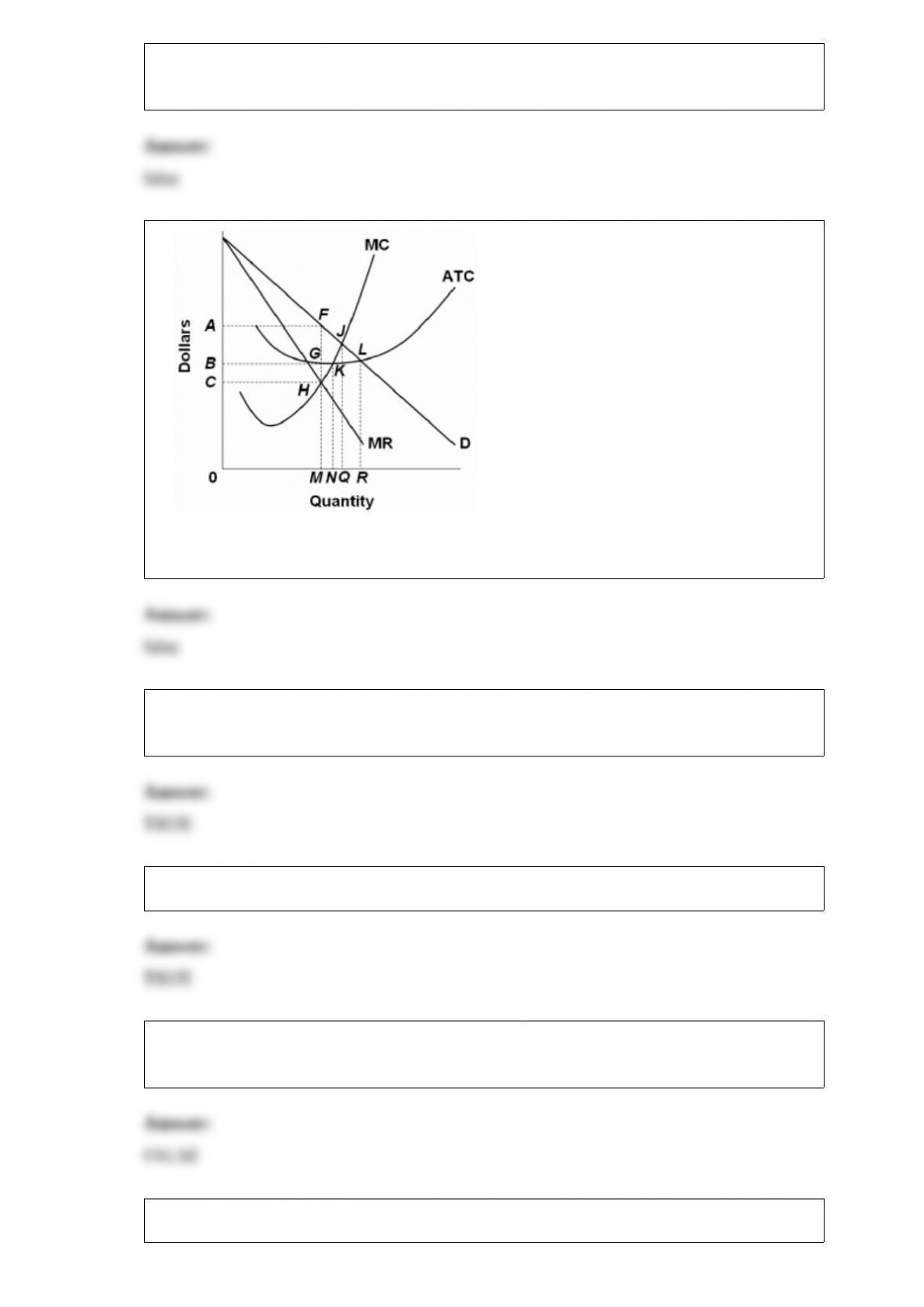
refer to the above diagram for a nondiscriminating monopolist. at output q production
will be unprofitable.
3) The free-land era of U.S. history reflected a situation in which the quantity of land
available at a zero price exceeded the quantity of land demanded.
4) In the extended AD-AS model, the long-run aggregate supply curve is vertical.
5) The presence of an agency shop requires all workers to join the union within the first
30 days of employment.
6) According to the inverted-U theory of R&D, other things equal, firms in industries

with concentration ratios around 10 percent will be more technologically progressive
than firms in industries with 50 percent concentration ratios.
7) the short-run supply curve slopes upward because producers must be compensated
for rising marginal costs.
8) Which of the following is not an example of a market imperfection that might
explain persistent wage differentials within an occupation?
A.geographic immobility of workers
B.discrimination
C.noncompeting groups
D.poor information about job opportunities and pay
9) assume an economy is incurring unemployment. the effect of resolving this problem
will be to:
a.move the level of actual output to the economy’s production possibilities curve.
b.create a less equal distribution of income.
c.shift its production possibilities curve to the left.
d.shift its production possibilities curve to the right.
10) which of the following concepts provides the basic rationale for international trade?
a.increasing opportunity costs.
b.consumer sovereignty.
c.comparative advantage.
d.the law of supply.
11) The supply-side anecdote about the 10 breakfast diners illustrates that:
A.people who pay the highest taxes get the least benefit from a tax reduction.
B.tax cuts are distributed evenly across the population.
C.unintended consequences may result from redistributing tax reductions at the expense
of those paying the highest taxes.
D.a tax cut would stimulate economic growth.
12) Suppose that, as expected, aggregate demand in the economy sharply declines. New
classical economists say that the price level will _____________ and real output will
____________.
A.fall; remain constant
B.rise; remain constant
C.remain constant; fall
D.remain constant; rise
13) the market system’s answer to the fundamental question “who will get the goods
and services?” is essentially:
a.”those willing and able to pay for them.”
b.”those who physically produced them.”
c.”those who most need them.”
d.”those who get utility from them.”
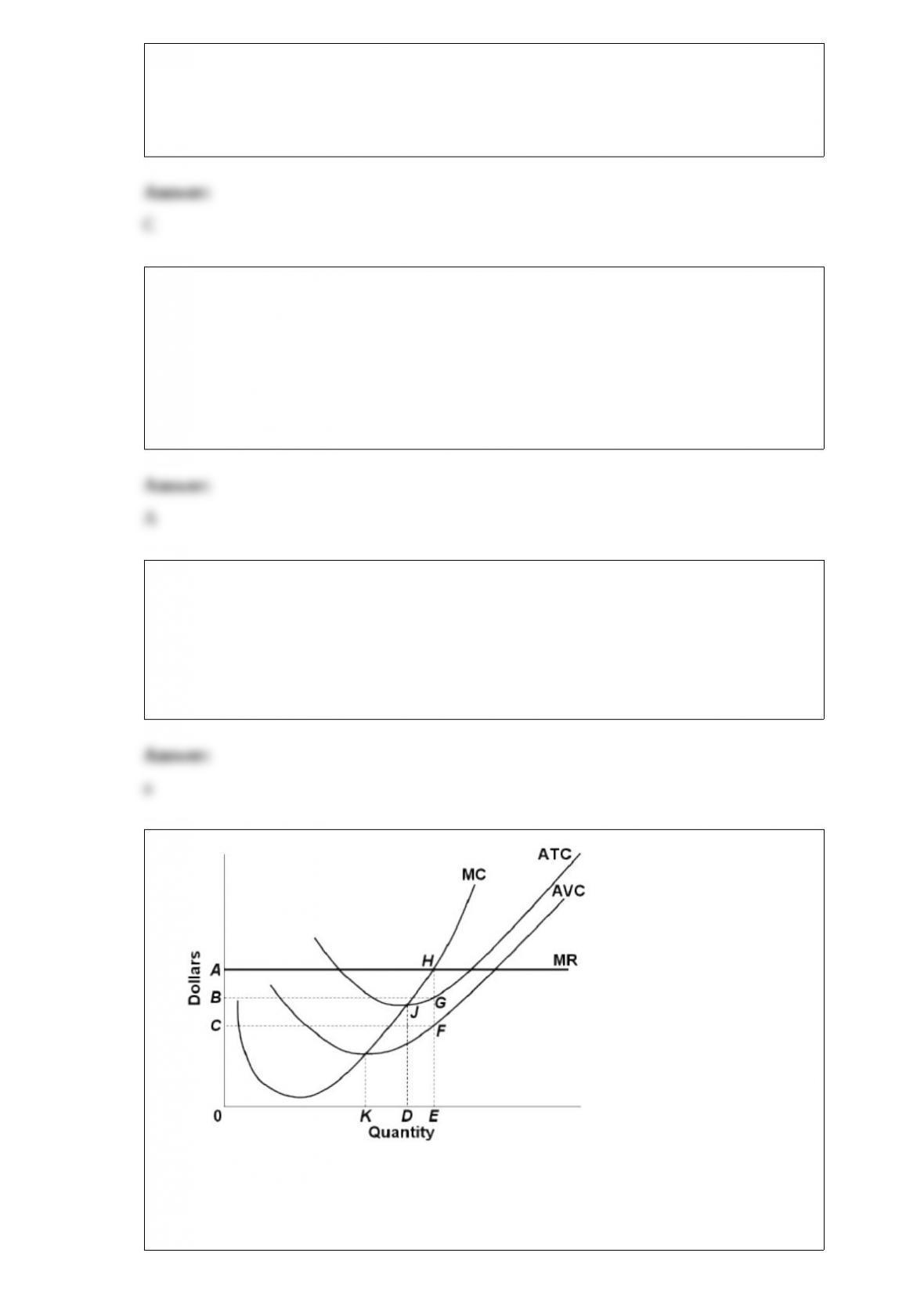
14)
refer to the above diagram. at the profit-maximizing output, total fixed cost is equal to:
a.0ahe
b.0bge
c.0cfe

d.bcfg
15) It is costly to hold money because:
A.deflation may reduce its purchasing power.
B.in doing so one sacrifices interest income.
C.bond prices are highly variable.
D.the rate at which money is spent may decline.
16) graphically, the market demand curve is:
a.steeper than any individual demand curve that is part of it.
b.greater than the sum of the individual demand curves.
c.the horizontal sum of individual demand curves.
d.the vertical sum of individual demand curves.
17) The equilibrium GDP is the level of domestic output:
A.where consumption equals saving.
B.where actual investment equals consumption.
C.which is sustainable.
D.where full employment exists.
18) joe sold gold coins for $1000 that he bought a year ago for $1000. he says, “at least
i didn’t lose any money on my financial investment.” his economist friend points out
that in effect he did lose money, because he could have received a 3 percent return on
the $1000 if he had bought a bank certificate of deposit instead of the coins. the
economist’s analysis in this case incorporates the idea of:
a.opportunity costs.
b.marginal benefits that exceed marginal costs.
c.imperfect information.
d.normative economics.
19)
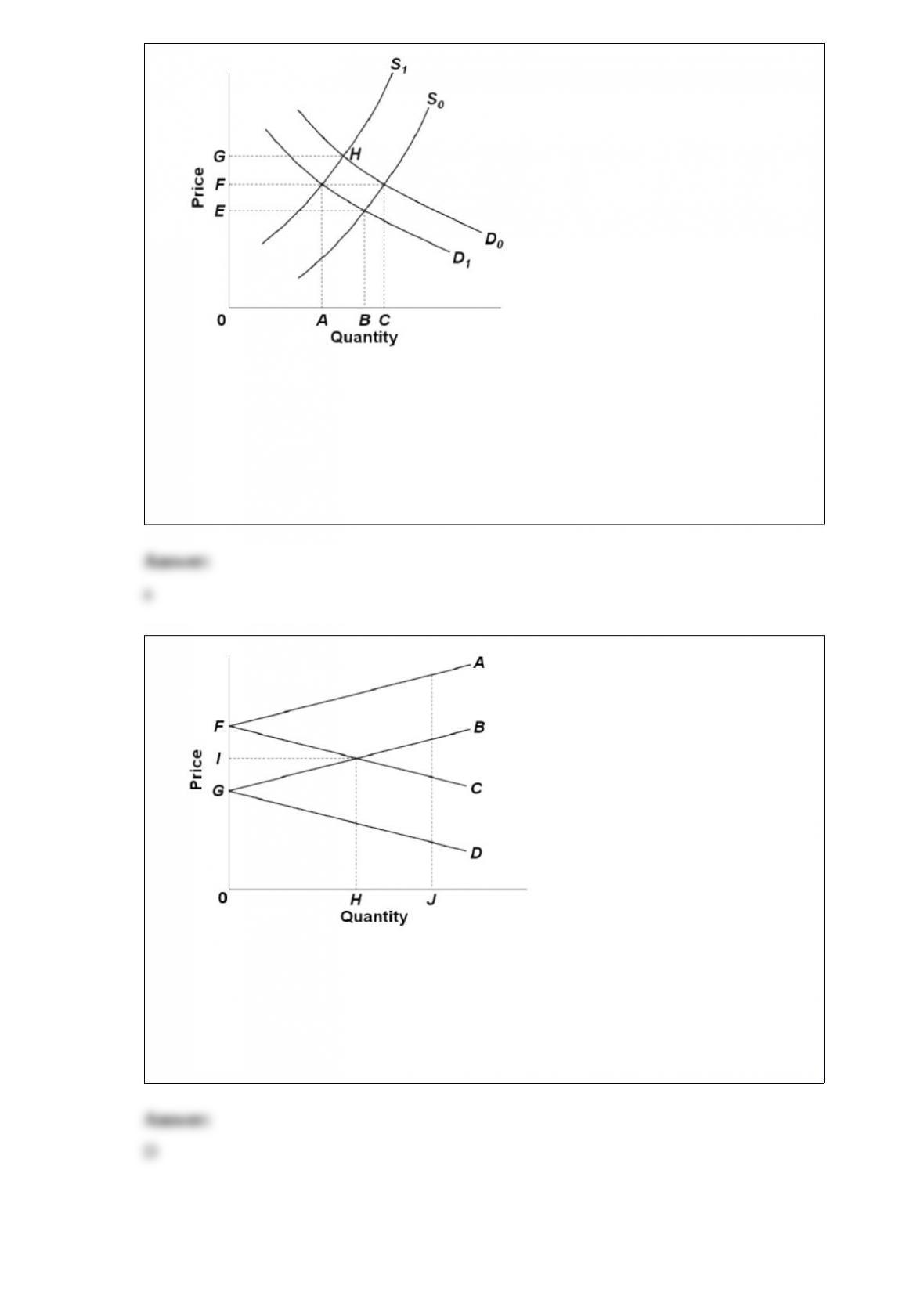
refer to the above diagram, which shows demand and supply conditions in the
competitive market for product x. if the initial demand and supply curves are d0 and s0,
equilibrium price and quantity will be:
a.0f and 0c respectively.
b.0g and 0b respectively.
c.0f and 0a respectively.
d.0e and 0b respectively.
20)
Refer to the above diagram pertaining to two nations and a specific product. Lines FA
and GB are:
A.domestic supply curves for two countries.
B.domestic demand curves for two countries.
C.import demand curves for two countries.
D.export supply curves for two countries.
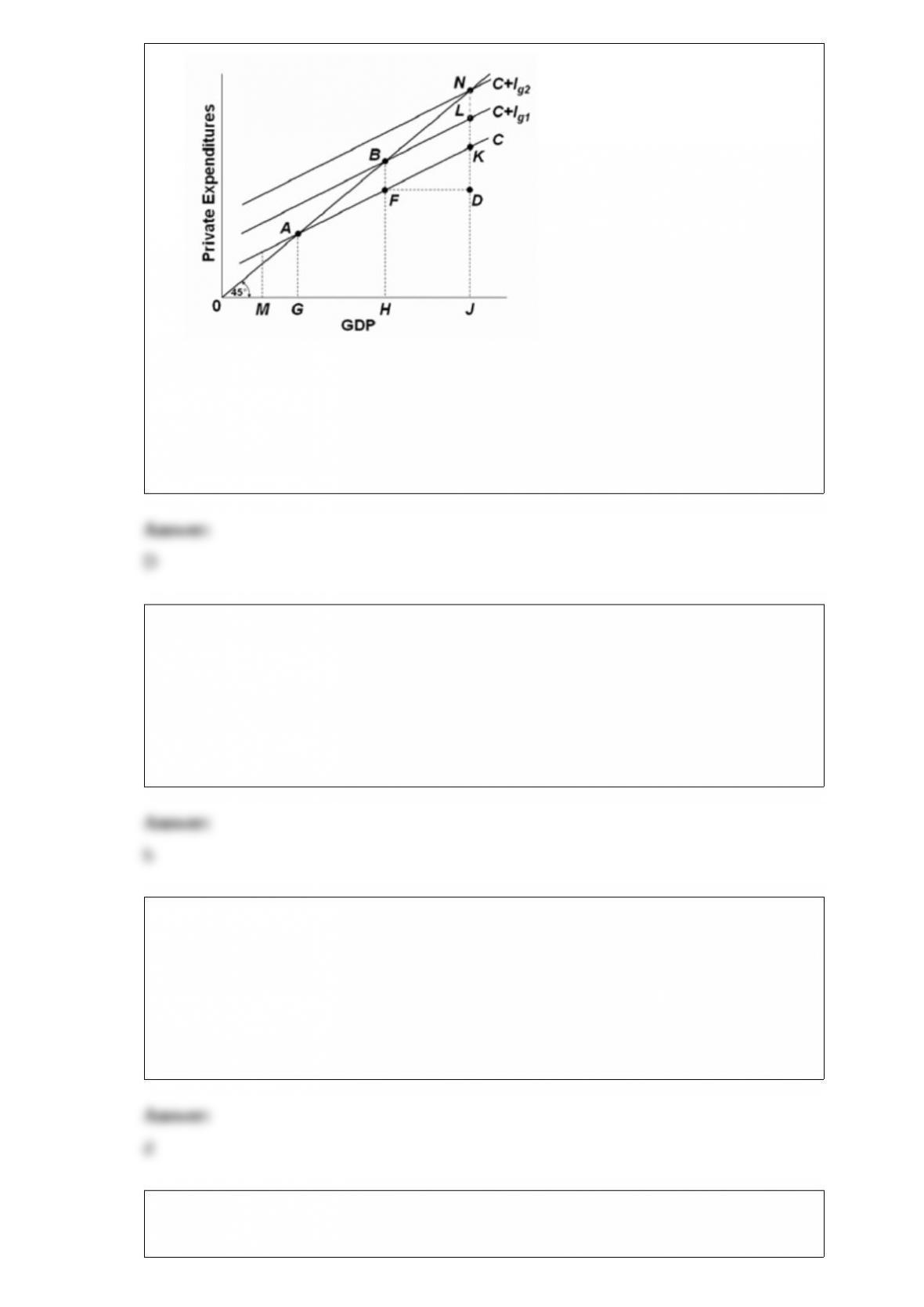
21)
Refer to the above diagram that applies to a private closed economy. If gross investment
is Ig 1, the equilibrium GDP and the level of consumption will be:
A.H and HB respectively.
B.J and JI respectively.
C.J and JK respectively.
D.H and HF respectively.
22) assume a purely competitive increasing-cost industry is initially in long-run
equilibrium and that an increase in consumer demand occurs. after all economic
adjustments have been completed product price will be:
a.lower, but total output will be larger than originally.
b.higher and total output will be larger than originally.
c.lower and total output will be smaller than originally.
d.higher, but total output will be smaller than originally.
23) which of the following statements is correct?
a.the u.s. population has increased more rapidly than real gdp in recent decades.
b.improved education and training of labor is the most important source of u.s.
productivity growth.
c.the average american factory worker has about 16 years of formal education.
d.the amount of real capital used per worker has increased historically in the united
states.
24) which of the following statements is correct?
a.the demand curve for a purely competitive firm is perfectly elastic, but the demand
curve for a purely competitive industry is downsloping.
b.the demand curve for a purely competitive firm is downsloping, but the demand curve
for a purely competitive industry is perfectly elastic.
c.the demand curves are downsloping for both a purely competitive firm and a purely
competitive industry.
d.the demand curves are perfectly elastic for both a purely competitive firm and a
purely competitive industry.
25) Approximately what percent of the world’s income is received by the poorest
one-fifth of the world’s population?
A.2
B.5
C.7
D.10
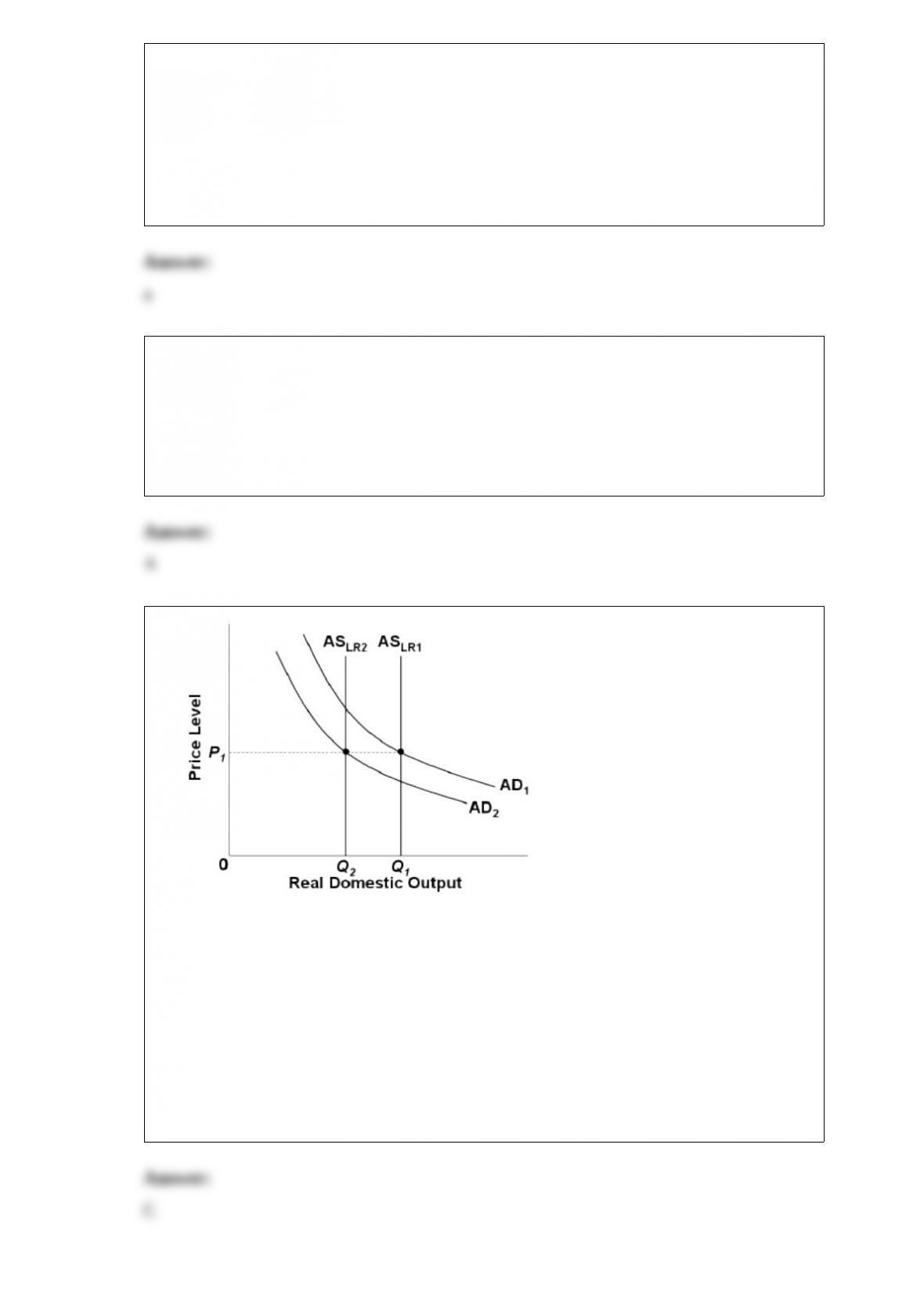
26)
Refer to the above diagram. The real-business cycle view of recession would best be
described by:
A.a decrease of aggregate demand from AD1 to AD2, followed by a decrease in
aggregate supply from ASLR1 to ASLR2.
B.an increase in aggregate demand from AD1 to AD2, which in turn caused a decrease
in aggregate supply from ASLR1 to ASLR2.
C.a decrease in aggregate supply from ASLR1 to ASLR2, followed by a decrease in
aggregate demand from AD1 to AD2.
D.a decrease in aggregate supply from ASLR1 to ASLR2, followed by an increase in
aggregate demand from AD2 to AD1.
27) What is the magnitude of the differences in GDP per capita between industrially
advanced countries and developing countries?
28) Evaluate the statement: A market that produces an identical product cannot be
become an oligopoly.
29) The magnitude and nature of the problems faced by the developing countries gives
socialism or communism an inside track over capitalism as a model for development.
Evaluate.

30) A pure monopolist determines that at the current level of output the marginal cost of
production is $2.00, average variable costs are $2.75, and average total costs are $2.95.
The marginal revenue is $2.75. What would you recommend that the monopolist do to
maximize profits?
31) Explain the reasoning behind the shape of the short-run aggregate supply curve.