
Accounting profit minus implicit costs equals:
A. total revenues.
B. economic profit.
C. explicit costs.
D. fixed costs.
The market value of a particular bond at any given point in time is called the bond’s:
A. coupon rate.
B. principal
C. term.
D. price
Alex, who is risk-neutral, is looking for an one-bedroom apartment to rent for the
month of August while he’s on vacation in Seattle. All of the one-bedroom apartments

in the neighborhood where he wants to stay are of equal quality, but 70 percent rent for
$700 per month, 20 percent rent for $600 per month, and 10 percent rent for $500 per
month. The first apartment Alex finds rents for $700 per month. Suppose Alex is
risk-neutral. If the cost to Alex of searching for another apartment is $30, then will he
search for another apartment?
A. No, because searching for another apartment is a less-than-fair gamble.
B. Yes, because searching for another apartment is a better-than-fair gamble.
C. No, because searching for another apartment is a fair gamble.
D. Yes, because searching for another apartment is a fair gamble.
Refer to the figure below.
Based on the figure, and starting from an initial short-run equilibrium where output
equals 20,000, if autonomous consumption spending decreases by 1,000, then the new
short-run equilibrium output (Y) is equal to:
A. 24,000.
B. 16,000.
C. 14,000.
D. 22,000.

When your grandfather keeps a bundle of $100 dollar bills behind a brick in the
basement, this is an example of dollars serving as:
A. bank reserves.
B. a medium of exchange.
C. a unit of account.
D. a store of value.
If the cross-price elasticity of demand between two goods is -1.2, then the two goods
are:
A. inferior.
B. elastically demanded.
C. complements.
D. substitutes.

Research confirms that government provision of infrastructure:
A. hinders economic growth.
B. promotes economic growth.
C. increases human capital.
D. leads to reduced spending on research and development.
The slope of the consumption function:
A. is vertical.
B. is horizontal.
C. equals 1.
D. equals the marginal propensity to consume.
Refer to the figure above. A decrease in demand is represented by shifting from:
A. curve A to curve B.

B. curve B to curve A.
C. curve C to curve D.
D. curve D to curve C.
Last year, Casey grew fresh vegetables, which she sold at her local farmers market, but
this year, Casey did not plant any vegetables and went to work at a bank instead. If
Casey’s decision to change careers did not affect the price of vegetables at the farmers
market, then this suggests that:
A. the demand for vegetables did not change.
B. the market for vegetables is perfectly competitive.
C. the demand for vegetables increased this year.
D. the market demand for vegetables is perfectly inelastic.
If the CPI equaled 1.00 in 1995 and 1.65 in 2005 and a typical household’s income
equaled $35,000 in 1995 and $40,000 in 2005, then between 1995 and 2005, real
household income:
A. increased.

B. decreased.
C. was constant.
D. may have either increased or decreased.
Suppose a private monopolist is supplying a good that is nonrival but excludable. The
market demand for the good is P = 24 – 3Q. If the marginal cost of providing this good
is zero, but the firm charges $18, then the monopolist will provide ______ units, and the
efficient number of units is ______.
A. 2; 8
B. 6; 8
C. 2; 2
D. 4; 2
Total taxes minus transfer payments minus government interest payments is called:
A. a budget surplus.
B. net taxes.
C. a budget deficit.

D. national saving.
A demand curve that is drawn as a vertical line has a price elasticity of demand equal
to:
A. 0.
B. 1.
C. infinity.
D. the quantity.
Duke is a highly skilled negotiator who could work for many law firms. The law firm
that hires Duke is able to collect twice as much revenue per hour of Duke’s time than it
can for any other negotiator in town. The increased revenue will:
A. be evenly split between Duke and the law firm to maximize surplus.
B. all go to the law firm because the firm bears the risk of running the business.

C. all go to Duke because, if it didn’t, another firm could hire Duke away.
D. be split between Duke and the law firm, but how it will be split cannot be
determined without more information.
Pat pays $10,000 for a newly issued two-year government bond with a $10,000 face
value and a 6 percent coupon rate. One year later, after receiving the first coupon
payment, Pat sells the bond. If the current one-year interest rate on government bonds is
5 percent, then the price Pat receives is:
A. $10,000.
B. $500.
C. greater than $10,000.
D. less than $10,000.
Suppose manufacturers introduce a new model car to replace a car currently included in
the CPI basket. The price of the new car is 10 percent higher than the discontinued
model, but the new car has additional safety features and amenities. In this situation the
CPI will tend to ______ inflation as a result of ______ bias.
A. overstate; substitution
B. understate; quality adjustment
C. accurately measure; substitution
D. overstate; quality adjustment
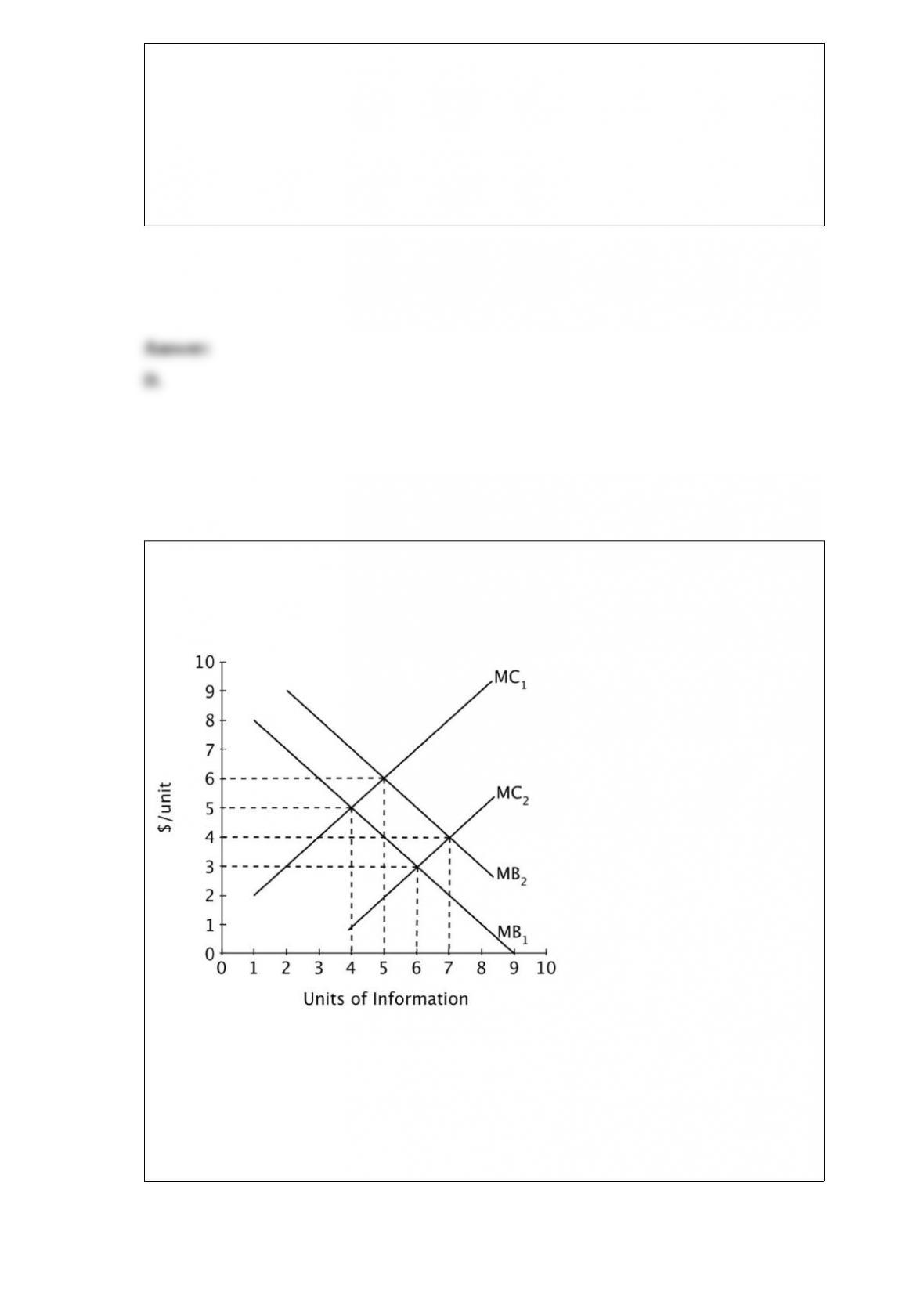
Refer to the figure below. If the relevant curves are MC1 and MB2, a rational consumer
will acquire ______ units of information, the amount for which marginal benefit for
information is ______ its marginal cost.
A. 4; equal to
B. 4; more than
C. 5; more than
D. 5; equal to

Suppose a firm’s total revenue is $100 when it sells 10 units, and $110 when it sells 11
units. The firm, therefore, is a(n):
A. pure monopolist.
B. oligopolist.
C. monopolistic competitor.
D. perfect competitor.
A sudden increase in household wealth is an example of a ______ demand shock, which
shifts the AD curve to the ______.
A. negative; left
B. positive; left
C. negative; right
D. positive; right

Refer to the figure below. At the private market equilibrium quantity, the marginal cost
of the last unit produced is ______ the social marginal benefit of the last unit produced.
A. equal to
B. greater than
C. less than
D. more important than
As the dollar exchange rate, e, increases, the quantity of dollars supplied in the foreign
exchange market ____, and the quantity of dollars demanded in the foreign exchange
market ____.
A. increases; increases
B. increases; decreases
C. decreases; increases
D. decreases; decreases

The table below gives the quantities and prices for 2000 and 2010 for an economy that
produces just two goods: sailboats and coconuts.
For this economy that produces just sailboats and coconuts, and with 2000 is the base
year, nominal GDP was approximately ______ times larger in 2010 than it was in 2000.
A. 1.34
B. 1.65
C. 1.77
D. 2.19
Hotelling’s model has been used to describe differentiation in the political “market.”
Suppose that 100 voters are evenly distributed between the extreme left and the extreme
right on the political spectrum, and that all voters vote, and they always vote for the
candidate closest to them on this spectrum. The numbers on this spectrum represent the
number of voters lying to the left of the number. So, at the midpoint, fifty voters lie to
the left and fifty to the right. At the extreme right end, all 100 voters lie to the left.
Suppose Candidate X is running against Candidate Y. If Candidate Z enters the race:
A. approximately half of the voters who were going to vote for X will now vote for Z.
B. X will win because Y and Z will be competing for the same voters.
C. all of the voters who were going to vote for Y will now vote for Z.
D. most of the voters who were going to vote for Y will now vote for Z.
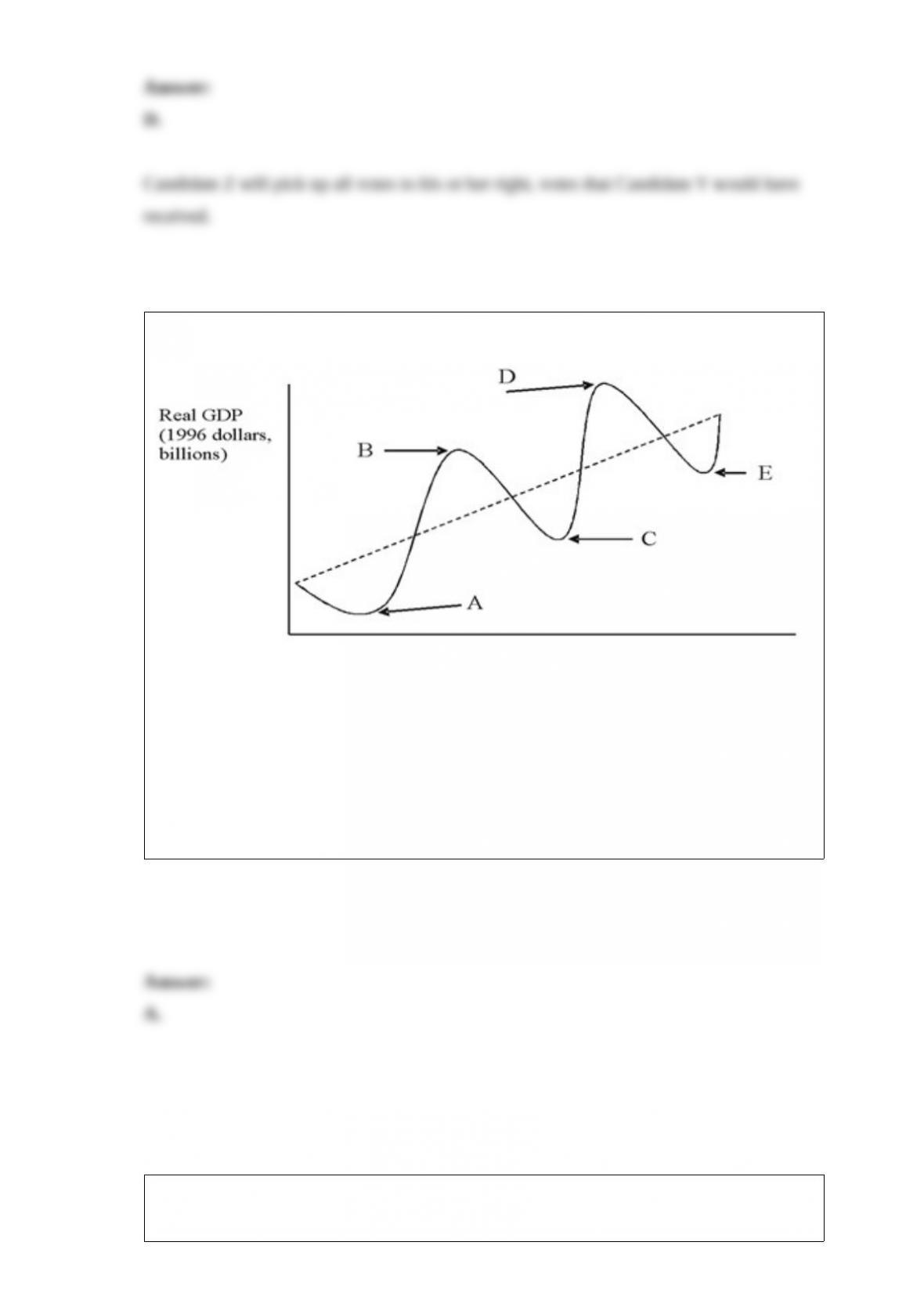
Refer to the figure below.
In the figure, which interval represents a business cycle expansion?
A. A to B
B. B to C
C. A to C
D. B to D
According to the Manning study, people with $1,000-deductible health care coverage
had:

A. better health outcomes than those with first-dollar coverage.
B. the same health outcomes as those with first-dollar coverage.
C. worse health outcome than those with first-dollar coverage.
D. worse health outcomes than those with no insurance coverage.
A government policy of providing free public education is an example of a policy to
promote economic growth by:
A. increasing human capital.
B. increasing physical capital.
C. improving technology.
D. increasing the availability of natural resources.
If real GDP per person in a country equals $40,000 and 60 percent of the population is
employed, then average labor productivity equals:
A. $24,000.
B. $40,000.

C. $60,000.
D. $66,667.
Suppose the price of a Snickers candy bar is $2.00 at both the airport and the grocery
store. The price elasticity of demand for a Snickers candy bar at an airport is likely to be
______ the price elasticity of demand for a Snickers candy bar at the grocery store.
A. less than
B. equal to
C. greater than
D. the reciprocal of
When real output decreases, planned aggregate expenditures decrease because:
A. autonomous expenditures increase.
B. autonomous expenditures decrease.

C. induced expenditures increase.
D. induced expenditures decrease.