1) Consider the following payoff matrix in which the numbers indicate the profit in
millions of dollars for a duopoly based either on a high-price or a low-price strategy.
(a)What will be the result when each firm chooses a high-price strategy?
(b)What will be the result when Firm A chooses a low-price strategy while Firm B
maintains a high-price strategy?
(c)What will be the result when Firm B chooses a low-price strategy while Firm A
maintains a high-price strategy?
(d)What will be the result when each firm chooses a low-price strategy?
(e)What two conclusions can you draw about collusion?
2) net exports are negative when:
a.a nation’s imports exceed its exports.
b.the economy’s stock of capital goods is declining.
c.depreciation exceeds domestic investment.
d.a nation’s exports exceed its imports.
3)
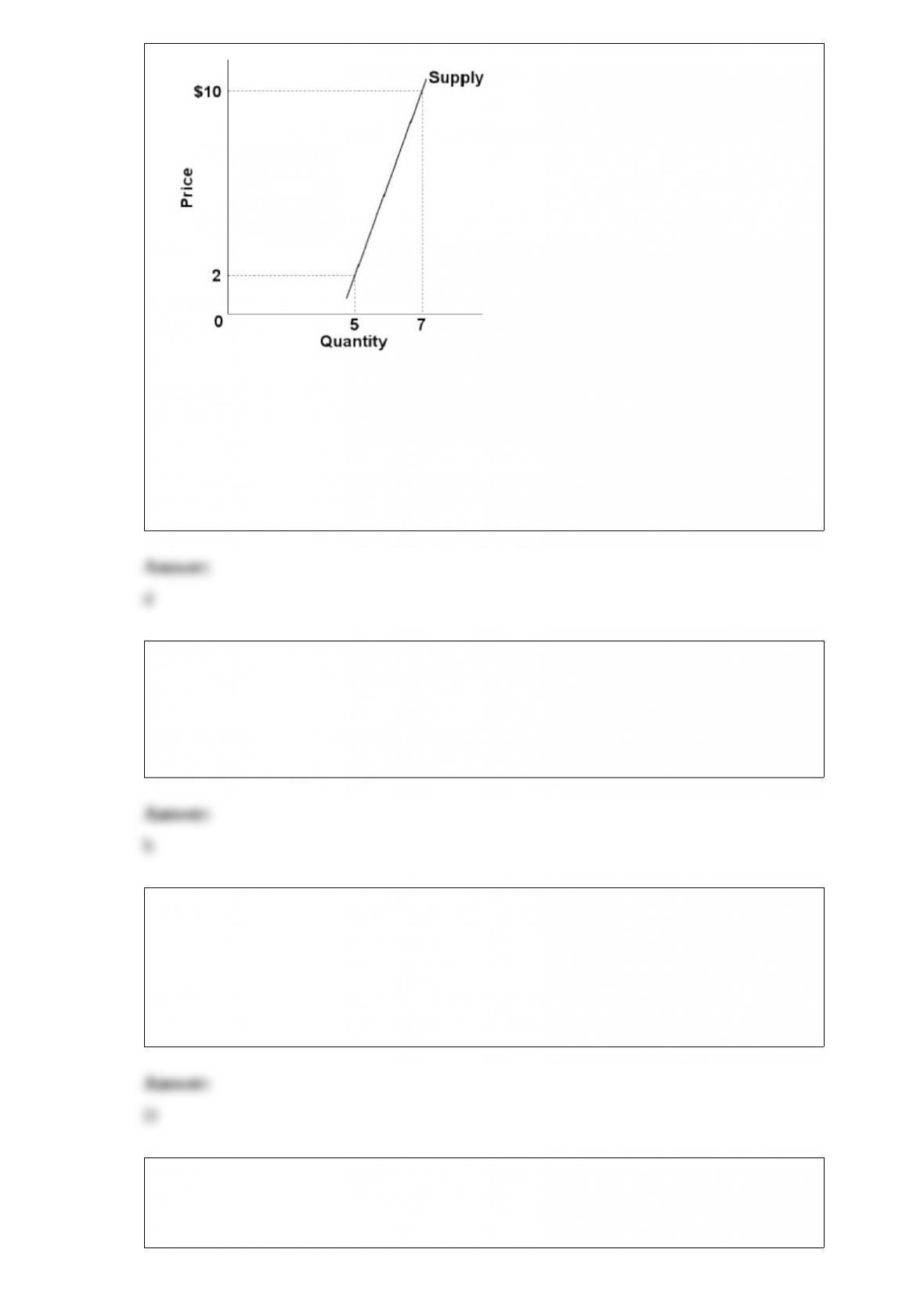
refer to the above diagram and assume that price decreases from $10 to $2. the
coefficient of the price elasticity of supply (midpoints formula) relating to this price
change is about:
a.4 and supply is elastic.
b.1 and supply is unit elastic.
c..5 and supply is inelastic.
d..25 and supply is inelastic.
4) an explicit cost is:
a.omitted when accounting profits are calculated.
b.a money payment made for resources not owned by the firm itself.
c.an implicit cost to the resource owner who receives that payment.
d.always in excess of a resource’s opportunity cost.
5) The profit-maximizing and the least-cost combination of inputs are:
A.the result of unrelated decisions.
B.always identical.
C.such that the minimization of costs always results in profit maximization.
D.such that the maximization of profits always entails the least-cost combination of
inputs.
6) The ability of the DVCs to use the technologies of the IACs is somewhat limited
because:
A.the IACs have patents on most of their technologies.

B.the IACs and the DVCs have much different resource endowments.
C.the technologies of the IACs rely heavily on unskilled labor.
D.IAC technologies are labor-intensive, while DVC technologies are capital-intensive.
7) the following demand schedule:
refer to the above data. if this demand schedule were graphed, we would find that:
a.its slope diminishes as we move southeast down the curve.
b.its slope diminishes as we move northwest up the curve.
c.its slope is constant throughout.
d.the data is inconsistent with the law of demand.
8) the market system’s answer to the fundamental question “what will be produced?” is
essentially:
a.”goods and services that are profitable.”
b.”low cost goods and services.”
c.”goods and service that can be produced using large amounts of capital.”
d.”goods and services that possess lasting value.”
9) which of the following statements is true about the effects of illegal immigration in
the united states?
a.illegal immigrant workers displace domestic-born workers on a one-for-one basis.
b.illegal immigration has a negative fiscal impact that falls most heavily on state and
local governments.
c.illegal immigration negatively impacts wages and the standard of living for all
domestic-born workers.
d.all of these are true.
10) (Last Word) ATMs and human bank tellers:
A.are substitute resources.
B.are capital goods.
C.have both declined in number because of bank mergers.
D.are complementary resources.
11) (1) The composite index of leading indicators turns downward for three consecutive
months, suggesting the possibility of a recession; (2) Economists reach agreement that
the economy is moving into a recession; (3) A tax cut is proposed in Congress; (4) The
tax cut is passed by Congress and signed by the President; (5) Consumption spending
begins to rise, aggregate demand increases, and the economy begins to recover.
Refer to the above information. The administrative lag of fiscal policy is reflected in
events:
A.1 and 2.
B.2 and 3.
C.3 and 4.
D.4 and 5.
12)
Refer to the above diagram for a private closed economy. The upward shift of the
aggregate expenditures schedule from (C + Ig)1 to (C + Ig) 2 reflects:
A.an increase in investment expenditures.
B.a decrease in consumption expenditures.
C.an increase in the MPC.
D.an increase in the APS.

13) The Federal Reserve Banks buy government securities from commercial banks. As
a result, the checkable deposits:
A.of commercial banks are unchanged, but their reserves increase.
B.and reserves of commercial banks both decrease.
C.of commercial banks are unchanged, but their reserves decrease.
D.and reserves of commercial banks are both unchanged.
14) Which of the following statements is correct? Other things equal:
A.a decline in real output will shift both the transactions demand curve for money and
the total money demand curve to the right.
B.a decline in the interest rate will shift the asset demand curve for money to the right,
but leave the total money demand curve unchanged.
C.deflation will shift both the transactions demand curve for money and the total money
demand curve to the left.
D.inflation will shift the transactions demand curve for money to the right, but leave the
total money demand curve unchanged.
15) Suppose that in an economy with a MPC of .8 the government wanted to shift the
aggregate demand curve leftward by $40 billion at each price level to remedy
demand-pull inflation. It could:
A.increase taxes by $10 billion.
B.reduce government spending by $40 billion.
C.reduce government spending by $5 billion.
D.increase taxes by $20 billion.
16) Assume that the coefficient of elasticity of product demand is 0.5 in industry A and
is 3.2 in industry B. Other things equal, labor demand will be:
A.more elastic in industry A than in B.
B.unit elastic in both industry A and B.
C.more elastic in industry B than in A.
D.relatively inelastic in both industry A and B.
17) diseconomies of scale means that:

a.a firm’s long-run average total cost curve is declining.
b.a firm’s long-run average total cost curve is rising.
c.the advantages of specialization are being more fully realized.
d.a given increase in inputs results in a more-than-proportionate increase in output.
18) which of the following statements is correct?
a.an increase in the price of c will decrease the demand for complementary product d.
b.a decrease in income will decrease the demand for an inferior good.
c.an increase in income will reduce the demand for a normal good.
d.a decline in the price of x will increase the demand for substitute product y.
19) Which of the following represents an uninsurable risk to a business firm?
A.the possibility that its warehouse will burn down
B.the possibility that several of its workers will be injured at work
C.the possibility that an adverse change in consumer tastes will decrease the demand
for the firm’s product
D.the possibility that a tornado will damage the plant and stop production for a month
20) According to monetarists, a change in the money supply changes:
A.the velocity of money which in turn changes the nominal GDP.
B.investment spending which in turn changes the nominal GDP.
C.the interest rate which in turn changes the nominal GDP.
D.aggregate demand which in turn changes the nominal GDP.
21) Explain what is needed for optimal harvesting of a forest. How do changes in
economic incentives and structures affect present and future decisions?
22) What is the Herfindahl index and how is it calculated?
23) Draw a graph of the cost curves for a monopolistically competitive firm that clearly
illustrates the excess capacity that arises in the long run. Explain why this excess
capacity arises.
24) Why is workplace safety often an information failure? Explain.
25) What is the probable incidence of the personal income tax?
26) Why is the overall world population still increasing? What are the expectations for
population growth in the future?
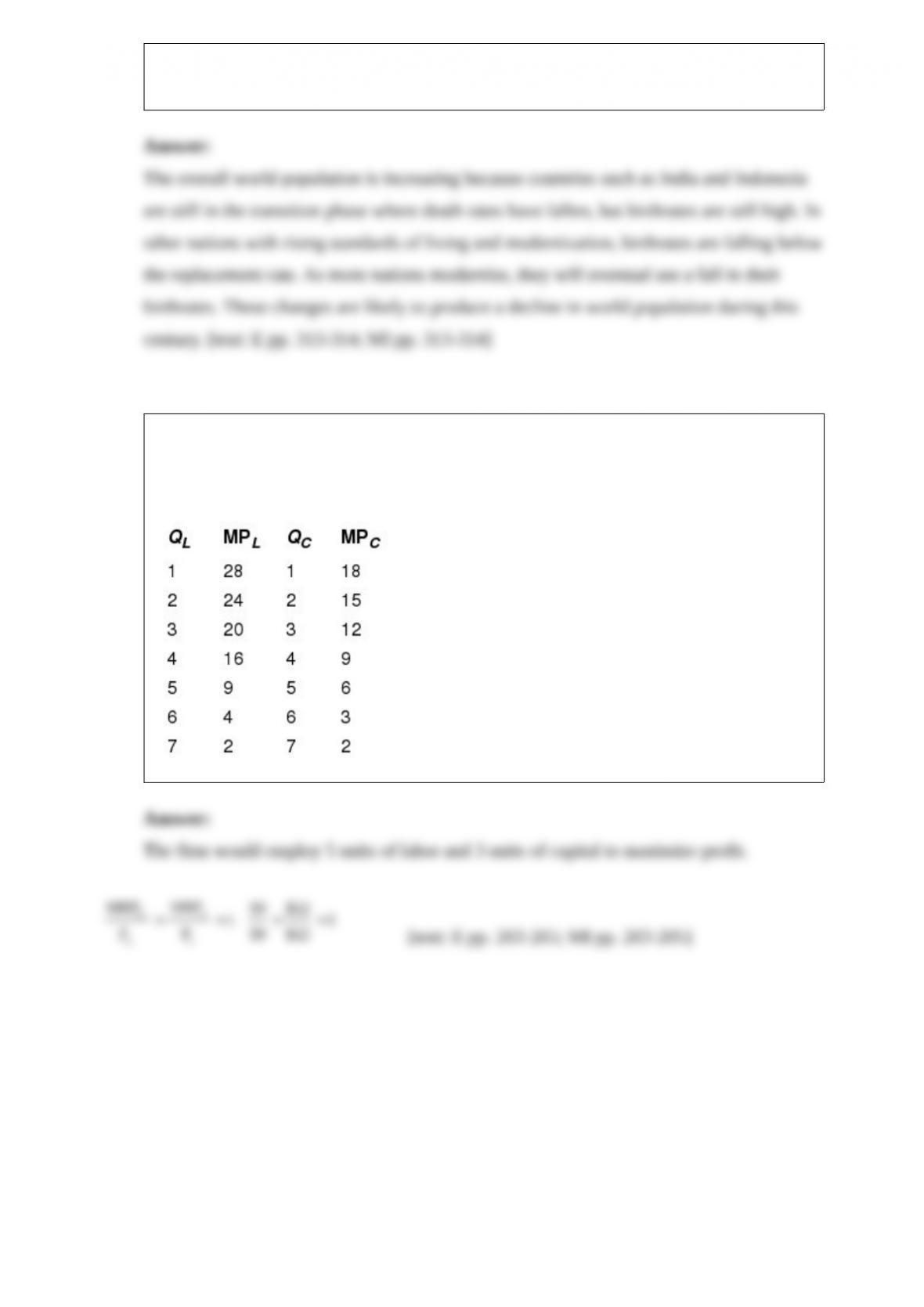
27) A perfectly competitive firm in the factor and product markets sells its output for $1
and pays factors PL = $9 and Pc = $12. What is the profit-maximizing combination of
labor (L) and capital (C) for the firm?