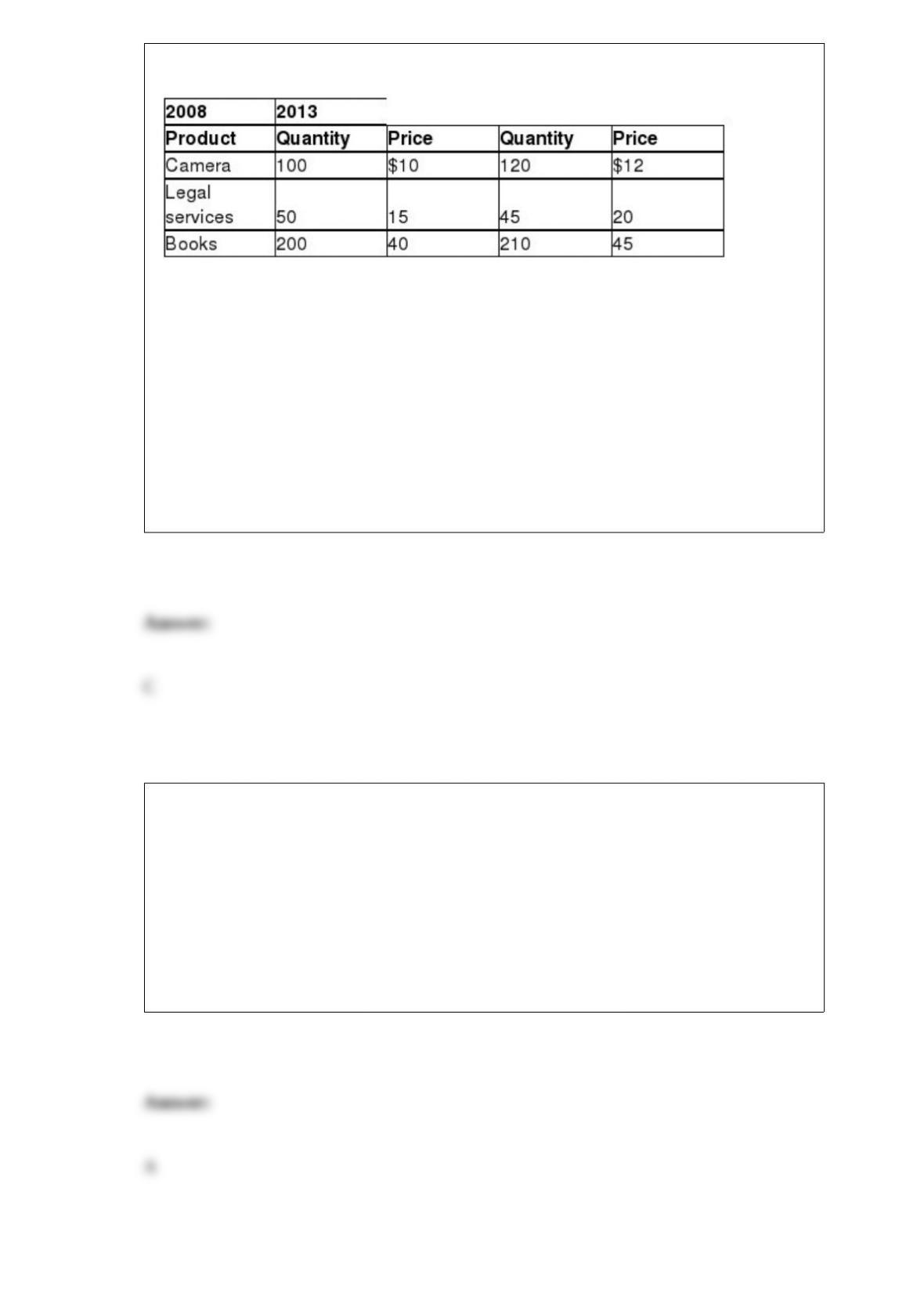
Table 19-18
A very simple economy produces three goods: cameras, legal services, and books. The
quantities produced and their corresponding prices for 2008 and 2013 are shown in the
table above. What is the GDP deflator in 2013 if 2013 is the base year?
A) 120
B) 118
C) 100
D) 87
A tax imposed by a government on imports of a good into a country is called a
A) tariff.
B) quota.
C) value added tax.
D) sales tax.
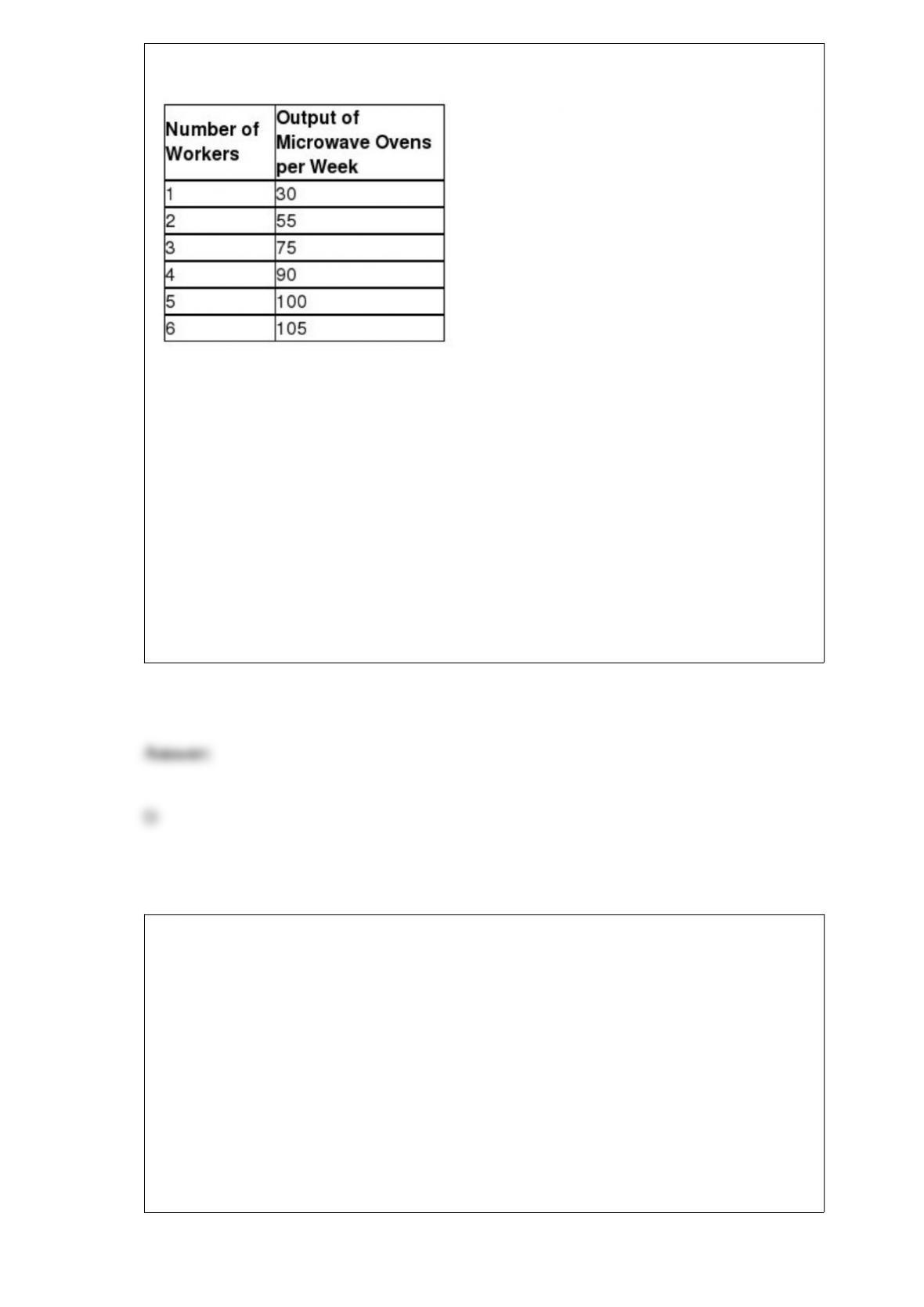
Table 17-3
Hotspur Incorporated, a manufacturer of microwave ovens, is a price taker in its input
and output markets. The firm hires labor at a constant wage rate of $800 per week and
sells microwave ovens at a constant price of $80. Table 17-3 shows the relationship
between the quantity of labor it hires and the quantity of microwave ovens it produces.
What is the amount of profit added as a result of hiring the fourth worker?
A) $7,200
B) $1,200
C) $800
D) $400
A car that is produced in 2013 is not sold until 2014. According to the definition of
GDP, in which year’s GDP should it be counted?
A) 2013
B) 2014
C) Half of the sales price will count as part of 2013 GDP and half will count as part of
2014 GDP.
D) The production cost will count as part of 2013 GDP while the sales price will count
as part of 2014 GDP.
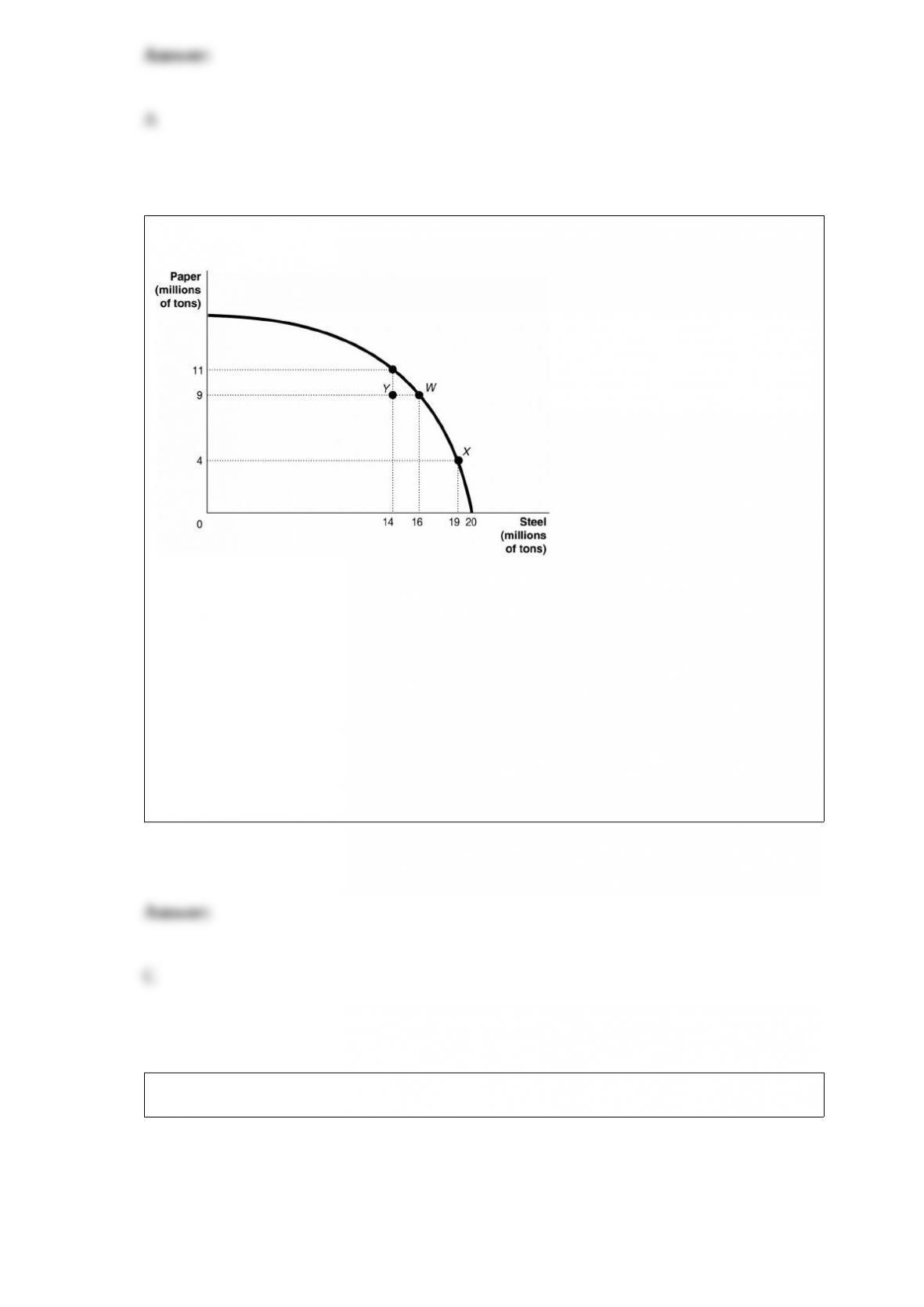
Figure 2-5
If the economy is currently producing at point W, what is the opportunity cost of
moving to point X?
A) 3 million tons of steel
B) 19 million tons of steel
C) 5 million tons of paper
D) 9 million tons of paper
Figure 11-2
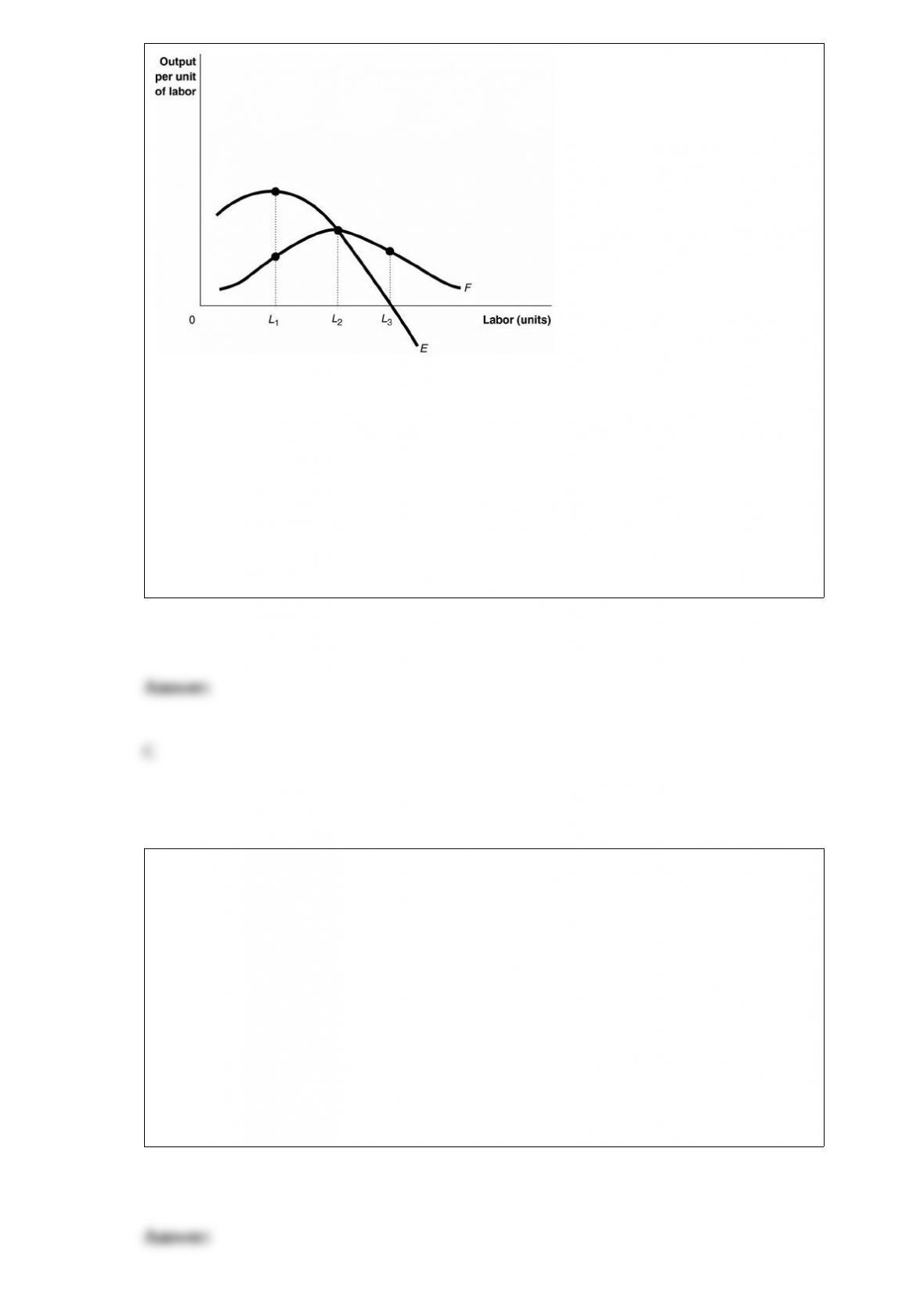
The curve labeled “E” is
A) the total product curve.
B) the average product curve.
C) the marginal product curve.
D) the output supply curve.
Suppose the government imposes an 8 percent sales tax on clothing items and the tax is
levied on sellers. Who pays for the tax in this situation? (Assume that the demand curve
is downward sloping and that the supply curve is upward sloping.)
A) The tax is borne entirely by the sellers.
B) The sellers will pass on the entire sales tax to consumers and therefore the
consumers bear the tax.
C) The tax will be borne partly by consumers and partly by sellers.
D) It is not possible to answer the question without information on price elasticities.
Cassie’s Quilts alters, reconstructs and restores heirloom quilts. Cassie has just spent
$800 purchasing, cleaning and reconstructing an antique quilt which she expects to sell
for $1,500 once she is finished. After having spent $800, Cassie discovers that she
would need some special period fabric that would cost her $200 in material and time in
order to complete the task. Alternatively, she can sell the quilt “as is” now for $900.
What is the marginal cost of completing the task?
A) $200
B) $500
C) $1,000
D) $1,000 plus the value of her time
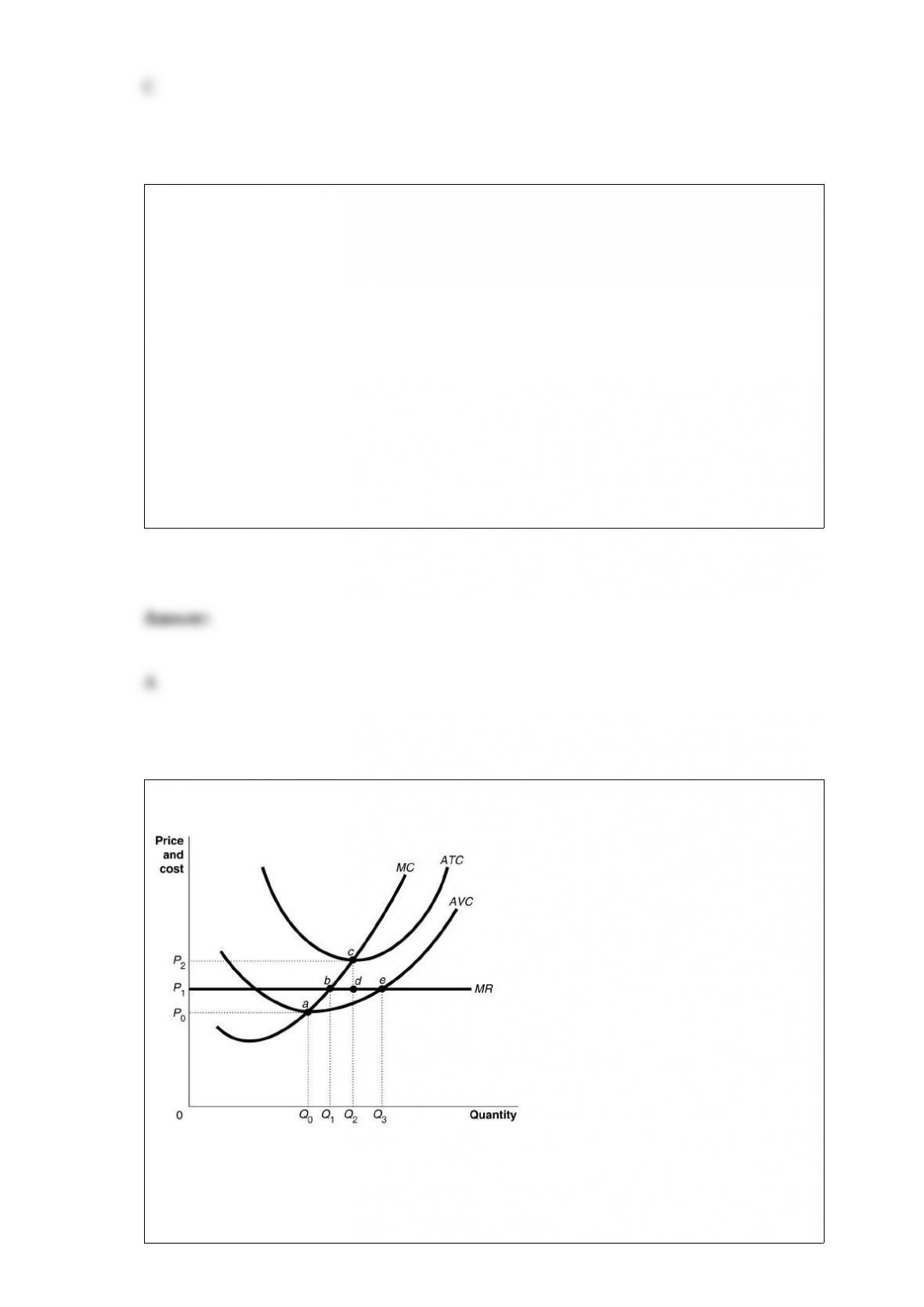
Figure 12-20
If the market price is P1, what is the allocatively efficient output level?
A) Q0

B) Q1
C) Q2
D) There is no allocatively efficient output level because the firm is making a loss.
Jake sells Star Wars memorabilia on eBay. His annual revenue is $42,000 per year, the
explicit costs of his business are $10,000, and the opportunity costs of his business are
$18,000 per year. What are the implicit costs of his business?
A) $8,000
B) $18,000
C) $24,000
D) $32,000
Juanita goes to the Hardware Emporium to buy a new circular saw. She is willing to pay
$120 for a new saw, but buys one on sale for $85. Juanita’s consumer surplus from the
purchase is
A) $35.
B) $85.
C) $120.

D) $205.