
If the price of good X goes up and the price of good Y goes down, then it is possible for
a. The person is better off than before.
b. The person is worse off than before.
c. The person is no better or worse off than before.
d. All of the above are possible.
When one person consumes a nonexcludable good,
a. others cannot be prevented from also consuming it.
b. it can be provided to others for no additional cost.
c. the amount available for others to consume is reduced.
d. any other users will receive zero economic rent from it.
The practice of a firm setting a price so low that all firms incur losses is called
a. a tournament.
b. predatory pricing.
c. a buy-out strategy.

d. a contestable market.
If this firm produces 5 units of output, then its total cost equals
a. $100
b. $130
c. $200
d. $230
Which of the following statements are false?
a. Player A has a dominant strategy.
b. Player B has a dominant strategy.
c. This is a prisoners’ Dilemma.
d. This game has no Nash Equilibrium.

A firm is currently producing 200 units of output using 60 hours of labor and 80 hours
of capital. The marginal product of labor is 12 units of output per hour, and the marginal
product of capital is 15 units of output per hour. If the wage rate is $6 per hour and the
rental rate is $3 per hour, then
a. the firm’s use of labor and capital is cost-efficient.
b. the firm should use more labor and less capital.
c. the firm should use more capital and less labor.
d. we cannot determine if the firm’s use of inputs is efficient without more information.
An uninsurable risk is one
a. where everyone wishes to bet on the same outcome.
b. in which information is asymmetrically distributed.
c. for which the odds of an event’s occurrence cannot be accurately estimated.
d. that cannot be diversified.
An outcome is not a Nash equilibrium if either player would be better off with a
different strategy.
Day care is provided by a competitive constant-cost industry at a price of $40 per child
per day. The government wants to increase the availability of day care and thus chooses
to build and operate 50 new day care centers across the nation.

If employers could fully monitor their workers’ performance, then employers would be
better off but workers would be worse off.
A risk-averse individual chooses to never place a bet.
The efficiency criterion is normative in nature.
People have rational expectations when their predictions are correct more often than
not.

Crowding at a common property site both reduces the benefits of visitors and increases
the costs
of being a visitor.
An increase in the price of gasoline would shift the demand curve for gasoline to the
left.
Consider the following:
Does the Invisible Hand Theorem remain true in the Prisoners’ Dilemma game? Why or
why not? What implication does this result have for cartels?
The competition among firms to acquire the rights to legal barriers to entry helps to
reduce the welfare costs of monopoly.

All other things being equal, firms that provide on-the-job training to workers will tend
to pay higher wages.
Normal goods have income elasticities greater than 1, while inferior goods have income
elasticities less than 1.
All outcomes in the Copycat Game are Pareto optimal.
Suppose a monopoly has constant marginal costs of $40 per unit. Demand for the
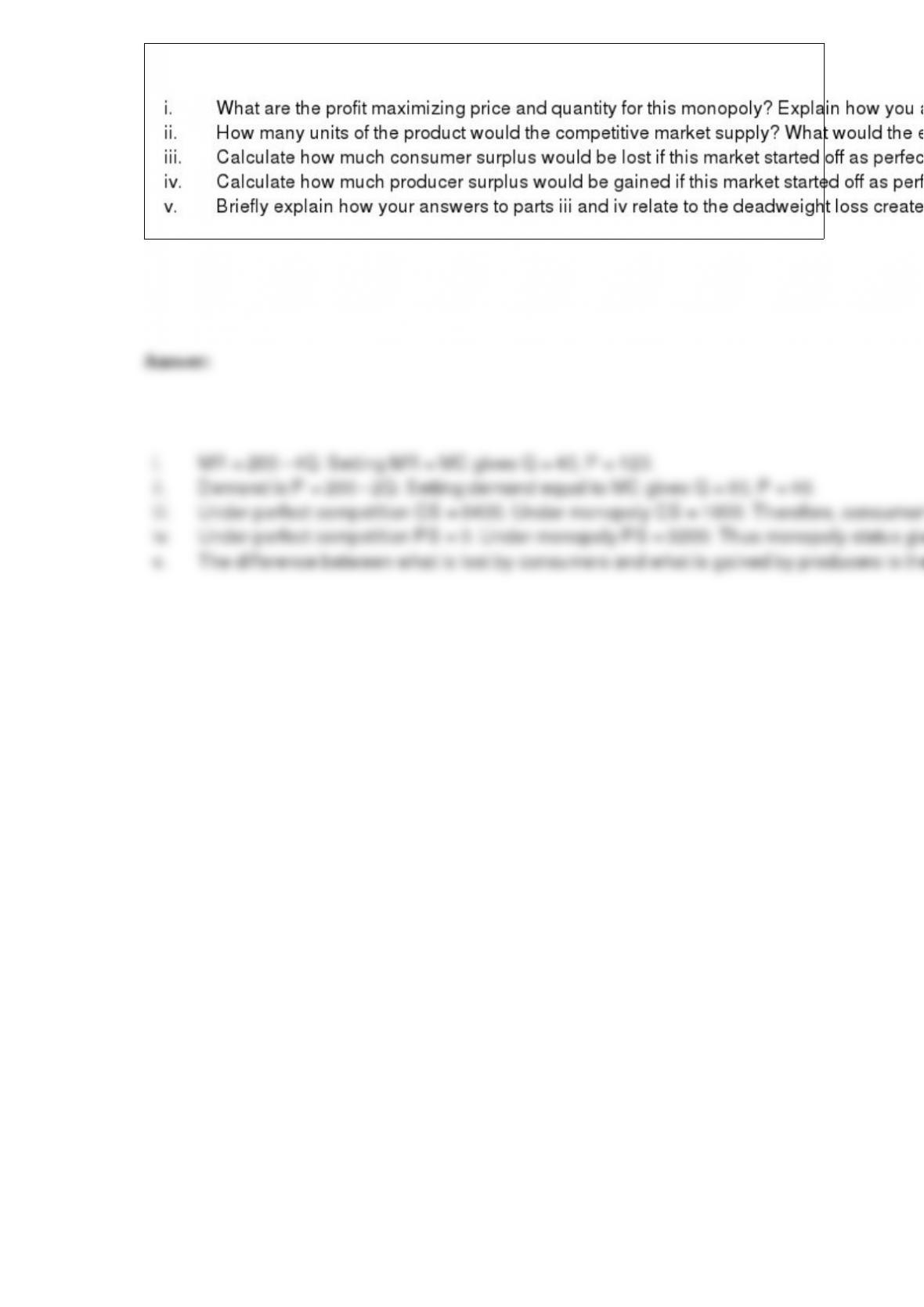
monopolist’s product is Q = 100 – 0.5P.