1)
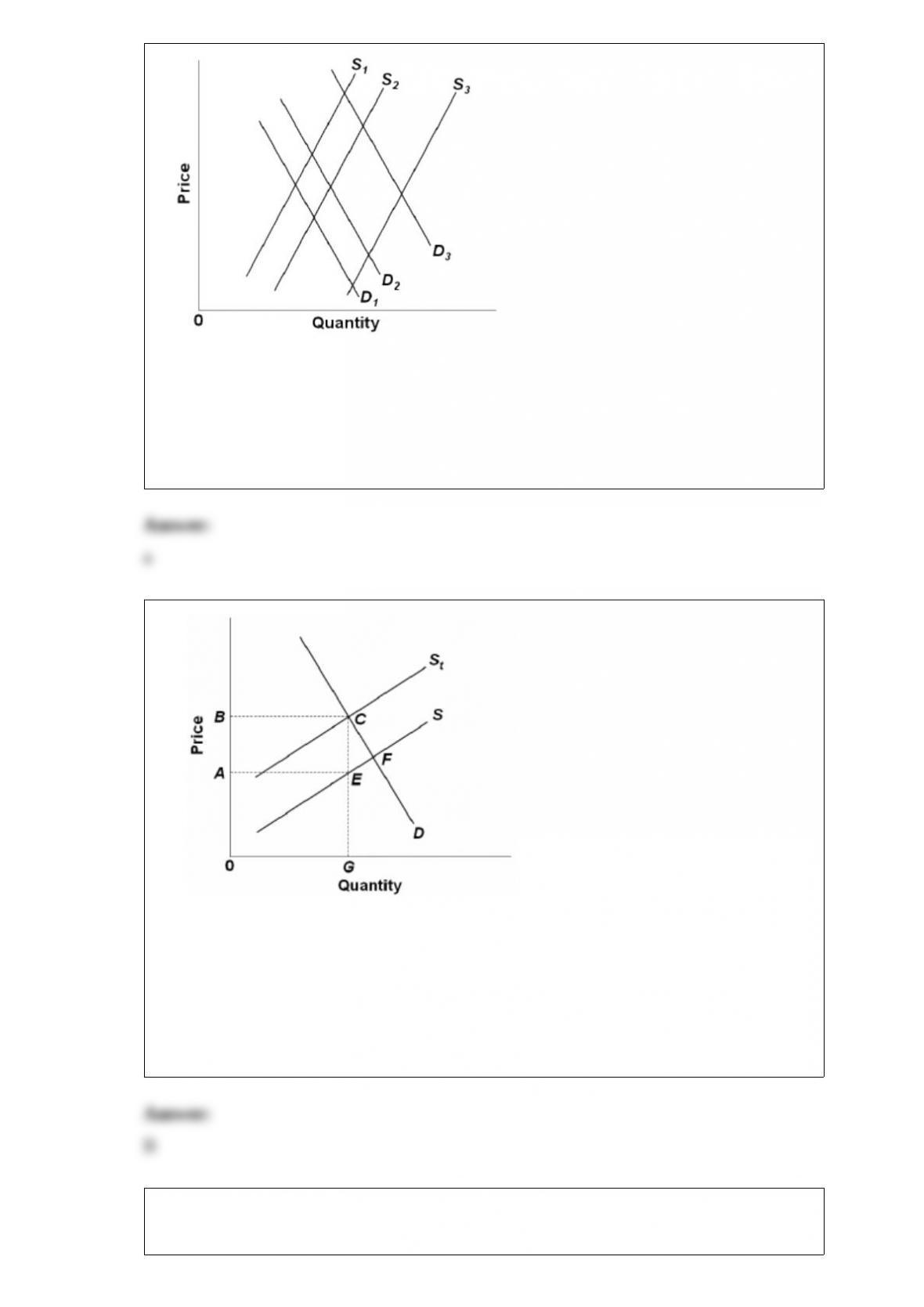
refer to the above figure that shows the market for u.s. health care. other things equal,
which of the following would shift the supply curve for medical care from s1 to s2?
a.greater reliance on skilled nurses rather than physicians.
b.higher insurance copayments and deductibles.
c.higher physician fees.
d.higher medical malpractice insurance premiums.
2)
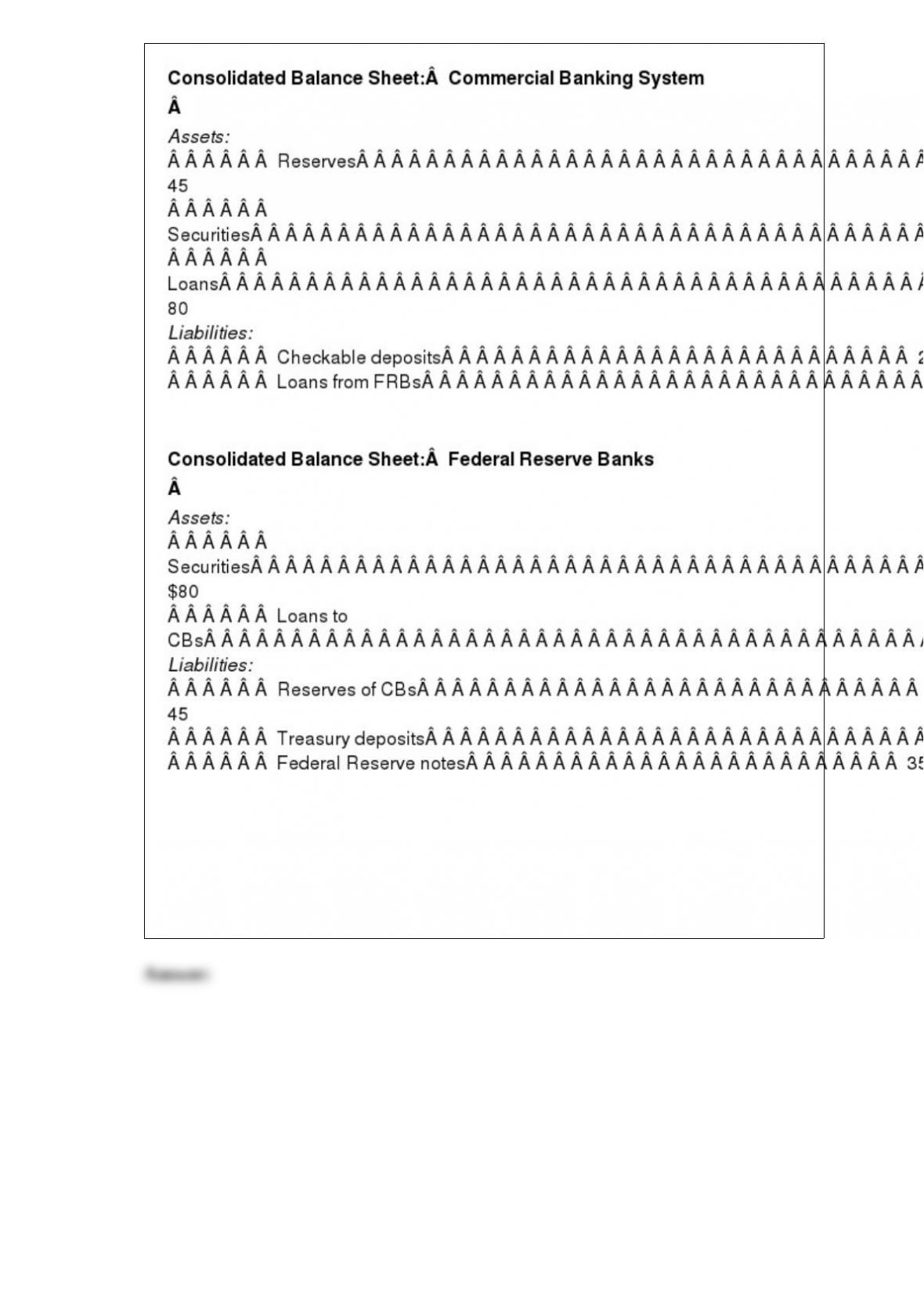
Refer to the above figure in which S is the before-tax supply curve and St is the supply
curve after an excise tax is imposed. The total tax collection from this excise tax will be
area:
A.ABCE + ECF.
B.ABCE.
C.ECF.
D.0BCG.
3) Which of the following is a true statement?
A.There is a long-run tradeoff between inflation and unemployment.

B.The short-run Phillips Curve is vertical.
C.The long-run Phillips Curve is horizontal.
D.Adverse aggregate supply shocks can simultaneously worsen unemployment and
inflation.
4) A major difference between social insurance and public assistance is that the:
A.former is regarded as an earned right while the latter is public charity.
B.latter is regarded as an earned right while the former is public charity.
C.latter is financed through earmarked payroll taxes and the former is financed by
general tax revenues.
D.former are state and local programs while the latter are Federal programs.
5) assume an economy is operating at some point on its production possibilities curve,
which shows civilian and military goods. if the output of military goods is increased,
the output of civilian goods:
a.will remain unchanged.
b.may be either increased or decreased.
c.must be decreased.
d.must also be increased.
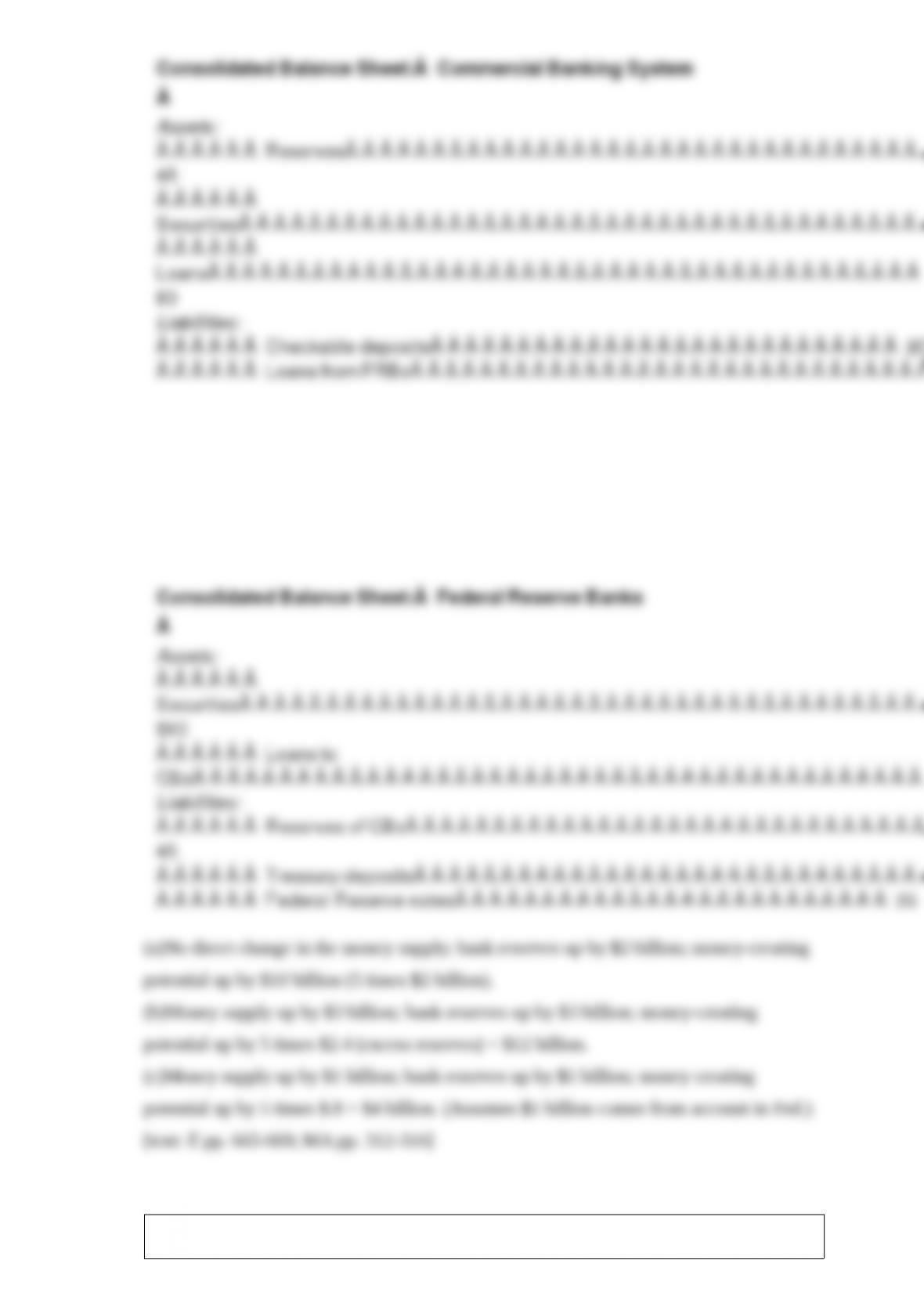
6) The following are simplified balance sheets for the commercial banking system and
the Federal Reserve system. Perform each of the following three transactions, a, b, and
c, making appropriate changes in columns (1) through (3) in each balance sheet. Do not
cumulate your answers. Also, answer these three questions for each part: (a) What
change, if any, took place in the money supply as a direct result of this transaction? (b)
What change, if any, occurred in commercial bank reserves? (c) What change occurred
in the money-creating potential of the commercial banking system if the reserve ratio is
20%? All figures are in billions of dollars.
(a)Suppose a drop in the discount rate causes commercial banks to borrow an additional
$2 billion from the Fed. Show the new sheet figures in column 1.
(b)The Fed buys $3 billion of government bonds from the public. Show the new sheet
figures in column 2.
(c)The Treasury spends $1 billion on research on new farm products. Show the new
sheet figures in column 3.
7) approximately what percentage of u.s. health care spending is financed by public

insurance?
a.19 percent.
b.34 percent.
c.47 percent.
d.81 percent.
8) specialization in production is economically beneficial primarily because it:
a.allows everyone to have a job which they like.
b.permits the production of a larger output with fixed amounts of resources.
c.facilitates trade by bartering.
d.guarantees full employment.
9) global competition:
a.forces domestic producers to become more efficient and to improve product quality.
b.drives up prices worldwide.
c.reduces employment worldwide.
d.creates higher flows of international migration than without trade.
10) (Consider This) According to economists Krueger and Perri:
A.Despite the fact that income inequality has increased in recent decades, consumption
inequality has remained relatively constant.
B.Increases in income inequality over recent decades understate the growth in
consumption inequality.
C.Both income and consumption inequality have increased at approximately the same
rate over recent decades.
D.Both income and consumption are more equally distributed than they were 30 years
ago.
11) Suppose that in an economy with a MPC of .8 the government wanted to shift the
aggregate demand curve leftward by $40 billion at each price level to remedy
demand-pull inflation. It could:
A.increase taxes by $10 billion.
B.reduce government spending by $40 billion.

C.reduce government spending by $5 billion.
D.increase taxes by $20 billion.
12) which of the following is a fundamental characteristic of the market system?
a.property rights.
b.central planning by government.
c.unselfish behavior.
d.government-set wages and prices.