
If Japanese real interest rates fall relative to real interest rates in the U.S., the yen will
likely appreciate and the dollar will likely depreciate.
a. True
b. False
If the Japanese yen trades at $1 = 98 yen, a Honda that sells for $29,000 in the U.S.
would be worth approximately how many yen?
a. 296 yen
b. 28,000 yen
c. 371,000 yen
d. 2,842,000 yen
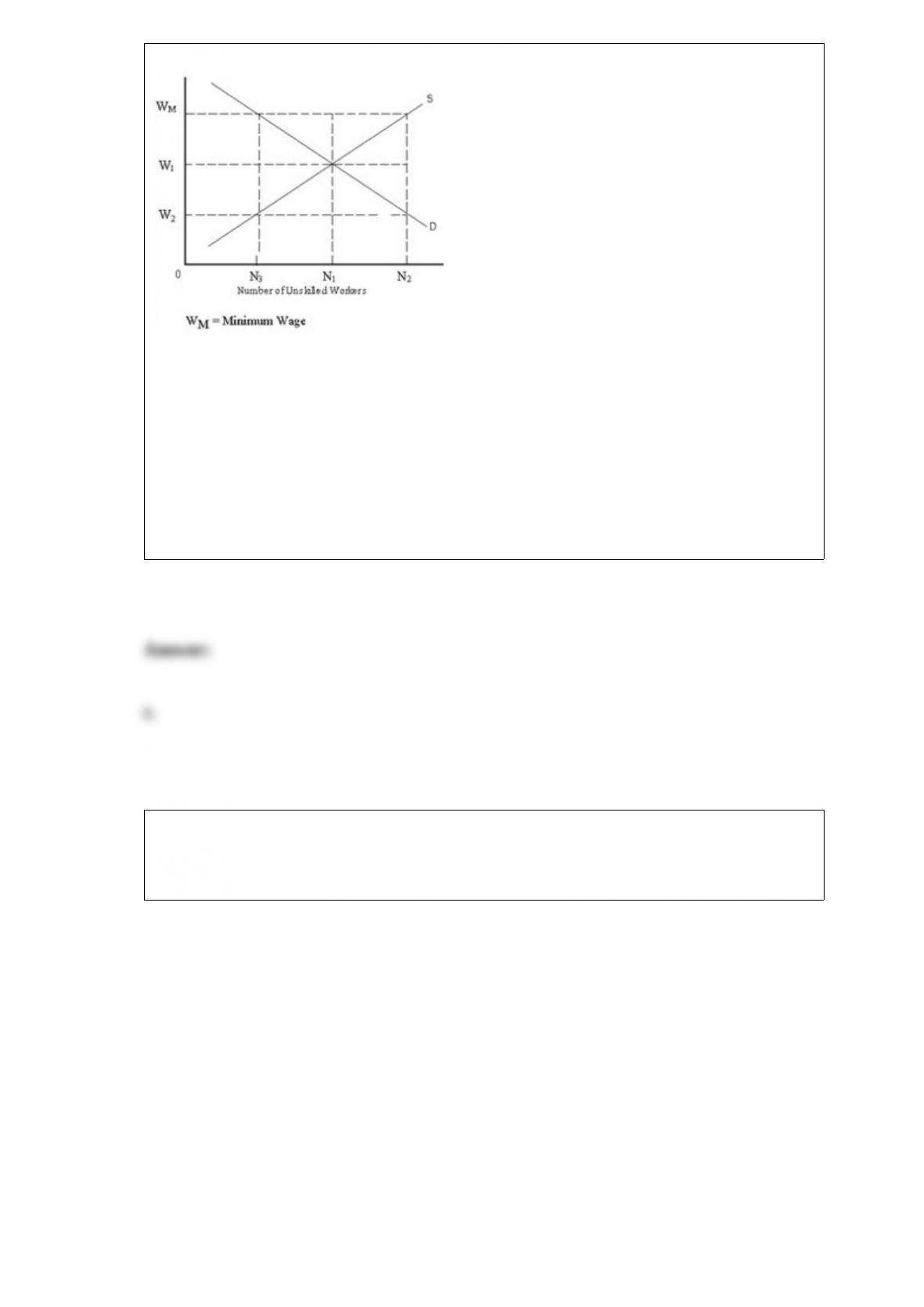
Refer to Exhibit 4-7. How many fewer persons work in the unskilled labor market at the
minimum wage (WM) than at the equilibrium wage (W1)?
Exhibit 4-7
a. (N2 – N1) persons
b. (N1 – N3) persons
c. (N2 – N3) persons
d. N3 persons
e. none of the above
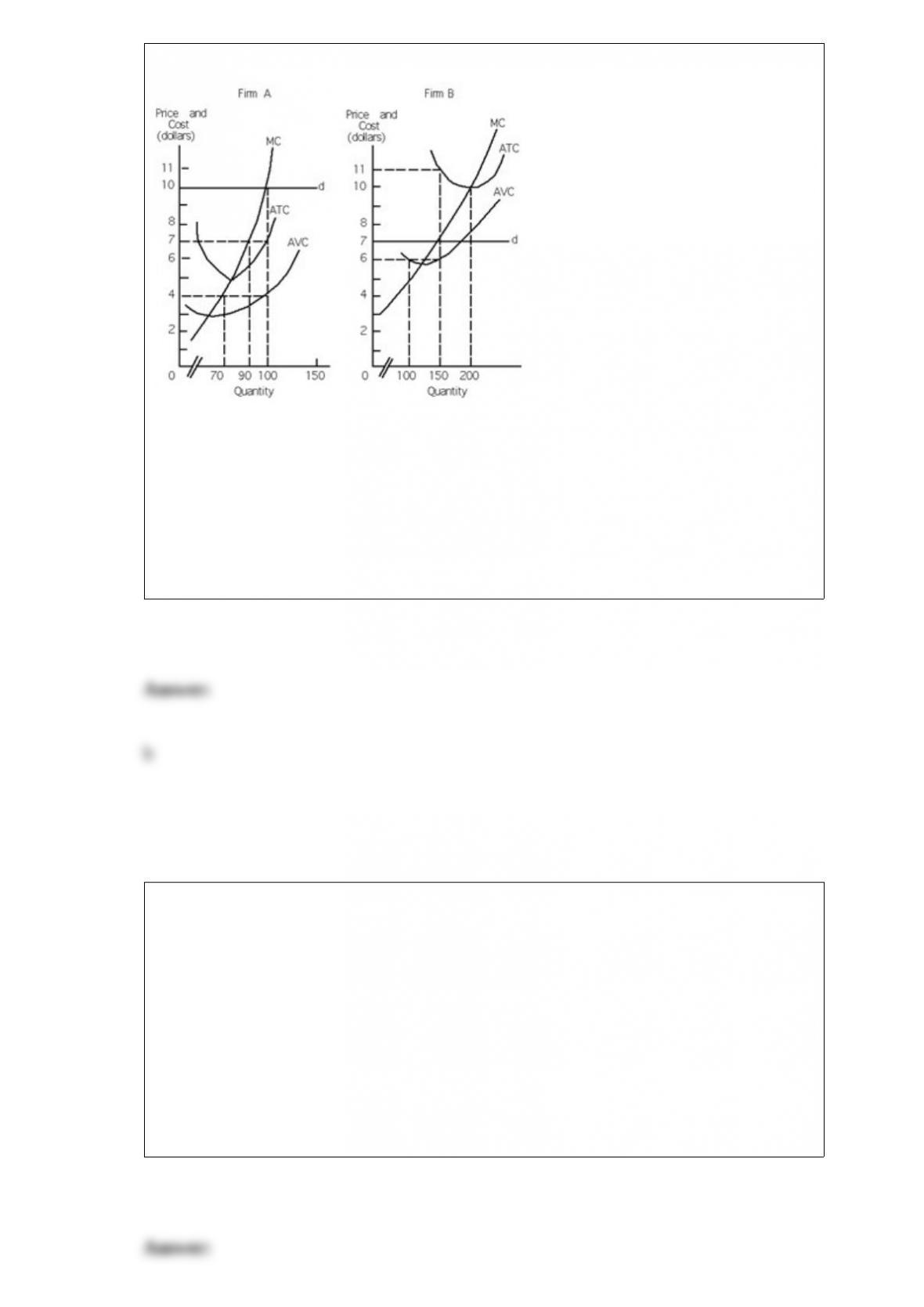
Refer to Exhibit 23-8. What is the total fixed cost of firm B at the profit-maximizing (or
loss-minimizing) level of output?
Exhibit 23-8
a. $5
b. $750
c. $90
d. $400
e. There is not enough information provided to answer this question.
If $1 is equal to 120 yen, then 1 yen is equal to approximately
a. $1.20
b. $0.94
c. $0.83
d. $0.0083
e. none of the above

A closed shop is an organization
a. that is closed on holidays.
b. in which an employee must belong to the union before he or she can work.
c. that does not require workers to be union members in order to be hired, but does
require them to join the union within a certain period of time after becoming employed.
d. set up by the federal government to train ex-convicts to become productive workers.
e. none of the above
Economies of scale are said to exist when
a. inputs are increased by some percentage and output increases by the same
percentage.
b. inputs are increased by some percentage and output increases by a lesser percentage.
c. inputs are increased by some percentage and output increases by a greater percentage.
d. the LRATC curve slopes upward.
e. none of the above

In year 1 the average price of X is $10, and in year 2 the average price of X is $23. If
consumers buy more units of X in year 2 than in year 1, it follows that
a. the law of supply does not hold for good X.
b. demand for good X could be higher in year 2 than in year 1.
c. supply of good X could be less in year 2 than in year 1.
d. good X buyers have received an increase in income between year 1 and year 2, and
good X is a normal good.
e. b and d
Which of the following situations is clearly and unambiguously descriptive of a positive
externality?
a. Jack feels better after his daily walk.
b. Joriel studies harder than anyone in his class.
c. Professor Gomez gave an unannounced quiz to her history class yesterday.
d. The President of the United States yesterday signed a legislative act that is very
popular in the country.
e. none of the above

What is the approximate present value of $500 four years from now if the interest rate
is 2 percent?
a. $462
b. $508
c. $510
d. $541
e. $485
Consumers’ surplus is the difference between the price
a. sellers receive for a good and the maximum price they would have paid for the good.
b. sellers receive for a good and the minimum price for which they could have sold the
good.
c. buyers pay for a good and the maximum price they would have paid for the good.
d. buyers pay for a good and the minimum price for which they would have sold the
good.
China has intervened in the foreign exchange market to maintain the value of its
currency vis-Ã -vis other countries.

a. True
b. False
“Regulatory lag” refers to the period between the time when
a. the natural monopolist’s costs change and the time the regulatory agency adjusts the
monopolist’s prices.
b. the natural monopolist changes its prices and the time when the regulatory agency
rules on that change.
c. the regulatory agency decides to regulate a firm and the time it actually accomplishes
the task.
d. a firm is initially regulated by an agency and the time the firm “captures” that agency.
e. the regulatory agency decides to deregulate a firm and the time it actually
accomplishes the task.
If the percentage change in quantity demanded is less than the percentage change in
price for good Y, then the demand for good Y is
a. inelastic.
b. unit elastic.
c. elastic.

d. perfectly elastic.
In the United States, patents are granted to inventors of a product or process for a period
of
a. unlimited time.
b. 10 years.
c. 20 years.
d. 25 years.
Suppose the economy goes from a point on its production possibilities frontier (PPF) to
a point directly to the left of it. Assuming that the PPF has not shifted, this could be due
to
a. a gain of resources.
b. a loss of resources.
c. technological improvement in the production of both goods.
d. a new law that interferes with productive efficiency.

On a supply-and-demand diagram, consider a price for which the horizontal distance to
the supply curve exceeds the horizontal distance to the demand curve. There is a
__________ at that price and the current price must be __________ the equilibrium
price.
a. shortage; above
b. shortage; below
c. surplus; above
d. surplus; below
The Clayton Act of 1914
a. made interlocking directorates illegal.
b. set up the Federal Trade Commission (FTC) to deal with “unfair methods of
competition.”
c. made monopolization of trade a misdemeanor.
d. prohibited suppliers from offering special discounts to large chain stores without
offering them to everyone else.
e. empowered the FTC to deal with false and deceptive acts or practices.

For a product price searcher (such as a monopolist),
a. P > MR, therefore VMP < MRP.
b. P = MR, therefore VMP = MRP.
c. P > MR, therefore VMP > MRP.
d. P < MR, therefore VMP < MRP.
What is the present value of a future income stream of three $12,000 payments to be
received one, two, and three years from today if the interest rate is 2.8 percent?
a. $32,799
b. $34,074
c. $28,134
d. $11,046