
On a diagram of a production possibility frontier, economic growth is represented by
the slope of the production possibility frontier.
The slope of an isocost line determines the marginal rate of substitution.
An increase in income results in an outward shift of an indifference curve.
“A decrease in the price of tablet computers will decrease the demand for desktop
computers.” This statement is an example of a normative economic statement.

Currently, the base year for the CPI is the average of prices in the years 1982 to 1984.
Over time, people in the United States and other high-income countries have, on
average, become taller, which is an indication that their nutritional status has improved.
If a buyer in an economic transaction has more information than the seller, the buyer
benefits at the expense of the seller. This phenomenon is due to
A) moral hazard.
B) adverse selection.
C) economically irrational behavior.
D) gains from trade.
Which of the following is typically considered a fixed cost by academic book
publishers but a variable cost by companies that print books?

A) postage and supplies
B) travel
C) rent
D) wages and salaries
One requirement for a firm pursuing a price-discrimination strategy is the ability to
segment the market for its product. This means that
A) the firm must set different prices for different regions where the product is sold.
B) the firm must be willing to offer price discounts for senior citizens and children.
C) the firm must be able to divide the market in a way that makes arbitrage impossible.
D) the firm must choose a marketing strategy that appeals to different segments of the
economy.
Calculate the income elasticity if an 8 percent increase in income leads to a 4 percent
increase in quantity demanded for organic produce.
A) -0.66
B) 0.5
C) 1.5
D) 2

If a country’s real GDP is rising by 3% per year while its population is rising at 5% per
year, which of the following is true?
A) The country’s standard of living is falling.
B) The country’s standard of living is rising.
C) Growth in nominal GDP outweighs growth in the population.
D) Growth in nominal GDP is less than the growth in the population.
In the decade of the ________, A.W. Phillips plotted data for Great Britain which
revealed a relationship between rates of changes in wages versus unemployment rates.
Economists later discovered other “Phillips Curve” relationships between rates of
inflation versus unemployment rates.
A) 1930s
B) 1940s
C) 1950s
D) 1960s

The Farm Factory, a booth at the local Farmer’s Market, sells fresh eggs for $1.50 per
dozen and fresh milk for $2.50 per gallon. What is the opportunity cost of buying a
gallon of milk?
A) 1 2/3 dozen eggs
B) 3/5 of a dozen eggs
C) $2.50
D) $1.50
An increase in unemployment insurance payments would, in effect, ________ the
amount of time spent searching for a job, which would increase ________
unemployment.
A) increase; cyclical
B) increase; frictional
C) decrease; cyclical
D) decrease; frictional
Adverse selection in the market for health insurance arises because
A) many insurance companies care more about profits than they do about providing

services for their customers in the event of illness.
B) the federal government intervenes in insurance markets by controlling prices and
reimbursement policies.
C) insurance companies are not allowed to charge premiums that are high enough to
insure against “worst-case” illness.
D) buyers of insurance know more than insurance companies about the likelihood of an
illness for which buyers want insurance.
Compared to a perfectly competitive firm, the demand curve facing a monopolistically
competitive firm is
A) more elastic because there are many close substitutes for the product of a
monopolistically competitive firm.
B) less elastic because monopolistically competitive firms produce similar, but not
identical, products.
C) just as elastic because there are many sellers in both markets.
D) more elastic because in the long run, the demand curve is tangent to the firm’s
average total cost curve.
According to an article the Wall Street Journal, “The big car makers are pushing a wide
array of new technology into production, responding to relentless competitive pressure,
rising energy prices and consumer demand for better safety.
Source: Joseph B. White, “Ford, GM Eye Shift in Buying Habits,” Wall Street Journal,
May 22, 2006. Which of Porter’s competitive forces does this statement allude to?

A) the threat of competition from new entrants
B) competition from foreign auto manufacturers
C) competition from existing firms within the industry
D) competition from substitute products from outside the industry
Of all barriers to entry, the most important are those that are due to
A) ownership of a key input.
B) economies of scale.
C) government-imposed barriers.
D) the Herfindahl-Hirschman Index.
Explain the meaning of the word “convergence” in the context of economic growth and
standards of living.

The total amount of copper in the earth is not increasing. Does this mean that in the
market for copper, the supply curve is perfectly inelastic? Explain.
What is the ceteris paribus condition?
Suppose a presidential candidate makes a statement in a debate whereby he promises
that he would encourage the Fed to permanently lower the unemployment rate to 3%.
His opponent claims that this type of policy idea is mired in the 1960s and would only
cause inflation. Explain what the opponent means.
What is the difference between a fixed exchange rate system and a managed float
exchange rate system?
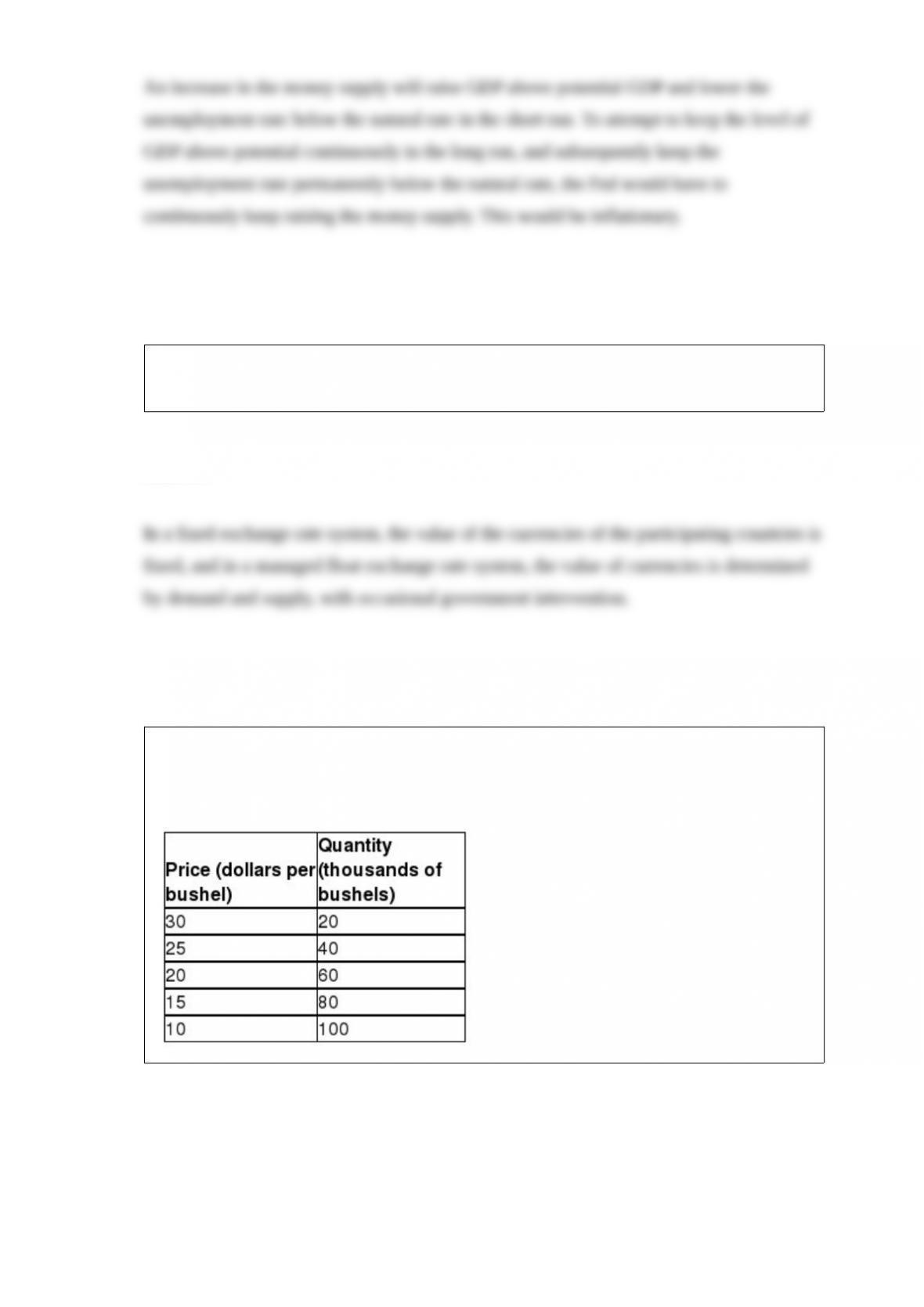
Use the following demand schedule for apples to draw a graph of the demand curve. Be
sure to label the demand curve and each axis, and show each point on the demand
curve.
List the five main factors of production.
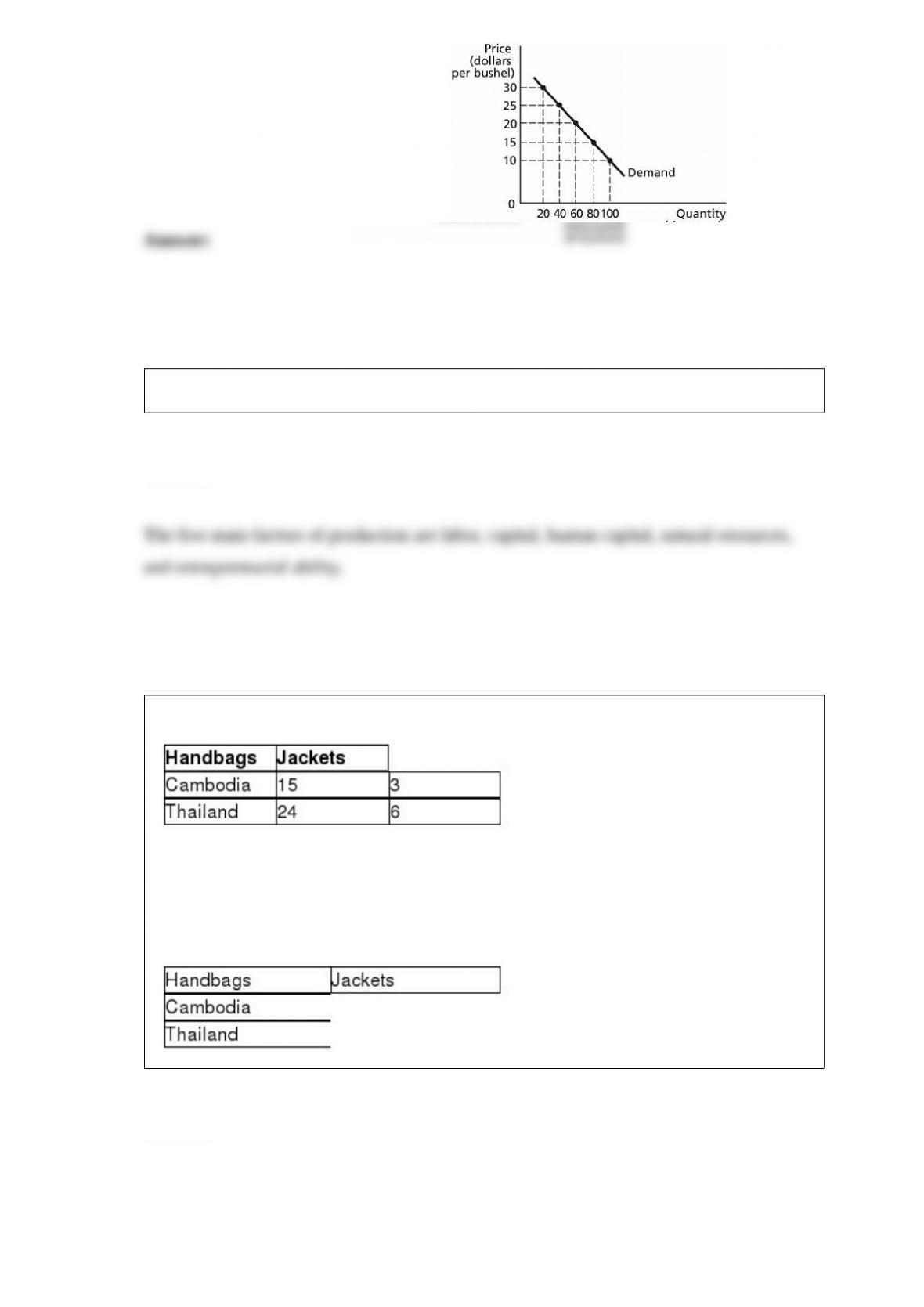
Table 9-7 Output Per Hour of Work
Table 9-7 shows the output per hour of work for handbags and jackets in Cambodia and
in Thailand.
Fill in the following table with the opportunity costs of producing handbags and jackets
for Cambodia and Thailand.