
Exhibit 34-4
The opportunity cost of one unit of good A is __________ for country 1 and
__________ for country 2.
a. 20B; 15B
b. 2B; 1B
c. 40B; 15B
d. 1/2B; 1B
e. 1/20B; 1/15B
If society is experiencing a net social cost from the production of a good, this implies
that
a. the socially optimal level of output is being produced and society is willing to accept
the costs that result.
b. producers would rather produce the output at which marginal social cost equals the
demand for the good.
c. negative externalities are involved in the production of this good.
d. none of the above

A three-word synonym for the term ceteris paribus is
a. “nothing else changes.”
b. “in my opinion.”
c. “it is proved.”
d. “under this assumption.”
If there is a decrease in the expected inflation rate, then,
a. the nominal interest rate will increase.
b. the nominal interest rate will decrease.
c. the real interest rate will increase.
d. a and c
e. b and c
The interest paid on corporate bonds is not subject to federal taxes.
a. True
b. False
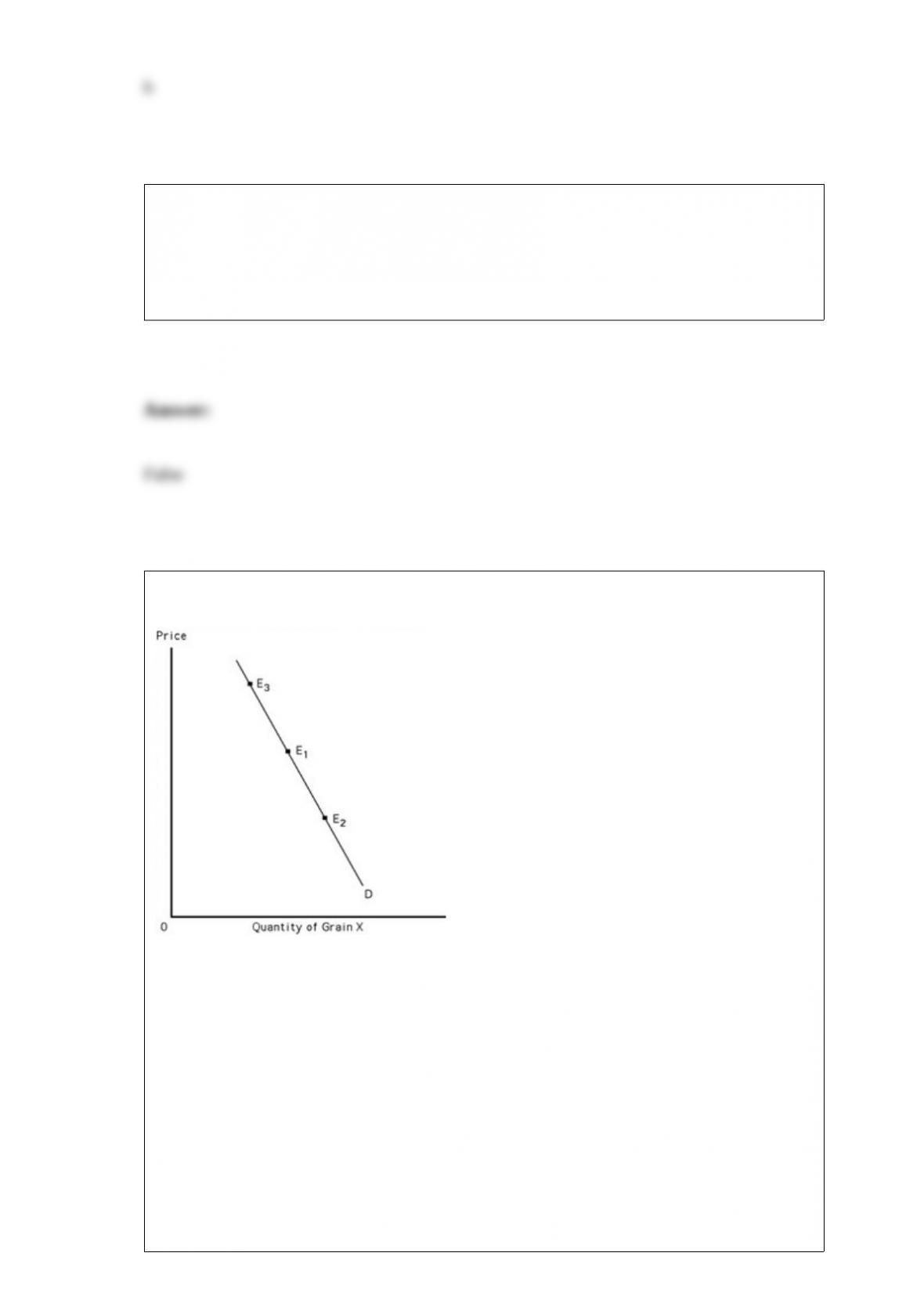
Exhibit 39-8
Assume that E1 represents the initial equilibrium in the market for grain X. As a result
of increased agricultural productivity, total revenues for farmers in this market will
a. increase if the demand curve is perfectly inelastic.
b. increase if the demand curve is inelastic between E1 and E2.
c. decrease if the demand curve is inelastic between E1 and E2.
d. decrease if the demand curve is inelastic between E1 and E3.

e. none of the above
When a positive externality exists,
a. external benefits are necessarily greater than private benefits.
b. social benefits are greater than private benefits.
c. social benefits are less than private benefits.
d. social benefits equal private benefits.
e. none of the above
Most economists believe that the supply curve of labor in the aggregate is extremely
elastic.
a. True
b. False

The capture theory of regulation holds that
a. regulators try to capture as much “profit” (for themselves) from the regulatory
process as possible.
b. the special interests that are being regulated will eventually capture and control the
regulatory body that “regulates” them.
c. the public usually captures the regulatory body and makes it do what it wants.
d. the courts usually capture the regulatory body and force it to do what is in the
public’s best interest.
e. none of the above
If total utility of a good is high while the price of the good is low, it is likely that the
good
a. is plentiful.
b. is inferior.
c. is rare.
d. has high marginal utility.
According to public choice theory, low voter turnouts may be the result of cost-benefit
calculations on the part of voters.
a. True
b. False
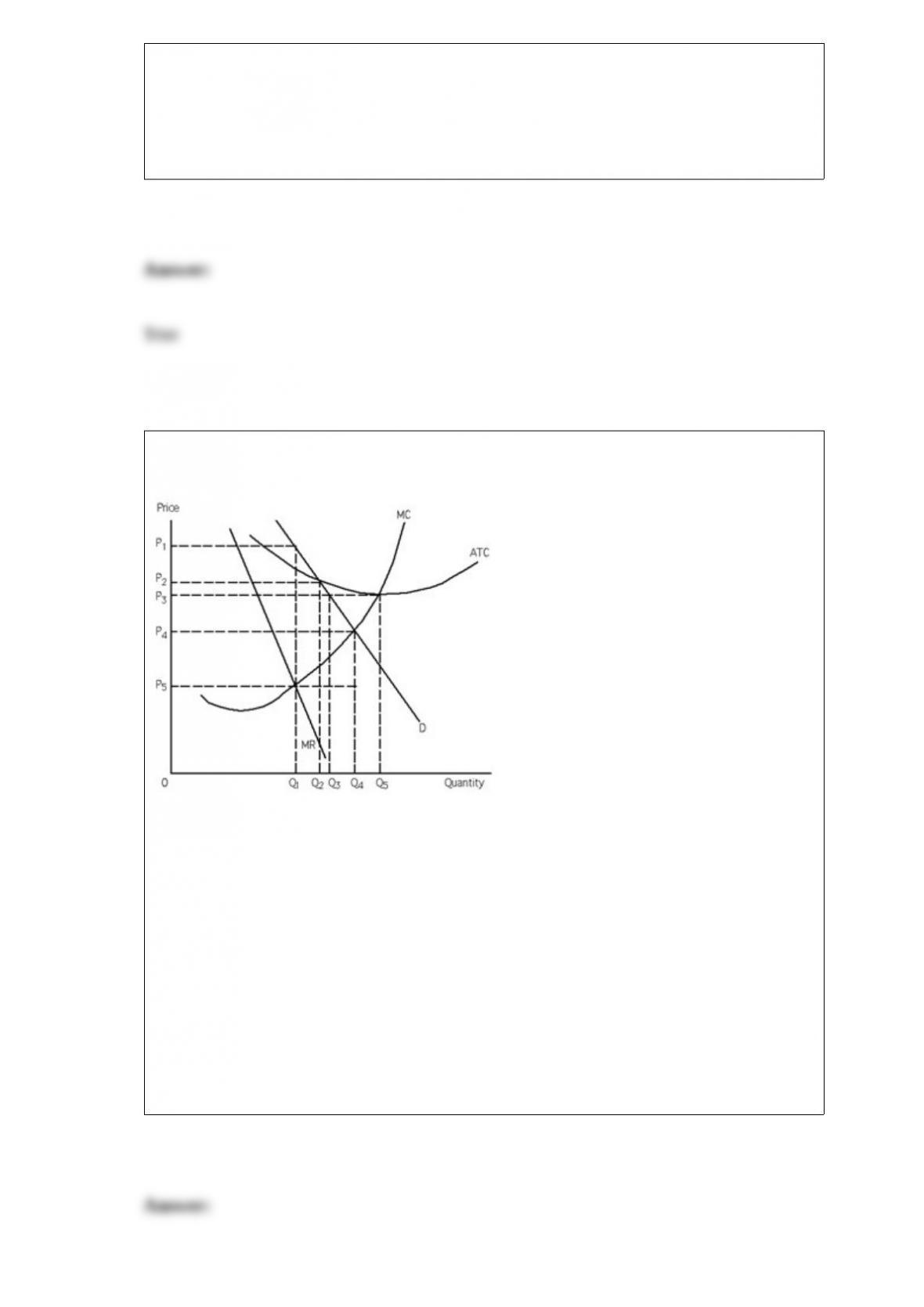
Exhibit 26-4
What is the total revenue of the profit-maximizing natural monopoly?
a. P1 x Q1.
b. P2 x Q2.
c. P5 x Q1.
d. P2 x Q2.
e. P3 x Q3.

Which of the following would result in higher price elasticity of good X?
a. more substitutes for good X
b. a shorter period of time has passed since the change in the price of good X
c. lower costs of labor in the production of good X
d. good X is more of a necessity than a luxury
A firm that is a price taker will not sell any of its product for less than the equilibrium
price because
a. it is against the law to do this.
b. it can sell all it can produce at the equilibrium price.
c. this would invite competition from outside the market and end up reducing the profits
of the firm.
d. this would be breaking the cartel agreement that price-taker firms often enter into.
e. none of the above
A perfectly-competitive firm produces 2,000 units of a good during some period of

time. For the 2,000th unit, marginal cost is equal to marginal revenue. The difference
between marginal revenue and marginal cost is greater for the first unit the firm
produces than the second, and greater for the second than the third, and so on.
Furthermore, marginal revenue is greater than marginal cost for every unit from the first
to the 1,999th. It follows that the
a. marginal cost curve for the firm has a downward-sloping portion and an
upward-sloping portion.
b. marginal cost curve for the firm is downward-sloping.
c. marginal cost curve for the firm is upward-sloping.
d. marginal revenue curve is downward-sloping.
e. c and d
The present value of $3,000 one year in the future at a 3.5 percent interest rate is
approximately
a. $4,045
b. $1,859.
c. $3,105.
d. $2,899.