
If, in response to an increase in the price of chocolate the quantity of chocolate
demanded decreases, economists would describe this as
A) a decrease in demand.
B) a decrease in quantity demanded.
C) a change in consumer income.
D) a decrease in consumers’ taste for chocolate.
A firm could continue to operate for years without ever earning a profit as long as it is
producing an output where
A) MR < ATC.
B) ATC > AVC.
C) MR > AVC.
D) AFC < AVC.
If, for a given output level, a perfectly competitive firm’s price is less than its average
variable cost, the firm
A) is earning a profit.

B) should shut down.
C) should increase output.
D) should increase price.
A very large number of small sellers who sell identical products imply
A) a multitude of vastly different selling prices.
B) a downward sloping demand for each seller’s product.
C) the inability of one seller to influence price.
D) chaos in the market.
Figure 4-1

Figure 4-1 shows Arnold’s demand curve for burritos.
Refer to Figure 4-1. If the market price is $2.00, what is the consumer surplus on the
second burrito?
A) $0
B) $1.00
C) $2.00
D) $4.50
Dividing the dividend payment by the stock’s closing market price determines the
A) coupon payment.
B) dividend yield.
C) price-earnings ratio.
D) selling price of the stock.
Figure 3-2
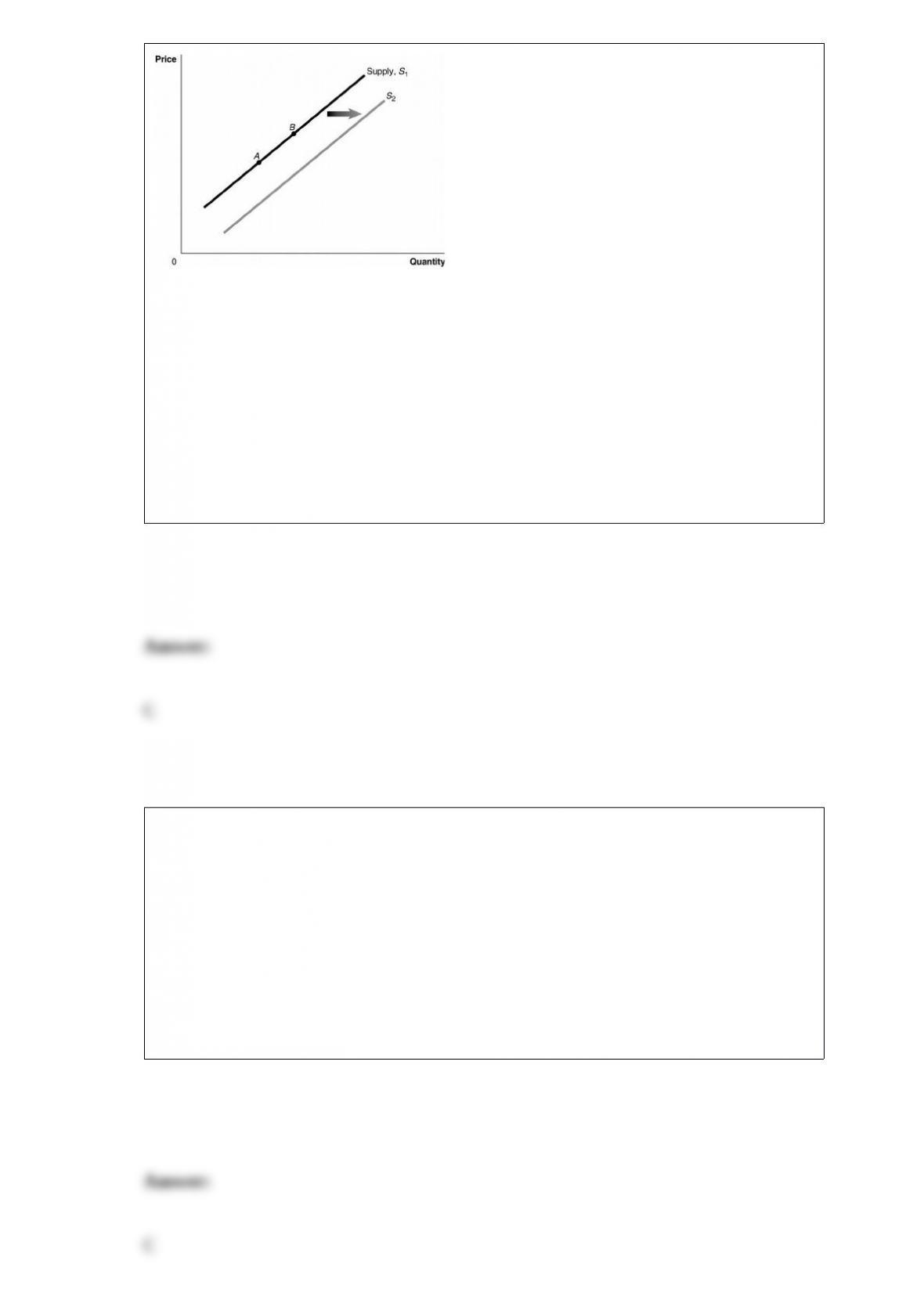
Refer to Figure 3-2. An increase in the number of firms in the market would be
represented by a movement from
A) A to B.
B) B to A.
C) S1 to S2.
D) S2 to S1.
Before its IPO, Facebook was an example of a private firm. As a private firm, Facebook
was
A) not subject to government regulations and taxation.
B) run by stockholders and a board of directors.
C) run by its founder, Mark Zuckerberg.
D) not legally allowed to raise funds through venture capital firms.

The price elasticity of supply of hot dog buns is estimated to be 1.5. Holding everything
else constant, this means that a 10 percent decrease in the price of hot dog buns will
cause the quantity of hot dog buns supplied to decrease by
A) 1.5 percent.
B) 15 percent.
C) approximately 25 percent.
D) approximately 5 percent.
Joss is a marketing consultant. Iris and Daphne are potential customers interested in
commissioning Joss to undertake a market survey and compile the findings in a report.
Iris is willing to pay $500 for the service while Daphne is willing to pay $800. Suppose
that the opportunity cost of Joss’s time is $1,200. Assume that Iris and Daphne do not
know each other. If the price is $800 per copy
A) both Iris and Daphne will purchase Joss’s services and Joss will undertake the job.
B) only Daphne will purchase Joss’s services and Joss will undertake the job for her.
C) only Daphne will want to purchase Joss’s services but Joss will not be willing to do
the work.
D) neither Iris nor Daphne will commission the work.

Joss is a marketing consultant. Iris and Daphne are potential customers interested in
commissioning Joss to undertake a market survey and compile the findings in a report.
Iris is willing to pay $500 for the service while Daphne is willing to pay $800. Suppose
that the opportunity cost of Joss’s time is $1,200. Assume that Iris and Daphne do not
know each other. If the price is $500 per copy
A) only Iris will purchase Joss’s services and Joss will undertake the job for her.
B) only Daphne will purchase Joss’s services and Joss will undertake the job for her.
C) both Iris and Daphne will purchase Joss’s services and Joss will undertake the job.
D) both Iris and Daphne will want to purchase Joss’s services but Joss will not be
willing to undertake the job.
Which of the following explains why a firm would be interested in the knowing the
price elasticity of demand for a good it sells?
A) The price elasticity of demand can be used to determine the impact of changes in
income on quantity sold.
B) Knowing the price elasticity of demand allows the firm to determine how the cost of
producing additional units of the good will change.
C) Knowing the price elasticity of demand allows the firm to calculate how changes in
the price of the good will affect the firm’s total profit.
D) The price elasticity of demand allows the firm to calculate how changes in the price
of the good will affect the firm’s total revenue.
If marginal cost is zero, with an optimal two-part tariff
A) total revenue is maximized.
B) consumers maximize their surplus
C) the firm does not have to charge a fixed-fee portion.
D) firms may not maximize profit.
Figure 18-1
Refer to Figure 18-1. Area E+H represents
A) the portion of sales tax revenue borne by consumers.
B) the portion of sales tax revenue borne by producers.
C) the excess burden of the sales tax.
D) sales tax revenue collected by the government.
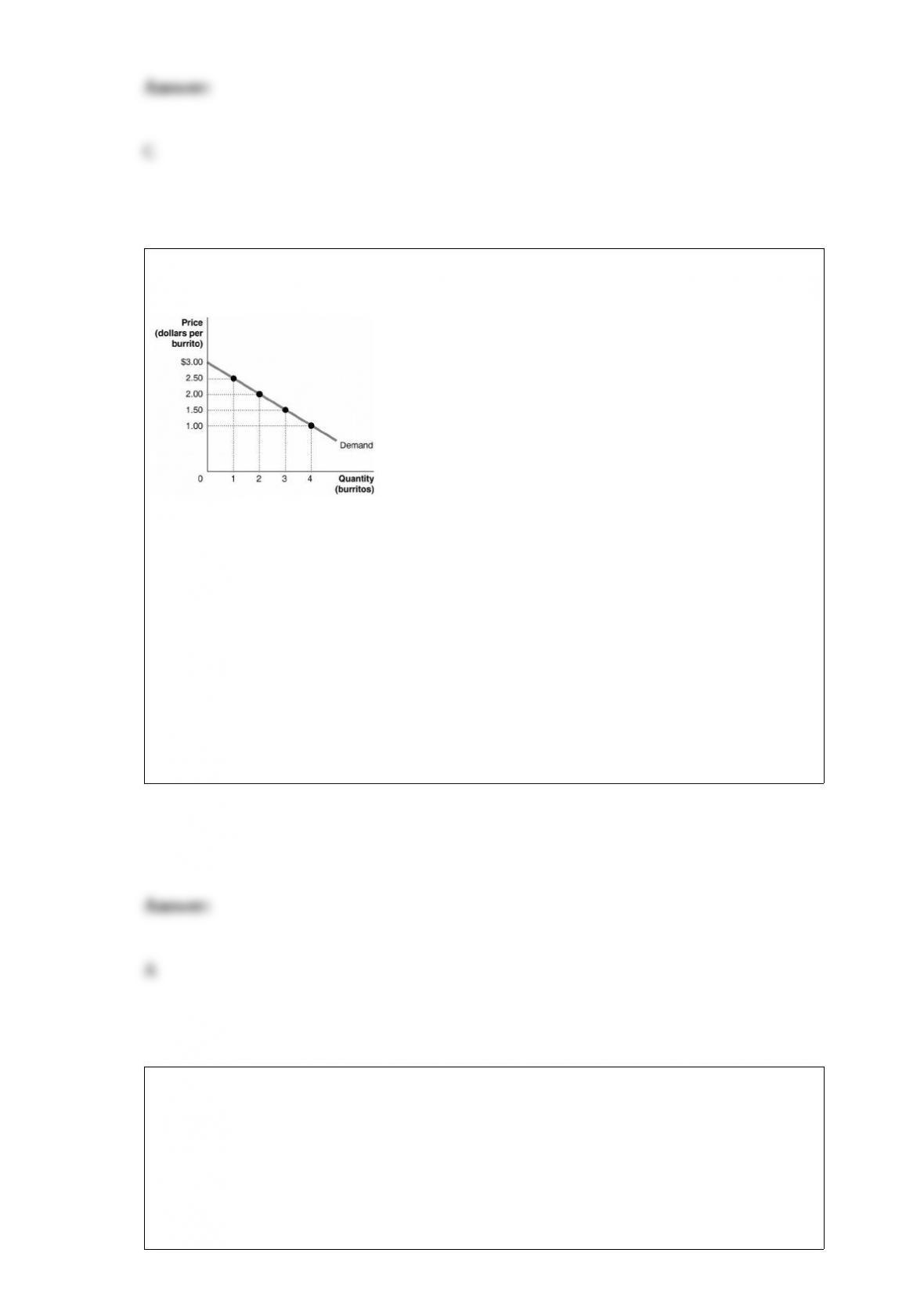
Figure 4-1
Figure 4-1 shows Arnold’s demand curve for burritos.
Refer to Figure 4-1. If the market price is $2.00, what is the consumer surplus on the
first burrito?
A) $0.50
B) $1.00
C) $2.00
D) $7.50
Some firms practice odd pricing because
A) they believe that customers will buy a larger quantity with an odd price.
B) it is a way to price discriminate.
C) it is too difficult for sellers to reeducate buyers into accepting even prices.
D) it lowers transactions costs.
The complexity of the U.S. federal income tax system results in significant annual
deadweight losses. The opportunity cost of the hours taxpayers spend on record keeping
and completing their tax returns amounts to billions of dollars.
a. If the tax system was simplified, how would this benefit the economy?
b. Why hasn’t the tax system been simplified?
The restriction that a consumer’s total expenditure on goods and services purchased

cannot exceed the income available is referred to as
A) maximizing behavior.
B) economizing behavior.
C) the price constraint.
D) the budget constraint.
During its run on Broadway, the play The Producers regularly sold out all available
tickets at the St. James Theater. The theater could have raised ticket prices from $75 to
$125 and still sold all available tickets but chose not to do so. The best explanation for
this decision is
A) theater owners are unaware of the elasticity of demand for Broadway shows.
B) theater owners do not want to raise their tickets on weekends, when demand is high,
and then have to lower prices during the week, when demand is lower.
C) firms sometimes give up profits in the short run to keep their customers happy and
increase their profits in the long run.
D) theater owners are not motivated to maximize their profits.
Which of the following refers to convergence in buyer preferences in markets around
the world?

A) heterogenization of markets
B) globalization of markets
C) segmentation of markets
D) nationalization of markets
If the social benefit of consuming a good or a service exceeds the private benefit
A) a negative externality exists.
B) the market achieves economic efficiency.
C) a positive externality exists.
D) the sum of consumer surplus and producer surplus is maximized.
The first economist to systematically analyze market failure was
A) Adam Smith.
B) Ronald Coase.
C) A. C. Pigou.

D) J. E. Meade.
In August 2011, Standard & Poor’s (S&P) changed its rating on U.S. Treasury bonds
from ________ based on the state of the federal government’s budget deficit.
A) “A” to “D”
B) “A” to “AAA”
C) “A+” to “B+”
D) “AAA” to “AA+”
In economics, the term “free rider” refers to
A) a person who evades taxes.
B) a supervisor who delegates menial time-consuming activities to others.
C) one who volunteers her services.
D) one who waits for others to produce a good and then enjoys its benefits without
paying for it.
Blu-ray players were introduced to the market in 2006, and new technology has allowed
for the cost of manufacturing the players to decline significantly since the initial
introduction. How did this change in technology affect the market for Blu-ray players?
A) The new technology caused an increase in the supply of Blu-ray players and a
decrease in price of Blu-ray players.
B) The new technology caused an increase in the supply of Blu-ray players and an
increase in price of Blu-ray players.
C) The new technology caused an decrease in the demand for Blu-ray players.
D) The new technology caused an increase in the quantity of Blu-ray players supplied.
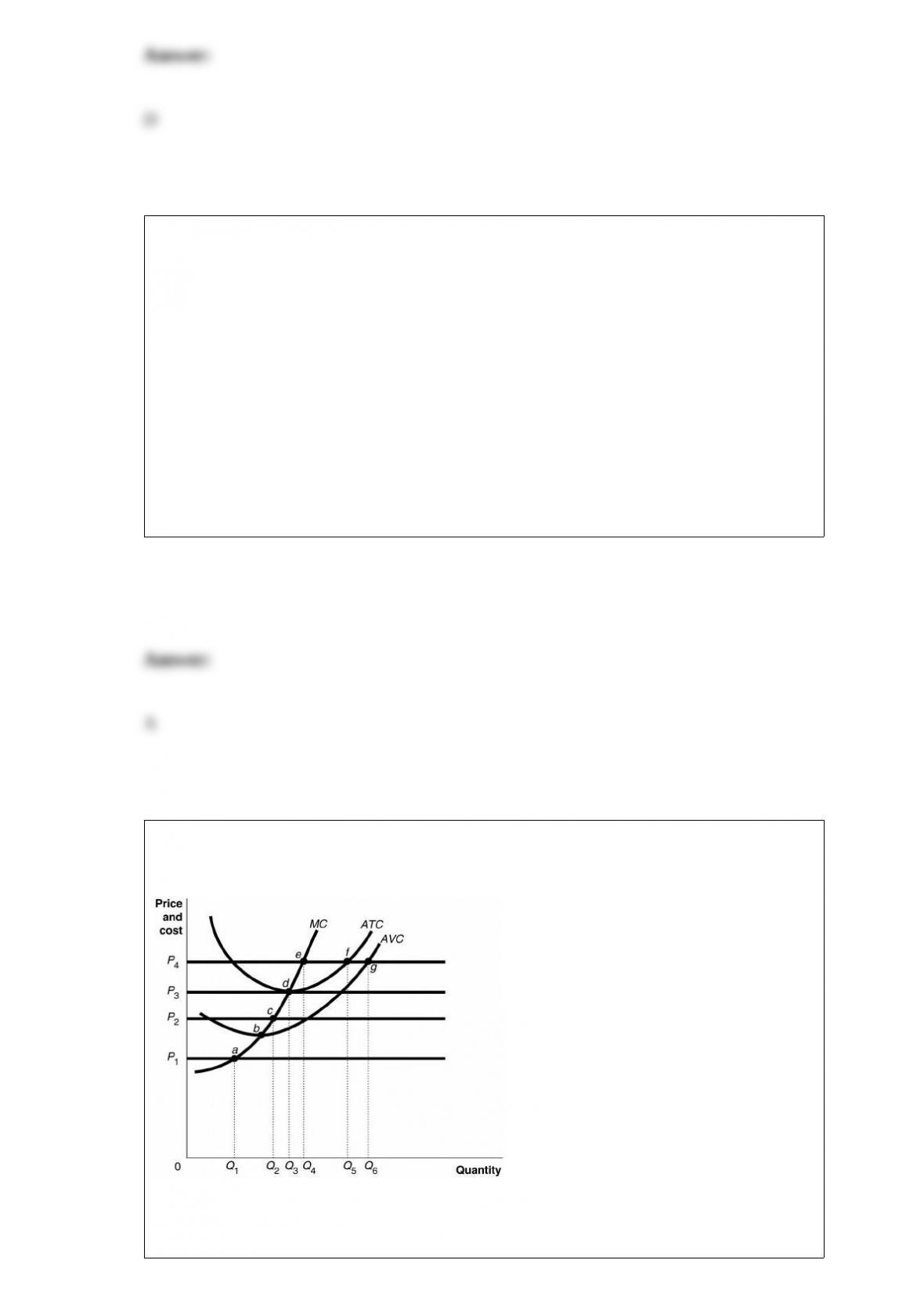
Figure 12-9
Figure 12-9 shows cost and demand curves facing a profit-maximizing, perfectly
competitive firm.

Refer to Figure 12-9. Identify the firm’s short-run supply curve.
A) the marginal cost curve
B) the marginal cost curve from a and above
C) the marginal cost curve from b and above
D) the marginal cost curve from d and above
Which of the following best explains why airlines often cut their ticket prices at the
last-minute in order to fill the remaining empty seats on their flights?
A) Fixed costs in the airline industry are very large, but the marginal cost of flying one
more passenger is very low.
B) Airlines receive a subsidy from the government for each flight that is fully booked
and departs on time.
C) The Federal Aviation Administration ranks each airline based on the percentage of
flights that are fully booked. These rankings affect the decisions of firms to use a
particular airline to fly their employees to business meetings.
D) Cutting prices makes the airlines more popular with their customers, who may fly
with the same airline in the future as the result of buying low-price tickets.

Table 17-6
Refer to Table 17-6. The Hair Cuttery, a new hair salon, is ready to start hiring. The
table above shows the relationship between the number of hairdressers the firm hires
and the quantity of haircuts it produces.
a. Suppose the price of haircuts is $8. Complete the table by filling in the values for
marginal product and marginal revenue product.
b. The Hair Cuttery is an input price-taker. Suppose the wage paid to hairdressers is $40
per day. What is the profit-maximizing number of hairdressers?
c. Suppose the wage rate rises to $60 per day.
(i) What happens to the firm’s demand curve for hairdressers?
(ii) What happens to the profit-maximizing quantity of hairdressers?
d. Suppose the wage rate is $40 per day and the price of haircuts is now $10.
(i) What happens to the firm’s demand curve for hairdressers?
(ii) What happens to the profit-maximizing quantity of hairdressers?
For a given supply curve, how does the elasticity of demand affect the burden of a tax
imposed on a product?
A) The excess burden of the tax will be minimized when the demand is unit-elastic.
B) The excess burden of the tax will be greater when the elasticity of supply is greater
than the elasticity of demand.
C) The excess burden of the tax will be greater when the demand is less elastic than
when it is more elastic.
D) The excess burden of the tax will be greater when the demand is more elastic than
when it is less elastic.
________ refers to reductions in a firm’s costs that result from an increase in the size of
an industry.
A) Internal economies
B) External economies
C) Autarkial dominance
D) Streamlining
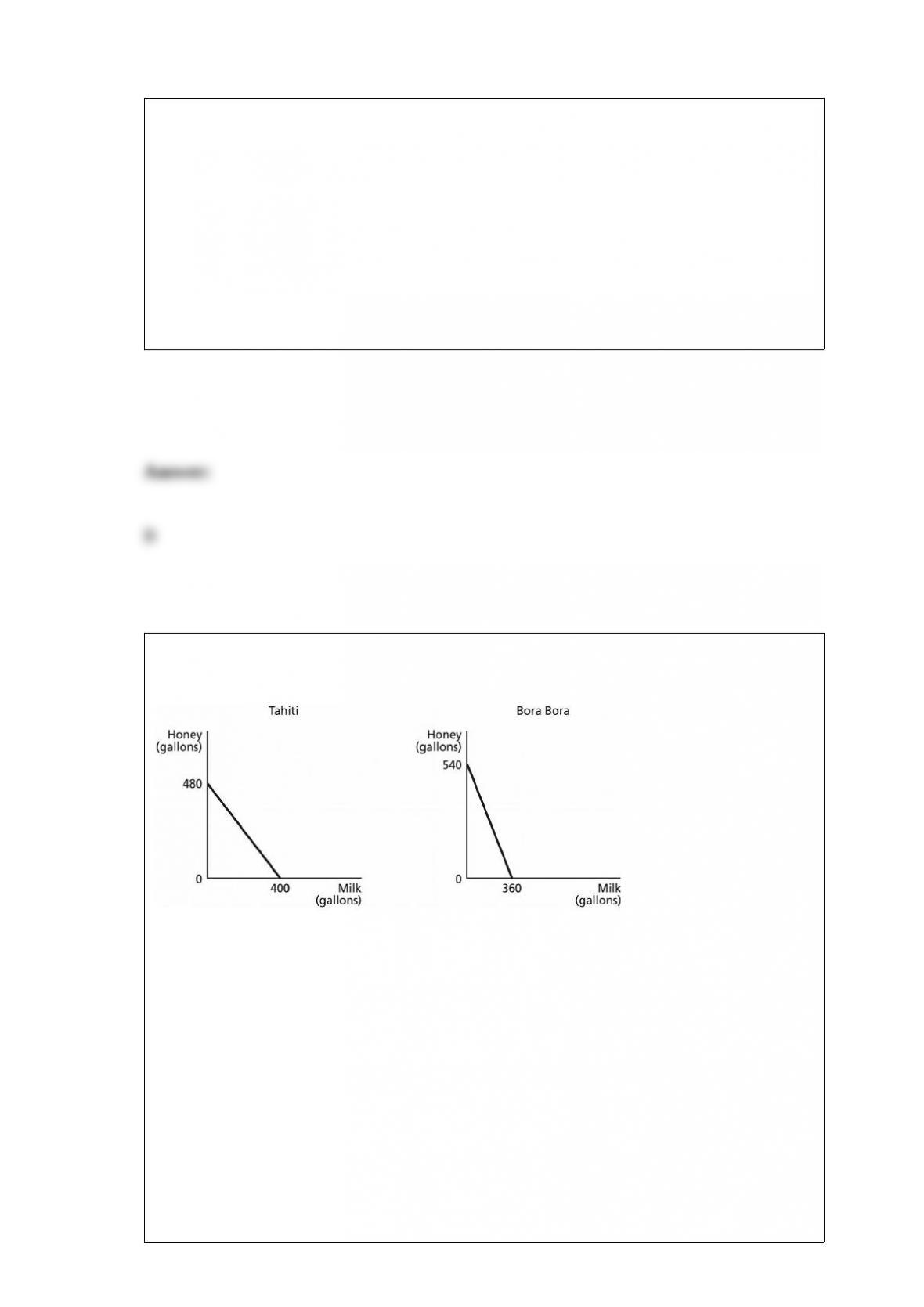
Figure 2-10
Figure 2-10 shows the production possibilities frontiers for Tahiti and Bora Bora. Each
country produces two goods, milk and honey.
Refer to Figure 2-10. If the two countries have the same amount of resources and the
same technological knowledge, which country has an absolute advantage in the
production of milk?
A) Bora Bora
B) They have the same advantage.
C) Tahiti
D) cannot be determined

As a percentage of GDP, exports are greater than imports for which of the following
countries?
A) the United Kingdom
B) France
C) the United States
D) China
The health care system in the United Kingdom is referred to as ________, under which
the government owns most of the hospitals and employs most of the doctors.
A) an out-of-pocket system
B) a single-payer health care system
C) a universal health insurance system
D) socialized medicine

Which of the following statements about commission systems of compensation is false?
A) They increase the risk to workers because sometimes output declines for reasons not
connected to the worker’s effort.
B) During sluggish periods, an employer’s payroll expenses will decline along with
sales.
C) If workers are paid on the basis of the number of units produced, they may become
less concerned about quality.
D) The lack of income stability will induce the more productive workers to leave in
search of more secure employment.
Which of the following is not a way by which price discriminating firms can segment a
market?
A) on the basis of time of purchase, for example long-distance calling
B) by requiring an advance purchase, for example air tickets
C) on basis of the buyer’s location, for example requiring out-of-state students to pay
higher tuition
D) on the basis of the supplier’s marginal cost of production, for example requiring
customers to pay a premium for customizing options