
What is the difference between an intermediate good and a final good?
a. Final goods are adjusted for depreciation, intermediate goods are not.
b. Final goods are adjusted for changes in the value of the dollar, intermediate goods are
not.
c. In GDP calculations, final goods are counted as consumption spending, intermediate
goods are counted as private investment spending.
d. There is no meaningful difference between them.
e. Final goods are finished and ready for sale; intermediate goods require further
processing.
If the U.S. inflation rate falls relative to the Mexican inflation rate, which of the
following will happen in the market for pesos?
a. A rightward shift of the demand curve, a leftward shift of the supply curve, and an
appreciation of the peso
b. A leftward shift of the demand curve, a rightward shift of the supply curve, and an
appreciation of the peso
c. A leftward shift of the demand curve, a leftward shift of the supply curve, and a
depreciation of the peso
d. A rightward shift of the demand curve, a rightward shift of the supply curve, and an
appreciation of the peso
e. A leftward shift of the demand curve, a rightward shift of the supply curve, and a
depreciation of the peso.
Inflation doves lean in the direction of milder recessions and are more willing to
tolerate higher inflation.
When the money market is in equilibrium, the bond market is in equilibrium as well.
Which of the following would not cause the consumption-income line to shift upward?
a. An increase in income
b. An increase in autonomous consumption
c. A decrease in the interest rate
d. Greater optimism about economic conditions
e. An increase in household wealth

Infrastructure projects result in the most value from a fiscal stimulus but a problem is
that
a. there are technological issues that need to be solved.
b. they are too complex to implement.
c. most such projects are “prestige” projects, with little tangible value.
d. most such projects do not increase productivity long into the future.
e. most such projects are not ‘shovel ready” when the stimulus is needed.
If a government runs a fixed exchange rate system and increases the dollar price of its
currency, we say there has been a(n)
a. appreciation of the foreign currency
b. depreciation of the foreign currency
c. revaluation of the foreign currency
d. devaluation of the foreign currency
e. fixing of the foreign currency
If net taxes are included in the model, the equation that shows consumption at each
level of income is: C = a + b(Y – T) or C = a + bY – bT.

If demand deposits increase, the result is that
a. required reserves must increase
b. the reserve ratio must increase
c. all banks are “loaned up”
d. the number of loans must decrease
e. all banks are suffering a loss
Careetha has just taken a fixed-rate loan and agreed to pay a nominal interest rate of 6
percent. If the inflation rate during the first year of the loan was 2 percent, her real
interest rate that first year was
a. 6 percent
b. 8 percent
c. 4 percent
d. 12 percent
e. impossible to calculate without additional information

The reason a shock to one sector can spread to the whole economy is that
a. a decrease in production in one sector leads to an overall decrease in spending
b. firms will need to help bail out other firms that are having troubles
c. an increase in production in one sector will lead to an overall decrease in spending
d. most shocks are not sector-specific but economy-wide
e. workers laid off in the one sector will purchase more goods in another sector
If you observed that the both the wage rate and employment increased, which of the
following would be a possible explanation?
a. A decrease in labor demand
b. An increase in labor demand that outpaced an increase in labor supply
c. A decrease in labor demand coupled with an increase in labor supply
d. A decrease in labor supply
e. An increase in labor supply that outpaced an increase in labor demand
The real wage can increase only if the nominal wage increases.
The Federal Reserve was originally created to
a. stabilize exchange rates
b. keep the unemployment rate at 0%
c. create jobs
d. issue bonds
e. create and regulate the U.S. money supply
If a society is on its production possibilities frontier, and decides to produce more health
care,
An increasing marginal product of labor would be most commonly found
The fact that the supply curve for a given firm’s bond is vertical reflects the fact that
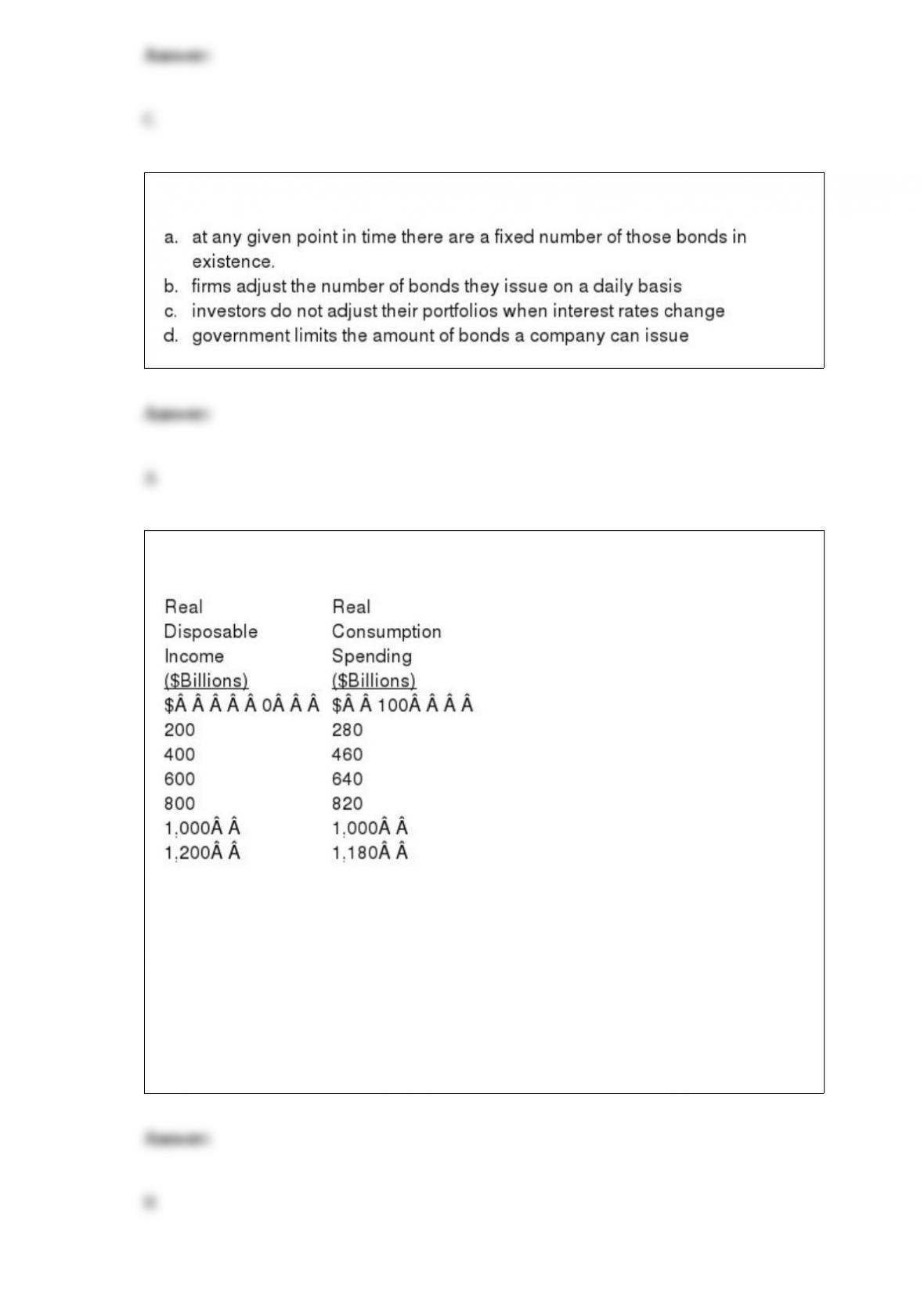
Use the table below to determine the marginal propensity to save (MPS).
a. 0
b. 0.1
c. 0.2
d. 0.5
e. 1.0

If the output level is such that the aggregate expenditure line lies below the 45-degree
line, which of the following is true?
a. Aggregate expenditure is greater than output, so inventories will increase and output
will be raised.
b. Aggregate expenditure is greater than output, so inventories will decrease and output
will be increased.
c. Aggregate expenditure is less than output, so inventories will decrease and output
will be raised.
d. Aggregate expenditure is less than output, so inventories will increase and output will
be lowered.
e. Aggregate expenditure is greater than output, so inventories will increase and output
will be lowered.
Any pro-growth policy that increases investment requires
a. an eventual increase in GDP
b. increased production of consumption goods
c. decreased production of capital goods
d. a sacrifice of current consumption spending
e. reduced government spending