
If a representative firm with long-run total cost given by TC = 2,000 + 20q + 5q2
operates in a competitive industry where the market demand is given by QD = 10,000 ”
40P, the long-run equilibrium output of the individual firm’s will be:
a. 10 units.
b. 20 units.
c. 30 units.
d. 35 units.
e. 40 units.
The per-week demand for use of the Golden Gate Bridge in San Francisco is P = 13 ”
0.15Q during peak traffic periods and P = 7 ” 0.1Q during off-peak hours, where Q is
the number of cars crossing the bridge in thousands and P is the toll in dollars. If the
marginal congestion cost of using the bridge is MC = 5 + 0.2Q, what is the optimal
off-peak load toll for crossing the bridge?
a. 6.5.
b. 8.0.
c. 8.7.
d. 9.9.
e. 10.6.

Using the Lagrangian multiplier technique, you allocate your $1,000,000 advertising
budget between four media markets so as to maximize your profits. Your assistant
informs you that the Lagrangian multiplier is equal to “$0.50. From this you conclude
that:
a. you are allocating your budget across markets optimally.
b. advertising is worthless.
c. another dollar of advertising would increase profits $0.50.
d. another dollar of advertising would decrease profits $0.50.
e. you could earn more profit with a larger advertising budget.
What is the optimal bid for a descending-price auction if the bidder’s reservation price
is 8, the lowest possible bid is 3, and there are five bidders?
a. 3.
b. 6.
c. 7.
d. 8.
e. None of the above.

The ABC Company estimates that a newspaper advertising campaign would cost
$25,000 and would generate $35,000 in new revenues. The firm should begin this
campaign as long as:
a. price elasticity of demand is at least 2.5 (in absolute value).
b. price elasticity of supply is 1.
c. price elasticity of demand is at least 1.4 (in absolute value).
d. marginal cost of production is no more than $25,000.
e. price elasticity of supply is 1.4.
Minimum efficient scale is the output at which:
a. long-run average cost is first minimized.
b. long-run average cost first equals long-run marginal cost.
c. short-run average cost equals long-run average cost for the first time.
d. short-run marginal cost equals long-run marginal cost for the first time.
e. diseconomies are first overcome and then economies of scale set in.

So long as price exceeds average variable cost, in the model of monopolistic
competition, a firm maximizes profits by producing where:
a. the difference between marginal revenue and marginal cost is maximized.
b. marginal cost equals marginal revenue.
c. marginal revenue equals price.
d. the difference between price and marginal cost is maximized.
e. price equals marginal cost.
If the Durbin-Watson statistic is 2, we can conclude that:
a. there is no serial correlation.
b. the error terms have constant variances.
c. there is negative serial correlation.
d. there is positive serial correlation.
e. there is multicollinearity.
The law that closed a loophole in an earlier law that allowed firms to merge to
monopoly by buying a firm’s assets rather than its shares was the:

a. Sherman Act.
b. Clayton Act.
c. Federal Trade Commission Act.
d. Robinson-Patman Act.
e. Celler-Kefauver Act.
A producer refuses to sell some of one joint product. MRA is the marginal revenue for a
low-demand good. If the producer were to sell all its production, what would be true of
MRA?
a. MRA = demand for A.
b. MRA = 0.
c. MRA = marginal cost of A.
d. MRA < 0.
e. MRA = 1.
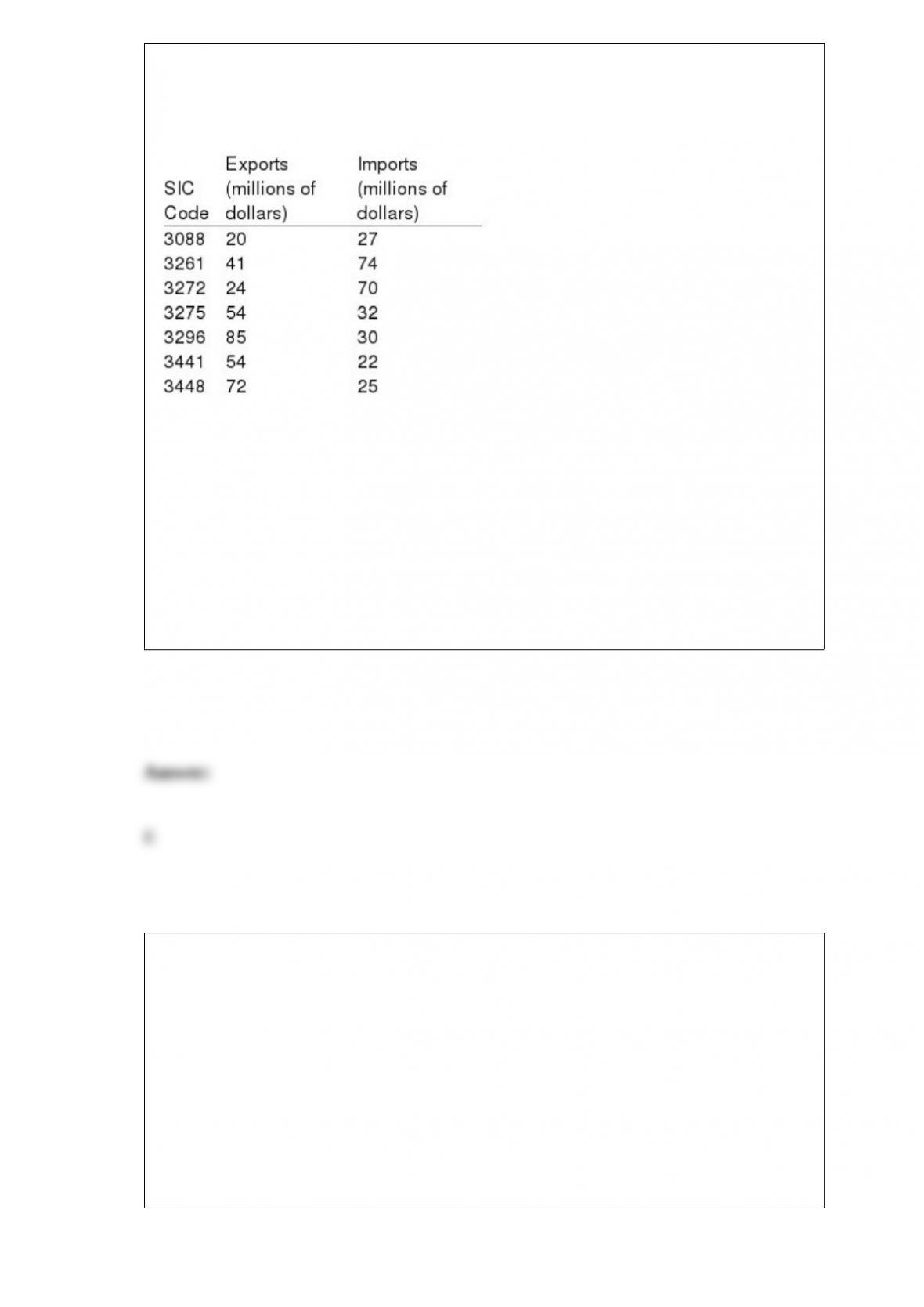
The 1991 exports and imports by industry code are given in the following table. What is
the approximate intercept coefficient estimate a of the regression of exports as a
function of imports?
a. 30.
b. 40.
c. 50.
d. 60.
e. 70.
Average profit is maximized when:
a. average profit is equal to marginal profit.
b. total profit is maximized.
c. marginal profit is increasing.
d. marginal profit is maximized.
e. marginal profit is minimized.

An external diseconomy occurs whenever a(n):
a. action taken by a firm or individual results in uncompensated benefits to others.
b. action taken by a firm or individual results in compensated benefits to others.
c. action taken by a firm or individual results in compensated costs to others.
d. firm trains workers in a highly specialized, firm-specific skill.
e. action taken by a firm or individual results in uncompensated costs to others.
Duopolists A and B face the following demand curves: QA = 150 ” 5PA + 4PB and QB =
150 ” 5PB + 4PA. If both firms have zero marginal cost and they form a cartel, what is
the profit-maximizing price and quantity?
a. P = 25, Q = 250.
b. P = 40, Q = 100.
c. P = 60, Q = 120.
d. P = 80, Q = 80.
e. P = 75, Q = 150.

If the perfectly competitive market supply of pork bellies shifts from QS,93 = 250 + 50P
to QS,94 = 400 + 40P, and the market demand is given by QD = +10,000 ” 200P, then
the change in equilibrium quantity will be:
a. 200 units.
b. 100 units.
c. 0 units.
d. “100 units.
e. “200 units.
If Harry Doubleday’s price elasticity of demand is “2, and its profit-maximizing price is
$6, then its:
a. average cost is $3.00.
b. average cost is $0.33.
c. marginal cost is $3.00.
d. marginal cost is $0.33.
e. average cost is $5.67.
An oligopolist that faces a kinked demand curve is charging price P = 6. Demand for an
increase in price is Q = 280 ” 40P and demand for a decrease in price is Q = 100 ” 10P.
Over what range of marginal cost would the optimal price remain unchanged?
a. Between 3 and 5.
b. Between 2 and 5.
c. Between 1 and 4.
d. Between 2 and 4.
e. Between 3 and 4.
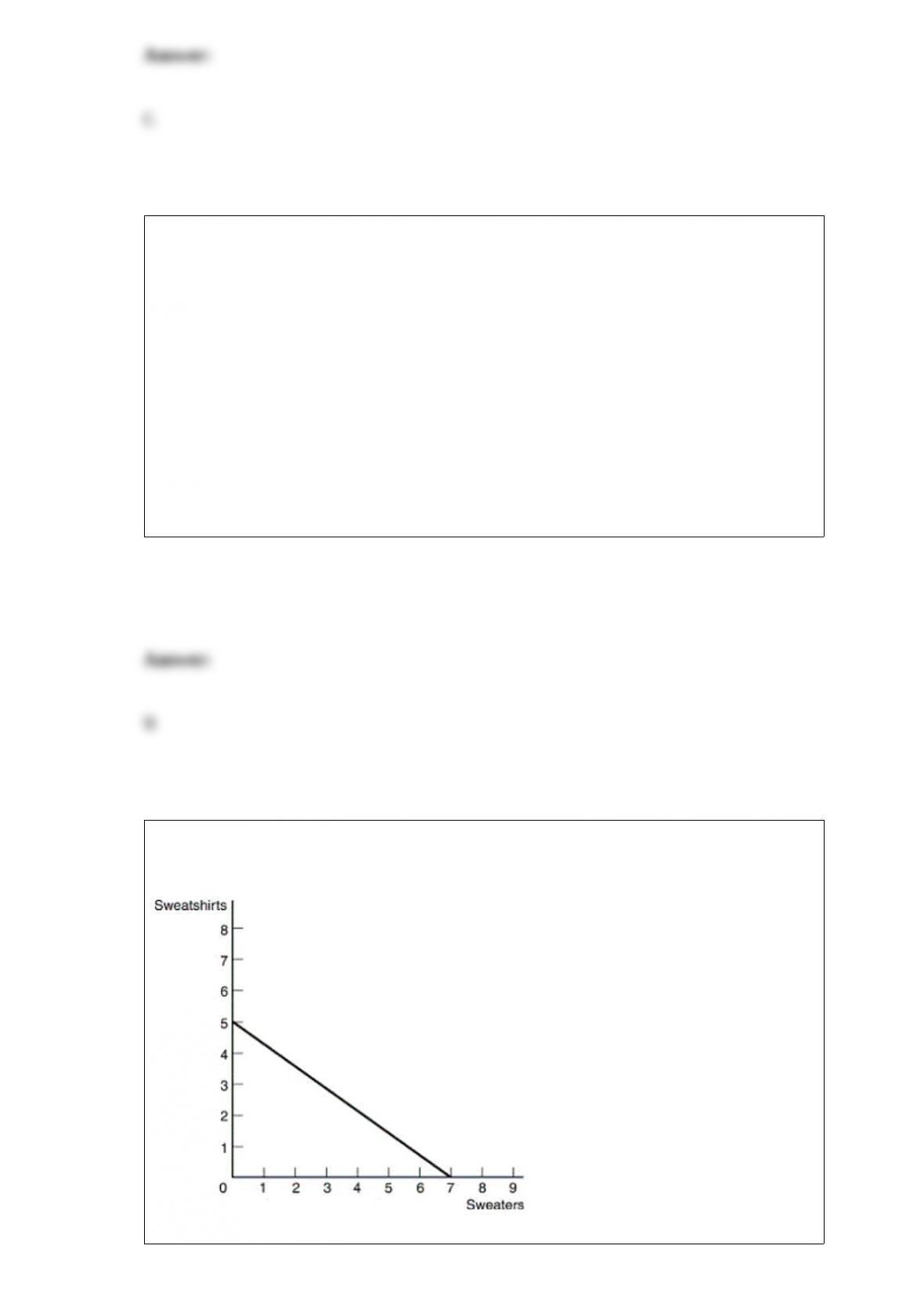
Consider the following budget constraint. Dennis spends all his money on sweaters and
sweatshirts. If the price of sweaters is $15, what is the price of sweatshirts?

a. $5.
b. $7.
c. $15.
d. $21.
e. None of the above.
If s is the standard deviation of a project with expected returns R, the coefficient of
variation is:
a. s / R.
b. s2/ R.
c. sR.
d. s2R.
e. R2s.
Regression analysis is:
a. a psychoanalytical tool, often called “regression toward the mean,” used by
economists to estimate consumer reactions.

b. always preferable to consumer interviews or market experiments.
c. usually done with a pencil and paper.
d. a statistical technique that describes how one variable is related to another.
e. almost never used in practice because of concerns about alienating a firm’s
customers.
Cartels can only exist:
a. in oligopoly markets.
b. when products are homogeneous.
c. when products are not homogeneous.
d. in countries where they are legal.
e. when demand curves are perfectly inelastic.
The power rule of differentiation is:
a. Y = aXbdY/dX = (b ” 1)aXb” 1.
b. Y = aXbdY/dX = (a ” 1)bXa” 1.

c. Y = aXbdY/dX = (a ” 1)aXa” 1.
d. Y = aXbdY/dX = (b ” 1)bXb” 1.
e. Y = aXbdY/dX = baXb” 1.
Which of the following is the dominant strategy when bidding in an auction?
a. Bid less than your reservation price to earn a larger surplus.
b. Bid more than your reservation price if you really want to win the auction.
c. Never bid your reservation price, because you will realize no surplus if you win the
auction.
d. Always bid up to, but not above, your reservation price.
e. The dominant strategy depends on the type of auction.
The opportunity cost of a firm’s inputs:
a. depends on who supplies them to the firm.
b. includes implicit costs but does not include explicit costs.
c. includes explicit costs but does not include implicit costs.

d. should not concern anyone but economists.
e. is the value of the inputs in their most highly valued alternative use.
Billy Joe Bob thinks he will win $3 with probability P; otherwise he will win $11. His
expected payoff is:
a. $3 + $8P.
b. $11 ” $8P.
c. $7.
d. $3 + $11P.
e. $11 ” $3P.
The antitrust law that made “every contract, combination…or conspiracy, in restraint of
trade” illegal was the:
a. Sherman Act.
b. Clayton Act.
c. Federal Trade Commission Act.

d. Robinson-Patman Act.
e. Celler-Kefauver Act.
When the error terms are correlated across observations, one way to address the
resulting econometric problem is to:
a. use weighted least squares.
b. use first differences rather than levels of the variables.
c. gather more data.
d. transform the independent variable.
e. eliminate covarying variables.
A risk-averse person has a utility function that, with income on the horizontal axis and
utility on the vertical axis, as income increases:
a. is a horizontal line.
b. is a vertical line.
c. has constant, positive slope.
d. is increasing at a decreasing rate.

e. is increasing at an increasing rate.
As far as we know, auctions first emerged:
a. as e-commerce exploded in recent years.
b. when capitalism became a popular form of economic organization.
c. after the emergence of communism, because black markets were popular in centrally
planned economies.
d. in Babylonian marriage markets.
e. to increase efficiency in the trading of commodities.
Craig’s Red Sea Restaurant is the only restaurant in Columbia, South Carolina, that sells
Ethiopian food. The demand for Ethiopian food is given by Q = 25 ” P. Craig’s costs are
given by TC = 25 + Q + 5Q2. Its maximum monopoly profit is:
a. “$1.
b. $21.
c. $22.
d. $24.

e. $26.
What is the advantage to a particular firm of cheating on an otherwise effective cartel?
a. The industry can then act like a monopoly.
b. It decreases risk.
c. It enhances credibility.
d. It always pays in the short run and may pay in the long run.
e. It always pays in the long run and may pay in the short run.
Lines that separate the economically relevant portion of an isoquant map from the
irrelevant portion are:
a. isocost lines.
b. ridge lines.
c. opportunity lines.
d. relevance lines.
e. budget lines.

El Niño wind patterns affected the weather across the United States during the winter of
1997″1998. Suppose the demand for home heating oil in Connecticut is given by Q =
20 ” 2Phho + 0.5Png ” TEMP, where Q is the quantity of home heating oil demanded,
Phho is the price of home heating oil per unit, Png is the price of natural gas per unit,
and TEMP is the absolute difference between the average winter temperature over the
past 10 years and the current average winter temperature. If the current price of home
heating oil is $1.20, the current price of natural gas is $2.00, and the average winter
temperature this year is 40 degrees compared to 28 degrees over the past 10 years, the
quantity of home heating oil demanded is:
a. 6.6 gallons.
b. 16.6 gallons.
c. 35.4 gallons.
d. 20 gallons.
e. none of the above.
You must produce 200 records this week. Using the Lagrangian technique, you
determine the profit-maximizing combination of pink vinyl and blue vinyl records and
find that the Lagrangian multiplier is $2.50. From this you conclude that:
a. the marginal revenue is about $2.50.
b. the average revenue is about $2.50.

c. the average revenue exceeds average cost by about $2.50.
d. the marginal revenue exceeds marginal cost by about $2.50.
e. consumers prefer pink vinyl to blue vinyl.
If you get $10 for heads but lose $10 for tails on the flip of a fair coin, the coefficient of
variation is:
a. undefined.
b. 0
c. 1
d. 10
e. 100