1) The first successful commercial introduction of a new product refers to:
A.invention.
B.innovation.
C.diffusion.
D.diversification.
2) If the demand for a product is perfectly inelastic, the incidence of an excise tax will
be:
A.entirely on the buyer.
B.mostly on the buyer.
C.entirely on the seller.
D.mostly on the seller.
3)
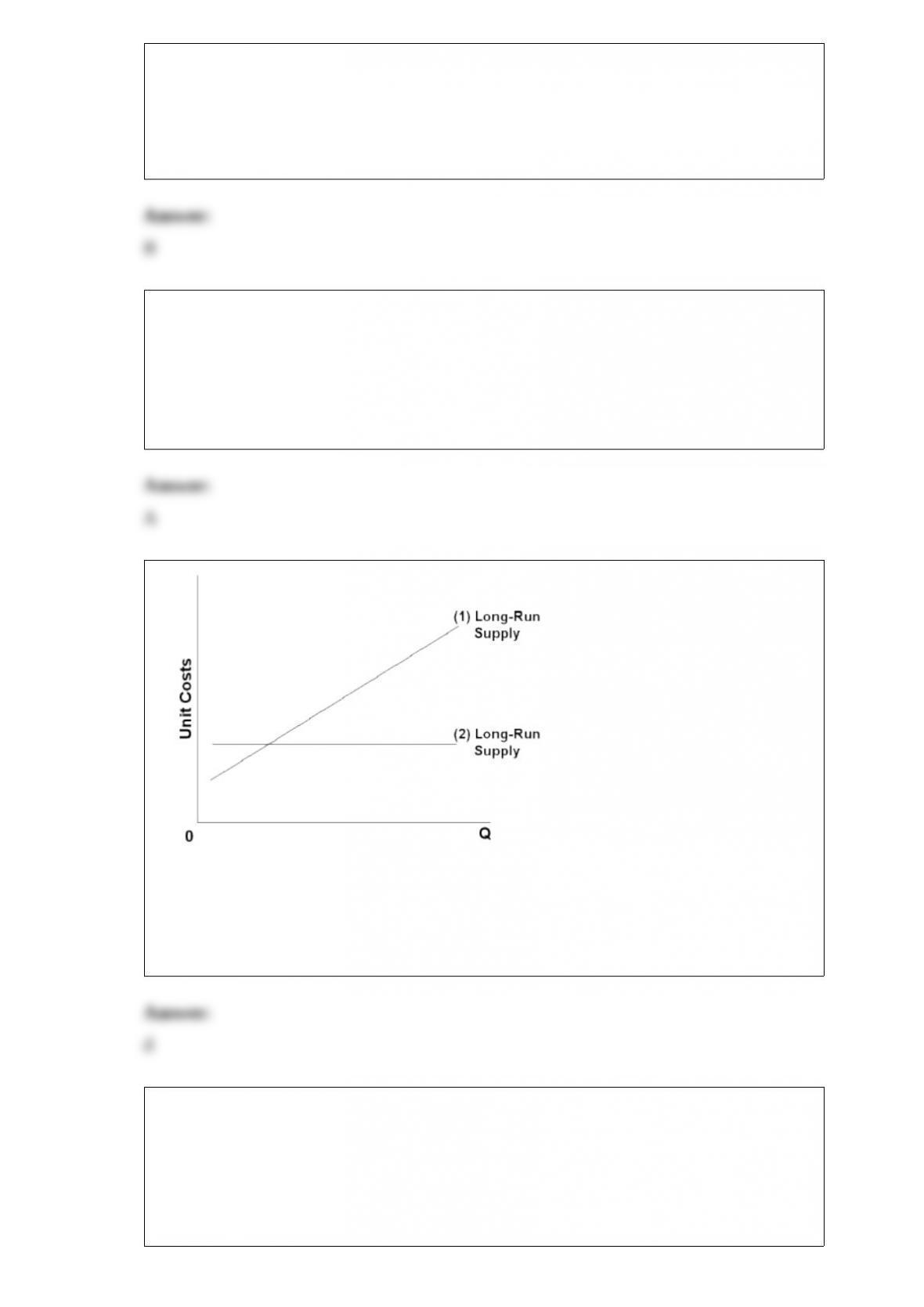
refer to the above diagram. line (2) reflects a situation where resource prices
a.decline as industry output expands.
b.increase as industry output expands.
c.rise and then decline as industry output expands.
d.remain constant as industry output expands.
4) assume product a is an input in the production of product b. in turn product b is a
complement to product c. we can expect a decrease in the price of a to:
a.increase the supply of b and increase the demand for c.
b.decrease the supply of b and increase the demand for c.
c.decrease the supply of b and decrease the demand for c.
d.increase the supply of b and decrease the demand for c.
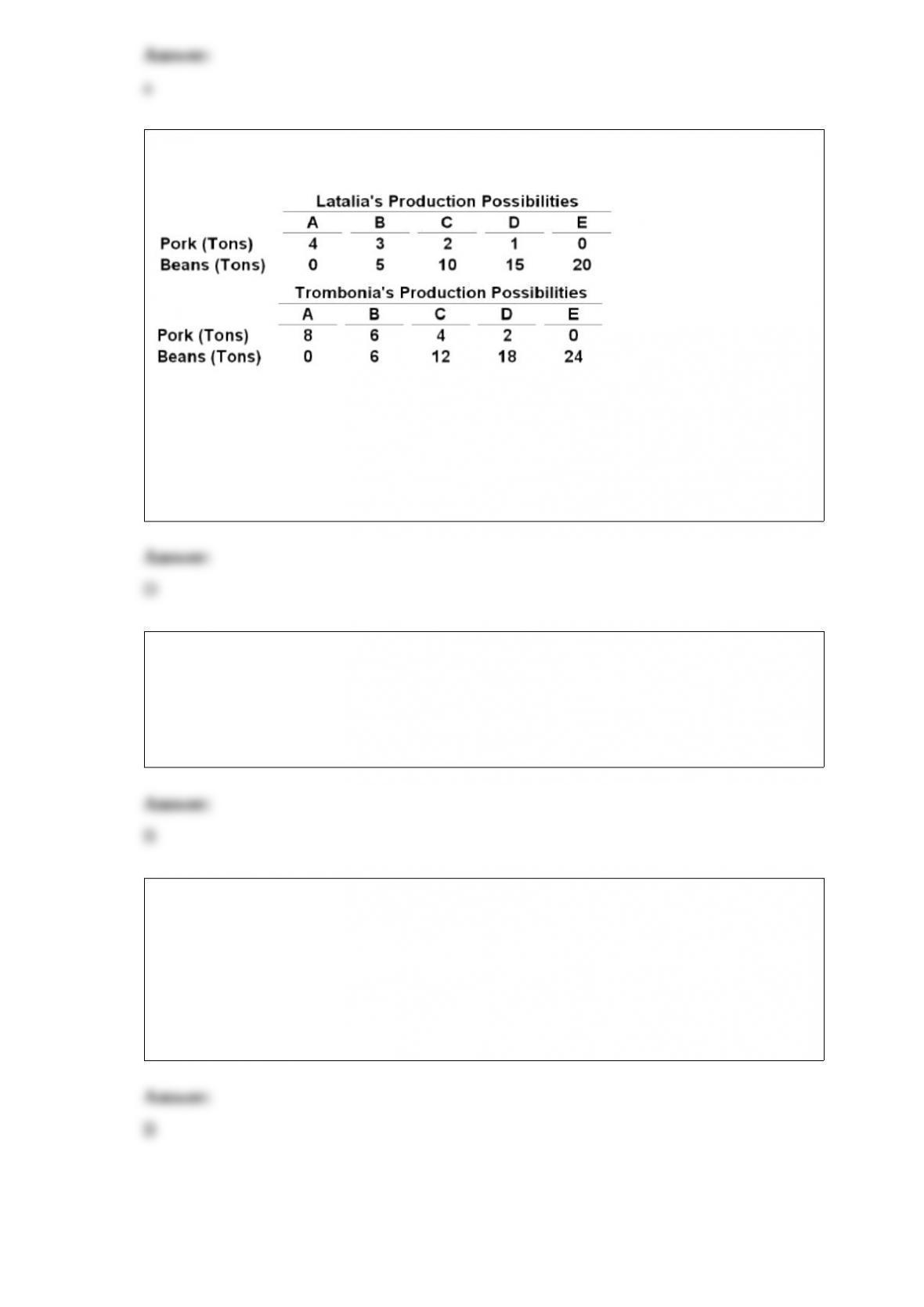
5) The following production possibilities tables for two countries, Latalia and
Trombonia:
Refer to the above tables. If these two nations specialize on the basis of comparative
advantage:
A.Trombonia will produce beans and Latalia will produce pork.
B.Trombonia will produce both beans and pork.
C.Latalia will produce both beans and pork and Trombonia will produce neither.
D.Latalia will produce beans and Trombonia will produce pork.
6) Which of the following would most likely increase income inequality?
A.Improvements in public education.
B.Greater monopoly power among product sellers.
C.Greater equality in the distribution of wealth.
D.Fewer differences in working conditions across occupations.
7) On a diagram where the interest rate and the quantity of money demanded are shown
on the vertical and horizontal axes respectively, the transactions demand for money can
be represented by:
A.a line parallel to the horizontal axis.
B.a vertical line.
C.a downsloping line or curve from left to right.
D.an upsloping line or curve from left to right.
8)
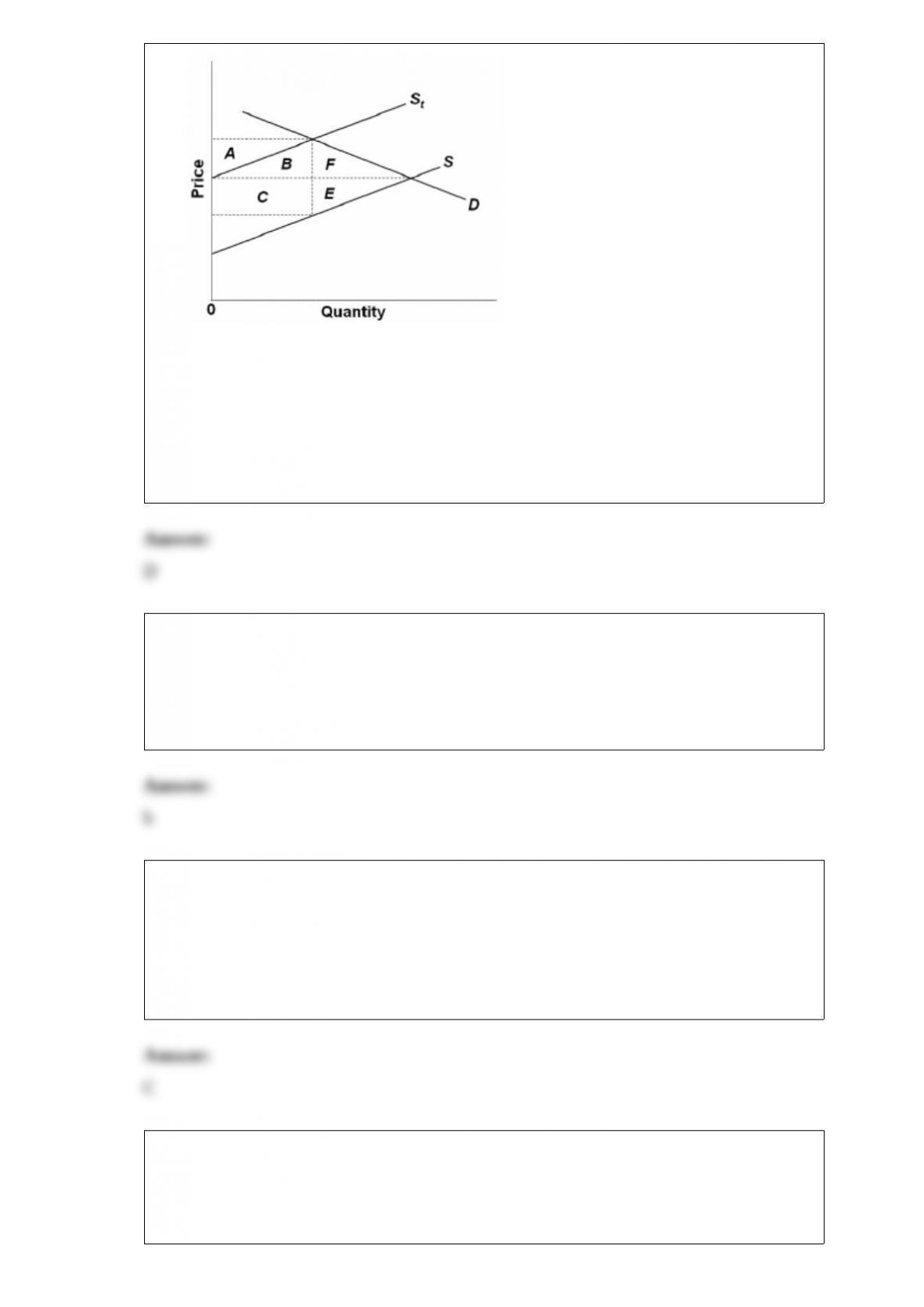
Refer to the above diagram in which S is the before-tax supply curve and St is the
supply curve after an excise tax is imposed. The efficiency loss of the tax is shown by
area(s):
A.A + B + C + E + F.
B.A + B + C.
C.A + B + F.
D.E + F.
9) a decrease in the price of digital cameras will:
a.cause the demand curve for memory cards to become vertical.
b.shift the demand curve for memory cards to the right.
c.shift the demand curve for memory cards to the left.
d.not affect the demand for memory cards.
10) A specific reduction in government spending will dampen demand-pull inflation by
a greater amount, the:
A.smaller is the economy’s MPC.
B.flatter is the economy’s aggregate supply curve.
C.smaller is the economy’s MPS.
D.less the economy’s built-in stability.
11) suppose that in each of four successive years producers sell more of their product
and at lower prices. this could be explained:
a.by small annual increases in supply accompanied by large annual increases in
demand.

b.in terms of a stable supply curve and increasing demand.
c.in terms of a stable demand curve and increasing supply.
d.as an exception to the law of supply.