
If planned aggregate expenditure is less than real GDP, some firms will experience
unplanned increases in inventories.
Expansionary fiscal policy is used to increase aggregate demand in an attempt to fight
rising inflation.
The values of real GDP and real GNP are almost the same in countries where a
significant fraction of domestic production takes place in foreign-owned firms.
Higher wages that compensate workers for unpleasant aspects of a job are called
compensating differentials.

Since World War II, the Federal Reserve has not been involved in carrying out
monetary policy.
In the circular flow model, households demand resources such as labor services in the
product market.
International flows of capital increase both efficiency and growth in countries around
the world.
The table below describes the value added in the production of a gallon of gasoline by
each stage of production. (The values are hypothetical.) Table 19-10
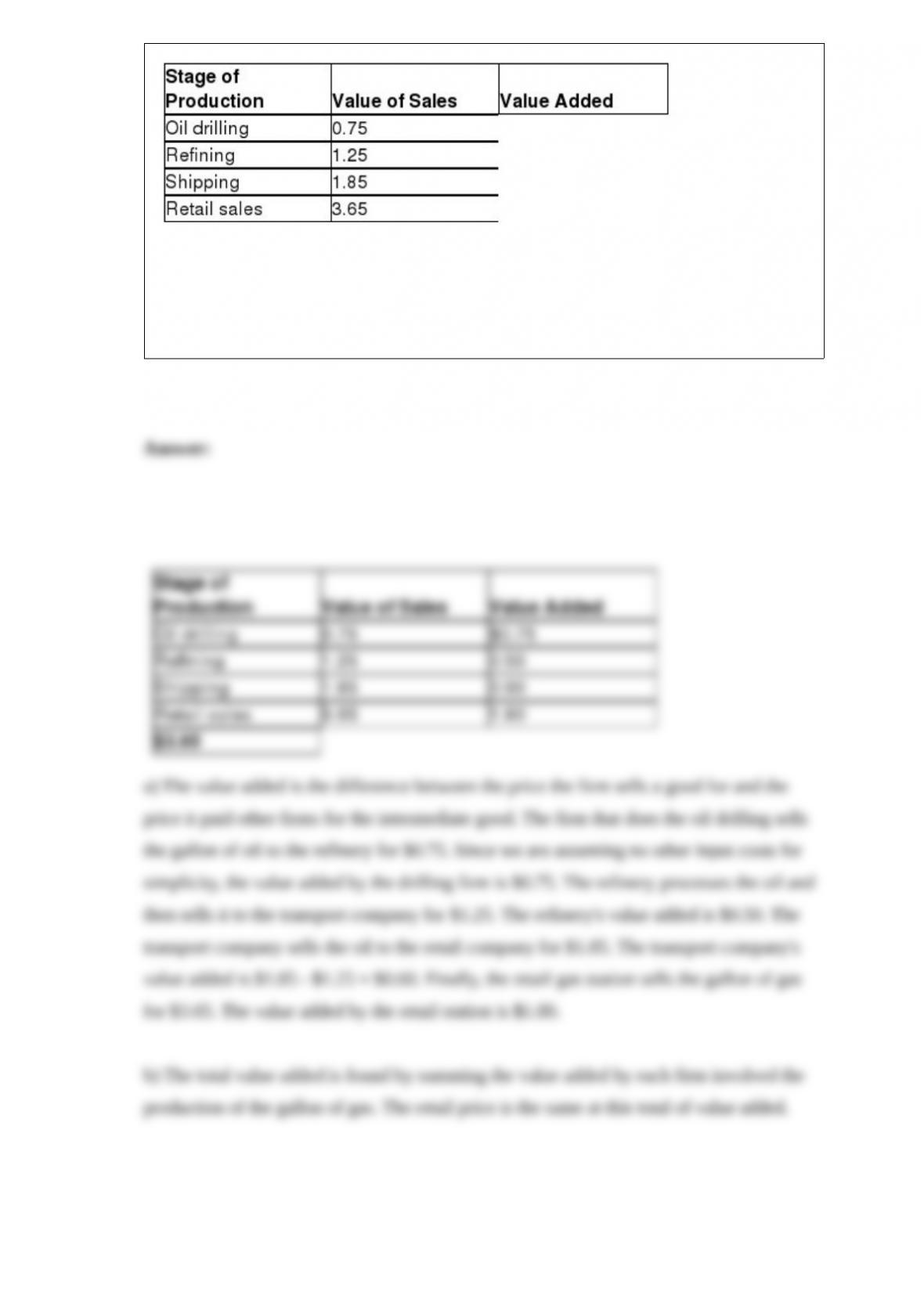
a) What is the value added by each stage of production?
b) What is the total value added?
For simplicity, you can ignore the cost of the inputs for oil drilling.

Which of the following government provisions would help increase the accumulation of
knowledge capital?
A) patents
B) copyrights
C) education subsidies
D) All of the above are correct.
If the Federal Reserve raises or lowers interest rates too late, it could result in a
________ policy that destabilizes the economy.
A) fiscal
B) budgetary
C) procyclical
D) countercyclical
Table 17-2
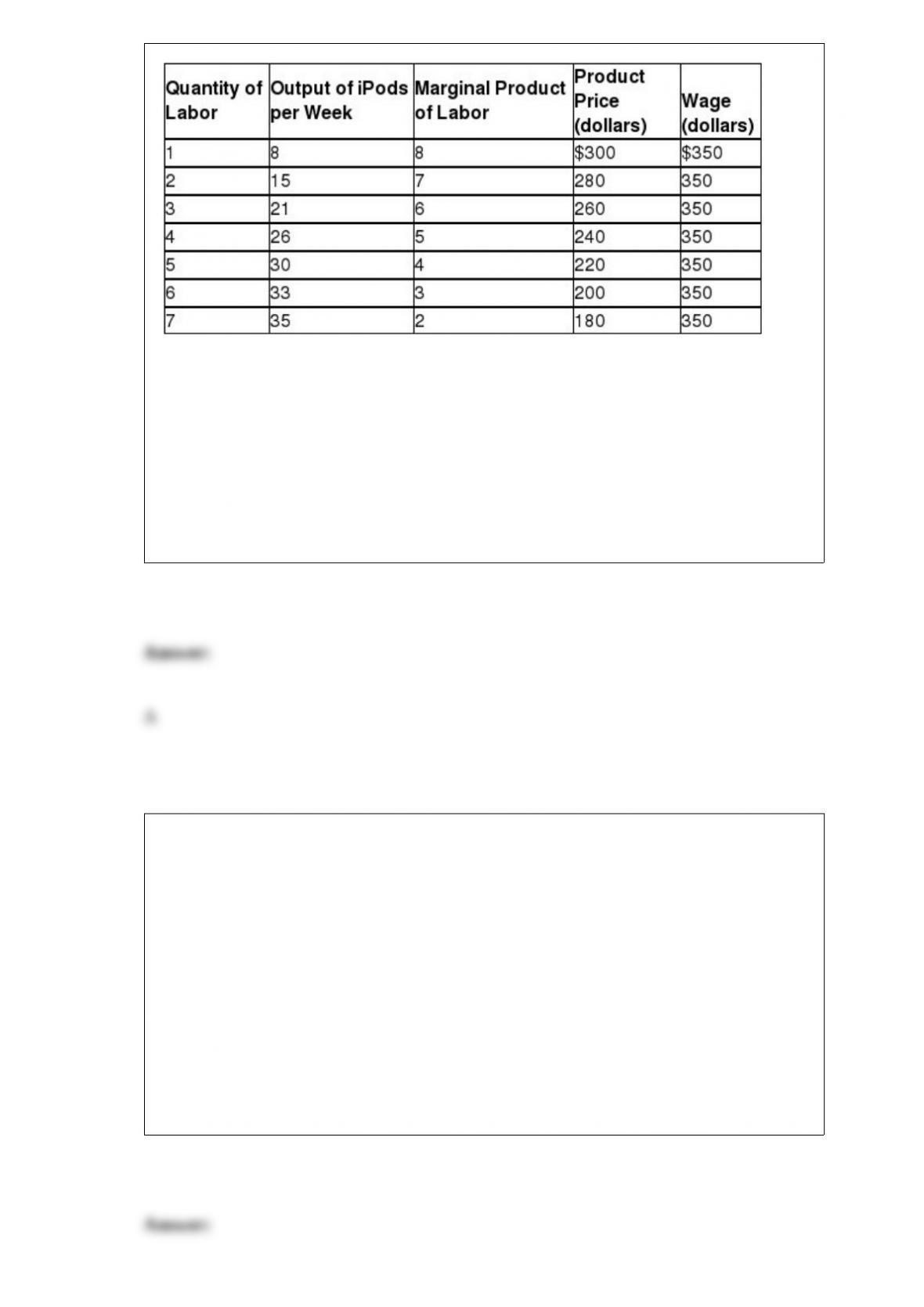
What is the profit-maximizing quantity of labor that the firm should hire?
A) 5 units
B) 4 units
C) 3 units
D) 2 units
David Card and Alan Krueger conducted a study of fast-food restaurants in New Jersey
and Pennsylvania. The study found that
A) there was a large reduction in employment of low-skilled workers when the
minimum wage was raised in these states.
B) the earned income tax credit is more effective in raising the incomes of low-skilled
workers than increases in the minimum wage.
C) increases in the minimum wage had a very small impact on employment.
D) increases in the prices of food have a greater effect on wage increases in New Jersey
than in Pennsylvania.

Table 9-11 Production and
Consumption Production
Without Trade With Trade
Denmark and Belize can produce both clocks and hats. Table 9-11 shows the production
and consumption quantities without trade, and the production numbers with trade.
If the actual terms of trade are 1 hat for 1.8 clocks and 150 hats are traded, how many
clocks will Denmark gain compared to the “without trade” numbers?
A) 30
B) 100
C) 150
D) 900
What is human capital?
A) a slang term for the underground labor market
B) manufactured goods that are used to produce other goods
C) accumulated knowledge and skills acquired by a worker
D) the manager or owner of a business
Who owns a corporation?
A) the board of directors
B) the stockholders
C) the employees
D) the CEO
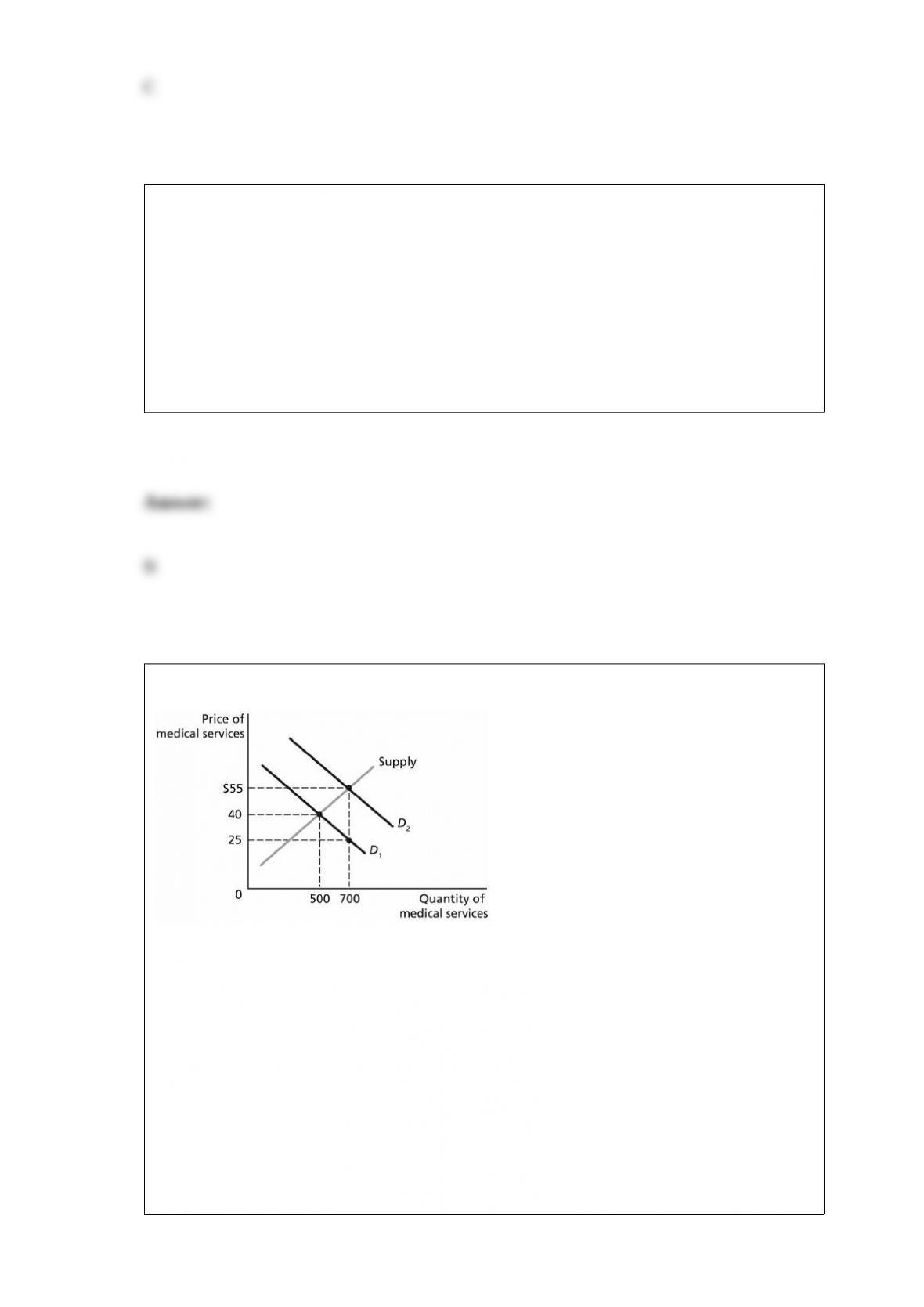
Figure 7-2
Figure 7-2 represents the market for
medical services with and without insurance, and the effect of a third-party payer
system on the demand for medical services.
If consumers paid the full price of medical services, the equilibrium quantity would be
A) 200.
B) 500.
C) 700.
D) >700.
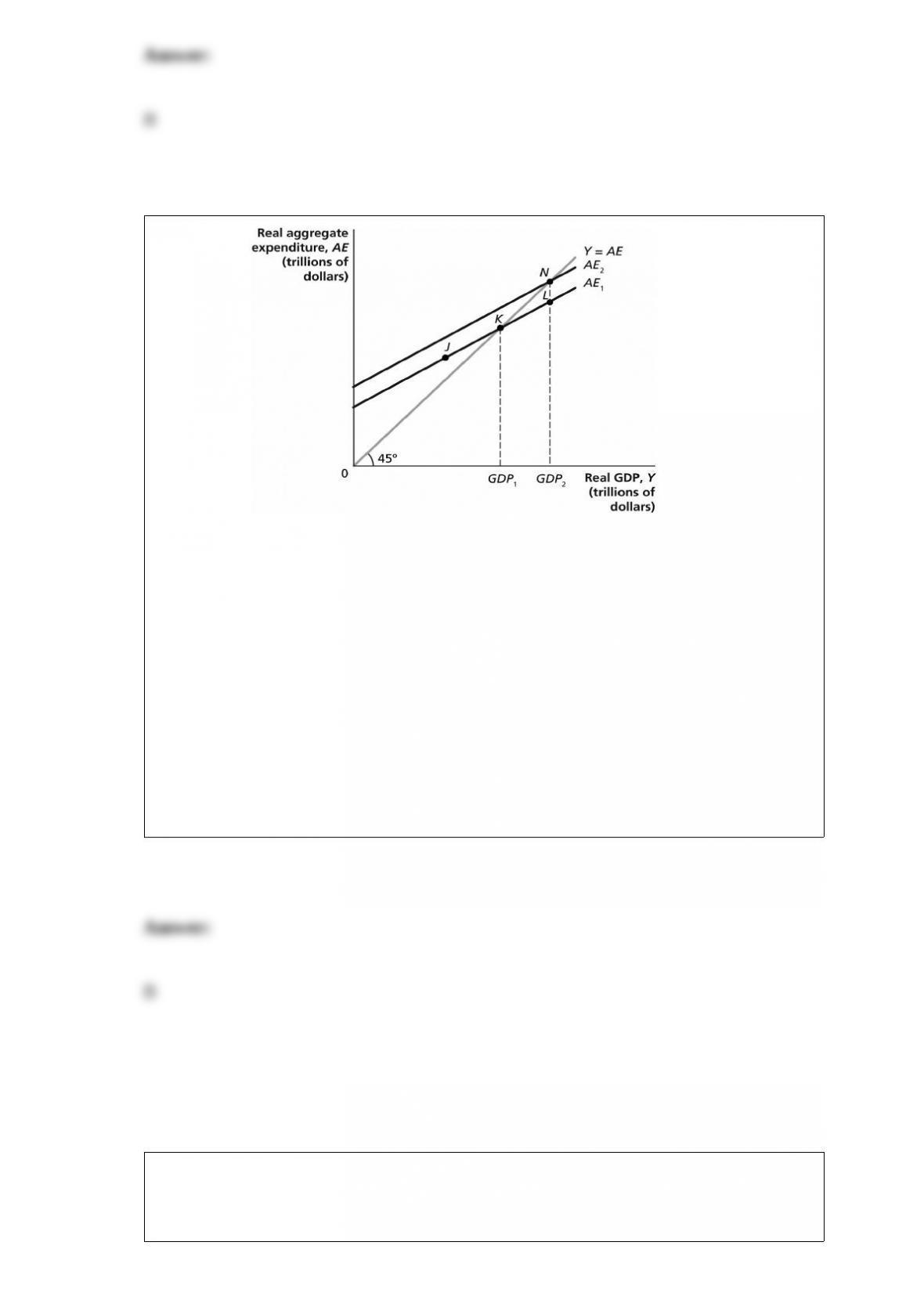
Figure 23-3
Suppose that government spending increases, shifting up the aggregate expenditure
line. GDP increases from GDP1 to GDP2, and this amount is $200 billion. If the MPC
is 0.8, then what is the distance between N and L or by how much did government
spending change?
A) $16 billion
B) $40 billion
C) $200 billion
D) $1,000 billion
During the turmoil in the market for subprime mortgages in 2007 and 2008, the Fed
increased the volume of discount loans. The goal of the Fed was to

A) reduce the rate of inflation.
B) stimulate economic growth.
C) reduce unemployment.
D) reassure financial markets and promote financial stability.
E) reduce the current account deficit.
Consumers are willing to purchase a product up to the point where
A) the marginal benefit of consuming the product is equal to the marginal cost of
consuming it.
B) the consumer surplus is equal to the producer surplus.
C) the marginal benefit of consuming the product equals the area below the supply
curve and above the market price.
D) the marginal benefit of consuming a product is equal to its price.
In recent years the cost of producing wines in the U.S. has increased largely due to
rising rents for vineyards. At the same time, more and more Americans prefer wine over
beer. Which of the following best explains the effect of these events in the wine market?
A) The supply curve has shifted to the left and the demand curve has shifted to the
right. As a result there has been an increase in the equilibrium quantity and an uncertain
effect on the equilibrium price.
B) Both the supply and demand curves have shifted to the right. As a result, there has
been an increase in the equilibrium price and an uncertain effect on the equilibrium
quantity.
C) Both the supply and demand curves have shifted to the right. As a result, there has
been an increase in both the equilibrium price and the equilibrium quantity.
D) The supply curve has shifted to the left and the demand curve has shifted to the
right. As a result, there has been an increase in the equilibrium price and an uncertain
effect on the equilibrium quantity.
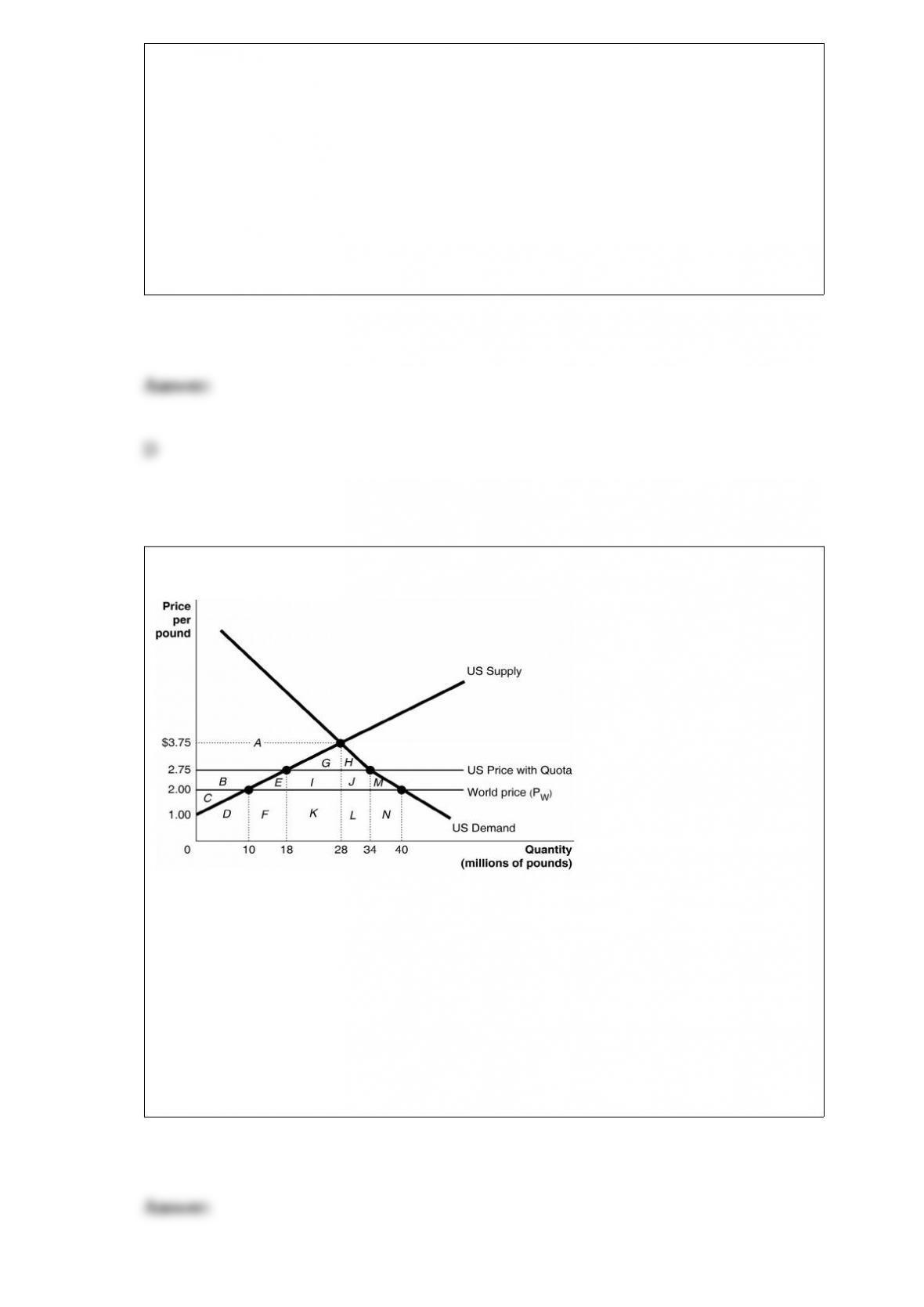
Figure 9-3
Since 1953 the United States
has imposed a quota to limit the imports of peanuts. Figure 9-3 illustrates the impact of
the quota. What is the area of domestic producer surplus after the imposition of a quota?
A) B
B) B + C
C) B + E + I + J + M
D) E + I + J + M
What is the Difference between an “increase in demand” and an “increase in quantity
demanded”?
A) There is no Difference between the two terms; they both refer to a shift of the
demand curve.
B) An “increase in demand” is represented by a rightward shift of the demand curve
while an “increase in quantity demanded” is represented by a movement along a given
demand curve.
C) There is no Difference between the two terms; they both refer to a movement
downward along a given demand curve.
D) An “increase in demand” is represented by a movement along a given demand curve,
while an “increase in quantity demanded” is represented by a rightward shift of the
demand curve.
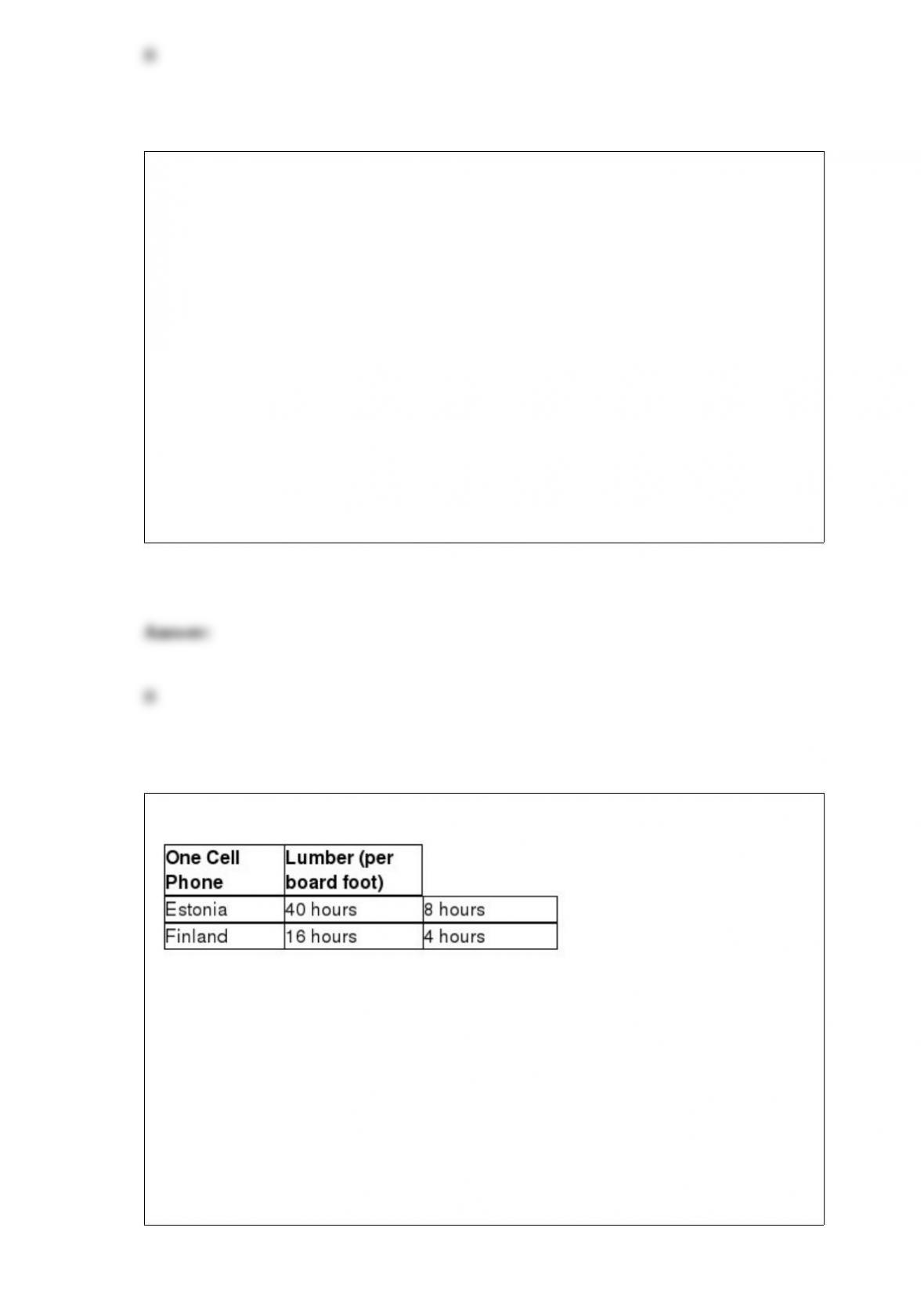
Table 2-16
Table 2-16 shows the number of labor hours required to produce a cell phone and a
board foot of lumber in Estonia and Finland. Finland has a comparative advantage in
the production of
A) both products.
B) lumber.
C) cell phones.
D) neither product.
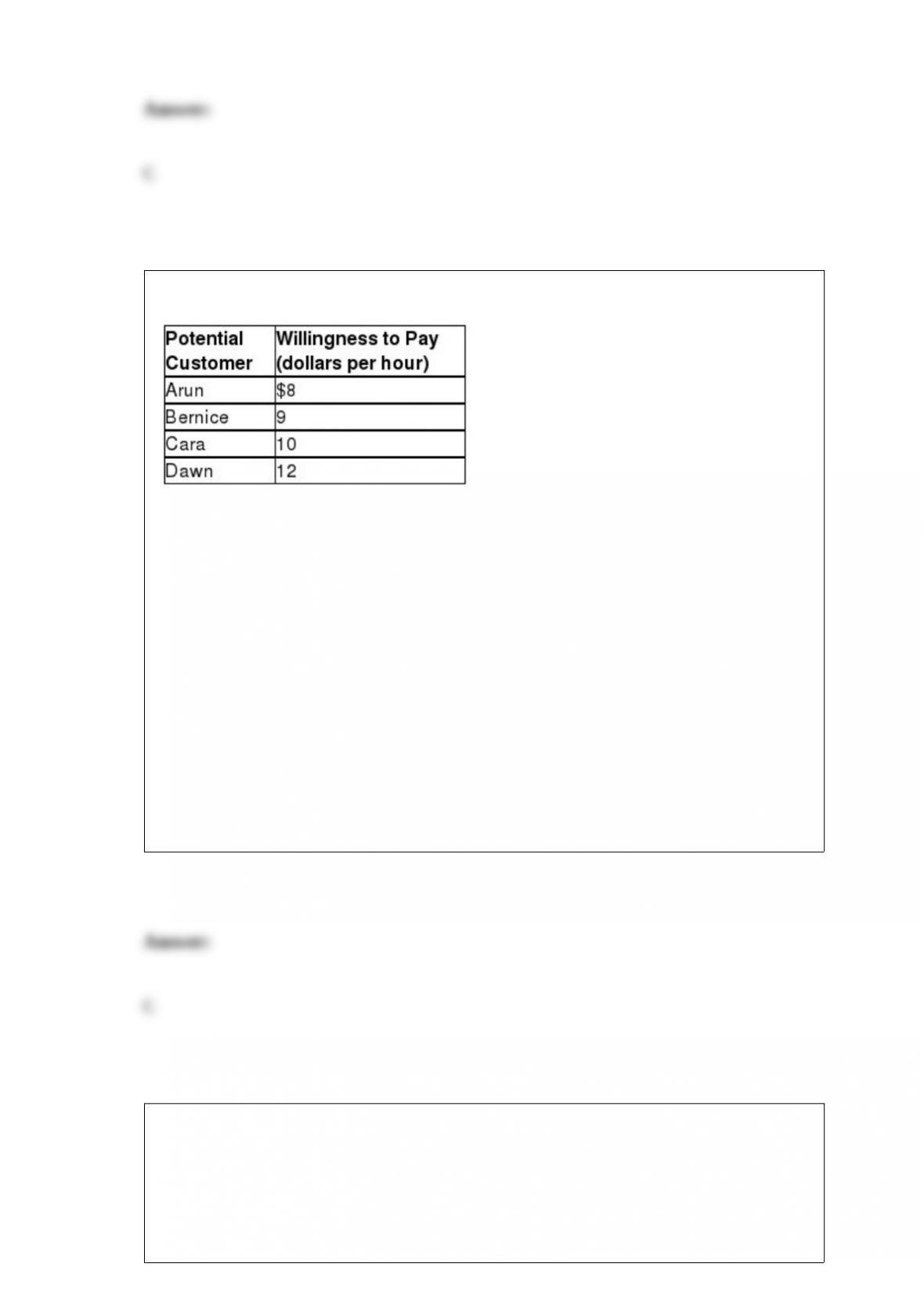
Table 16-3
Julie plans to start a pet-sitting service. She surveyed her neighborhood to determine the
demand for this service. Assume that each person surveyed demands only one hour of
pet sitting services per period. Table 16-3 above shows a portion of her survey results.
Suppose Julie’s marginal cost of providing this service is constant at $7 and she charges
$7 per hour. What is her marginal revenue?
A) It is $7 for the first hour and starts declining thereafter.
B) It is $7 for the first hour and starts increasing thereafter.
C) It is constant at $7.
D) It coincides with the figures in the table; $12 for the first hour, $10 for the second,
$9 for the third and $8 for the fourth.
Tax increases on business income decrease aggregate demand by decreasing
A) business investment spending.
B) consumption spending.
C) government spending.
D) wage rates.
What are the implications of the quantity theory of money for monetary policy and
price stability?
If your income is $92,000 and you pay taxes of $19,475, what is your average tax rate?
Show your work.

Mortgage lenders often resell mortgages in secondary markets. How might this make
lenders act differently than if they intended to hold the mortgages themselves?
If pilots and flight attendants agree to wage and benefit reductions in the wake of the
financial difficulties in the airline industry, what impact would this have on the supply
and demand in the market for airline service, assuming no other changes take place in
this market?
Ronald Coase is famous for the Coase Theorem, which is based on the premise that
there is an economically efficient level of pollution reduction. Many economists believe
that the tradable emissions allowance program that has been used to deal with the
problem of acid rain has been successful in reducing emissions of sulfur dioxide in an
economically efficient manner. Why isn’t this program an example of the Coase

Theorem?