
1) a linear demand curve has a constant elasticity over the full range of the curve.
2) Checkable deposits are a liability on a bank’s balance sheet.
3) market economies use capital goods because they improve productive efficiency.
4) Mainstream macroeconomists see two main sources of macroeconomic instability:
changes in investment spending and, occasionally, adverse aggregate supply shocks.
5) The interest rate is the price paid for the use of money.
6) welfare payments to immigrants have steadily increased since 1996.
7) The demand for productive resources has grown faster than the supply of productive
resources for the past 150 years.
8) if the demand for labor in a country receiving immigrants is inelastic, the
immigration will increase the total wages paid in that country.
9) welfare payments to low-income families are included in national income.
10) “Vote for my special local project and I will vote for yours.” This political
technique:
A.illustrates the paradox of voting.
B.often accompanies pork-barrel politics.
C.illustrates the median voter model.
D.undermines the benefits-received principle.
11) The members of the Federal Reserve Board:
A.serve seven-year terms.
B.are appointed by the American Economic Association.
C.are elected by votes of the 12 presidents of the Federal Reserve Banks.
D.serve 14-year terms.
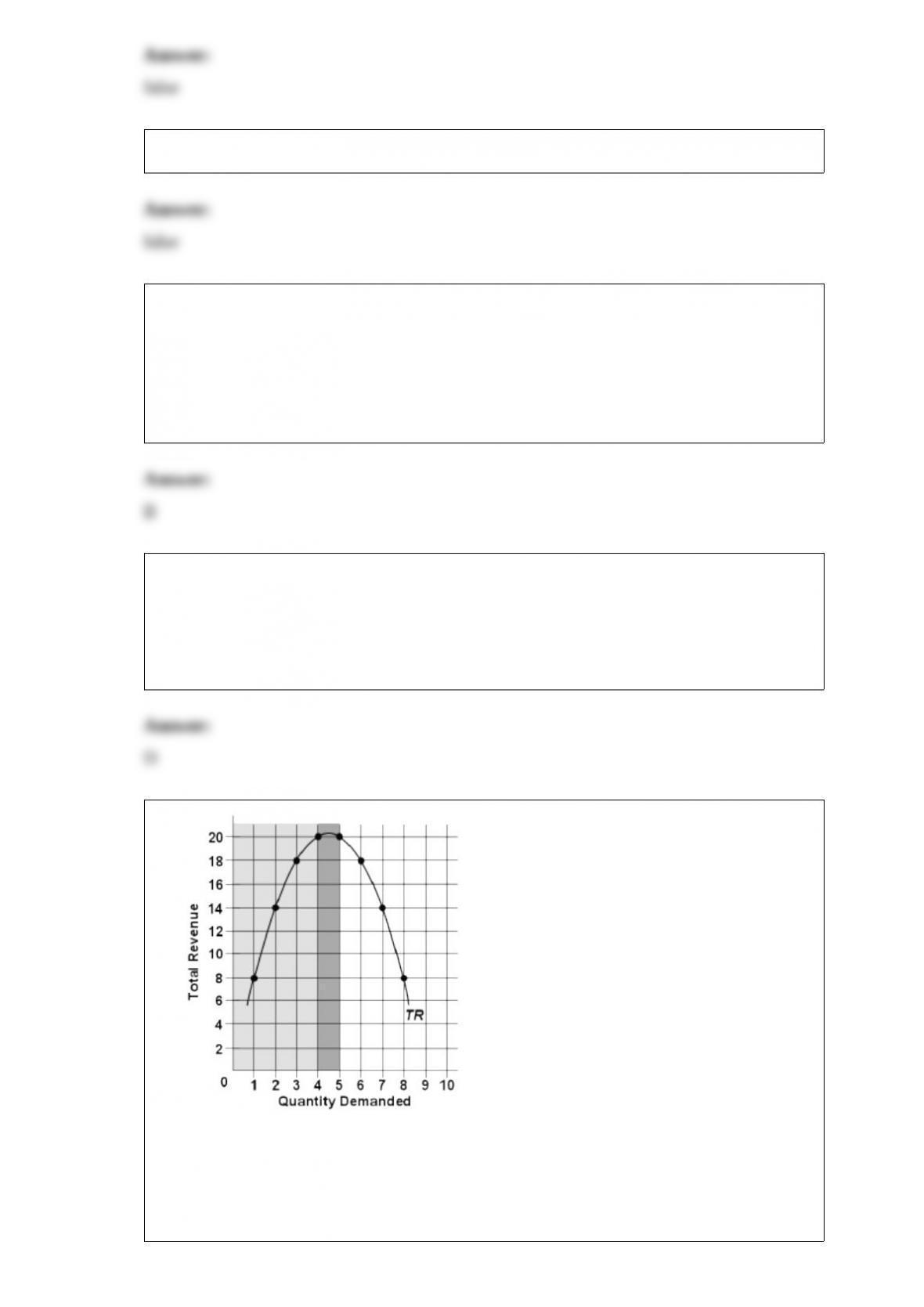
12)
suppose that the above total revenue curve is derived from a particular linear demand
curve. that demand curve must be:
a.inelastic for price declines that increase quantity demanded from 6 units to 7 units.
b.elastic for price declines that increase quantity demanded from 6 units to 7 units.
c.inelastic for price increases that reduce quantity demanded from 4 units to 3 units.

d.elastic for price increases that reduce quantity demanded from 8 units to 7 units.
13) The exercise of market power by suppliers in resource markets tends to:
A.reduce income inequality ensuring that all workers receive fair wages.
B.have little impact on the distribution of income.
C.increase income inequality by raising incomes of those able to “rig the market.”
D.increase income inequality but is offset by the exercise of market power in product
markets.
14) The commercial success of a new product depends on:
A.its price only.
B.its marginal utility only.
C.both its price and its marginal utility.
D.neither its price nor its marginal utility.
15) in the short run the individual competitive firm’s supply curve is that segment of
the:
a.average variable cost curve lying below the marginal cost curve.
b.marginal cost curve lying above the average variable cost curve.
c.marginal revenue curve lying below the demand curve.
d.marginal cost curve lying between the average total cost and average variable cost
curves.
16) The labor demand schedule is identical with the:
A.marginal product schedule.
B.marginal resource cost schedule.
C.marginal revenue product schedule.
D.product demand schedule.
17) Assume that Switzerland and Britain have floating exchange rates. Other things
unchanged, if a tight money policy raises interest rates in Britain as compared to
Switzerland:
A.gold bullion will flow into Switzerland.
B.the Swiss franc will depreciate.
C.the pound will depreciate.
D.the Swiss franc will appreciate.
18) Which of the following would not shift the aggregate supply curve?
A.an increase in labor productivity
B.a decline in the price of imported oil
C.a decline in business taxes
D.an increase in the price level
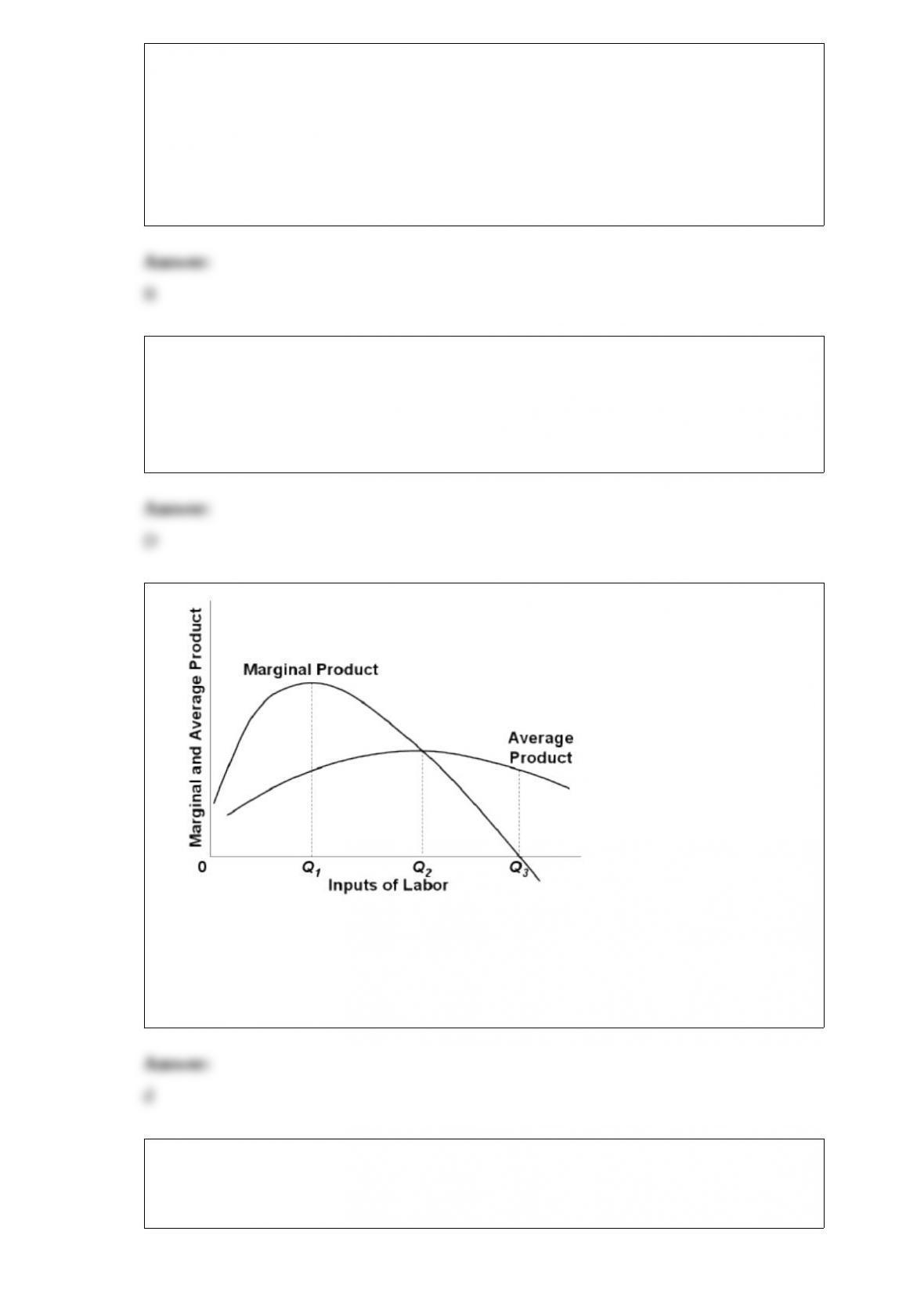
19)
in the above diagram the range of diminishing marginal returns is:
a.0q3.
b.0q2.
c.q1q2.
d.q1q3.
20) How do profit incentives and property rights affect the management of a renewable
resource such as a forest? Why do some nations have growing or sustainable forests and
other nations experience deforestation?
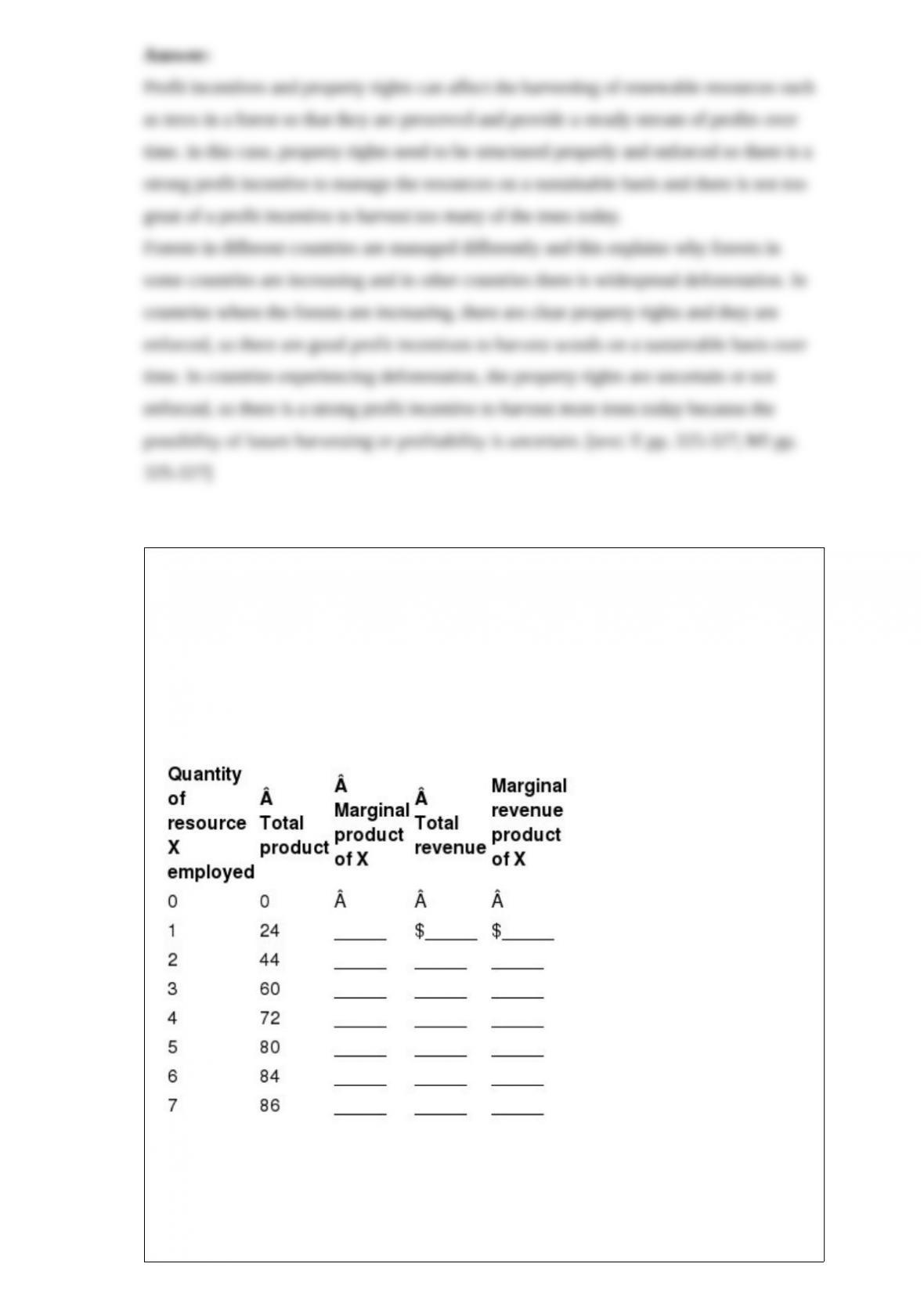
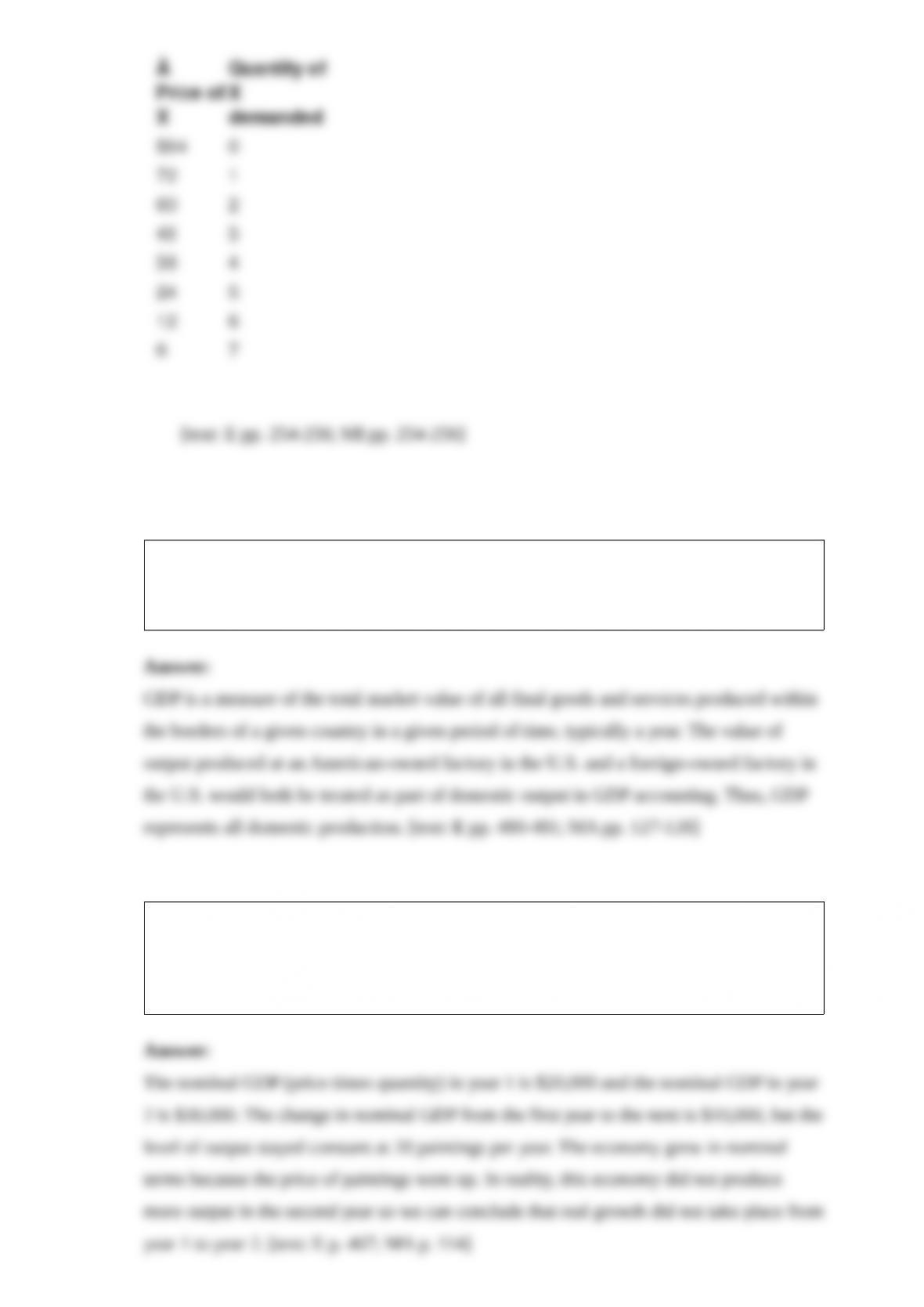
21) The table below shows the total production a firm will be able to obtain if it
employs varying amounts of resource X while the amounts of the other resources the
firm employs remain constant. Compute the marginal product of each of the seven
units of resource X and enter these figures in the table. Assume the product the firm
produces sells in the market for $3.00 per unit. Compute the total revenue of the firm at
each of the eight levels of output and the marginal revenue product of each of the seven
units of resource X. Enter these figures in the table below.
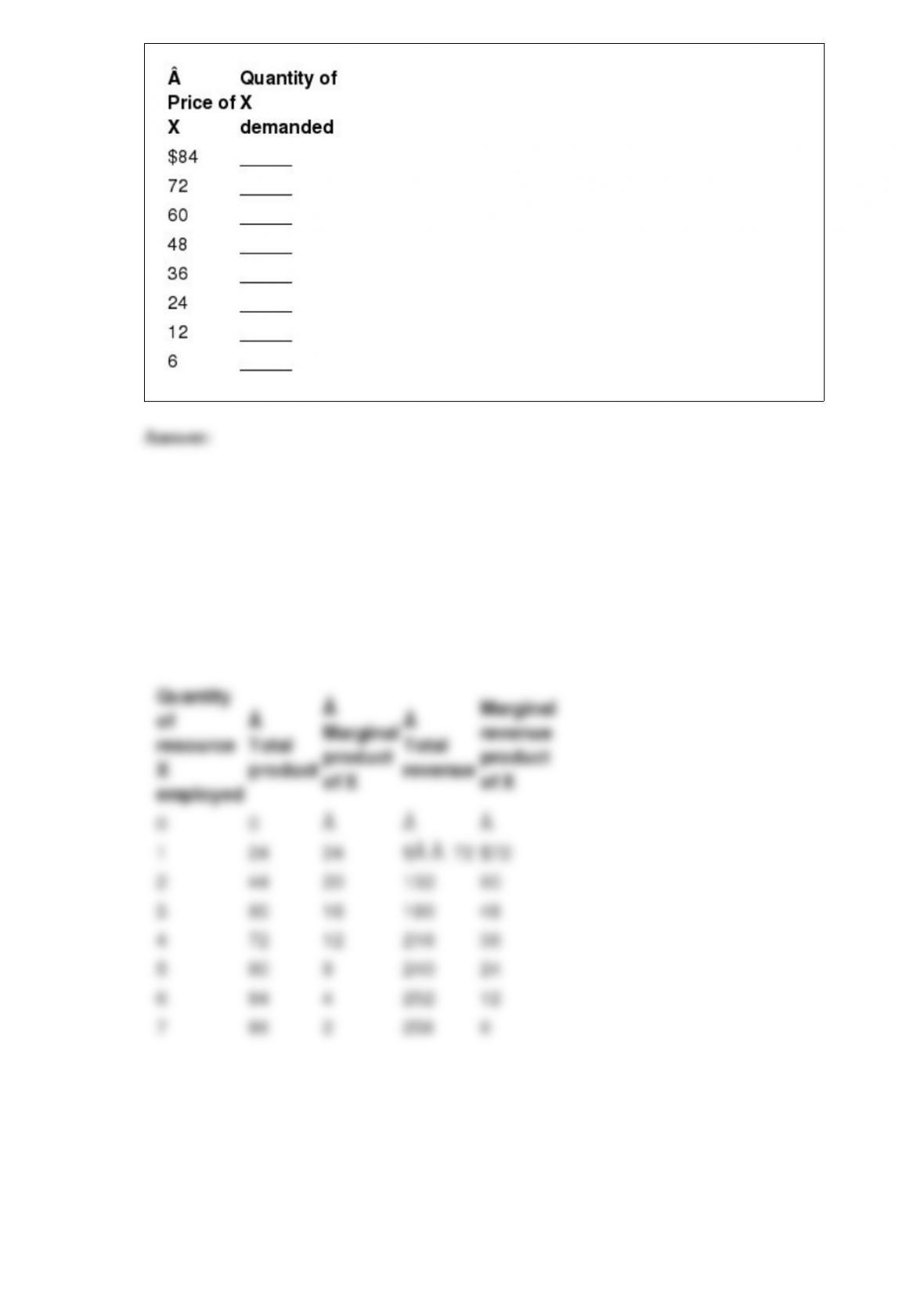
On the basis of your computations complete the firm’s demand schedule for
resource X by indicating in the table below how many units of resource X the firm
would employ at the given prices.
22) What is the definition of GDP? How would the value of output produced at an
American-owned factory in the U.S. and a foreign-owned factory in the U.S. be treated
in GDP accounting?
23) Assume that a painter produces 20 paintings this year and 20 paintings next year.
What is the annual change in nominal GPD if the price of paintings rises from $1,000
this year to $1,500 next year? Can you conclude that the economy grew from this year
to next year based on your answer? Why?
24) What are the three time horizons used to categorize aggregate supply? What is the
difference between the immediate short-run and the short-run aggregate supply?
25) Why may majority voting produce economically inefficient outcomes? Give a
numerical example that leads to the rejection of a public good.
26) What is the Council of Economic Advisers?

27) Explain the difference between a money-market deposit account and a
money-market mutual fund.
28) Describe the basic features of a commercial banks balance sheet.