Consider a used car market in which half the cars are good and half are bad (lemons). A
rational buyer in this market should
A) offer to pay a price equal to the most she would pay for a good car.
B) offer to pay a price equal to the most she would pay for a lemon.
C) offer to pay a price somewhere between the price she would pay for a good car and
the price she would pay for a lemon.
D) save up and buy a new car.
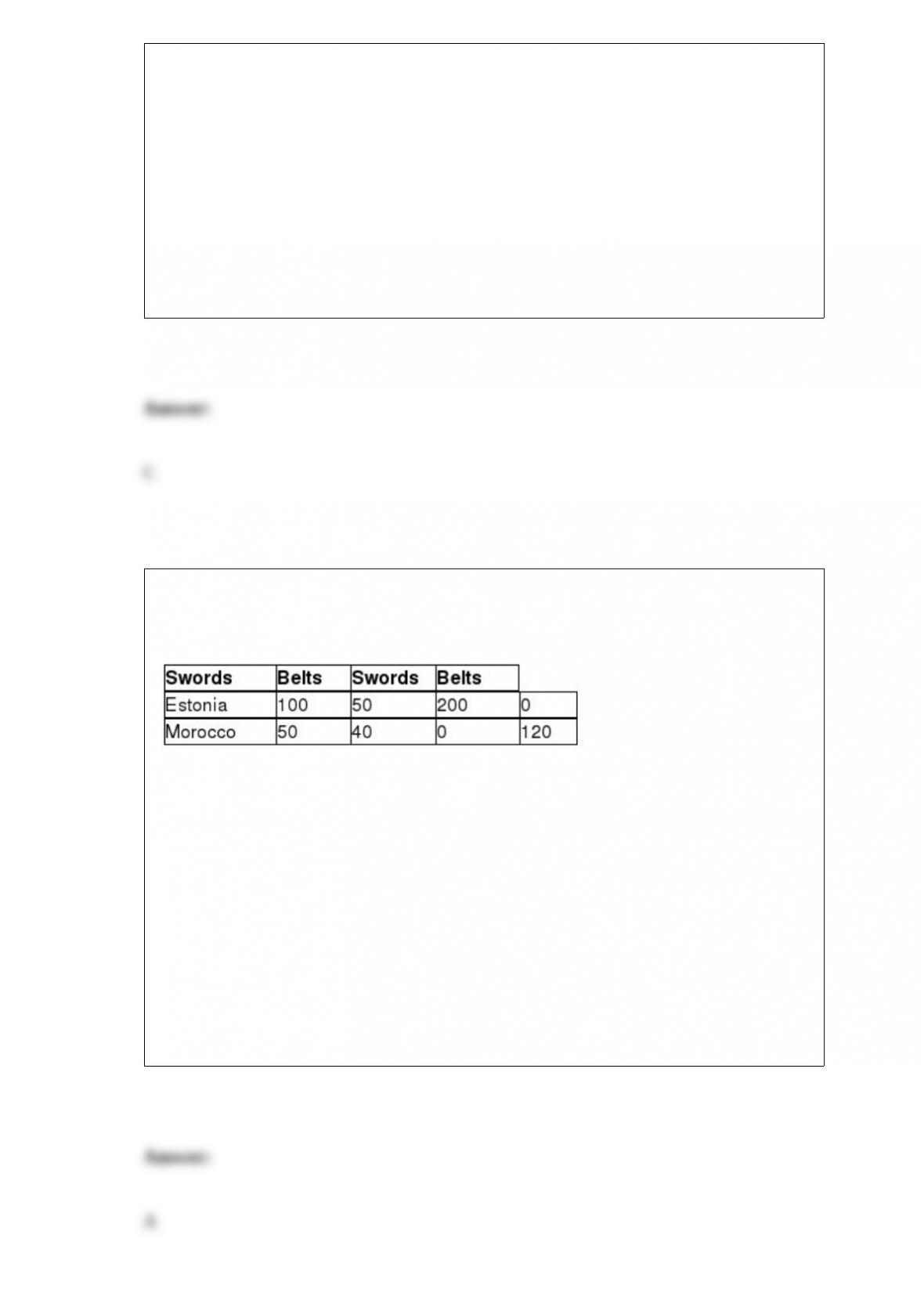
Table 9-12 Production and
Consumption Production
Without Trade With Trade
Estonia and Morocco can produce both swords and belts. Table 9-12 shows the
production and consumption quantities without trade, and the production numbers with
trade.
With trade, what is the total gain in sword production?
A) 50
B) 100
C) 200
D) 350

The health care system in ________ is referred to as a single-payer health care system,
and is a system in which the government provides national health insurance to all
residents.
A) Canada
B) Japan
C) the United Kingdom
D) the United States
Consider an industry that is made up of six firms with the following market shares:
Firm A – 50%, Firm B – 20%, Firms C and D – 10% each, and Firms E and F – 5% each.
What is the value of the Herfindahl-Hirschman Index and how will the industry be
categorized?
A) 2,500; mildly concentrated
B) 3,150; highly concentrated
C) 8,100; highly concentrated
D) 10,000; effectively competitive
If Sweden exports cell phones to Denmark and Denmark exports butter to Sweden,
which of the following would explain this pattern of trade?

A) Sweden has a lower opportunity cost of producing cell phones than Denmark and
Denmark has a comparative advantage in producing butter.
B) The opportunity cost of producing butter in Denmark is higher than the opportunity
cost of producing butter in Sweden.
C) Sweden must have an absolute advantage in producing cell phones and Denmark
must have an absolute advantage in producing butter.
D) Sweden has a higher opportunity cost of producing cell phones than Denmark, and
Denmark has a higher opportunity cost of producing butter.
Cost-plus pricing would be consistent with selecting the profit-maximizing price when
A) it results in a price that causes quantity sold to be where marginal revenue equals
marginal cost.
B) a firm has no difficulty estimating its demand curve.
C) consumers value the product beyond its marginal cost.
D) the demand for the firm’s product is unit-elastic.
Figure 5-1
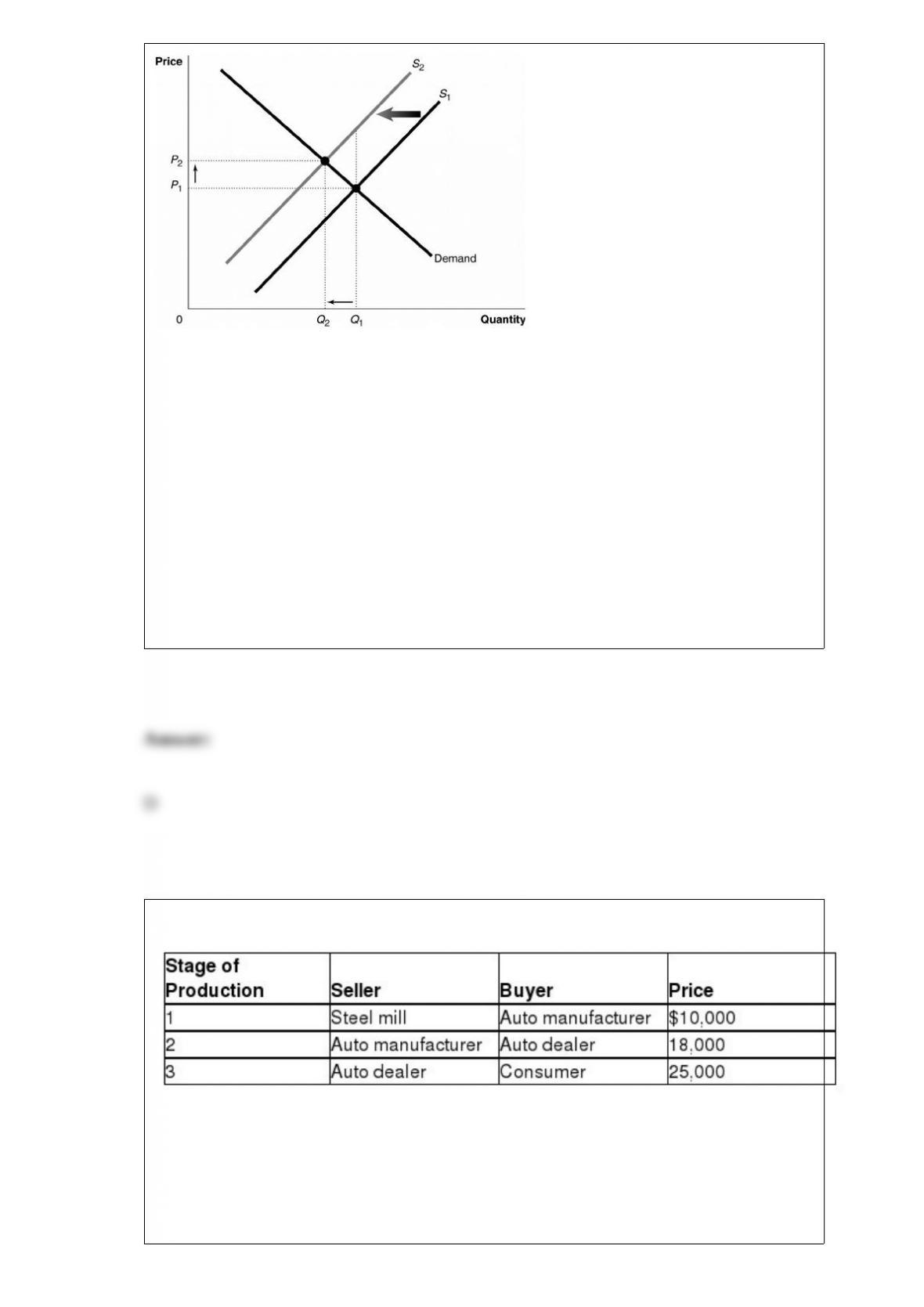
Figure 5-1 shows a market with an
externality. The current market equilibrium output of Q1 is not the economically
efficient output. The economically efficient output is Q2. If, because of an externality,
the economically efficient output is Q2 and not the current equilibrium output of Q1,
what does S1 represent?
A) the market supply curve reflecting external cost
B) the market supply curve reflecting implicit cost
C) the market supply curve reflecting social cost
D) the market supply curve reflecting private cost
Table 8-5
Consider the table above showing three stages of production of an automobile. The
value added by the automobile dealer equals
A) $7,000.
B) $15,000.
C) $18,000.
D) $25,000.
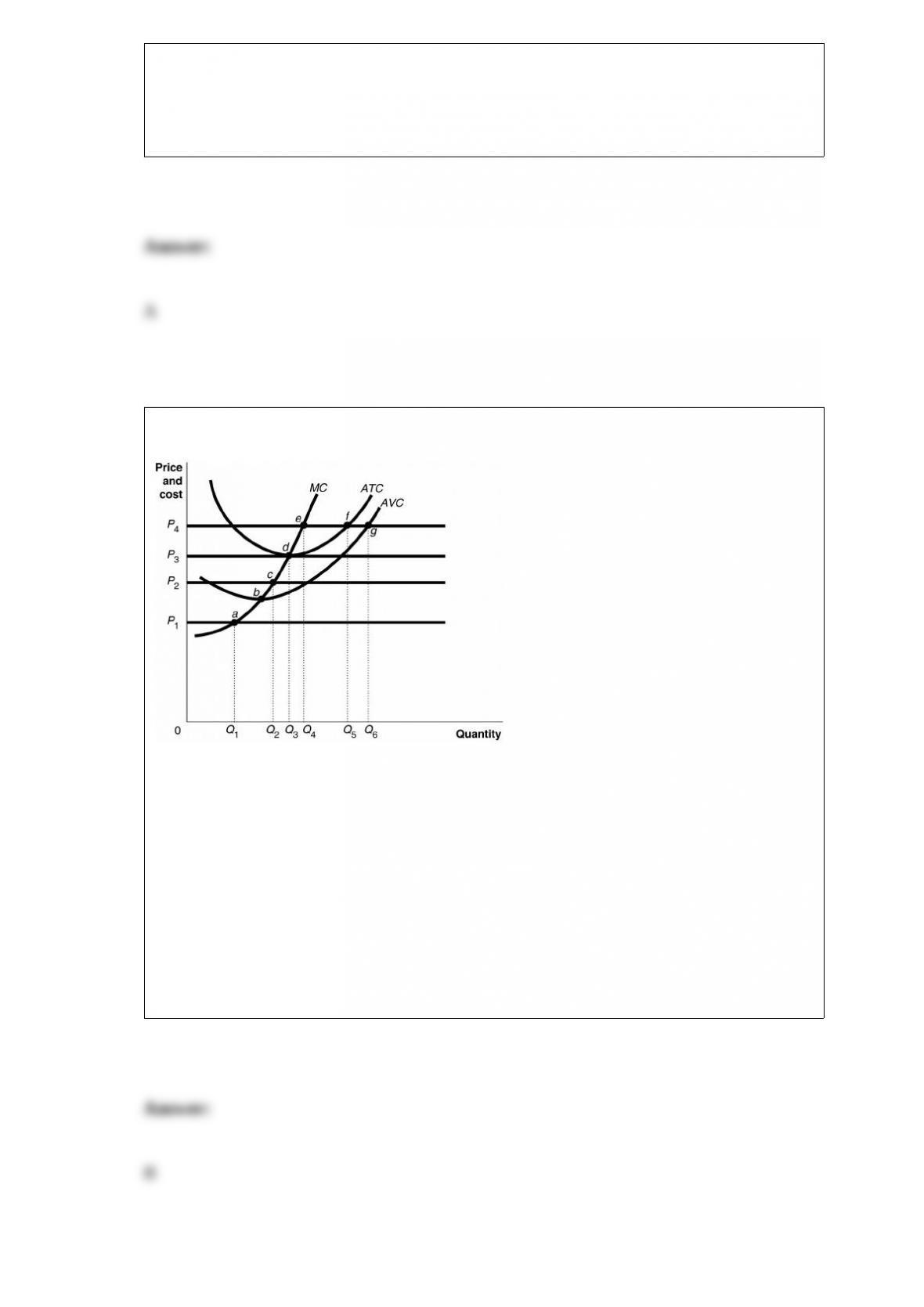
Figure 12-9
Figure 12-9 shows cost and demand
curves facing a profit-maximizing, perfectly competitive firm.
At price P4, the firm would
A) lose an amount equal to its fixed cost.
B) make a profit.
C) lose an amount less than fixed cost.
D) make a normal profit.
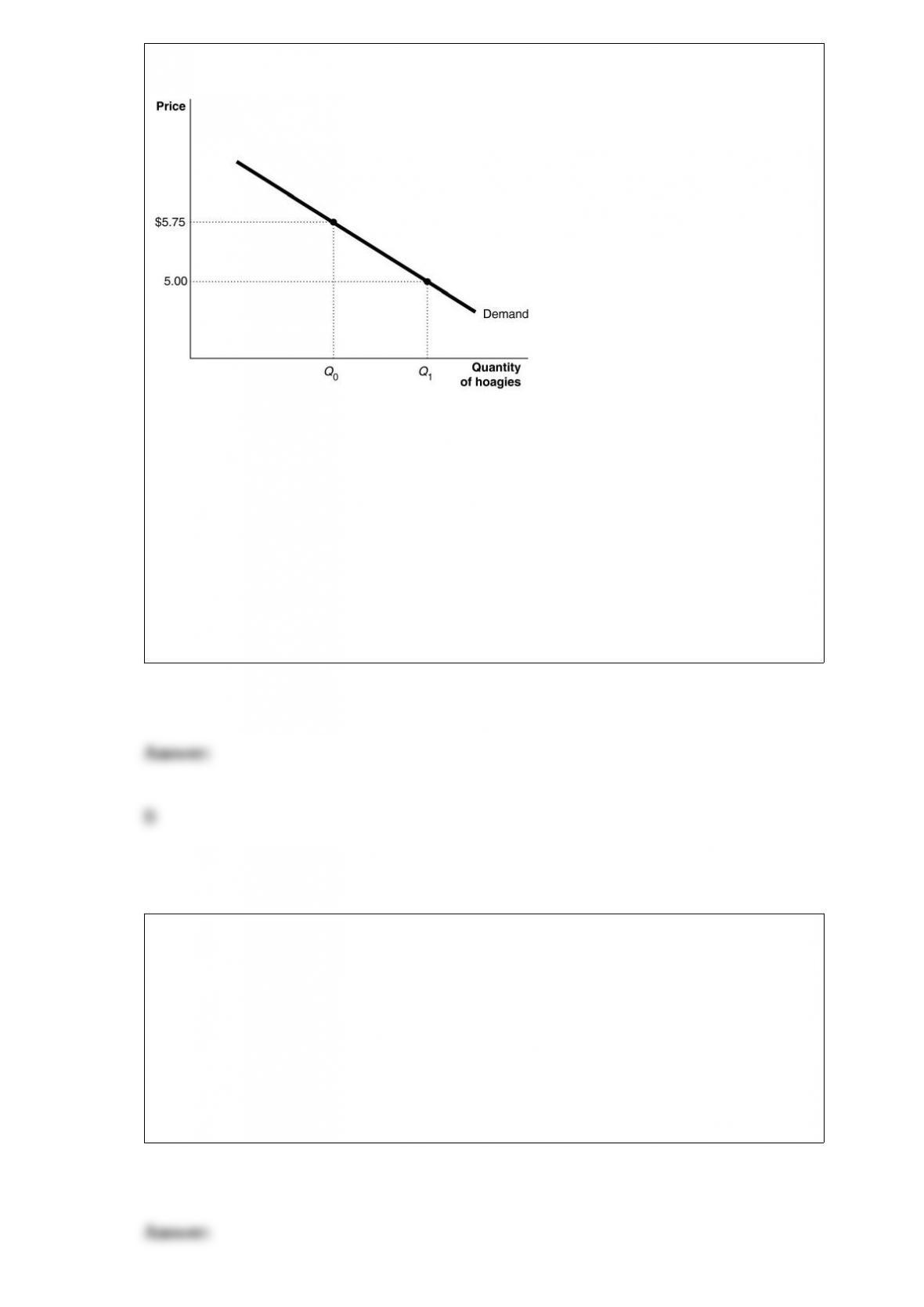
Figure 10-1
When the price of hoagies increases from $5.00 to $5.75, quantity demanded decreases
from Q1 to Q0. This change in quantity demanded is due to
A) the price and output effects.
B) the income and substitution effects.
C) the fact that marginal willingness to pay falls.
D) the law of diminishing marginal utility.
If the MPC is 0.95, then a $10 million increase in disposable income will
A) increase consumption by $200 million.
B) increase consumption by $9.5 million.
C) decrease consumption by $105 million
D) increase consumption by $950 million.
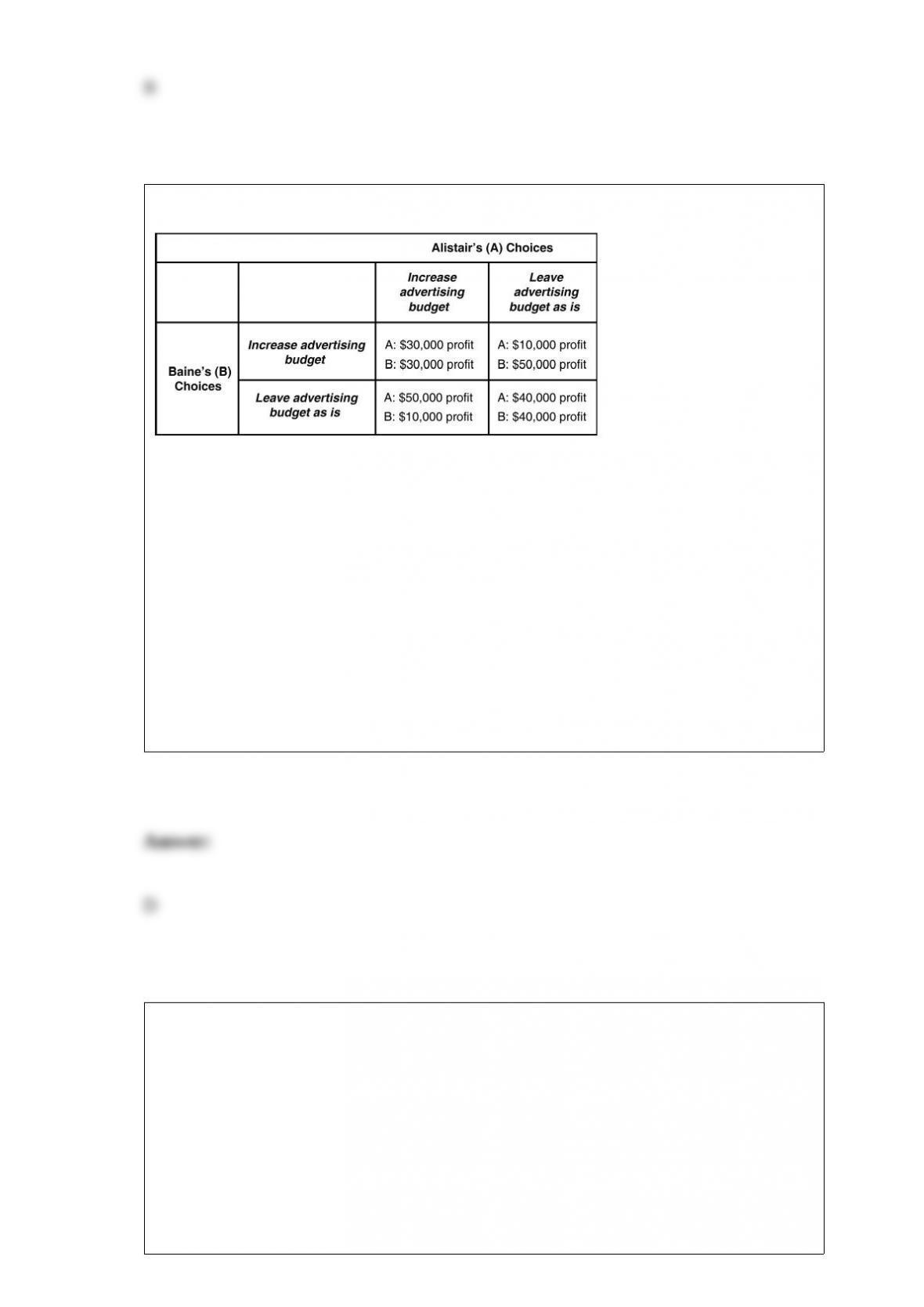
Table 14-4
Alistair Luggage and Baine
Baggage are the only firms selling luggage in the upscale town of Montecito. Each firm
must decide on whether to increase its advertising spending to compete for customers.
If one firm increases its advertising budget but the other does not, then the firm with the
higher advertising budget will increase its profit. Table 14-4 shows the payoff matrix
for this advertising game. What is the Nash equilibrium in this game?
A) There is no Nash equilibrium.
B) Baine increases its advertising budget, but Alistair does not.
C) Alistair increases its advertising budget, but Baine does not.
D) Both Alistair and Baine increase their advertising budgets.
The Arrow impossibility theorem explains
A) why there is no system of voting that will consistently represent the underlying
preferences of voters.
B) why government regulation of private markets will always result in a reduction in
economic efficiency in these markets.
C) why voters are always rationally ignorant.

D) why it is not possible to provide the economically efficient amount of any public
good.
Suppose when the price of jean-jackets increased by 10 percent, the quantity supplied
increased by 16 percent. Based on this information the price elasticity of supply of
jean-jackets is
A) 0.625.
B) 6%.
C) 1.6.
D) 1.6%.
if government spending and the price level increase, then
A) the interest rate increases, consumption declines, and investment spending declines.
B) the interest rate decreases, consumption declines, and investment spending declines.
C) the interest rate increases, consumption increases, and investment spending
increases.
D) the interest rate decreases, consumption increases, and investment spending
increases.
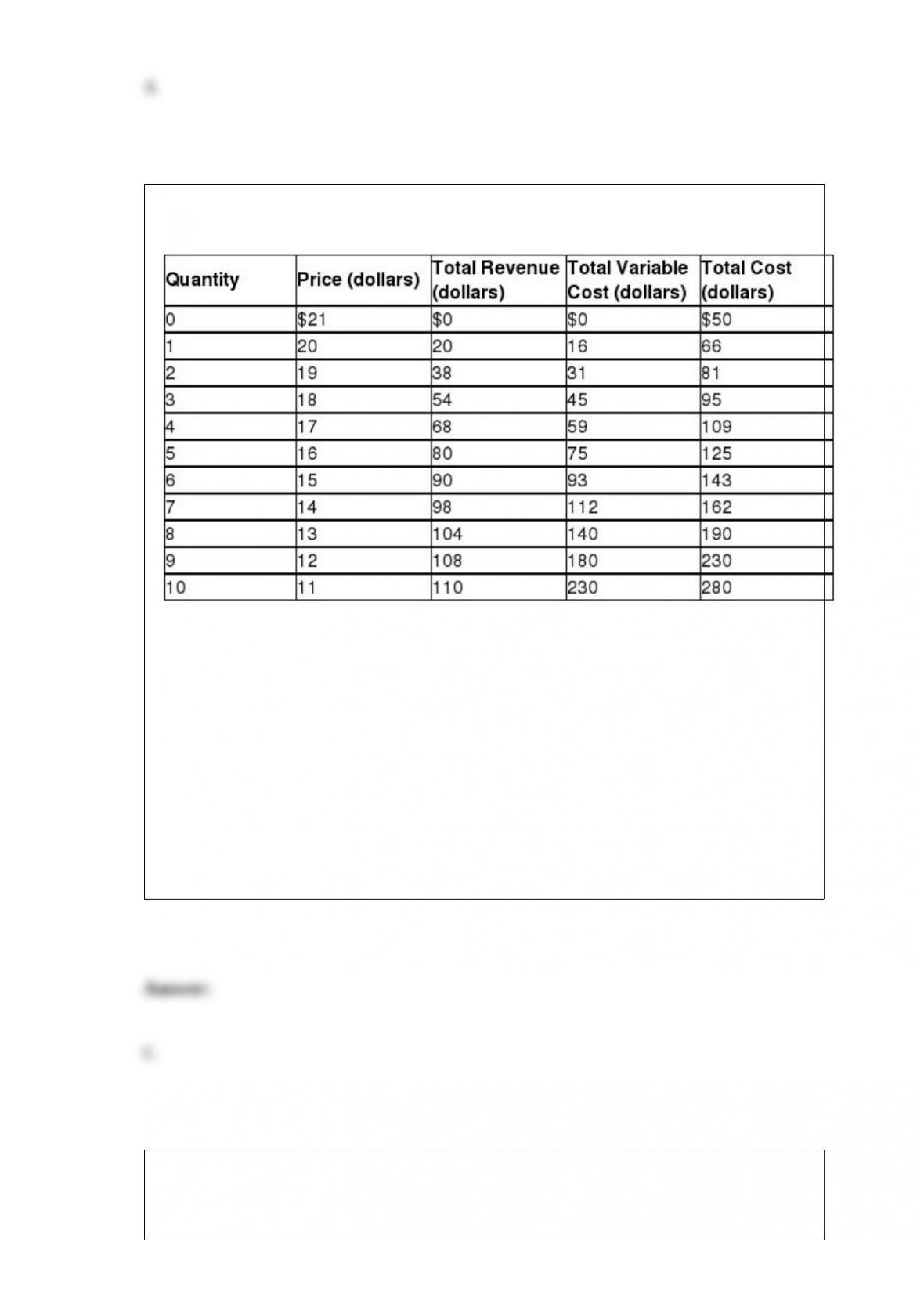
Table 13-3
Table 13-3 shows the demand and cost schedules for a monopolistically competitive
firm.
What are the profit-maximizing/loss-minimizing output level and price?
A) Q=0 (firm should not produce)
B) Q=3; P=$18
C) Q=4; P=$17
D) Q=5; P=$16
Assume you set up a sole proprietorship and your lawyer tells you that as the owner you
will face unlimited liability. What does that mean?

A) You are liable for organizing the business.
B) You could stand to lose your personal wealth if the business goes bankrupt.
C) There is no legal responsibility of the business in case a customer sues, as the
business is legally untouchable.
D) None of these explain what unlimited liability means.