How do the owners of a partnership relate to the business?
A) The owners and the business are not separate legal entities.
B) The owners and the business are separate legal entities.
C) The assets of the owners are considered separate from the asset of the business.
D) None of these describe the legal relationship of the owners to the business.
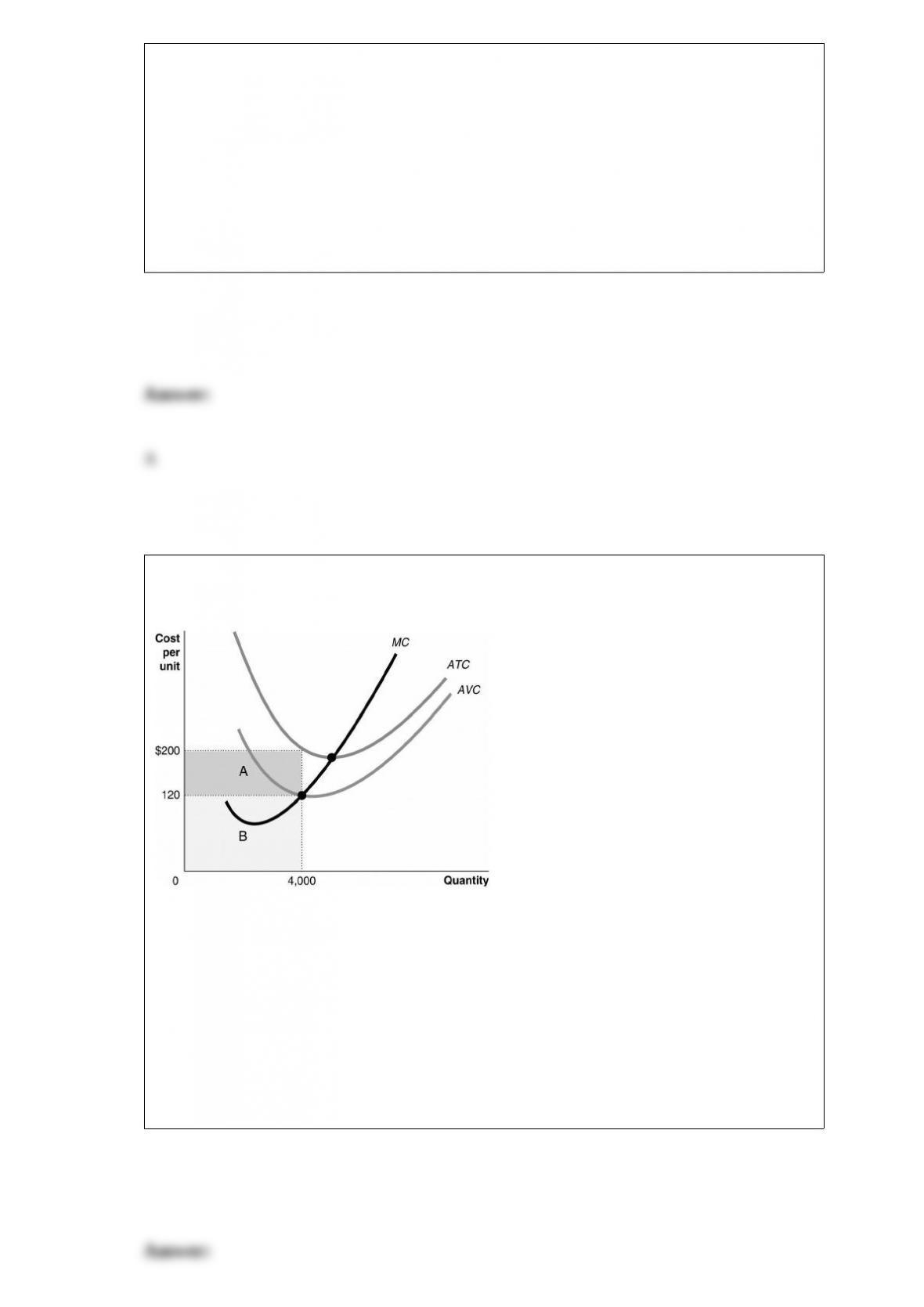
Figure 12-8
Refer to Figure 12-8. Suppose the firm produces 4,000 units. What does the shaded
area labeled A represent?
A) total variable cost
B) profit
C) total fixed cost
D) total revenue

Each member of OPEC can increase its income by selling more oil than its output quota
because
A) by selling more at OPEC’s cartel price, a member will automatically earn more
income.
B) each member’s demand is more elastic than the total demand for oil.
C) the demand for oil is inelastic so total revenue increases.
D) the demand for oil is perfectly elastic.
Suppose two firms in a duopoly implicitly collude and charge a high price. How might
each firm benefit from advertising that it will match the lowest price offered by its
competitor?
A) The offer to match prices is a way of deterring entry by other large firms, thereby
keeping the market share of the existing firms intact.
B) The advertisement ensures that the other firm does not cheat. If a firm cheats on the
agreement and charges the lower price, the rival firm will retaliate by doing the same.
C) The offer to match prices is a way of signaling to antitrust authorities that the firms
are not engaged in illegal collusion.
D) The advertisement is meant to suggest to consumers that the offered price is actually
the lowest price available.

Growth in labor productivity in health care has been ________ labor productivity in the
economy as a whole.
A) approximately equal to
B) slightly faster than
C) almost twice as fast as
D) less than half as fast as
A market economy benefits from market power
A) if the majority of the population are entrepreneurs.
B) if firms with market power do research and development with the profits earned.
C) if market power gets so bad the government creates public enterprises.
D) under no circumstances.

Figure 3-8
Refer to Figure 3-8. The graph in this figure illustrates an initial competitive
equilibrium in the market for apples at the intersection of D1 and S1 (point A). If there is
an increase in the wages of apple workers and an increase in the price of oranges, a
substitute for apples, the equilibrium could move to which point?
A) none of the points shown
B) B
C) C
D) E
Suppose that when the price of strawberries decreases, Simone increases her purchase
of whipped cream. To Simone
A) strawberries and whipped cream are complements.
B) strawberries and whipped cream and substitutes.
C) strawberries and whipped cream are normal goods.
D) strawberries are a normal good and whipped cream is an inferior good.

Consider the following economic agents:
a. the government
b. consumers
c. producers
Who, in a market economy, decides what goods and services will be produced with the
scarce resources available in that economy?
A) the government
B) producers
C) consumers
D) consumers and producers
E) the government, consumers and producers
A perfectly competitive industry achieves allocative efficiency in the long run. What
does allocative efficiency mean?
A) Each firm produces up to the point where the price of the good equals the marginal
cost of producing the last unit.
B) Each firm produces up to the point where all scale economies are exhausted.

C) Production occurs at the lowest average total cost.
D) Firms use an input combination that minimizes cost and maximizes output.
The 10-year protection period from generic competition for drug manufacturers is a
form of
A) copyright.
B) trademark.
C) hallmark.
D) patent.
Which of the following statements correctly describes the distinction between
technology and technological change?
A) Technology refers to the processes used by a firm to transform inputs into output of
goods and services while technological change is a change in a firm’s ability to produce
a given level of output with a given quantity of inputs.
B) Technology refers to the ability of a firm to increase its maximum output from a
given quantity of inputs and technological change is the process by which the firm
achieves this productivity gain.

C) Technology is product-centered; its refers to developing new products with limited
resources while technological change is process-centered in that it focuses on
developing new production techniques.
D) Technology involves research and development while technological change involves
the use of more efficient machinery.
The owners of a ________ have a separate legal distinction from the business.
A) corporation
B) partnership
C) sole proprietorship
D) All of the above are correct.
When a proposed merger between two companies is reviewed by the government, the
relevant market is defined by
A) whether or not there are close substitutes for the products of the two firms.
B) how elastic the demand is for each firm’s product.
C) counting the number of firms that produce the same product.
D) how much advertising is done in the industry.
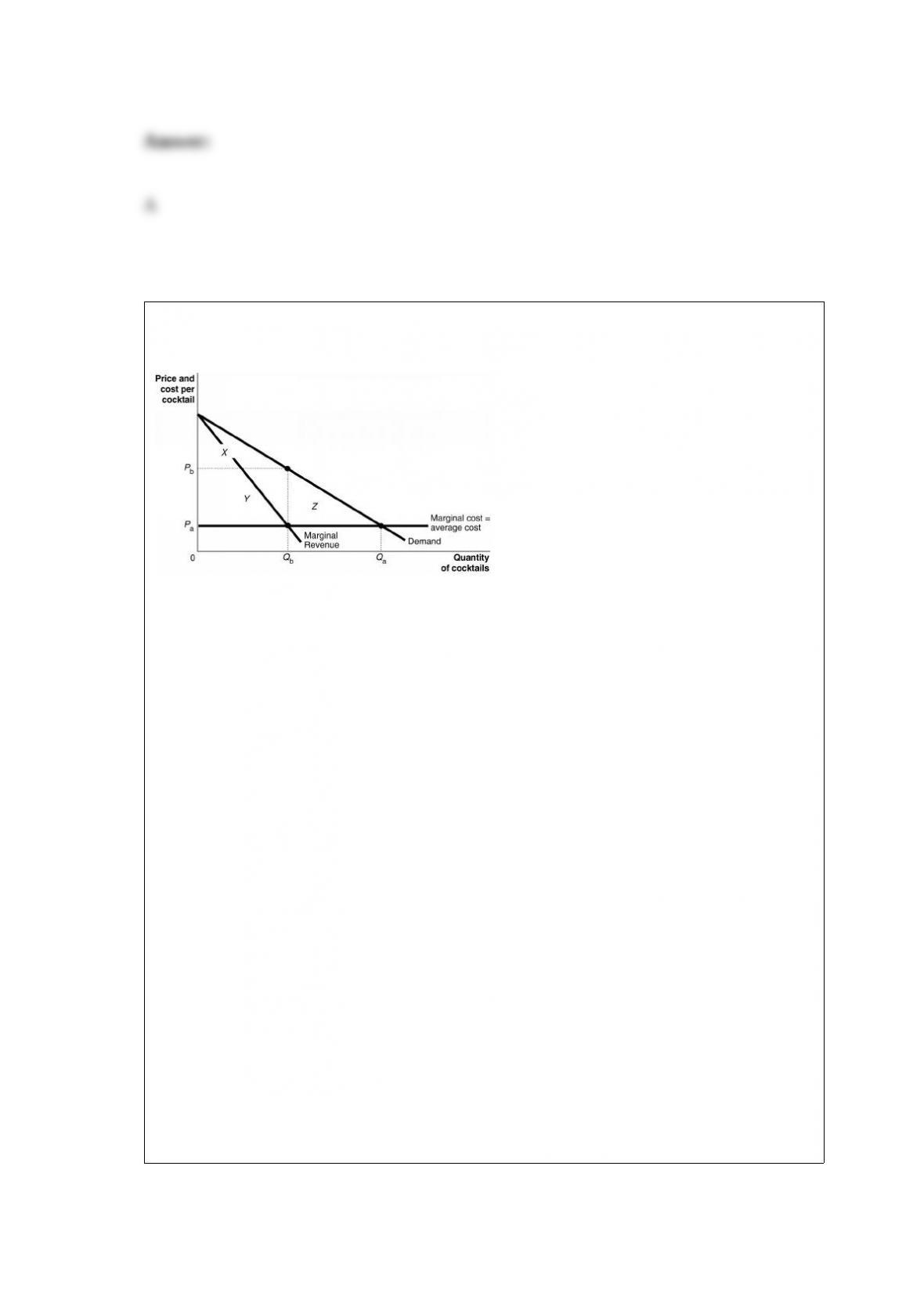
Figure 16-7
The Lizard Lounge is well known for its exotic cocktails. Figure 16-7 shows its
estimated demand curve for cocktails.
Refer to Figure 16-7. The owners of the Lizard Lounge are considering the following
four pricing options:
a. A single price scheme where the cocktail price equals the monopoly price.
b. A single price scheme where the cocktail price equals the competitive price.
c. A two-part tariff: a monopoly cocktail price and a cover charge that will generate
total revenue equal to the area X.
d. A two-part tariff: a competitive cocktail price and whatever cover charge that will
generate a total revenue equivalent to the area X + Y + Z.
Which pricing scheme(s) achieve the economically efficient outcome?
A) schemes a and c
B) scheme b
C) schemes b and d
D) scheme d only

A study discussed in the Making the Connection feature in the text found that there is
________ that some consumers are not well aware of prices, even for goods they buy
regularly.
A) no evidence
B) substantial evidence
C) little evidence
D) no reason to believe
The labor supply for an industry would decrease if
A) the wage rate falls.
B) the percentage of the population from age 16 to 65 decreases.
C) the government welcomes foreign workers into the country.
D) a greater percentage of women want to work outside the home.
Suppose the demand curve for a product is horizontal and the supply curve is upward
sloping. If a unit tax is imposed in the market for this product
A) sellers bear the entire burden of the tax.
B) the tax burden will be shared among the government, buyers and sellers.
C) buyers bear the entire burden of the tax.
D) the tax burden will be shared by buyers and sellers.
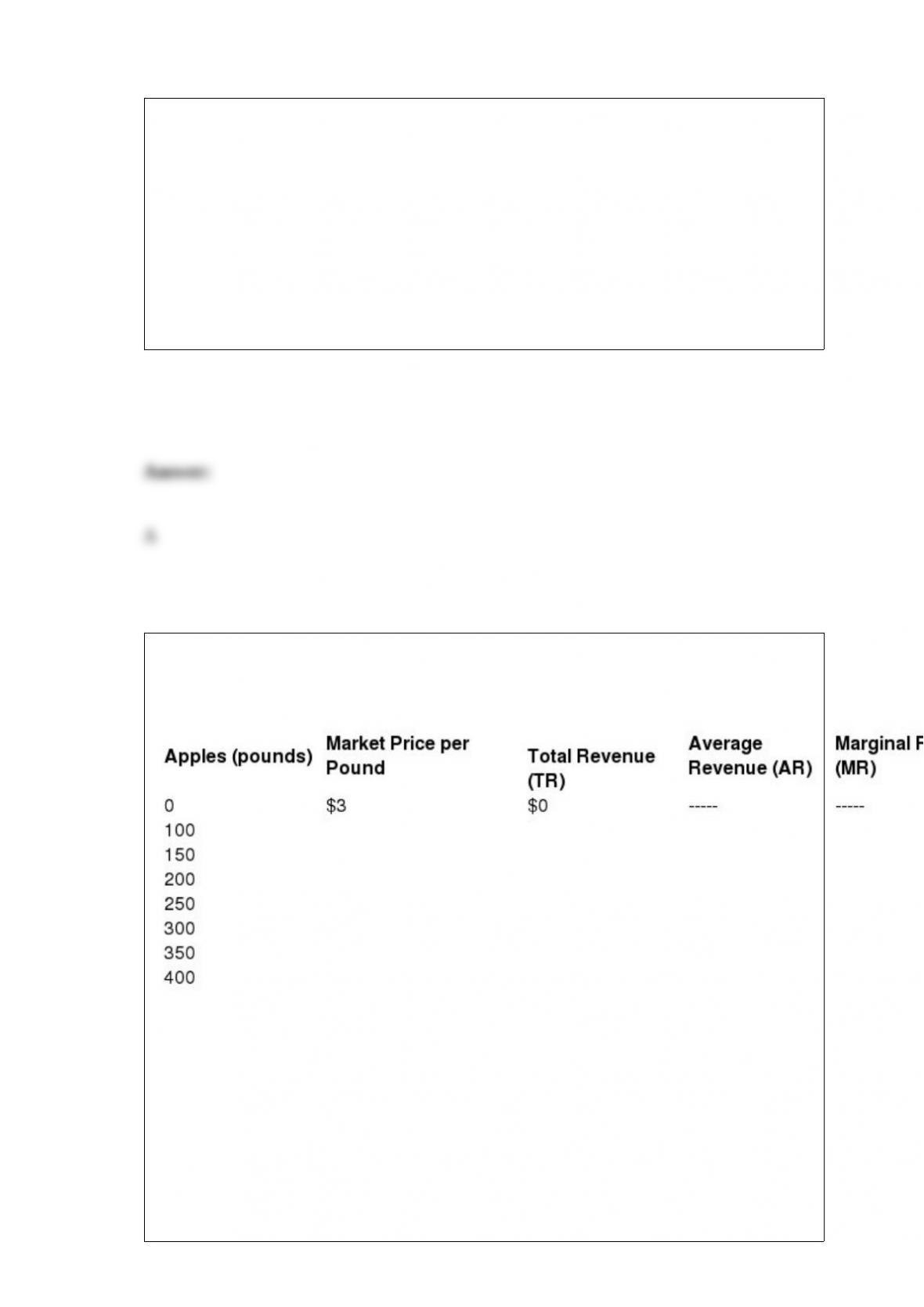
Table 12-2
Table 12-2 lists the various pounds (lbs.) of apples that Margie Stattler can sell. Assume
that Margie operates in a perfectly competitive market.
Refer to Table 12-2. What is Margie’s total revenue if she sells 250 pounds of apples?
A) $250
B) $500
C) $750

D) There is not enough information in the table to determine Margie’s total revenue.
The prevalence of Alzheimer’s dementia is very high among residents living in nursing
homes. A student concludes that it is likely that living in a nursing home causes
Alzheimer’s dementia. What is the flaw in the student’s reasoning?
A) The student has failed to take into account other causes of Alzheimer’s disease.
B) The student is drawing a false conclusion; he is confusing cause and effect.
C) The student is using an inadequate sample size.
D) The student is drawing a false conclusion by making the mistake of omitting critical
variables such as the age and gender of the residents.
In the long run, a perfectly competitive market will
A) produce only the quantity of output that yields a long-run profit for the typical firm.
B) supply whatever amount consumers will buy at a price which earns the market an
economic profit.
C) supply whatever amount consumers demand at a price determined by the minimum
point on the typical firm’s average total cost curve.
D) generate a long-run equilibrium where the typical firm operates at a loss.
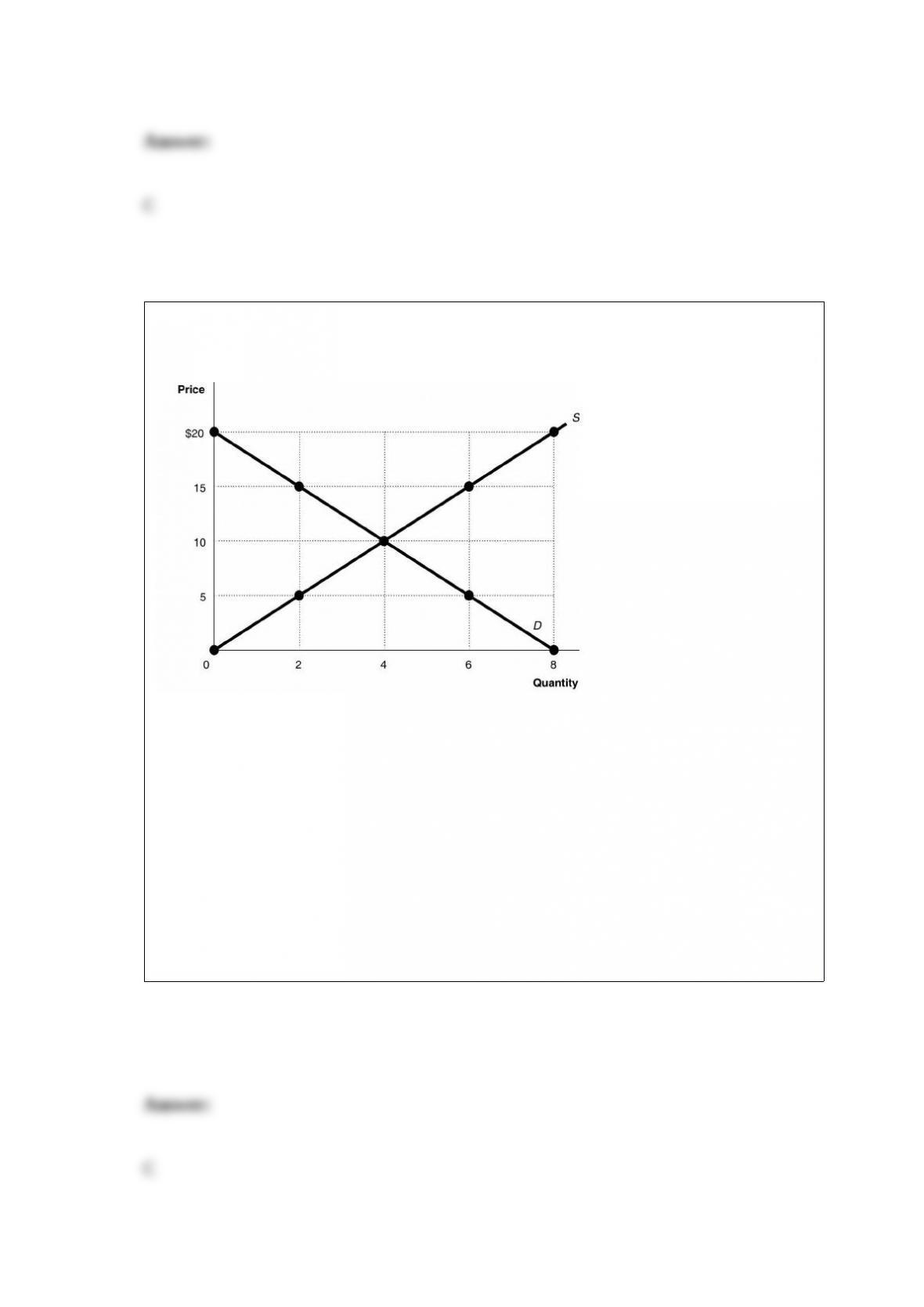
Figure 3-5
Refer to Figure 3-5. In a free market such as that depicted above, a surplus is
eliminated by
A) a price increase, increasing the supply and decreasing the demand.
B) a price decrease, decreasing the supply and increasing the demand.
C) a price decrease, decreasing the quantity supplied and increasing the quantity
demanded.
D) a price increase, increasing the quantity supplied and decreasing the quantity
demanded.

If Southwest Airlines borrows $20 million from a bank to finance the renovation of
their corporate offices, this is an example of
A) a bond market transaction.
B) indirect finance.
C) a stock market transaction.
D) direct finance.
The town of Harmonia gives away all 500 tickets to its annual Founder’s Day Free
Concert-in-the-Park to local residents. Each year, more than 500 people wish to attend
the concert, so some of the residents who receive the free tickets sell them for as much
as $75 each. Is a transaction where someone pays a resident $75 for a “free ticket”
economically efficient?
A) No, people should never be allowed to sell items they received for free.
B) Yes, it was a voluntary exchange that benefited both parties.
C) No, the buyer paid too much for the ticket.
D) Yes, it is efficient only from the perspective of the seller and not from the
perspective of the buyer.
At a recent company meeting, Ravi Batra, sales manager of Life’s a Beach, a surfboard

producer announced, “We have increased our sales by 13 percent in just 9 months.”
Suppose 9 months ago, its sales amounted to $245,000, what is the value of its sales
today?
A) $31,850
B) $207,638
C) $276,850
D) $359,905
The median voter theorem states that the outcome of a majority vote
A) tends to favor the preferences of high income individuals and ignore the median
voter.
B) is likely to represent the preferences of society’s middle-income voter.
C) is likely to represent the preferences of the voter who is in the political middle.
D) is determined by the average consumer and producer in an economy.
Figure 12-6

Figure 12-6 shows the demand, marginal cost (MC) and average total cost (ATC) curves
for Jason’s House of Apples.
Refer to Figure 12-6. Which of the following statements is true?
A) Jason should produce where MC equals $3 (point d) where he will minimize his
losses.
B) Jason should produce where the distance between MC and his demand curve is
greatest (point b).
C) Jason cannot earn a profit from selling any number of apples.
D) Jason should produce where MC equals $3 (point d) where he will maximize his
profit.
We can draw demand curves for firms in perfectly competitive and monopolistically
competitive industries, but not for oligopoly firms. The reason for this is
A) there are no barriers to entry in perfectly competitive and monopolistically
competitive industries. There are high barriers to entry in oligopoly industries.
B) we can assume that the prices charged by perfectly competitive and monopolistically
competitive firms have no impact on rival firms. For oligopoly this assumption is
unrealistic.

C) that perfectly competitive and monopolistically competitive firms are price takers.
Oligopoly firms are price makers.
D) perfectly competitive and monopolistically competitive firms sell standardized
products. Oligopoly firms sell differentiated products.
Table 14-5
Ming and Henri each run one of the two dry cleaning facilities in the town of Scaraby.
Both consider offering free pickup and delivery services. Table 14-5 shows the payoff
matrix containing the expected quarterly profits for each firm.
Refer to Table 14-5. What is the Nash equilibrium in this game?
A) There is no Nash equilibrium.
B) Ming offers free pickup and delivery, but Henri does not.
C) Henri offers free pickup and delivery, but Ming does not.
D) Both Ming and Henri offer free pickup and delivery.

Hotspur Incorporated, a manufacturer of microwaves, is a price taker in both the input
and output markets. To maximize its profit, Hotspur will hire labor up to the point
where
A) the marginal product of labor is no longer positive.
B) all economies of scale have been exhausted.
C) the marginal revenue product of labor equals the wage rate.
D) the marginal revenue product of labor equals the output price.
What is the primary difference between a sole proprietorship and a partnership?
A) Proprietorships have unlimited liability while partnerships have limited liability.
B) Partnerships can issue stocks and bonds while proprietorships cannot.
C) Partnerships have more owners than do proprietorships.
D) There is no real difference between the two types of firms.
An important difference between the demand for a private good and the demand for a
public good is that
A) individuals reveal their preferences for a public good but they do not have to reveal
their preferences a private good.
B) the resources used to provide public goods are common resources or government
owned; the resources used to produce private goods are all privately owned.
C) individuals reveal their preferences for a private good but they do not have to reveal
their preferences for a public good.
D) the demand for a private good produces consumption externalities; the demand for a
public good produces production externalities.
Figure 13-4
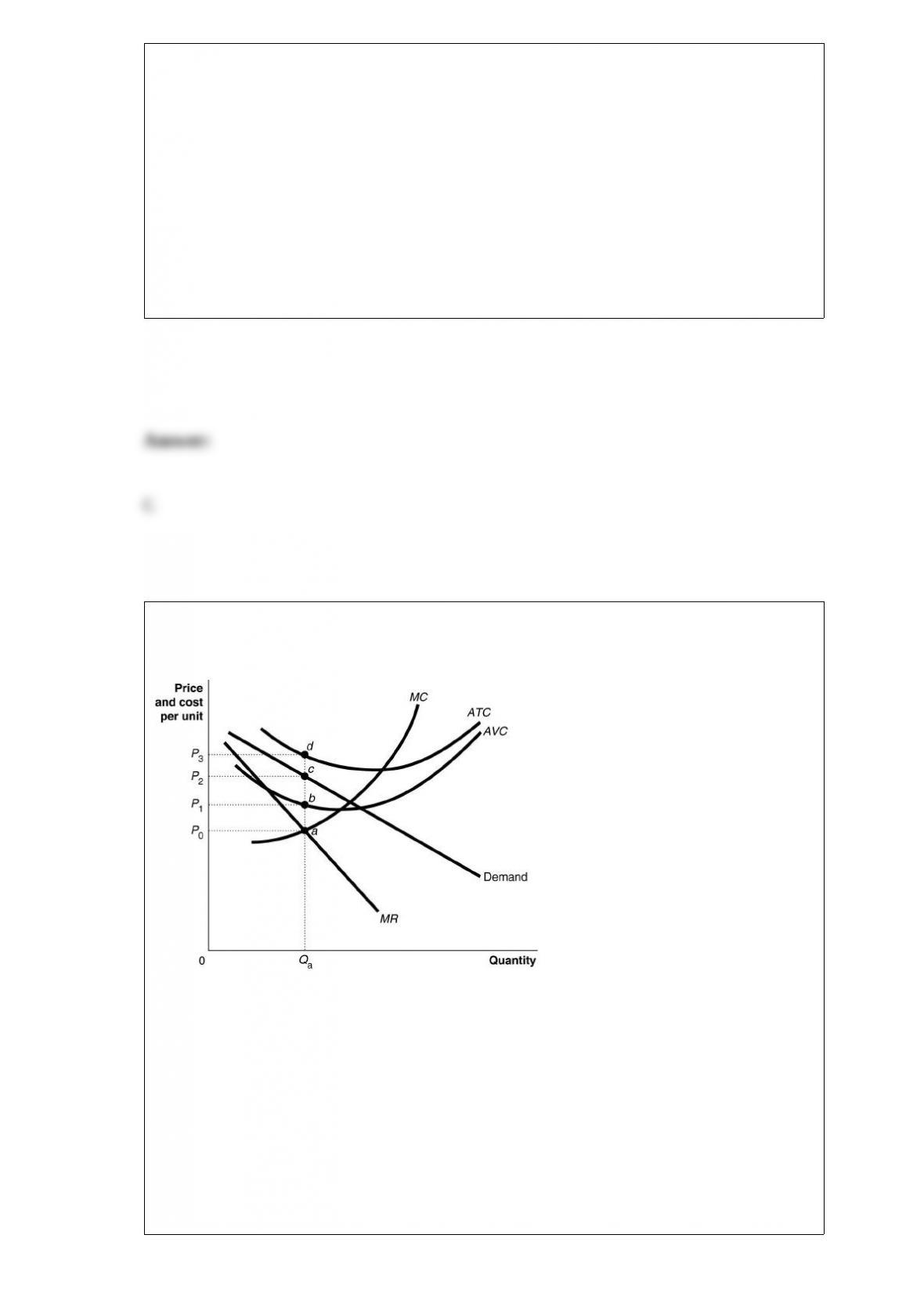
Figure 13-4 shows short-run cost and demand curves for a monopolistically competitive
firm in the market for designer watches.
Refer to Figure 13-4. If the firm represented in the diagram is currently producing and
selling Qa units, what is the price charged?
A) P0
B) P1
C) P2
D) P3
Figure 10-4
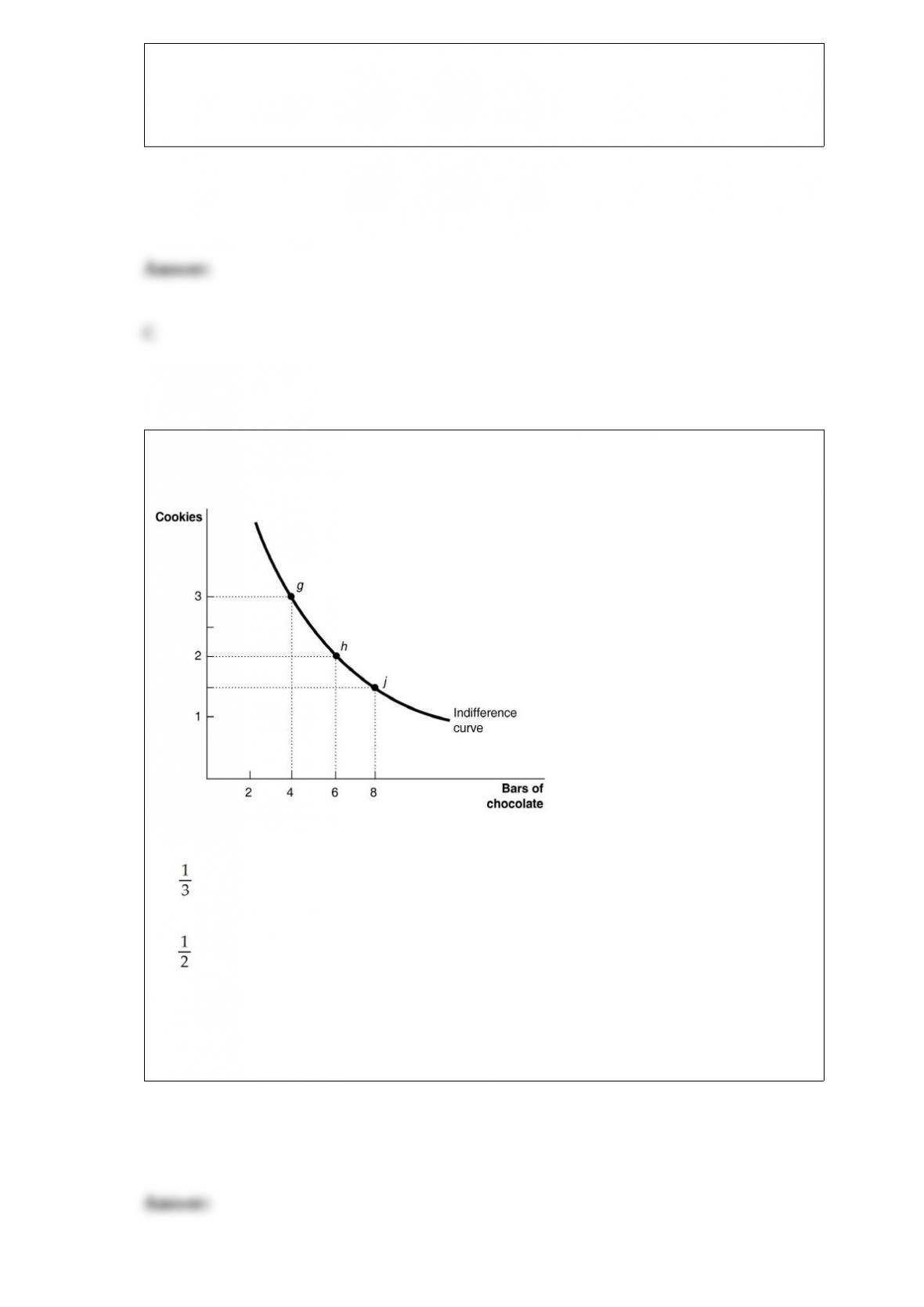
Refer to Figure 10-4. What is the marginal rate of substitution between g and h?
A) cookie.
B) cookie.
C) 2 cookies.
D) 3 cookies.

Marty’s Bird House suffers a short-run loss. Marty can reduce his loss below the
amount of his total fixed costs by continuing to produce if his revenue
A) exceeds his implicit costs.
B) exceeds his nonmonetary opportunity costs.
C) exceeds his variable costs.
D) exceeds his marginal costs.