1) from society’s point of view the economic function of profits and losses is to:
a.promote the equal distribution of real assets and wealth.
b.achieve full employment and price level stability.
c.contribute to a more equal distribution of income.
d.reallocate resources from less desired to more desired uses.
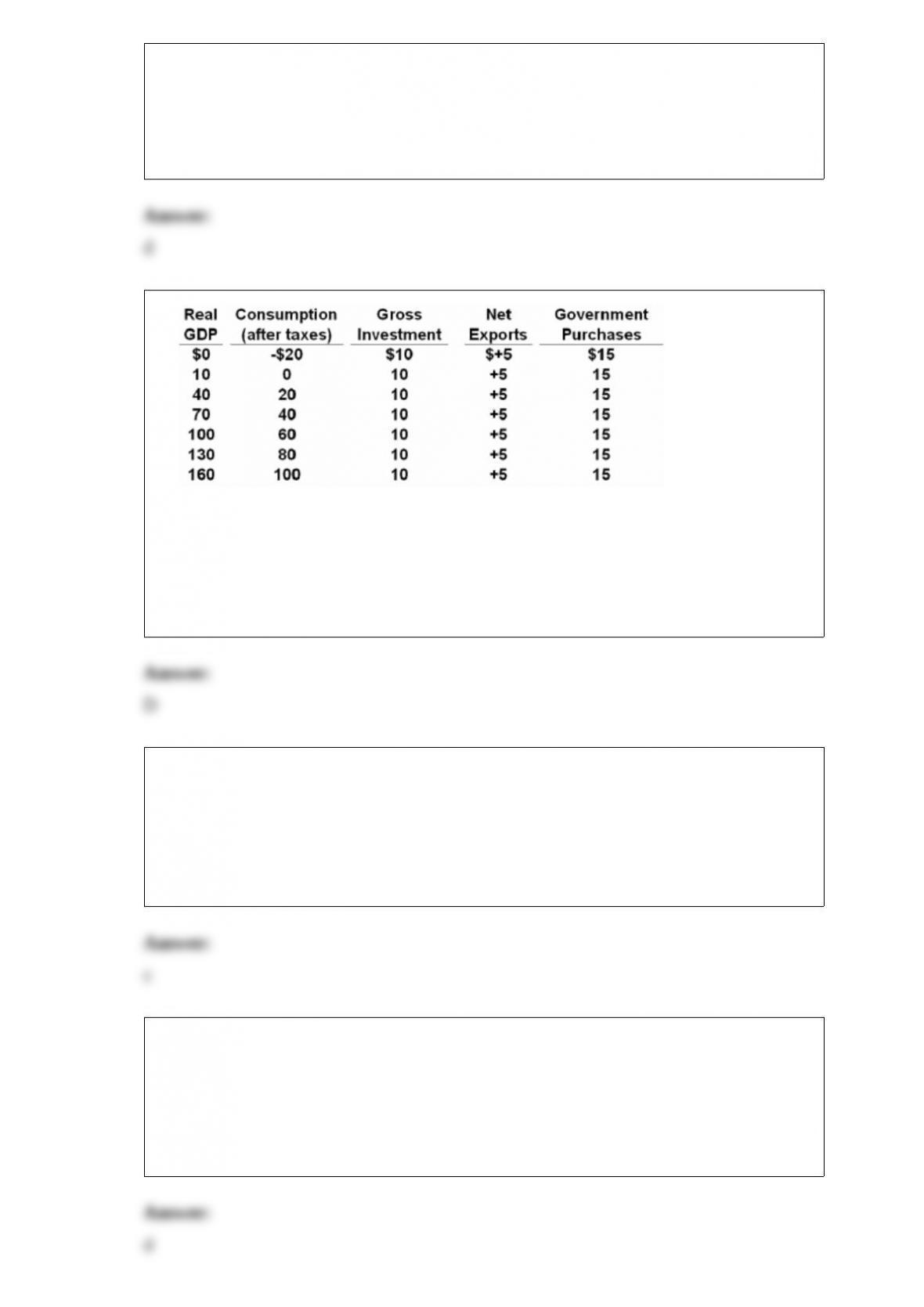
2)
Refer to the above table. If the full-employment real GDP is $100 the:
A.inflationary expenditure gap is $30.
B.inflationary expenditure gap is $10.
C.recessionary expenditure gap is $20.
D.recessionary expenditure gap is $10.
3) (last word) the u.s. government agency responsible for compiling the national
income accounts is the:
a.census bureau.
b.bureau of labor statistics (bls).
c.commerce department’s bureau of economic analysis (bea).
d.government accounting office (gao).
4) suppose that dave normally orders two tacos, but on seeing they are on sale, decides
to buy three. dave’s decision is best explained by the:
a.law of increasing opportunity costs.
b.law of supply.
c.principle of comparative advantage.
d.the principle of utility maximization.
5) the separation of ownership and control in a corporation means that:
a.hired managers play a larger role in determining company policy than do a
corporation’s legal owners.
b.the ownership of corporations is becoming increasingly concentrated in the hands of a
few common stockholders.
c.a firm’s board of directors has no power over hired managers.
d.stockholders have lost their voting privileges.
6) An expansionary fiscal policy is shown as a:
A.rightward shift in the economy’s aggregate demand curve.
B.movement along an existing aggregate demand curve.
C.leftward shift in the economy’s aggregate supply curve.
D.leftward shift in the economy’s aggregate demand curve.
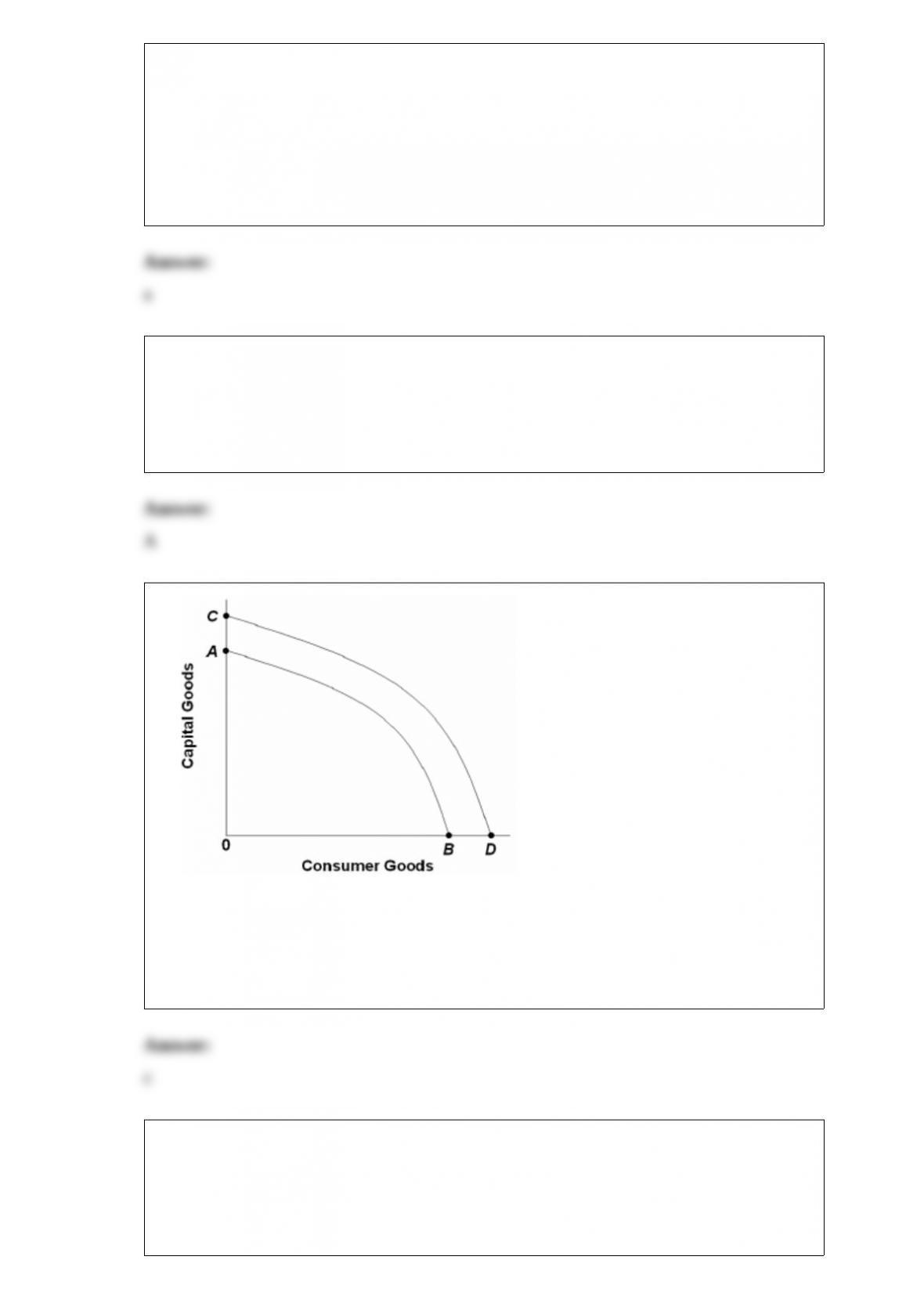
7)
refer to the above graphs. an increase in an economy’s labor productivity would:
a.move the economy away from point a and toward point b.
b.move the economy away from point b and toward point a.
c.shift curve ab to cd
d.shift curve cd to ab.
8) a firm that makes computer chips at several locations across the country best
illustrates a:
a.vertically integrated firm.
b.multinational corporation.
c.multiplant firm.
d.conglomerate.
9) Consider the two diagrams below. Diagram A represents a typical firm in a purely
competitive industry. Diagram B represents the supply and demand conditions in that
industry.
(a)Describe the price, output, and profit situation for the individual firm in the short run.
(b)Describe what will happen to the individual firm and the industry in the long run.
Show the changes on diagrams A and B.
10) assume a purely competitive firm is selling 200 units of output at $3 each. at this
output its total fixed cost is $100 and its total variable cost is $350. this firm:
a.is maximizing its profit.
b.is making a profit, but not necessarily the maximum profit.
c.is incurring losses.
d.should shut down in the short run.

11) The United States’ most important trading partner quantitatively is:
A.China.
B.Canada.
C.Mexico.
D.Japan.
12) A company’s upsloping extraction cost curve reflects:
A.that faster extraction requires firms to acquire more equipment.
B.that faster extraction requires firms to hire more workers.
C.that faster extraction requires firms to pay overtime to existing workers.
D.all of these.
13) If m equals the maximum number of new dollars that can be created for a single
dollar of excess reserves and R equals the required reserve ratio, then for the banking
system:
A.m = R-1.
B.R = m/1.
C.R = m-1.
D.m = 1/R.
14) suppose the supply of product x is perfectly inelastic. if there is an increase in the
demand for this product, equilibrium price:
a.will decrease but equilibrium quantity will increase.
b.and quantity will both decrease.
c.will increase but equilibrium quantity will decline.
d.will increase but equilibrium quantity will be unchanged.