
Recall the Application about how society will cope with increased demands for
entitlement programs to answer the following question(s). This Application addresses
the impact of increasing life expectancy and aging populations on the costs of
government entitlement programs such as Social Security, Medicare and Medicaid, and
examines several possible solutions to the potential problem.
According to this Application, one solution proposed to deal with the rising expenses of
government entitlement programs is to raise taxes. An increase in taxes to help cover
the rising expenses of entitlement programs would
A) increase aggregate demand, shifting the AD curve to the right.
B) increase aggregate demand, shifting the AD curve to the left.
C) decrease aggregate demand, shifting the AD curve to the right.
D) decrease aggregate demand, shifting the AD curve to the left.
When deciding whether to hire another worker, firms look at how the additional worker
will affect:
A) productivity.
B) costs.
C) revenues.
D) profit.
Federal spending consists of:

A) discretionary and mandatory spending.
B) discretionary federal spending and debt payments.
C) federal government purchases and transfer payments.
D) defense and social security programs.
Recall the Application about the causes of the Argentinean financial crisis to answer the
following question(s). During the late 1980s, Argentina suffered from hyperinflation. As
part of its financial reforms, Argentina pegged its currency to the U.S. dollar, making
pesos “convertible” into dollars. The financial and other institutional reforms worked
well in the early 1990s, but then problems developed. As the dollar appreciated sharply
on world markets after 1995, Argentina began to suffer from a large trade deficit
because its currency was pegged to the dollar. Then in 1999, Brazil devalued its
currency, putting additional pressure on neighboring Argentina. Eventually, Argentina
was forced to default on its international debt in 2002 and freeze bank accounts, and a
severe depression ensued.
According to this Application, during the late 1980s, Argentina pegged its currency to
the U.S. dollar. When the dollar appreciated sharply on world markets after 1995, this
caused a large trade deficit in Argentina because
A) Argentina could no longer afford to purchase as many imported products.
B) Argentinean exports became relatively more expensive in global markets.
C) Argentinean exports grew relative to the nation’s imports.
D) U.S. exports to Argentina declined.
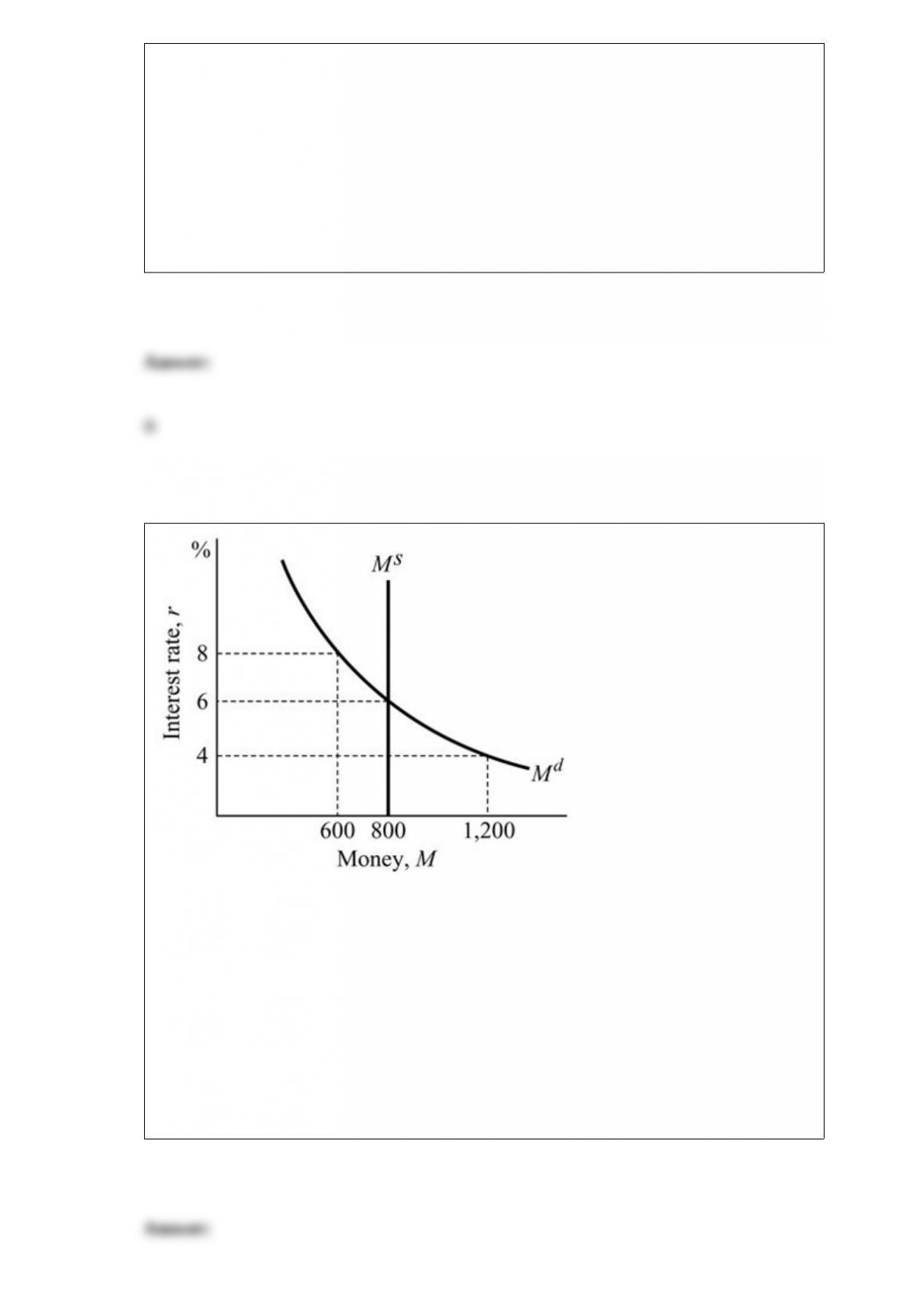
Which of the following sequence of events would follow an open market sale of bonds?
A) interest rate investment aggregate demand real GDP
B) interest rate investment aggregate demand real GDP
C) interest rate investment aggregate demand real GDP
D) interest rate investment aggregate demand real GDP
Figure 14.4 Refer to Figure 14.4. If the Fed wants to reduce the economy’s market
interest rate from 6 percent to 4 percent, and the reserve ratio is 10 percent, then it
needs to ________.
A) sell $20 in government bonds
B) buy $20 in government bonds
C) sell $200 in government bonds
D) buy $200 in government bonds

What is the difference between the CPI and the GDP chain index?
A) The CPI basket includes imported goods while the GDP chain index does not.
B) The CPI does not include capital goods but the chain index does.
C) The CPI basket includes fewer goods and services than the GDP chain index basket.
D) All of the above are correct.
Checking accounts that pay interest are included in the
A) “demand deposits” part of M1.
B) “other checkable deposits” part of M1.
C) ‘savings deposits” part of M2.
D) “money market mutual funds deposits” part of M2.
When people interact in markets for their own self interest, it is described as the:
A) principle of supply and demand.

B) principle of voluntary exchange.
C) laws of each state.
D) principle of scarcity.
Automatic stabilizers were clearly in evidence during the recession of 2007-2009 as
A) tax revenues increased.
B) tax revenues decreased.
C) transfer payments decreased.
D) tax revenues and transfer payments both decreased.

Table 3.3
Consider two individuals, Nigel and Mia, who produce hair pins and bandanas. Nigel’s
and Mia’s hourly productivity are shown in Table 3.3. Which of the following is true?
A) Nigel has a comparative advantage in producing hair pins but not bandanas.
B) Nigel has a comparative advantage in producing bandanas but not hair pins.
C) Nigel has a comparative advantage in producing both goods.
D) Nigel does not have a comparative advantage in producing either good.
The ________ is one reason why the aggregate demand curve is downward sloping.
A) natural rate of unemployment
B) wealth effect
C) presence of sticky prices
D) paradox of thrift
The nominal interest rate is determined in the

A) stock market.
B) money market.
C) exchange market.
D) bond market.
When you pay for your groceries with money because the supermarket does not accept
stocks and certificates of deposits (CDs), then the reason why you are holding money is
the:
A) transactions demand for money.
B) liquidity demand for money.
C) speculative demand for money.
D) All of the above are correct.
Economists believe that Alan Greenspan’s credibility in his determination to fight
inflation has helped the U.S.:
A) reduce inflation in the 1990s.
B) increased inflation in the 2000s.
C) raised the unemployment rate in 2003.
D) caused the financial crisis in 2008.

Economists employ economic models:
A) because reality is complex.
B) to make the field more scientific.
C) to make reality more complex.
D) because economic theory is too easy without them.
The relationship between the level of prices and the total demand for all goods and
services is known as
A) aggregate supply.
B) market supply.
C) aggregate demand.
D) market demand.