1)
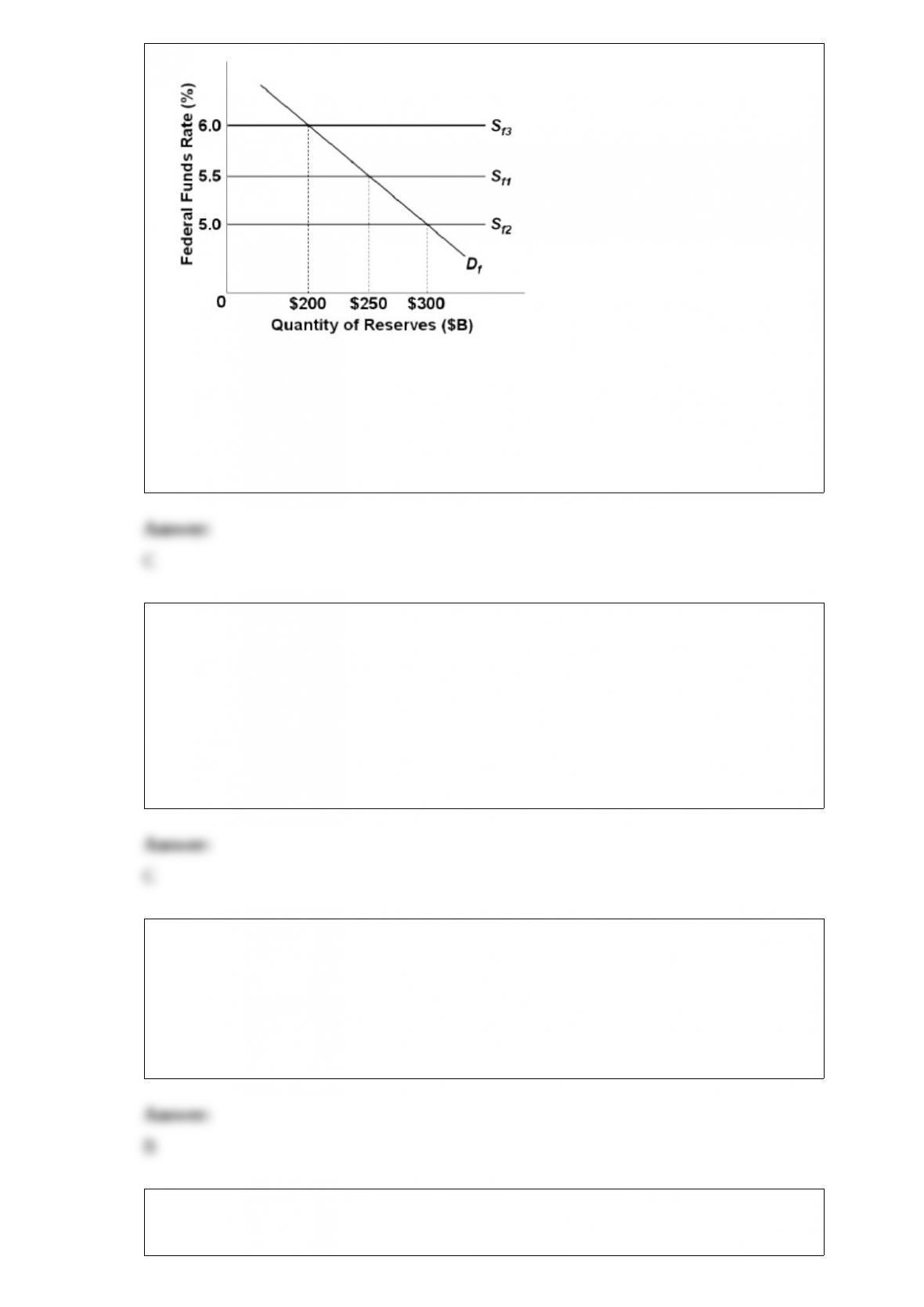
Refer to the above diagram for the Federal funds market. If the Fed supplies $300
billion in reserves, the equilibrium Federal funds rate is:
A.6.0 percent.
B.5.5 percent.
C.5.0 percent.
D.undeterminable with the information given.
2) Which of the following is correct?
A.The rapid expansion of foreign incomes will reduce U.S. agricultural exports.
B.A decrease in the international value of the dollar will reduce U.S. agricultural
exports.
C.An increase in the international value of the dollar will reduce U.S. agricultural
exports.
D.Changes in the international value of the dollar have no effect on U.S. agricultural
exports.
3) Economists refer to a budget deficit that exists when the economy is achieving full
employment as a:
A.cyclical deficit.
B.full-employment deficit.
C.natural deficit.
D.nonrecurring deficit.
4) If government increases lump-sum taxes by $20 billion and the economy’s MPC is .
6, then the:

A.consumption schedule will shift upward by $12 billion.
B.consumption schedule will shift downward by $12 billion.
C.equilibrium GDP will increase by $40 billion.
D.equilibrium GDP will decrease by $40 billion.
5) The lifetime distribution of income is more equal than the annual distribution. This
statement is:
A.true, because the rich have gotten richer and the poor have gotten poorer.
B.true, because there is considerable income mobility over time.
C.false, because people tend to stay in the same income quintile over extended periods
of time.
D.false, because the rich have gotten richer and the poor have gotten poorer.
6)
Assume a pencil manufacturer is employing resources C and D in such quantities that
the MRPs of the last units hired are $80 and $50 respectively. The price of resource C is
$90 and the price of D is $35. This firm:
A.should hire less of C and more of D.
B.should hire more of both C and D.
C.should hire less of both C and D.
D.is using the least-cost combination of C and D
7) at its profit-maximizing output, a pure nondiscriminating monopolist achieves:
a.neither productive efficiency nor allocative efficiency.
b.both productive efficiency and allocative efficiency.
c.productive efficiency but not allocative efficiency.
d.allocative efficiency but not productive efficiency.
8) The aggregate demand curve is:
A.vertical if full employment exists.
B.horizontal when there is considerable unemployment in the economy.
C.downsloping because of the interest-rate, real-balances, and foreign purchases effects.
D.downsloping because production costs decrease as real output rises.
9) in the united states, business cycles have occurred against a backdrop of a long-run
trend of:
a.declining unemployment.
b.stagnant productivity growth.
c.rising real gdp.
d.rising inflation.
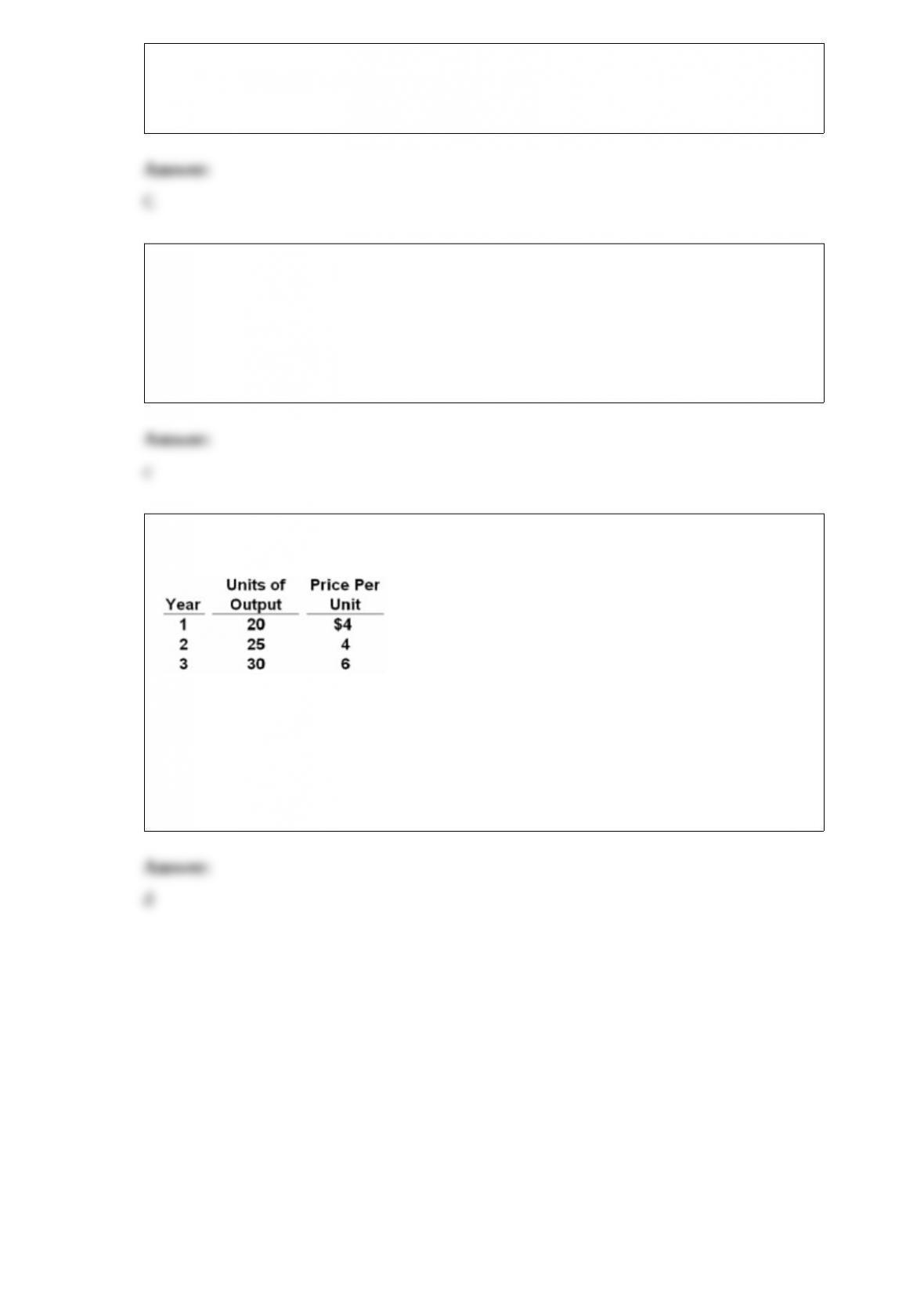
10) assume an economy that is producing only one product. output and price data for a
three-year period are as follows. answer the next question(s) on the basis of these data.
refer to the above data. if year 2 is chosen as the base year, in years 1 and 3 the price
index values, respectively, are:
a.4 and 6.
b.6 and 4.
c.120 and 100.
d.100 and 150.