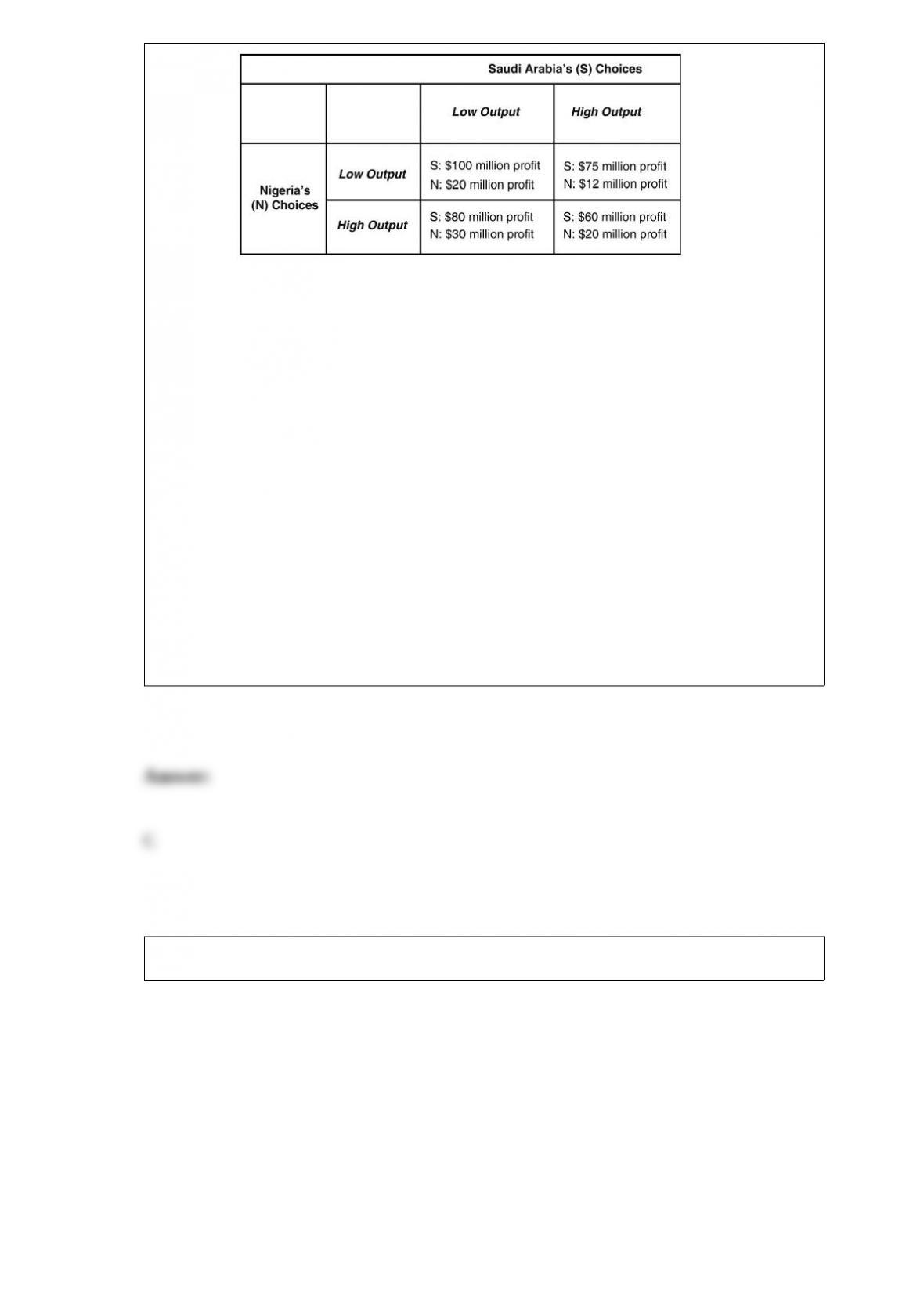
Table 14-3 Suppose OPEC
has only two producers, Saudi Arabia and Nigeria. Saudi Arabia has far more oil
reserves and is the lower cost producer compared to Nigeria. The payoff matrix in Table
14-3 shows the profits earned per day by each country. “Low output” corresponds to
producing the OPEC assigned quota and “high output” corresponds to producing the
maximum capacity beyond the assigned quota.
What is the Nash equilibrium in this game?
A) In the Nash equilibrium, both Saudi Arabia and Nigeria produce a low output and
earn a profit of $100 million and $20 million respectively.
B) In the Nash equilibrium, both Saudi Arabia and Nigeria produce a high output and
earn a profit of $60 million and $20 million respectively.
C) In the Nash equilibrium, Saudi Arabia produces a low output and earns a profit of
$80 million and Nigeria produces a high output and $30 million respectively.
D) There is no Nash equilibrium.
Figure 12-11
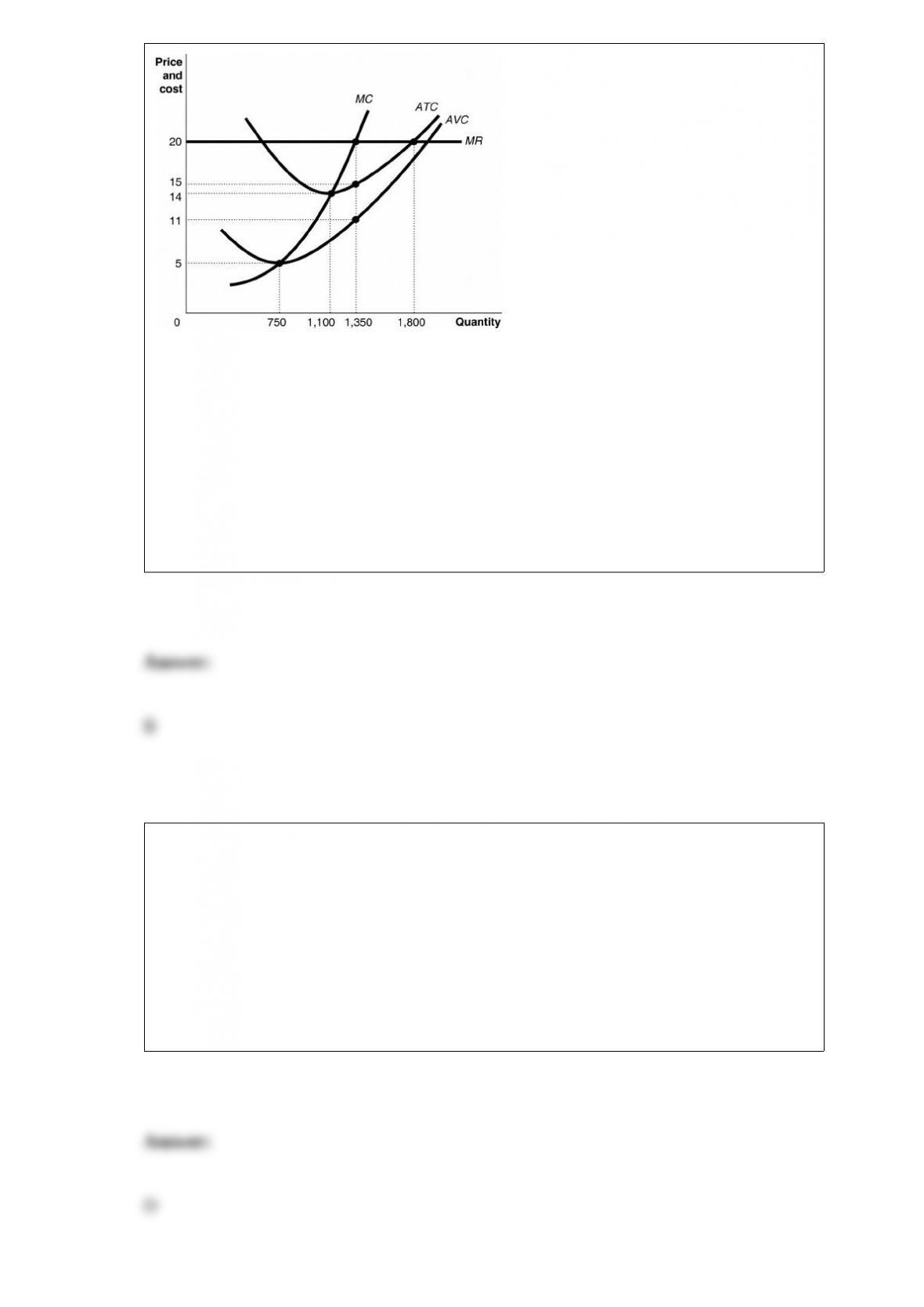
If this is a constant-cost industry, what is the market price in the long-run equilibrium?
A) $5
B) $14
C) $15
D) $20
When calculating GDP, the Bureau of Economic Analysis revises its quarterly data
A) a total of one time.
B) a total of two times.
C) a total of three times.
D) many times over the next several years.

Kenneth Chay and Michael Greenstone examined the impact of reductions in air
pollution since the passage of the Clean Air Act of 1970. Which of the following
statements summarizes their findings?
A) The marginal benefit of reductions in air pollution was less than the marginal cost.
B) The marginal cost of reducing emissions of sulfur dioxide has increased over time as
the marginal benefit of the reductions has increased.
C) The benefits of reducing the six main air pollutants in the two years following the
Act greatly exceeded the costs.
D) In the two years following passage of the Act, fewer infants died than would have
died if the Act had not been passed.
If the CPI rises from 206.7 to 212.7 between two consecutive years, by how much has
the cost of living changed between these two years?
A) The cost of living has increased by 6%.
B) The cost of living has increased by 2.9%.
C) The cost of living has increased by 12.7%.
D) The cost of living has decreased by 6%.
When every good or service is produced up to the point where the last unit provides a

marginal benefit to society equal to the marginal cost of producing it, ________ occurs.
A) allocative efficiency
B) productive efficiency
C) equity
D) efficient central planning
The existence of ________ increases the risk of buying stock in a corporation.
A) the principal-agent problem
B) corporate governance
C) unlimited personal liability
D) employee-owned corporations
Which of the following is an example of foreign direct investment?
A) You purchase a plane ticket to China on American Airlines.
B) American Airlines builds a hub in China.
C) You buy a plane that was made in China.
D) A stock broker from China sells you a Chinese government savings bond.

A key Difficulty facing insurance companies is that people know more about their
health than do insurance companies, and that those people who are seriously ill are the
most likely to want to obtain health insurance. What is this phenomenon called?
A) moral hazard
B) economic irrationality
C) asymmetric information
D) adverse selection
Damian shares a small food truck with his sister. His share of the expenses is $500 per
month. He has decided to get his own, newer food truck which he will not have to share
with anyone. His expenses for the newer truck are $1,400 per month. Damian is as
rational as any other person. As an economics major, you rightly conclude that
A) Damian cannot afford the newer truck and will have to go back to sharing a truck
with his sister.
B) Damian figures that the additional benefit of having his own truck (as opposed to
sharing) is at least $900.
C) Damian figures that the benefit of having his own truck (as opposed to sharing) is at
least $1,400.
D) the cost of having one’s own truck outweighs the benefits.

Which of the following is common to both tariffs and quotas?
A) Tariffs and quotas are both used as a means to increase government revenue.
B) Tariffs and quotas both increase economic efficiency.
C) Tariffs and quotas are both designed to reduce foreign competition faced by
domestic firms.
D) Tariffs and quotas are both examples of voluntary export restraints.
If a restaurant were a natural monopoly, dividing the restaurant equally into two
separate restaurants would
A) decrease marginal cost.
B) raise average total cost.
C) increase total revenue.
D) make marginal revenue less elastic.
Lower personal income taxes
A) increase aggregate demand.
B) decrease disposable income.
C) decrease aggregate demand.
D) increase transfer payments.
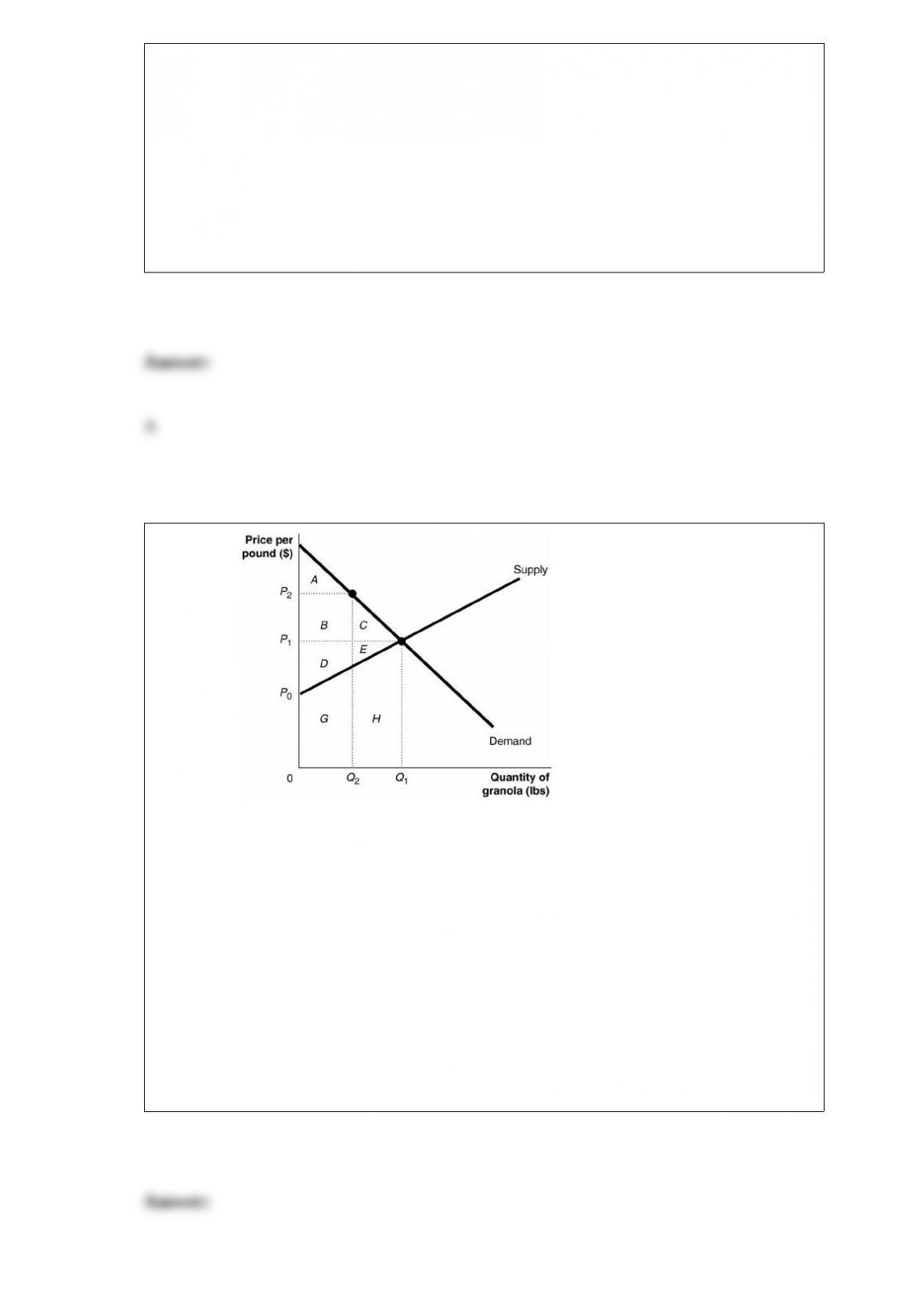
Figure 4-6 Figure 4-6 shows the market for
granola. The market is initially in equilibrium at a price of P1 and a quantity of Q1.
Now suppose producers decide to cut output to Q2 in order to raise the price to P2.
What area represents consumer surplus at the equilibrium price of P1?
A) A
B) A + B + C
C) D + E
D) A + B + C + D + E

The government of Silverado raises revenue through a general income tax paid by all its
residents to operate the city’s marina. The marina is used by private boat owners. This
method of raising revenue to operate the marina is
A) consistent with the benefits-received principle.
B) consistent with the ability-to-pay principle.
C) inconsistent with the benefits-received principle.
D) inconsistent with the ability-to-pay principle.
When a firm experiences a positive technological change,
A) the price of a share of the firm’s stock rises.
B) the firm is able to produce more output using the same inputs, or the same output
using fewer inputs.
C) the value of the firm’s assets rises.
D) the firm will hire additional workers in order to increase production.