
In recent years, the prices of new domestically produced cars have been falling.
Suppose consumers respond by reducing their demand for used cars and mass transport
services such as bus travel. This information suggests that the cross-price elasticity
between new cars and used cars, and the cross-price elasticity between new cars and
bus travel are negative.
Answer:
One of the monetary policy goals of the Federal Reserve is price stability.
Answer:
The rising cost of uninsured patients receiving treatment at hospital emergency rooms is
one of the leading causes of the increase in health care spending as a percentage of GDP
in the United States.
Answer:
If consumers paid the full price of medical services instead of using health insurance
and third-party payers to cover part of the cost, the quantity of medical services
provided would decrease.
Answer:

Monetary policy is conducted by the U.S. Treasury Department.
Answer:
Life expectancy at birth in the United States has more than doubled since 1850.
Answer:
Crowding out refers to a decrease in government purchases as a result of an increase in
private expenditures.
Answer:
Human capital refers to the percentage of the working-age population in the labor force.
Answer:

The German central bank, the Bundesbank, faced the risk of increased inflation caused
by its actions to support an overvalued deutsche mark in the 1960s.
Answer:
One reason why many low-income countries experience low rates of growth is because
of poor public education and health.
Answer:
Holding all else constant, a rise in interest rates in the United States will cause the
dollar to appreciate in international exchange markets.
Answer:
New classical macroeconomic theory emphasizes the role of ‘sticky” prices in the
economy.

Answer:
One example of human capital is the amount of savings that you have.
Answer:
________ is a situation in which a good or service is produced at the lowest possible
cost.
A) Allocative efficiency
B) Productive efficiency
C) Equity
D) Optimal marginalism
Answer:
Lucinda buys a new GPS system for $250. She receives consumer surplus of $75 from
the purchase. How much does Lucinda value her GPS system?
A) $75
B) $175
C) $250

D) $325
Answer:
M2 includes M1 plus
A) currency in circulation, checking account deposits in banks, and holdings of
traveler’s checks.
B) savings account balances, money market deposit accounts in banks,
small-denomination time deposits, and noninstitutional money market fund shares.
C) checking account deposits, large-denomination time deposits, and noninstitutional
money market fund shares.
D) currency in circulation, savings account balances, and small-denomination time
deposits.
Answer:
The profits a corporation keeps to finance future expansion are known as
A) retained earnings.
B) preferred stock.
C) dividends.
D) capital gains.
Answer:

During an economic expansion as consumer incomes rise, holding everything else
constant,
A) the demand for most goods, except luxuries, will rise.
B) the demand for luxuries will rise while the demand for inferior goods will fall.
C) the demand for luxuries and inferior goods will rise.
D) the prices of luxuries will fall while the prices of inferior goods will rise.
Answer:
The cost of raising beef cattle has risen at the same time as consumer preference for
beef has fallen. In the market for beef, this would be represented by the equilibrium
price ________ and the equilibrium quantity ________.
A) increasing; increasing or decreasing
B) increasing or decreasing; decreasing
C) decreasing; increasing or decreasing
D) increasing or decreasing; increasing
Answer:
Figure 9-1
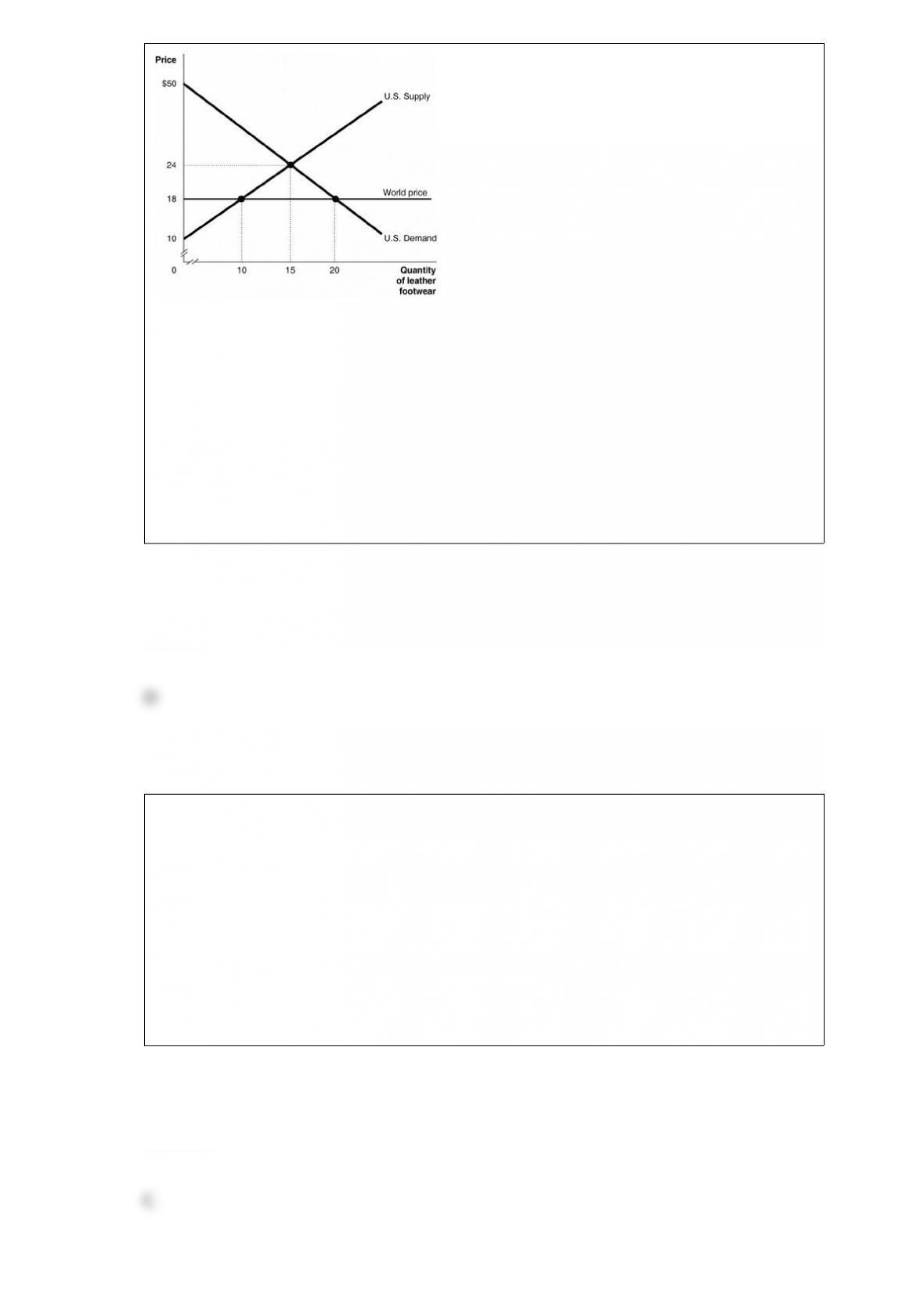
Figure 9-1 shows the U.S. demand and supply for
leather footwear. Suppose the government allows imports of leather footwear into the
United States. What will be the quantity demanded?
A) 5 units
B) 10units
C) 15 units
D) 20 units
Answer:
In economics, activities done for others, such as providing house cleaning or dental
work, are referred to as
A) technology.
B) physical capital.
C) services.
D) goods.
Answer:

Mel’s House of Cars is an automobile dealership that sells both new and used cars. Two
other dealerships located nearer Mel’s pay their salespeople a straight salary€they
receive no commission for each car they sell. Mel has decided to pay all of his
salespeople a commission on all car sales. Which of the following is most likely to
occur as a result of Mel’s decision?
A) Mel will have difficulty finding salespeople. Research by labor economists has
found that most employees prefer the security of a salary to the uncertainty of being
paid based on how much revenue they generate for their employers.
B) Mel will experience a principal-agent problem. Some of his salespeople will tend to
shirk because they will not be paid if they sell no cars, regardless of how hard they
work.
C) Mel will be able to hire some of the most productive salespeople who work for the
other two dealerships.
D) Mel risks violation of federal law that regulates firms’ compensation policies.
Answer:
When housing prices fell as they did beginning in 2006 following the housing market
bubble, most banks and other lenders ________ the requirement for borrowers, making
it ________ for potential home buyers to obtain mortgages.
A) tightened; easier
B) tightened; harder
C) eased; easier
D) eased; harder
Answer:

Table 2-9
Table 2-9 shows the number of labor hours required to produce a wristwatch and a
pound of rice in Japan and Thailand. What is Thailand’s opportunity cost of producing
one pound of rice?
A) 60 wristwatches
B) 20 wristwatches
C) 5 wristwatches
D) 0.05 units of a wristwatch
Answer:
Figure 5-5
Figure 5-5 shows a market with an externality. The current market equilibrium output of
Q1 is not the economically efficient output. The economically efficient output is Q2.
Suppose the current market equilibrium output of Q1 is not the economically efficient
output because of an externality. The economically efficient output is Q2. In that case,
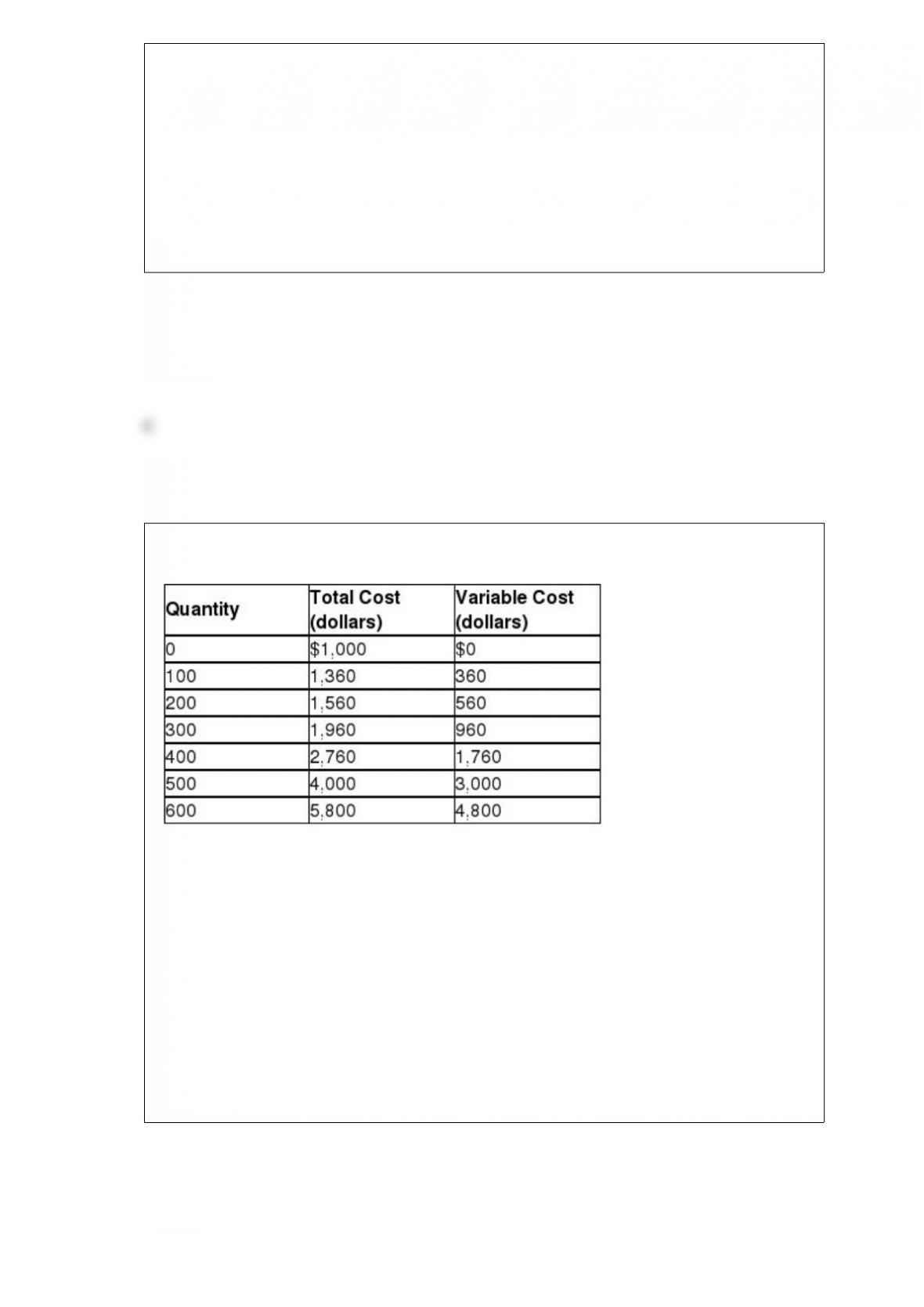
diagram shows
A) the effect of a subsidy granted to producers of a good.
B) the effect of an excess demand in a market.
C) the effect of a positive externality in the consumption of a good.
D) the effect of a negative externality in the consumption of a good.
Answer:
Table 12-1
Table 12-1 shows the short-run cost data of a perfectly competitive firm that produces
plastic camera cases. Assume that output can only be increased in batches of 100 units.
Suppose the fixed cost of production rises by $500 and the price per unit is still $8.
What happens to the firm’s profit-maximizing output level?
A) It must fall.
B) It must rise to offset the increased cost.
C) It will remain the same.
D) The firm will shut down.
Answer:
Suppose the value of the price elasticity of demand is -3. What does this mean?
A) A 1 percent increase in the price of the good causes quantity demanded to increase
by 3 percent.
B) A 1 percent increase in the price of the good causes quantity demanded to decrease
by 3 percent.
C) A 3 percent increase in the price of the good causes quantity demanded to decrease
by 1 percent.
D) A $1 increase in price causes quantity demanded to fall by 3 units.
Answer:
Figure 11-2
Assuming no technological change, if the United States increases capital per hour
worked by $40,000 every year between 2010 and 2014, we would expect to see
A) real GDP per hour worked will increase by the same increment each year between
2010 and 2014.
B) real GDP per hour worked will be lower in 2014 than it was in 2010.
C) the per-worker production function will get flatter over time.

D) the per-worker production function will shift up every year there is increase in
capital per hour worked.
Answer:
In the long run, a firm in a perfectly competitive industry will supply output only if its
total revenue covers its
A) explicit plus its implicit costs.
B) fixed costs.
C) implicit costs.
D) explicit costs.
Answer:
Equations for C, I, G, and NX are given below. If the equilibrium level of GDP is
$32,000, what will the new equilibrium level of GDP be if government spending
increases to 2,500? C = 5,000 + (MPC)Y
I = 1,500
G = 2,000
NX = -500 A) $32,500
B) $34,000
C) $38,000
D) $42,000
Answer:

What is the poverty rate?
A) the rate at which the number of people relative to the size of the population fall
below the poverty line
B) the percentage of the population earning an annual income below the poverty line,
according to the federal government’s definition
C) the percentage of working adults whose annual income is sufficiently low as to be
are exempt from paying income taxes
D) the percentage of households who qualify for government assistance to meet the
minimal requirement for adequate nutrition
Answer:
A key assumption of the public choice model is that government policymakers will
pursue their own self-interests. Economists assume that consumers and firms pursue
their own self-interests when they interact in competitive markets and this interaction
results in efficient economic outcomes. Does the pursuit of self-interest by
policymakers result in efficient economic outcomes?
Answer:
If firms and workers have adaptive expectations, what impact will expansionary
monetary policy have on inflation, unemployment, and the Phillips curve?
Answer:
Explain the relationship between price elasticity of demand and total revenue.
Answer:
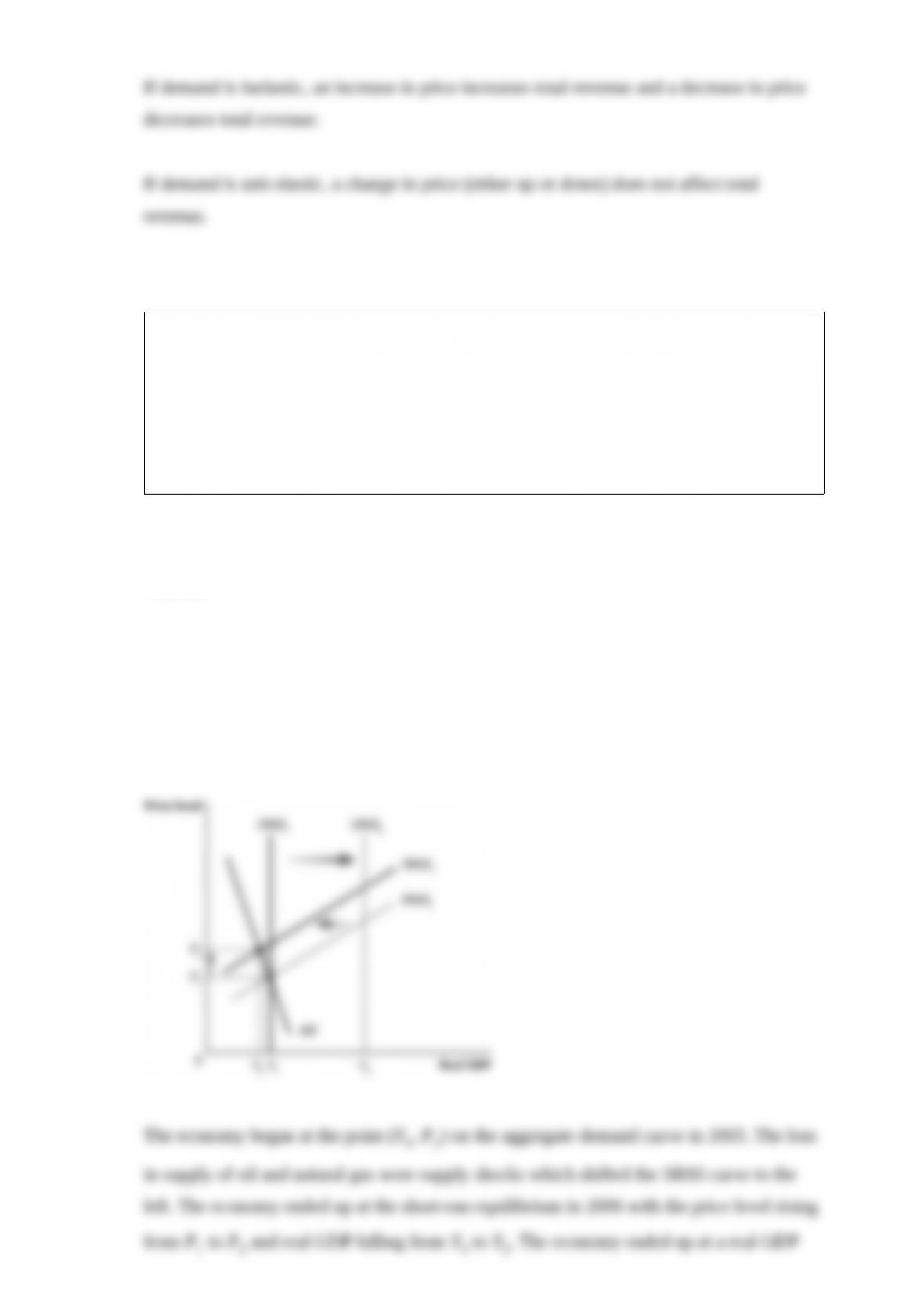
Hurricane Katrina resulted in a decline in oil production infrastructure along the gulf
coast. As a result there was an unexpected decline in oil and natural gas supplies in
2005. Suppose that this caused an increase in the price level and a decline in real GDP
in 2006. Also assume that potential real GDP continued to grow due to other factors.
You can assume the aggregate demand curve did not change. Show the macroeconomic
equilibrium for 2005 and 2006 using the dynamic aggregate supply and aggregate
demand model.
Answer:
The “Big Mac Theory of Exchange Rates” tests the accuracy of the purchasing power
parity theory. In July 2013, the Economist reported that the average price of a Big Mac
in the United States was $4.56. In Mexico, the average price of a Big Mac at that time
was 37 pesos. If the exchange rate between the dollar and the peso was 13.60 pesos per
dollar, explain how it would be profitable to buy Big Macs in Mexico instead of in the
United States.
Answer: