
Suppose you have just opened a store to sell espresso machines. Both you and a
competing store buy this machine from a manufacturer for $130 each. Your competitor
who has a store of the same size as yours is currently selling about 10 machines a
month at a price of $200 per machine. You expect to sell about 6 machines a month at a
price of $220 per machine. If you lower your price, you expect to make a loss. Which of
the following could explain why your competitor is able to profitably sell the machine
at a lower price although the cost of purchasing the machine is the same for the both of
you?
A) The competing store probably has a lower marginal cost of production.
B) The competing store probably has a lower average variable cost of production.
C) The competing store’s goal is to maximize revenue and not profit.
D) The competing store probably has a lower average cost because average fixed cost
falls as output increases.
If a corporate bond with a face value of $5,000 pays yearly coupon payments of $100,
what is the coupon rate?
A) 2%
B) 5%
C) 10%
D) 20%
At the end of World War II in 1945, many economists and business managers expected
that the U.S. economy would enter a severe recession. At that time, Sears and
Montgomery Ward were the two largest department store chains in the country. Sears
CEO Robert Wood expected continuing prosperity and opened new stores. Montgomery
Ward CEO Sewell Avery expected falling incomes and rising unemployment and closed
a number of existing stores. The results of their actions were seen during the late 1940s,
when
A) Sears declared bankruptcy and was purchased by Montgomery Ward.
B) Montgomery Ward weathered the economic downturn in better financial shape than
Sears.
C) Sears rapidly gained market share at Montgomery Ward’s expense.
D) Sears had to close many of the new stores it had opened following the end of the
war.
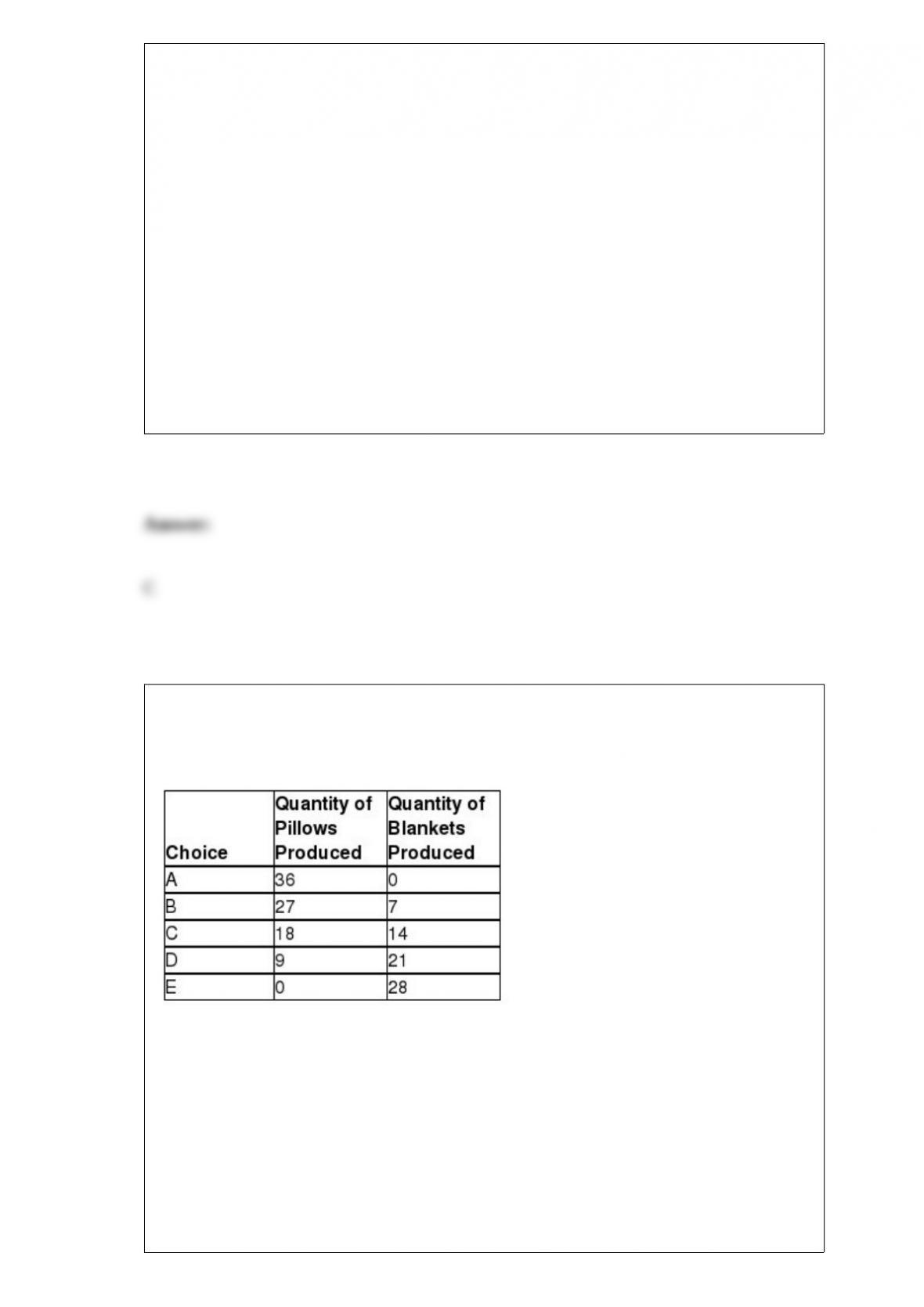
Table 2-2
Production choices for Billie’s Bedroom Shop
Assume Billie’s Bedroom Shop only produces pillows and blankets. A combination of 5
pillows and 21 blankets would appear
A) along Billie’s production possibilities frontier.
B) inside Billie’s production possibilities frontier.
C) outside Billie’s production possibilities frontier.
D) at the vertical intercept of Billie’s production possibilities frontier.

If labor productivity growth slows down in a country, this will
A) accelerate the increase in real GDP per capita.
B) accelerate the increase in nominal GDP.
C) slow down the increase in real GDP per capita.
D) slow down the increase in nominal GDP.
The price elasticity of the supply of teenage labor services is approximately 1.36.
Suppose the minimum wage rises from $7.25 per hour to $8.75. Using the midpoint
formula, calculate the approximately change in the quantity supplied of teenage labor.
A) 7.3 percent
B) 14.4 percent
C) 25.5 percent
D) There is insufficient information to answer the question.

Harry attended a baseball card show in New York City where he bought a number of
rookie cards of Pittsburgh Pirates baseball players from the 1950s and 1960s. Harry
then sold the cards in Pittsburgh, Harry’s hometown, where he knew the cards sold for
higher prices. The profits Harry earned from these transactions are called
A) arbitrage profits.
B) normal profits.
C) accounting profits.
D) implicit profits.
“For a given supply curve, the excess burden of a tax will be greater when the demand
for a product is less elastic than when the demand is more elastic.” This statement is
A) correct.
B) incorrect because the incidence of the tax, not the burden of the tax, is affected by
the elasticity of demand.
C) incorrect. When demand is less elastic, the burden of the tax is smaller than when the
demand is more elastic.
D) incorrect. The statement confuses demand with quantity demanded.
Which of the following is an example of an activity undertaken by an entrepreneur?
A) designing your landscaping for your new home

B) holding a position as the president of a liberal arts college
C) running for the president of the United States
D) starting your own pet sitting business
Which of the following must a firm in a market economy do today to succeed?
A) Produce the goods and services that consumers want at a lower cost than consumers
themselves can produce.
B) Organize the factors of production into a functioning, efficient unit.
C) Have access to sufficient funds.
D) Market firms today must do all of these things.
Consider three pricing strategies that the firm can pursue:
a. optimal two-part tariff pricing
b. perfect price discrimination
c. single-price monopoly pricing. Of these three strategies, which is least likely to
benefit society as a whole?
A) a two-part tariff pricing because consumers have to pay a fixed fee in addition to a
per-unit price
B) perfect price discrimination because those willing to pay higher prices are forced to

subsidize those who are not
C) Both perfect price discrimination and two-part tariff pricing do not benefit society
because the entire consumer surplus is extracted by the producer.
D) single-price monopoly pricing because there are mutually beneficial trades (between
consumers and seller) that are not exploited
Which term refers to a legally established maximum price that firms may charge?
A) a price ceiling
B) a subsidy
C) a price floor
D) a tariff