
Recall the application about the California kiwifruit market and the “lemons” problem.
If the problem of adverse selection exists in the kiwifruit market, we can expect the
quality of fruit to be ________ and the price to be ________.
A) high; high
B) high; low
C) low; high
D) low; low
Governments require immunizations of school children and offer immunization shots
for free to low income people. Immunizations are:
A) public goods.
B) private goods with external benefits.
C) nonrival goods.
D) all of the above.
Recall Application 5, “Repaying Student Loans,” to answer the following
questions:
According to the application, if you are a debtor who owes student loans, you are
helped in paying back your student loans by:
A) unexpected deflation.
B) unexpected inflation.
C) expected inflation.
D) expectedly deflation.
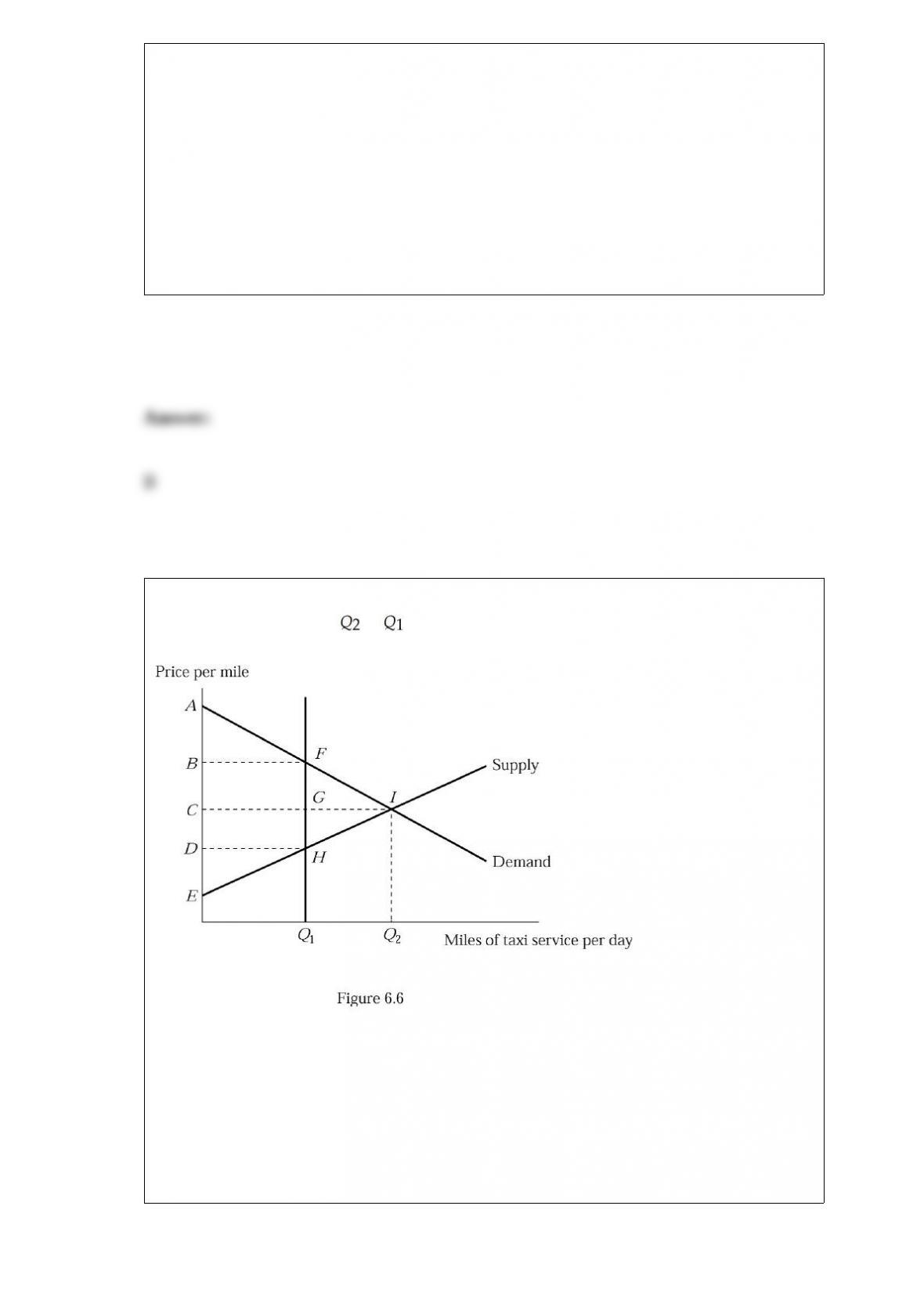
Refer to Figure 6.6, which shows a market for taxi medallions. If the number of taxi
licenses is reduced from to , the consumer surplus:
A) decreases by area FGI.
B) decreases by (area BCFG + area FGI).
C) decreases by area GHI.
D) decreases by (area CDGH + area GHI).
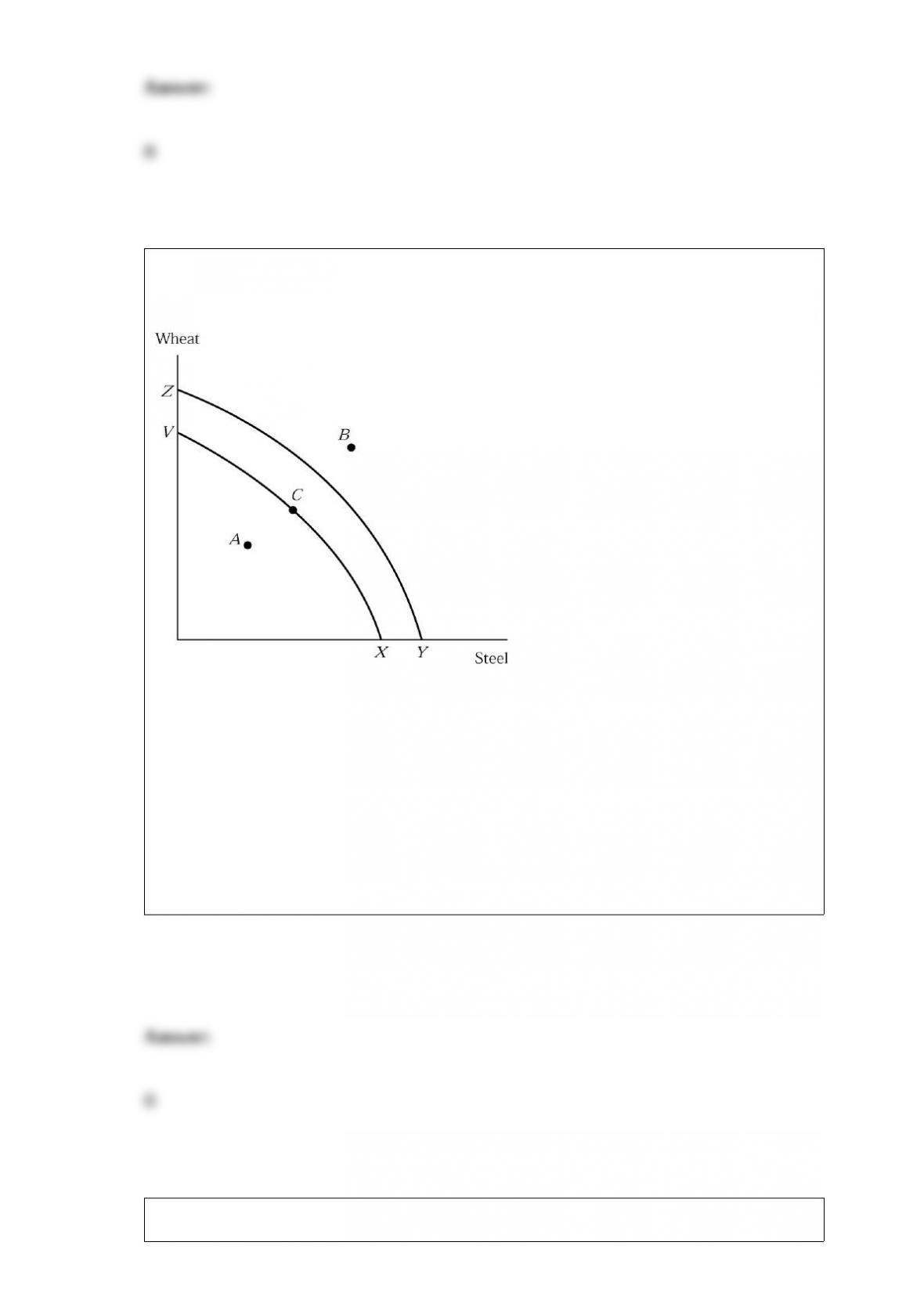
In Figure 2.3, the move from production possibility curve XV to production possibility
curve YZ could be caused by:
Figure 2.3
A) decreased unemployment.
B) more land, labor or capital.
C) a decline in technology.
D) all of the above.
At the free market equilibrium, the efficient level of output is produced because:

A) government regulates the output level that must be produced.
B) firms are maximizing profit.
C) willingness to pay is the same for all consumers.
D) total surplus is maximized.
Which of the following is NOT an economic decision in a modern economy?
A) Who consumes the products produced?
B) What will be produced?
C) Where will the products produced be consumed?
D) How will we produce it?
Figure 4.3 illustrates the supply and demand for blue jeans. If the actual price of blue
jeans is $30, there is:
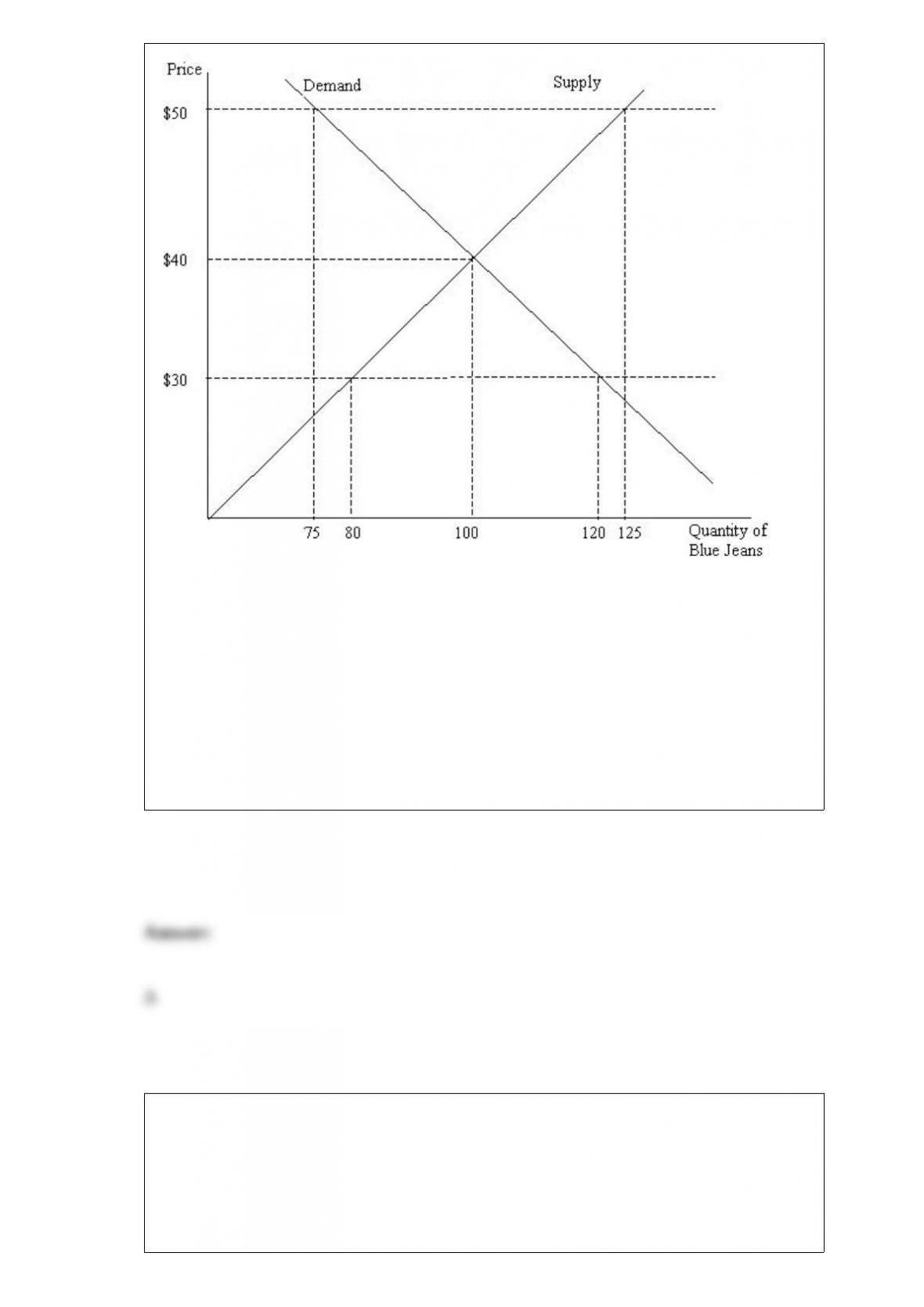
Figure 4.3
A) excess demand of 40 pairs of blue jeans.
B) excess supply of 40 pairs of blue jeans.
C) excess demand of 50 pairs of blue jeans.
D) excess supply of 50 pairs of blue jeans.
One advantage of pollution permits over pollution taxes is:
A) pollution permits allow firms to choose their profit-maximizing level of pollution
while taxes do not.
B) pollution permits generate more revenue for the government than do pollution taxes.

C) the government can set a maximum level of pollution using pollution permits.
D) none of the above.
Suppose that buyers in the used electric washer market are willing to pay $100 for a
high-quality electric washer and $50 for a low-quality electric washer. If buyers believe
that 70% of all used electric washer are low-quality, what is the maximum price they
would be willing to pay for a used electric washer?
A) $65
B) $70
C) $50
D) $35
Recall the Application. A study of the effect of automobile insurance and traffic
fatalities conducted by Alma Cohen and Rajeev Dehejia estimates that a one percentage
point decrease in the number of uninsured drivers:
A) decreases the number of traffic fatalities by 10 percent.
B) decreases the number of traffic fatalities by 0.5 percent.
C) has no measurable effect on the number of traffic fatalities.

D) increases the number of traffic fatalities by 2 percent.
Recall the Application. What makes the wireless telephone market in the United States
NOT perfectly competitive?
A) many buyers and many sellers in the United States
B) It is very expensive to enter the market in the United States.
C) Wireless phone calls are standardized product.
D) All of the above are correct.
Refer to Table 7.2. Diminishing marginal utility sets in after the ________ slice of pie
per day.
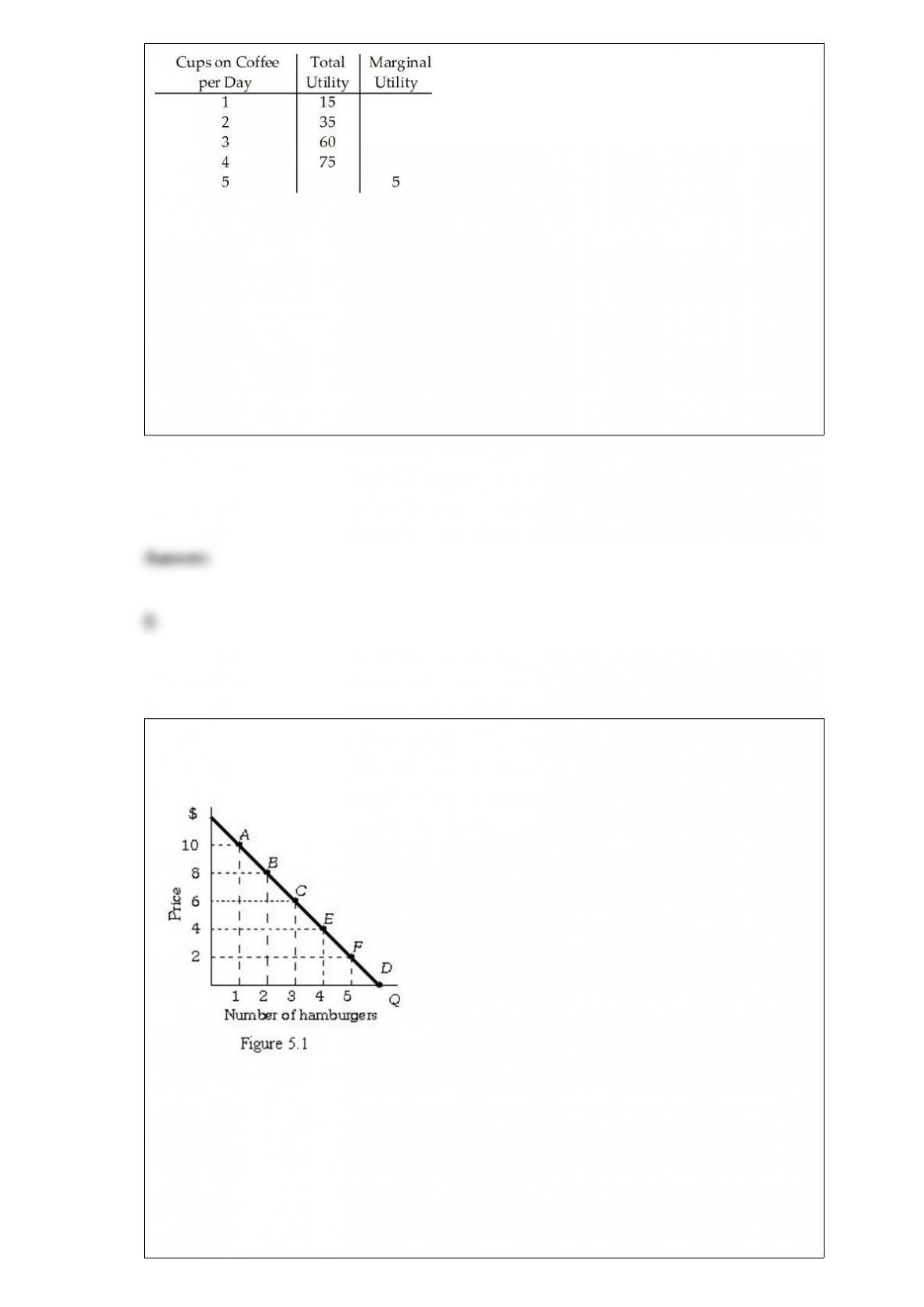
Table 7.1
A) fourth
B) third
C) second
D) first
Refer to Figure 5.1. Using the initial-value method, if the price of a hamburger is
increased from $6 to $8, the price elasticity of demand equals:
A) 0.7.
B) 5.0.
C) 1.0.
D) 2.0.

According to the Application, as the quantity of wine demanded increases, prices
________ in the short run and ________ as supply catches up with demand.
A) rise; stabilize
B) fall; stabilize
C) rise; fall
D) fall; rise
The feature that distinguishes monopolistic competition from perfect competition is that
monopolistically competitive firms are:
A) large relative to the market.
B) price takers.
C) able to block the entry of other firms.
D) able to differentiate their product.

Table 14.4 represents 3 markets for used motorcycles. Which of the markets in Table
14.4 are NOT in equilibrium?
Table 14.4
A) 1 only
B) 2 only
C) 3 only
D) 1 and 3
Because U.S. tariffs are higher on textiles, footwear and apparel items, U.S. tariffs fall
relatively most heavily on:
A) the middle class.
B) the rich.
C) the poor.
D) the government.
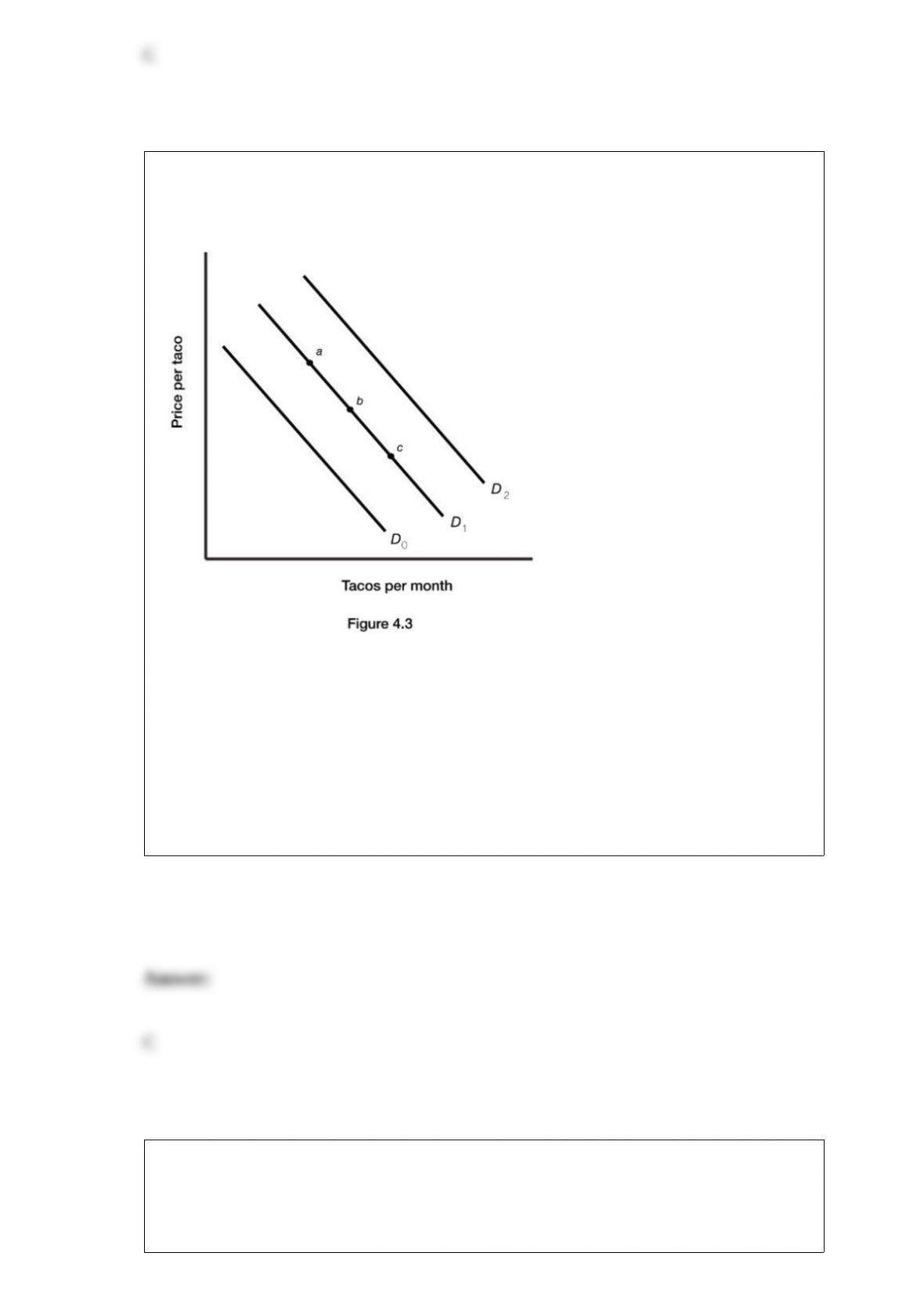
Figure 4.3 illustrates the demand for tacos. Assume that tacos and beer are
complements. An increase in the price of beer would bring about a movement from:
A) point a to point b.
B) point c to point b.
C) D2 to D1.
D) D0 to D2.
Recall the Application about how marginal utility changes with the quantity
consumed to answer the following question(s). Neuroscientists offered subjects in
an experiment varying monetary rewards, and observed the neural activity in a

subject’s striatum region of the brain.
Recall the Application. The larger the monetary reward offered to the subjects in the
experiment:
A) the higher the marginal utility and total utility of the reward money.
B) the lower the marginal utility and total utility of the reward money.
C) the lower the marginal utility and higher the total utility of the reward money.
D) the higher the marginal utility and lower the total utility of the reward money.
When a few firms sell similar products in a market, the market structure is most likely
to be:
A) a perfectly competitive market.
B) a monopoly.
C) a monopolistically competitive market.
D) an oligopoly.
The rate at which nations will exchange goods and service is known as the:
A) exchange rate.

B) transfer rate.
C) terms of trade.
D) terms of exchange.
Price fixing tends to fail in an oligopoly because:
A) firms like to have flexibility in setting prices.
B) each firm has an incentive to underprice the other firms.
C) it increases the quantity demanded.
D) consumers don’t like fixed prices.
Which of the following tariffs resulted in worldwide retaliation against the United
States during the Great Depression?
A) the Pasta Tariff
B) the Chicken tariff
C) the Smoot-Hawley tariff
D) the Tariff of Abominations

Suppose that for Virginia the marginal benefit per dollar spent on make-up is less than
the benefit per dollar spent on clothes. Virginia can always increase her utility by
buying:
A) more make-up and fewer clothes.
B) fewer make-up and more clothes.
C) more of both goods.
D) Virginia is already maximizing utility.
When the price of a car is $25,000, car sales are 10,000 per month. When the price of a
car increases to $29,000, car sales fall to 8,000 per month. Since the demand for cars is
________, the car company can expect revenue to ________ when they increase the
price of a car.
A) inelastic; increase
B) inelastic; decrease
C) elastic; increase
D) elastic; decrease
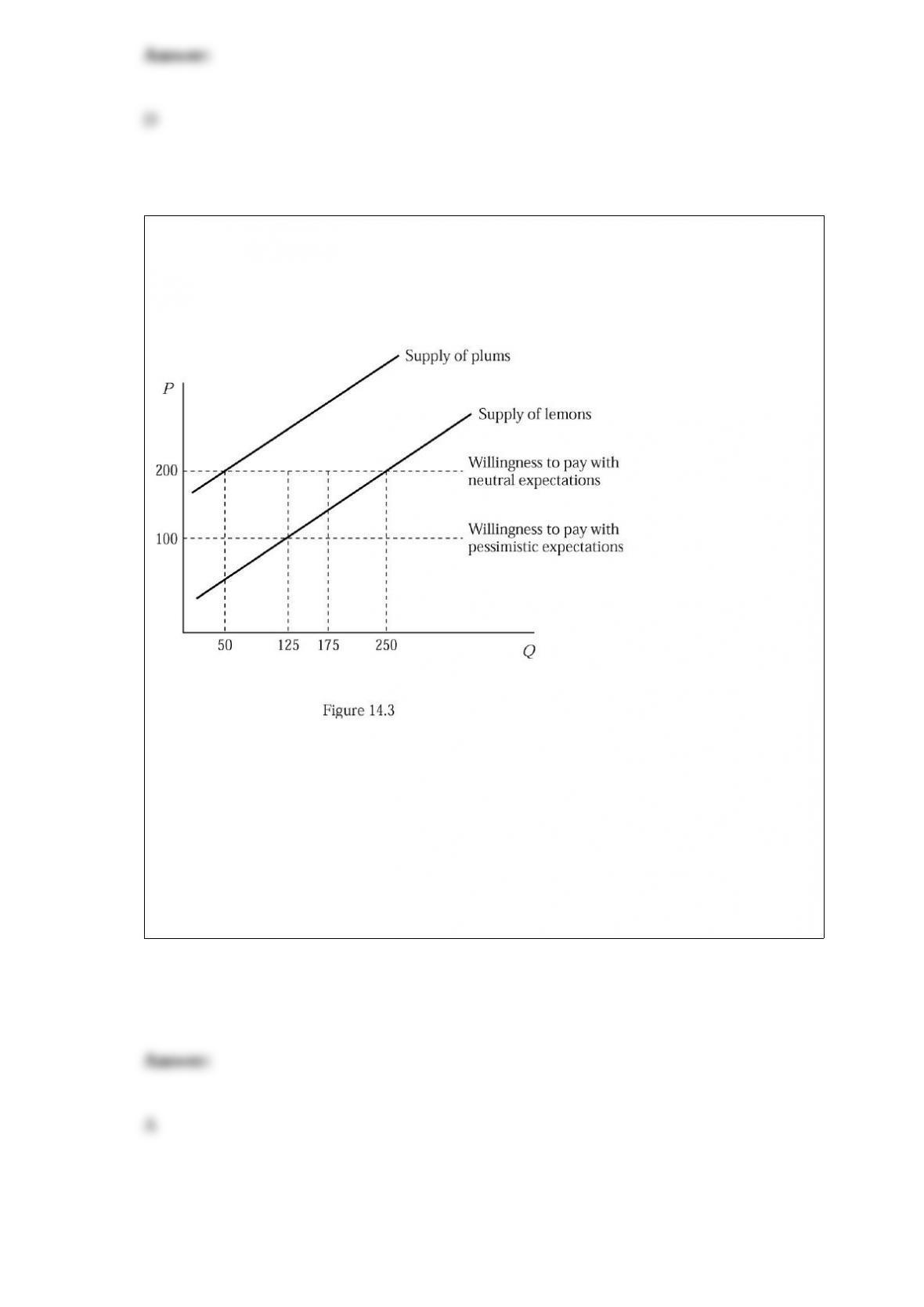
Figure 14.3 represents the market for used refrigerators. Suppose buyers are willing to
pay $300 for a plum (high-quality) used refrigerator and $100 for a lemon (low-quality)
used refrigerator. Compared to the situation when buyers have neutral expectations, if
buyers believed that fewer than 50% of used refrigerators are lemons (low-quality):
A) more plums (high-quality) used refrigerators would be on the market.
B) fewer plums (high-quality) used refrigerators would be on the market.
C) fewer lemons (low-quality) used refrigerators would be on the market.
D) the same total number of used refrigerators would be on the market, but more of
them would be plums (high-quality) used refrigerators.

Which of the following is true for a perfectly competitive market in short-run
equilibrium?
A) The quantity supplied equals the quantity demanded.
B) The typical firm earns zero economic profit.
C) The typical firm will always make a positive profit.
D) All of the above are correct.
In short-run equilibrium for a competitive firm economic profits:
A) will be positive.
B) will be negative.
C) will be zero.
D) may be positive, negative, or zero.
The example about London’s congestion problem illustrates which of the following
economic ways of thinking?
A) isolate variablesceteris paribus
B) use of assumptions to simplify

C) thinking at the margin
D) all of the above
Marginal cost is defined as:
A) total variable cost resulting from a one-unit increase in quantity.
B) quantity resulting from a one-unit increase in total variable cost.
C) the change in total variable cost resulting from a one-unit increase in the change in
quantity.
D) the change in quantity resulting from a one-unit increase in the change in total
variable cost.
The principle that states that what matters to people is the real value or purchasing
power of money is the:
A) marginal principle.
B) principle of diminishing returns.
C) spillover principle.
D) real-nominal principle.