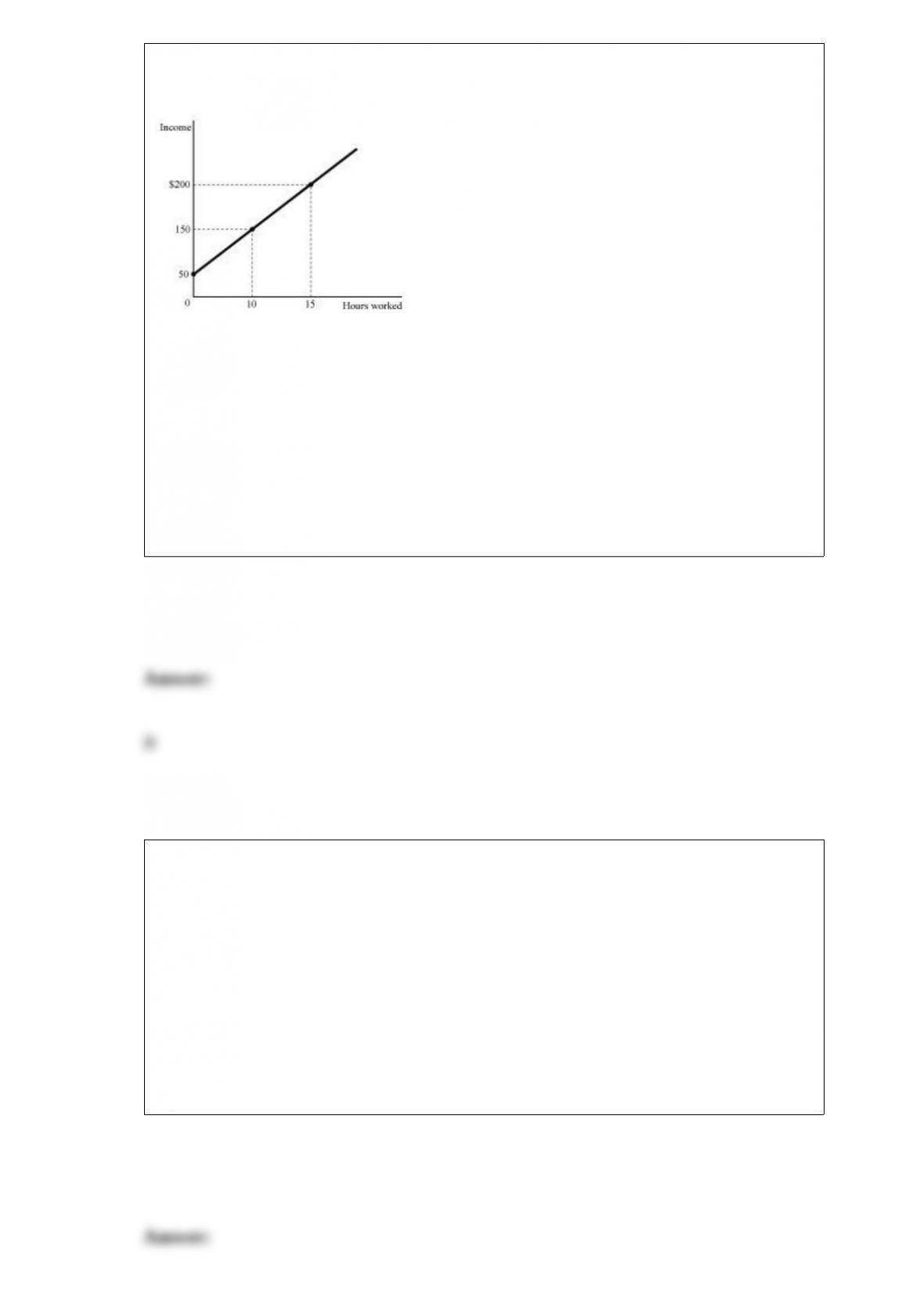
Refer to Figure 1.1. The relationship between hours worked and income, as shown by
the graph in Figure 1.1 is:
Figure 1.1
A) negative.
B) positive.
C) nonlinear.
D) exponential.
Recall the application on happy hour pricing, each bar has a local monopoly within its
neighborhood, but faces competition from other bars outside its neighborhood. The bars
respond by decreasing its prices, in what happens to the demand curve facing each bar?
A) It becomes flatter.
B) It becomes downward slopping.
C) It shifts to the right.
D) A and C are correct.
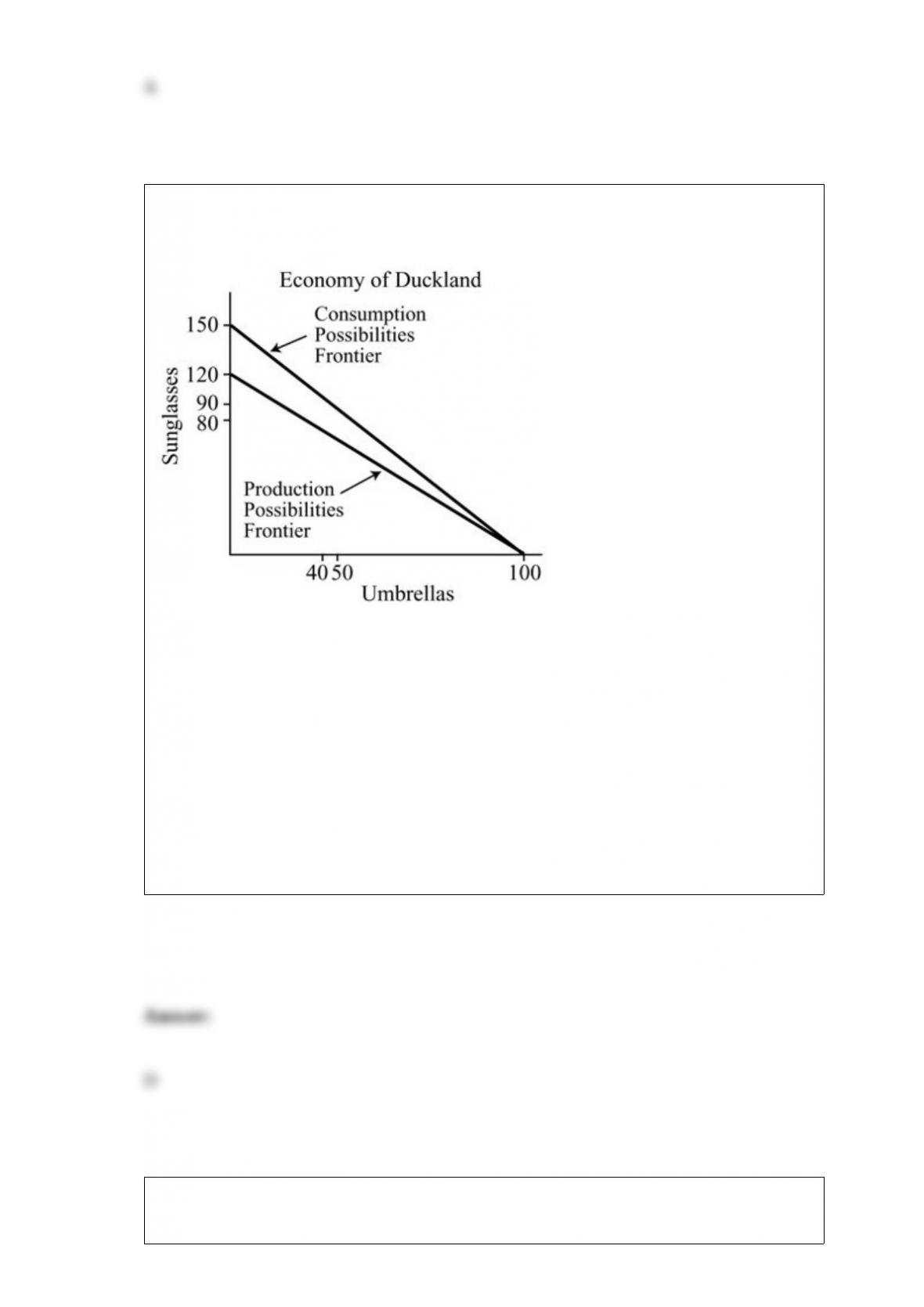
Figure 18.1
Refer to Figure 18.1. In autarky, the maximum amount of sunglasses that Duckland can
produce is:
A) 90.
B) 100.
C) 150.
D) 120.
If substantial up-front investments in advertising campaigns become essential to a
successful market entry, the market is most likely to be:

A) a perfectly competitive market.
B) a monopoly.
C) a monopolistically competitive market.
D) an oligopoly.
If the wage rate is less than the marginal revenue product of labor, the firm should
________ to maximize profits.
A) hire less labor and produce less output
B) hire less labor and produce more output
C) hire more labor and produce less output
D) hire more labor and produce more output
Recall Application 3, “Jasper Johns and House Painting,” to answer the following
questions:
According to the application, if Jasper Johns earns $5,000 per day painting art and
$1,500 per day painting houses, he should:
A) only paint art.
B) only paint houses.
C) paint both houses and art.
D) paint art on the side of his house.
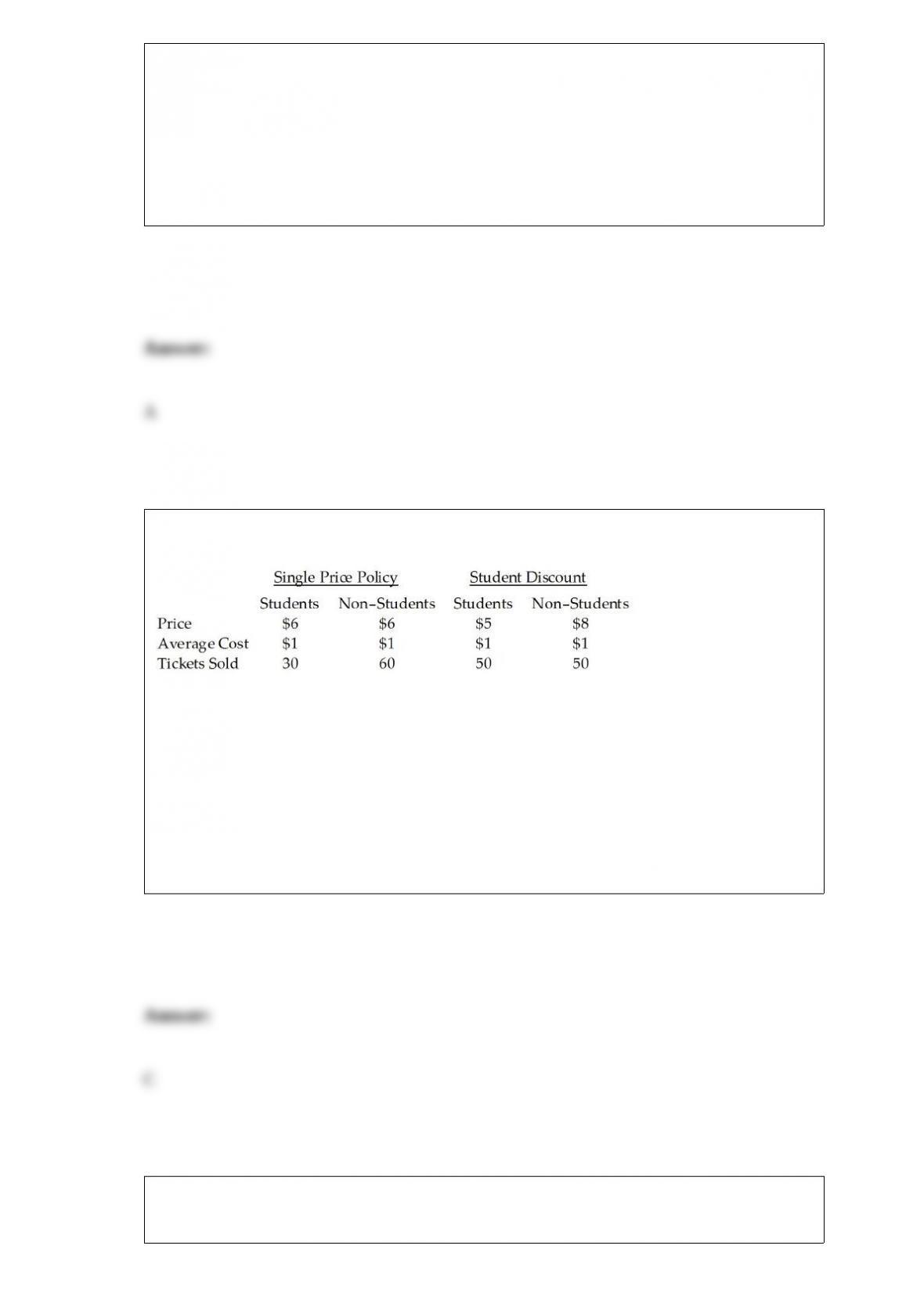
Table 10.2 contains price, demand, and cost data for the Capri Theater, the only first-run
movie theater in a small town. What is its total profit under the single price policy?
Table 10.2
A) $300
B) $360
C) $450
D) $540
Recall the Application about FTC information on predatory pricing to answer the

following question(s).
Recall the Application. According to the FTC, pricing below a competitor’s cost:
A) is generally a violation of antitrust laws.
B) is generally not a violation of antitrust laws.
C) is always a violation of antitrust laws.
D) is never a violation of antitrust laws.
The Celler-Kefauver Act:
A) made predatory pricing illegal.
B) outlawed asset-mergers that reduce competition.
C) created the Federal Trade Commission.
D) all of the above
Suppose Carolyn is on a fixed monthly income of $200 to spend on food while she is in
medical school. Further, suppose the price of a single-serving macaroni and cheese is $4
and the price of a baguette is $2. Which one of the following consumption
combinations is possible given these prices and income?

A) 40 macaroni and cheeses, 50 baguettes
B) 15 macaroni and cheeses, 80 baguettes
C) 20 macaroni and cheeses, 60 baguettes
D) 20 macaroni and cheeses, 100 baguettes
A tax on a good or service ________ the price that buyers pay and ________ the price
that sellers receive.
A) raises; lowers
B) raises; raises
C) lowers; lowers
D) lowers; raises
As a whole, nations are better off after trade and specialization because:
A) nations can consume along their consumption possibilities curve, which is above of
their production possibilities curve.
B) nations can consume along their consumption possibilities curve, which is below of
their production possibilities curve.

C) nations can consume along their production possibilities curve, which is above of
their consumption possibilities curve.
D) nations experience an outward shift of their production possibilities curve.
Which of the following is NOT a characteristic of a monopolistically competitive
market?
A) There are many firms.
B) Firms sell products that are similar but not identical.
C) Firms must take the market price as given.
D) There are no artificial barriers to entry.
The effect of diminishing marginal returns outweighing the effect of spreading out the
fixed costs is illustrated by the ________ average cost curve ________.
A) long-run; decreasing
B) long-run; increasing
C) short-run; decreasing
D) short-run; increasing
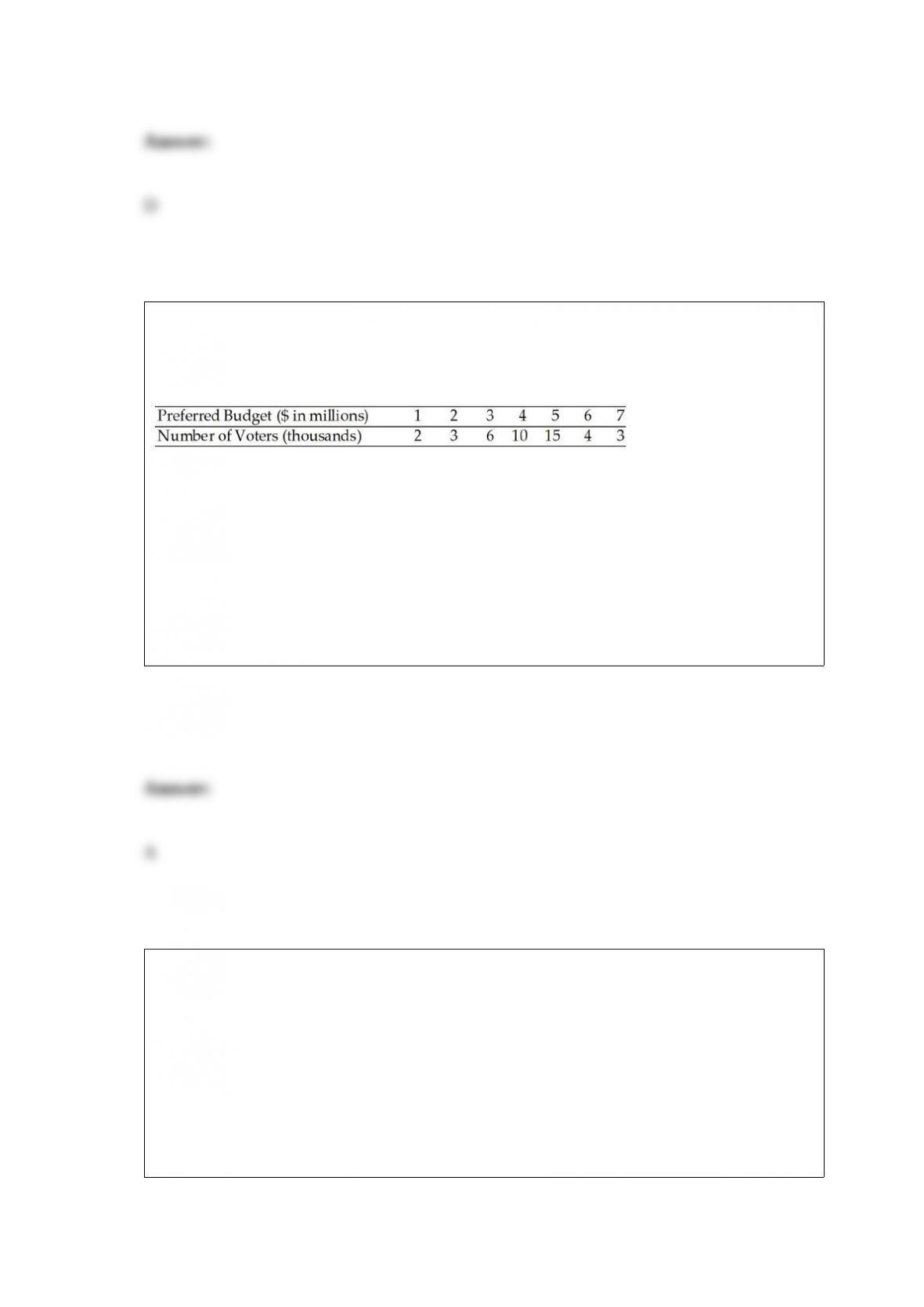
Table 15.1 shows the preferred budget in millions for a new sports facility and the
number of thousands of voters in a community who prefer that budget. Tom proposed a
budget of $7 million while Mary proposed a budget of $2 million. Which of the two
candidates will be elected if everyone votes?
Table 15.1
A) Tom
B) Mary
C) It will be a tie.
D) The outcome of the election cannot be predicted.
When economists construct economic models:
A) all but the essential features of the environment are eliminated.
B) all the essential features of the environment are eliminated.
C) only mathematical equations are used.
D) every detail found in reality must be included.
The budget line shows:
A) the different combinations of two goods that a consumer can buy.
B) the quantity of a single good that a consumer is willing to buy at different prices.
C) the maximized utility from a good.
D) none of the above
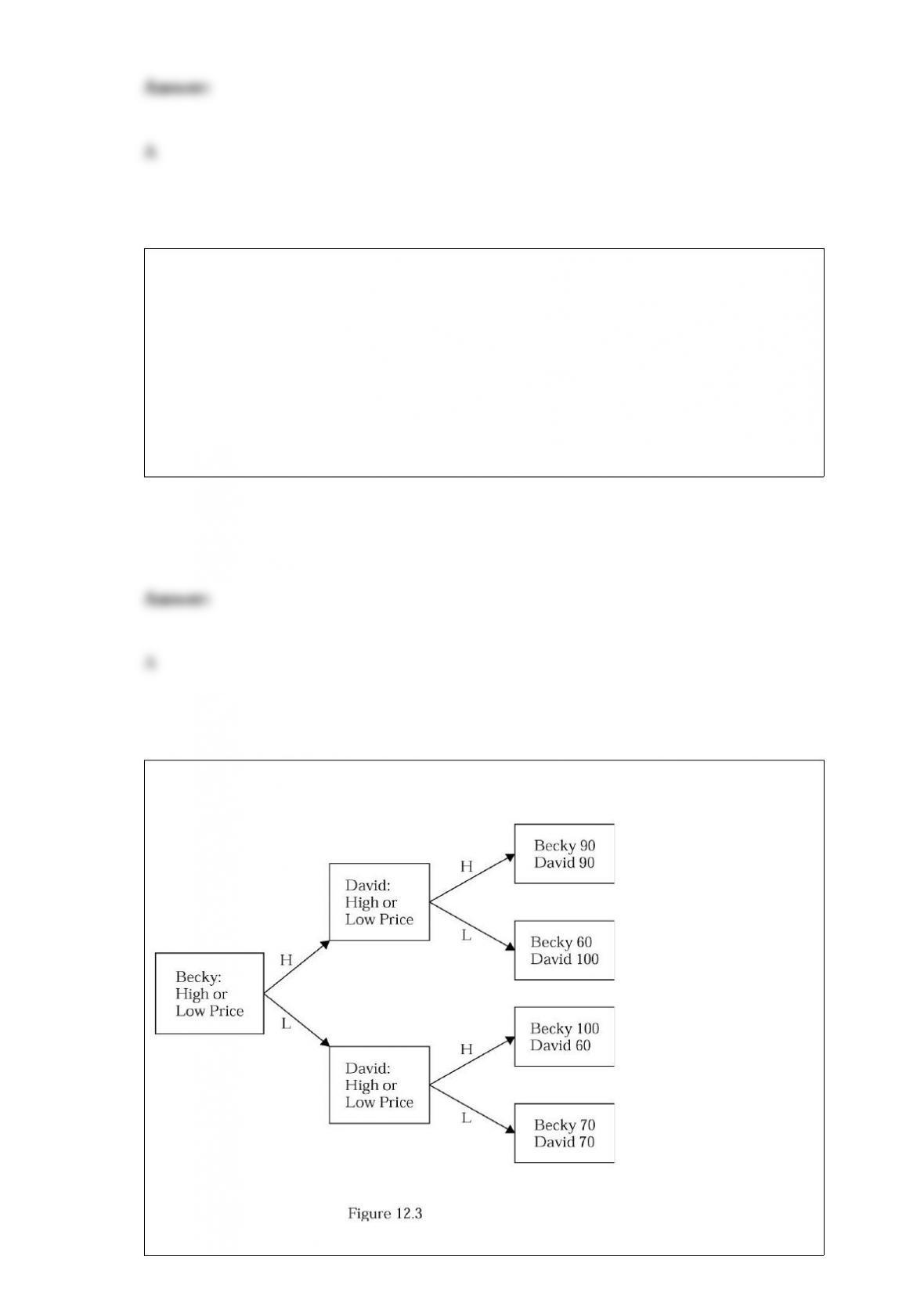
Consider Figure 12.3. If the players choose independently, what will be the outcome?

A) Becky chooses a low price and David chooses a low price.
B) Becky chooses a high price and David chooses a low price.
C) Becky chooses a low price and David chooses a high price.
D) Becky chooses a high price and David chooses a high price.
If each extra driver on the road makes every other drivers commute last one minute
longer and there are 600 drivers on the road, then one extra driver costs society:
A) 1 hour extra in commuting time.
B) 10 hours extra in commuting time.
C) 100 hours extra in commuting time.
D) 10 extra minutes in commuting time.
Which of the following is true about private goods?
A) They are rival in consumption.
B) They can have external benefits.
C) They are consumed by a single person or household.

D) All of the above are true.
Suppose that the marginal benefit per dollar spent on bicycles exceeds the marginal
benefit per dollar spent on skateboards. The consumer can always increase her utility by
buying:
A) more bicycles and fewer skateboards.
B) fewer bicycles and more skateboards.
C) more of both goods.
D) The consumer is already maximizing utility.
Recall the Application. One of the primary goals of the salt producers who tried to form
a cartel was to:
A) establish a uniform price for salt.
B) boost the demand for salt.
C) establish an export market for salt.
D) increase competition in the market for salt.

Which of the following is a macroeconomic question?
A) Should we have a constitutional amendment requiring the government to implement
a national consumption tax to replace the current income tax?
B) Why did a leading computer manufacturer establish call centers in India?
C) Why does a pharmaceutical manufacturer try to lower its production costs?
D) Should the government put a tax on alcohol in an attempt to assist in the funding of
support groups like Alcoholics Anonymous?
Which of the following is NOT an example of a marginal question?
A) How many more years of education must I take if I want to get a Ph.D. in
economics?
B) How many more dollars will I earn in my lifetime if I get my Master’s degree?
C) How many students borrow money in order to attend college?
D) How many more points will I expect to have if I study an hour longer?
If the law of supply holds, then the supply curve can never:
A) slope downwards.
B) be concave.
C) shift to the right.
D) shift to the left.
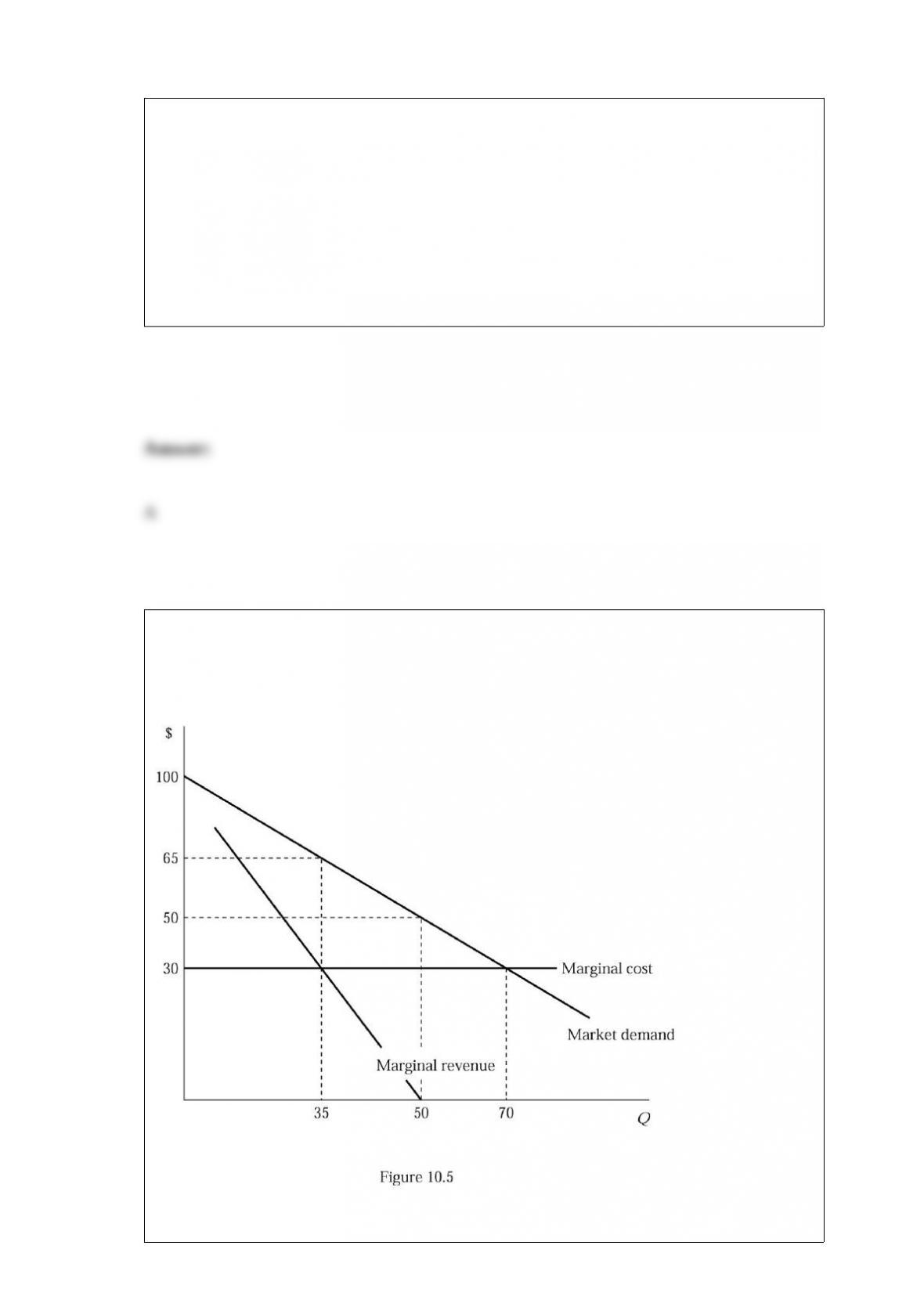
Suppose that Figure 10.5 shows an industry’s market demand, its marginal revenue, and
the production costs of a representative firm. If the industry was perfectly competitive,
it will produce a quantity of ________ and charge a price of ________.
A) 35; $65

B) 50; $50
C) 70; $30
D) There is not sufficient information.
According to the marginal principle, an individual will do best by producing or
consuming where:
A) marginal benefit exceeds total benefits.
B) marginal benefit is less than marginal cost.
C) marginal benefit equals marginal cost.
D) total benefit equals total cost.
Referring to Figure 2.1, if you increase the production of farm goods, what other area is
affected?
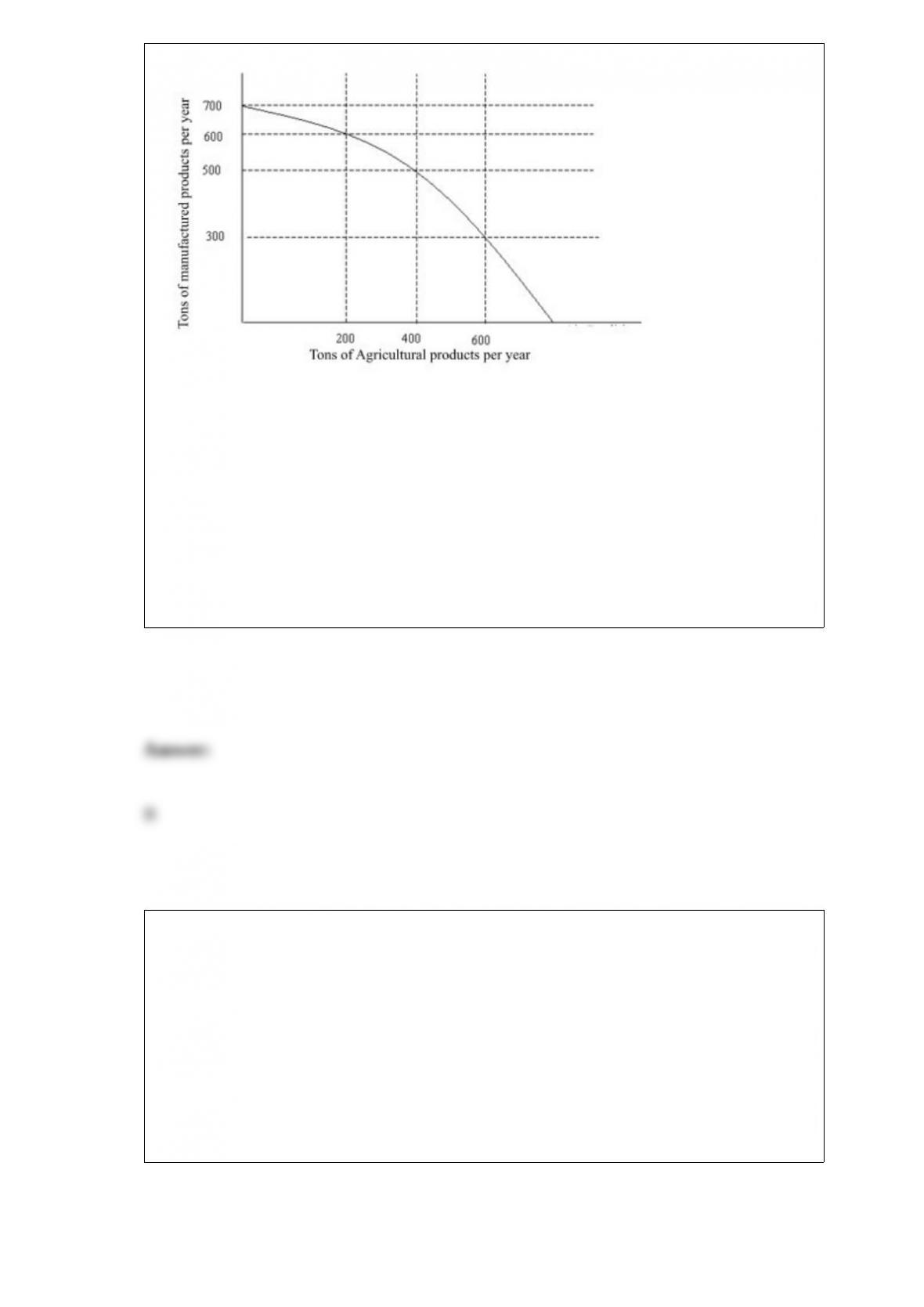
Figure 2.1
A) the price of produce
B) the production of factory goods
C) how much people can purchase
D) the wages earned by farm workers
From 1998 to 2010, the cost of electricity produced with nuclear power has ________
and the cost of electricity produced with solar power has ________.
A) increased; increased
B) increased; decreased
C) decreased; increased
D) decreased; decreased
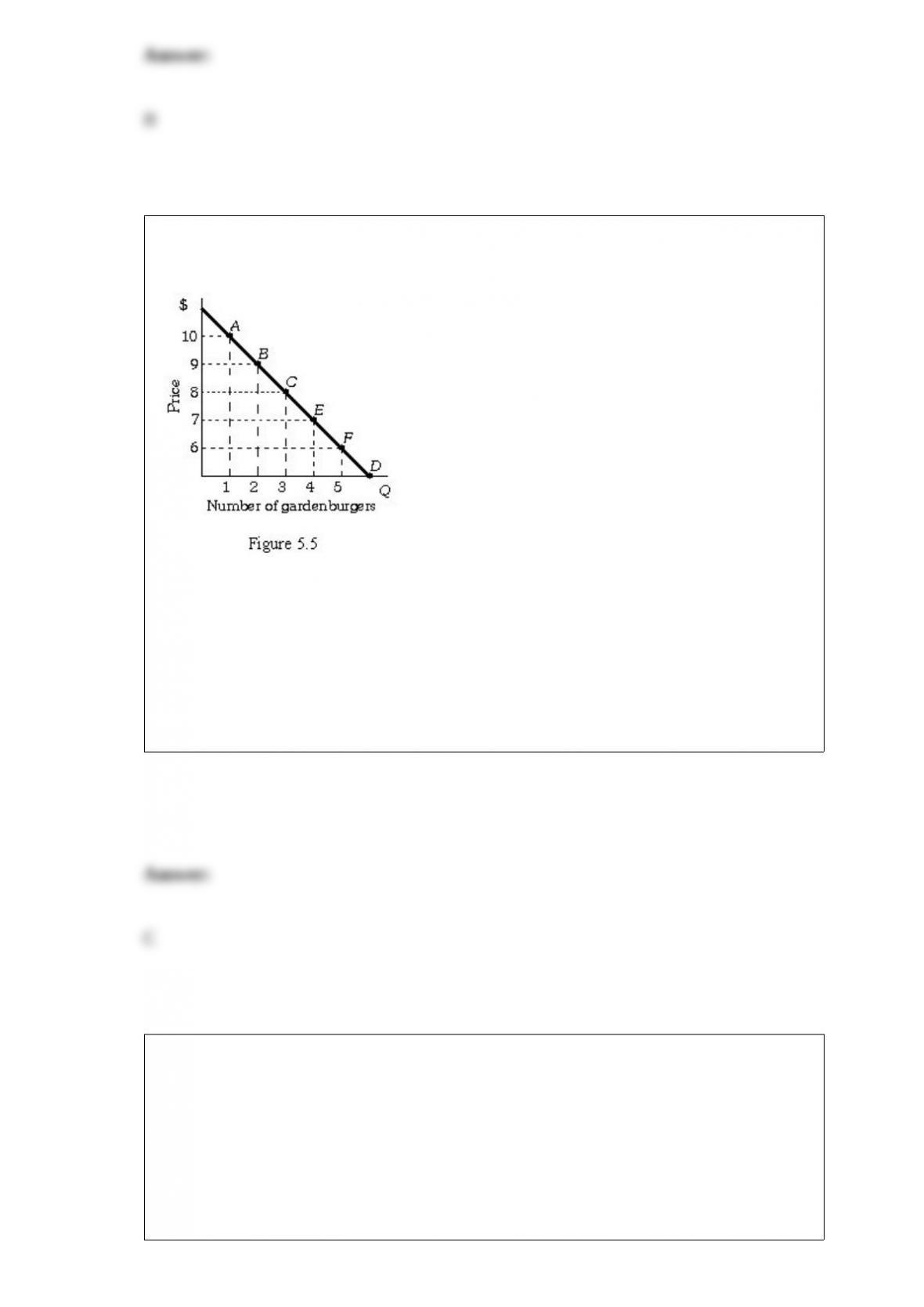
Refer to Figure 5.5. Using the midpoint method, if the price of a gardenburger is
increased from $6 to $7, the price elasticity of demand equals:
A) 0.13.
B) 0.33.
C) 1.44.
D) 13.
Under the conditions of monopolistic competition:
A) prices are always lower in the long run than in the short run.
B) firm profits are always higher in the long run than in the short run.
C) average costs of production are always higher in the short run than in the long run.

D) None of the above is correct.
Short-run costs that depend on the level of output are:
A) total fixed cost only.
B) total variable costs only.
C) total costs only.
D) both total variable costs and total costs.
The satisfaction experienced from consuming a good or service is referred to as:
A) utility.
B) marginal utility.
C) the law of diminishing marginal utility.
D) all of the above

One result of asymmetric information about people’s ability to repay a loan is that:
A) loans will only be made to people who don’t pay them back.
B) a bank could make many loans to people who don’t pay them back.
C) lenders are better off than with perfect information.
D) banks will not make loans.
In considering the relationships between price and quantity demanded, ceteris paribus
means economists assume that:
A) price increases affect quantity.
B) quantity increases affect prices.
C) either price or quantity can affect demand.
D) all other variables remain unchanged.