
George earns $500,000 playing baseball for team X. His next best alternative to playing
baseball is to own a fast-food restaurant, for which he would earn $100,000 a year. His
next best alternative to playing baseball for team X is playing baseball for team Y, for
which he would earn $400,000 a year. This example best illustrates the economic
principle that
a. economic rent is never zero.
b. baseball players earn higher incomes than fast-food restaurateurs.
c. economic rent exists in all situations.
d. economic rent differs depending upon the perspective from which the factor is
viewed.
Scarcity is defined as the condition in which
a. both wants and resources are limited.
b. wants are finite and resources infinite.
c. both wants and resources are infinite.
d. wants are infinite and resources finite.
No matter what the price of a given item of food, a person will eat the same amount of
that food. This situation is __________ with the concept of __________.
a. consistent; consumer equilibrium
b. not consistent; consumer equilibrium
c. consistent; maximizing total utility
d. consistent; consumers’ surplus
e. none of the above
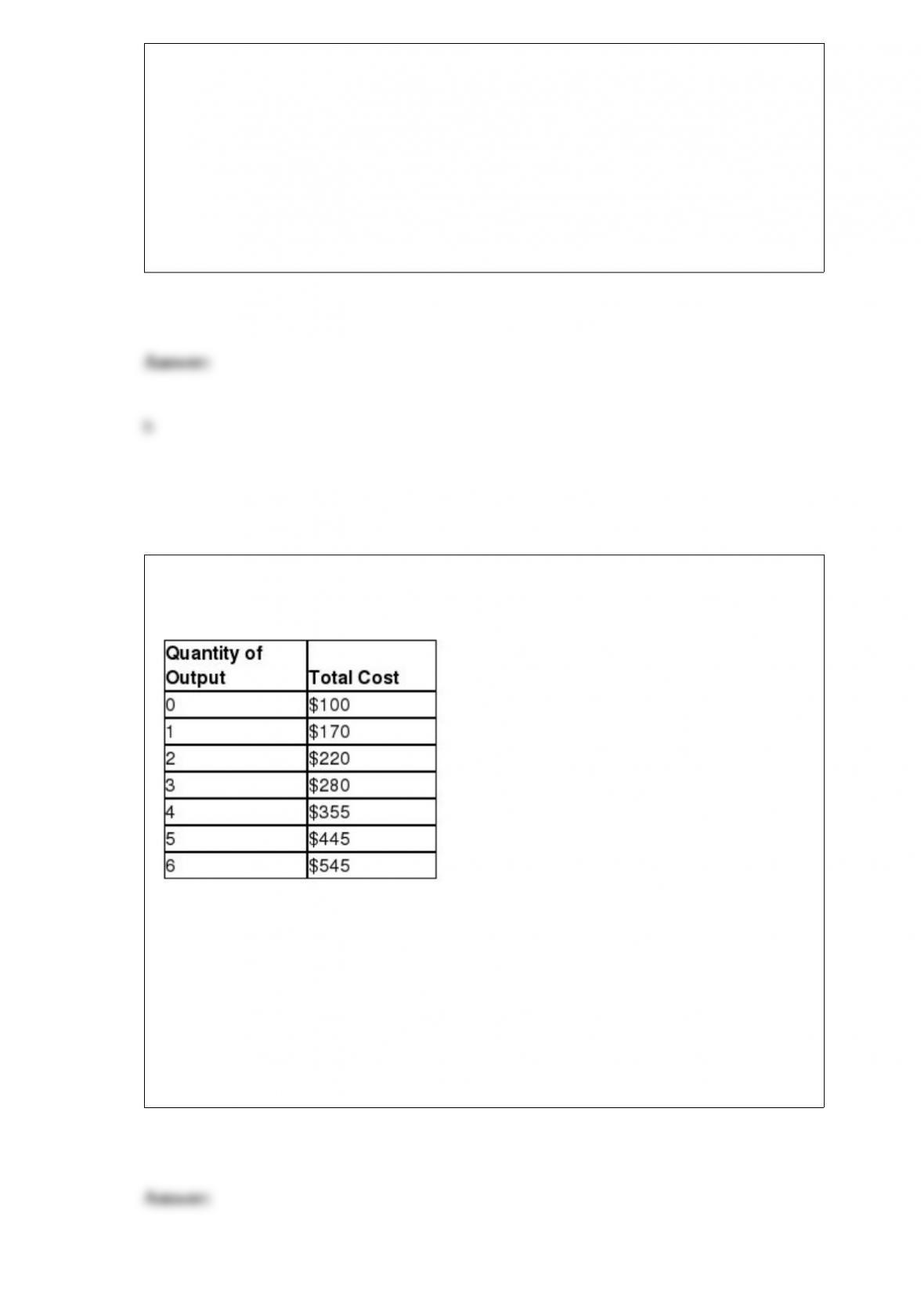
Refer to Exhibit 22-11. Average variable cost at two units of output is
Exhibit 22-11
a. $50.
b. $60.
c. $100.
d. $110.
e. There is not enough information provided to answer this question.

Which of the following statements is false?
a. A perfectly price-discriminating monopolist does not lower price on all previous units
in order to sell an additional unit of its product.
b. Second-degree price discrimination is when the seller charges a uniform price per
unit for one specific quantity, a lower price of an additional quantity, and so on.
c. Charging senior citizens less for medicine is an act of third-degree price
discrimination.
d. Charging women less for a car wash is an act of second-degree price discrimination.
e. A price taker cannot practice price discrimination.
Which of the following statements is false?
a. In some instances, simple majority voting leads to a project being undertaken even
though the total costs of the project exceed the total benefits.
b. Simple majority voting fails to take into account the intensity of individuals’
preferences.
c. Public choice economists often explain low voter turnouts in terms of the individual
costs and benefits of voting.
d. If an individual will only vote if he or she feels that his or her vote will make a
difference in the election, it is likely that he or she will vote.
Produced goods used as inputs for the production of other goods comprise the resource
known as
a. natural resources.
b. services.
c. capital.
d. entrepreneurship.
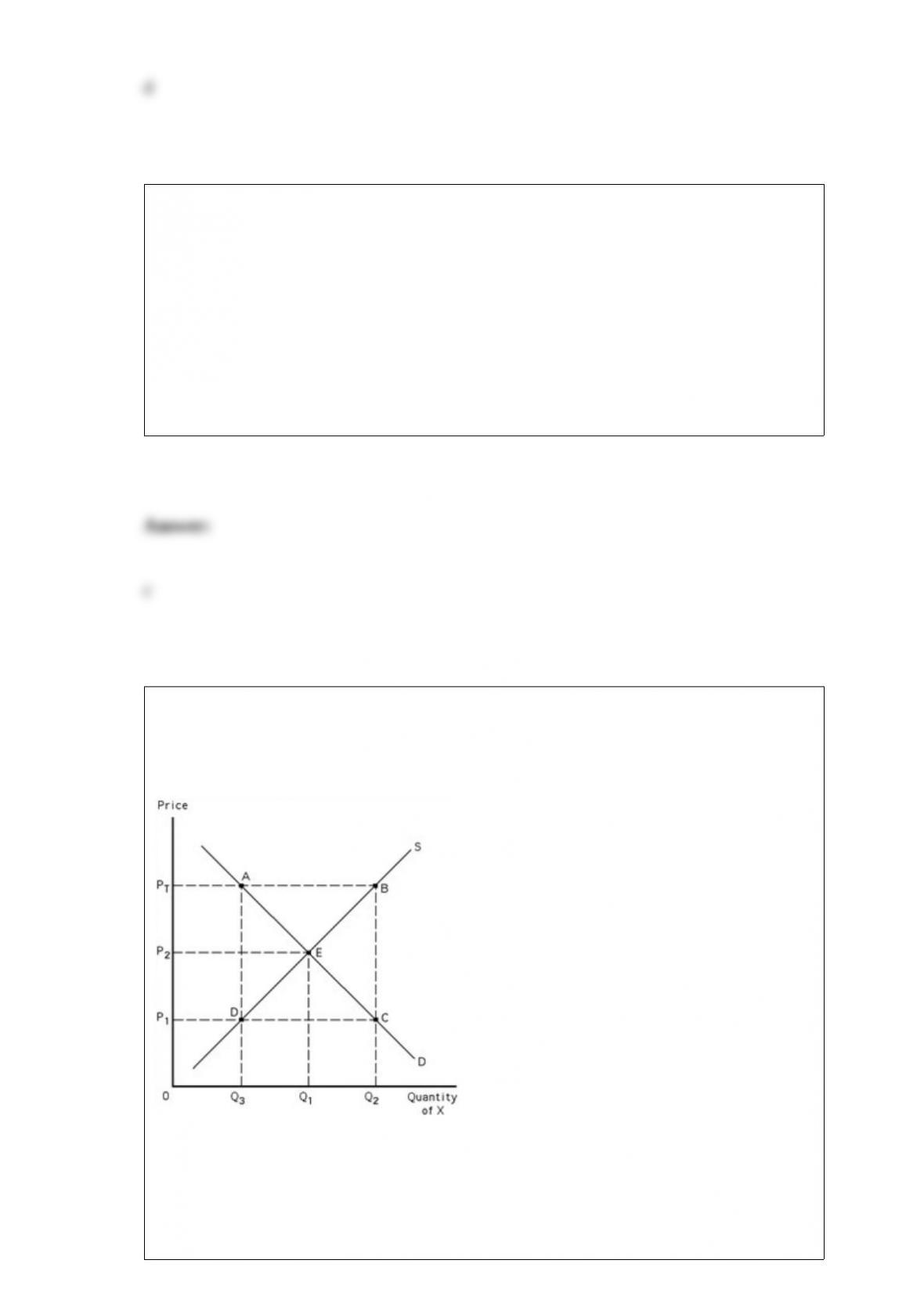
Refer to Exhibit 39-1. Given the target price of PT, farmers will receive a total income
equal to
Exhibit 39-1
a. 0PTBQ2.
b. 0P1CQ2.

c. 0PTAQ3.
d. 0P2EQ1.
The number of unskilled workers employed before and after a change in the minimum
wage is found to be the same. This means
a. the minimum wage change did not affect the unskilled labor market.
b. nothing, unless we also know that the number of hours worked by each worker has
not changed.
c. the minimum wage could be below the equilibrium wage for unskilled labor.
d. either b or c
e. none of the above
If two firms in the same industry (but at different stages of the production process)
merged, this would be a(n) __________ merger.
a. vertical
b. conglomerate
c. horizontal
d. antitrust

e. none of the above
The equilibrium price of a good in market A is $24. The current price of the good in
market A is $21. At this price, a(n) ________________________ of the good exists in
market A.
a. surplus
b. shortage
c. excess supply
d. excess demand
e. b and d
Refer to Exhibit 31-1. This graph represents a negative externality situation. Given this,
which of the two curves, X or Y, represents marginal social costs and why?
Exhibit 31-1
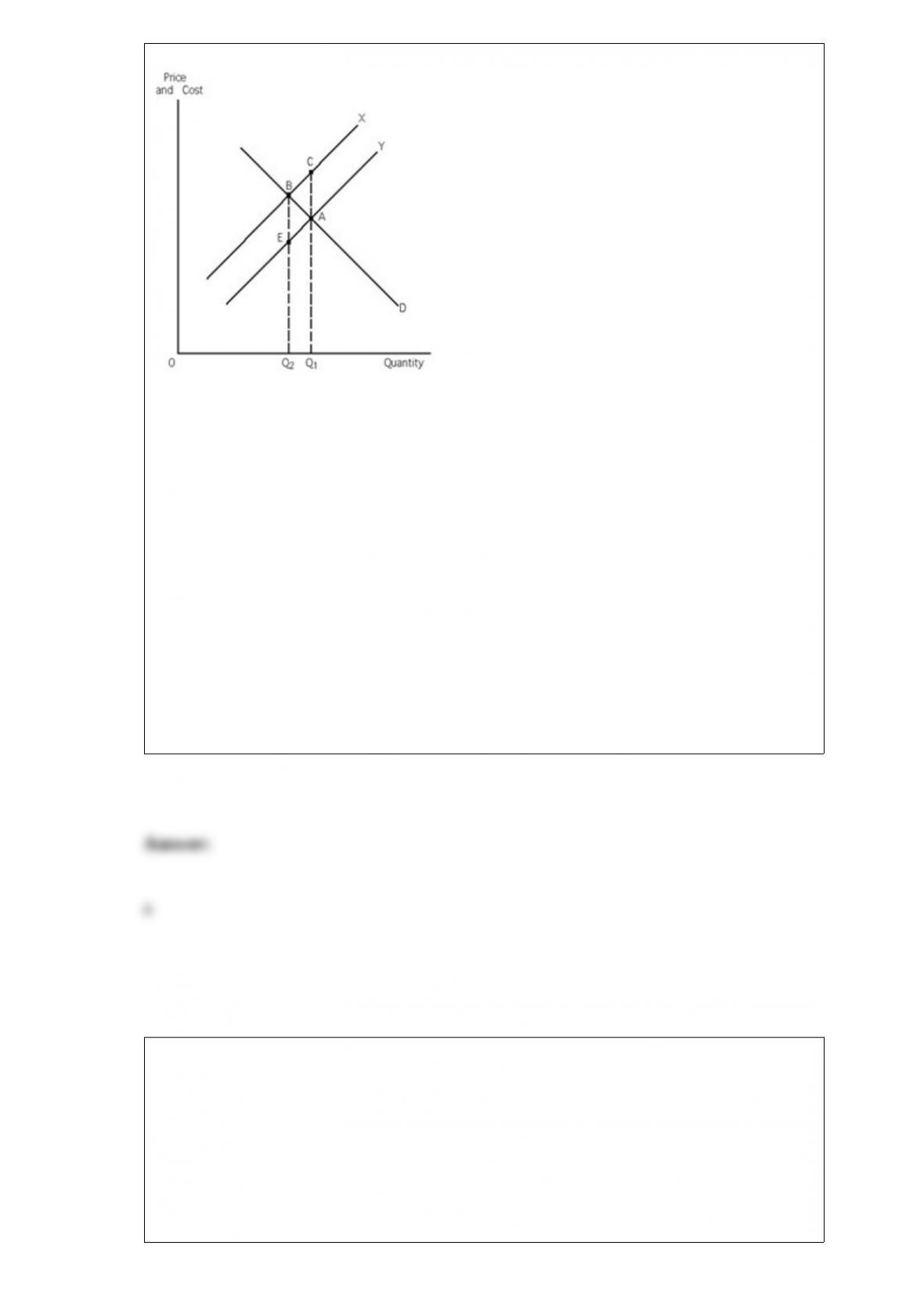
a. Curve X, because if there is a negative externality, external costs are associated with
it: social costs = external costs + private costs, therefore the marginal social cost curve
must lie above the marginal private cost curve.
b. Curve Y, because if there is a negative externality, negative external costs are
associated with it: social costs = negative external costs + private costs, therefore the
marginal social cost curve must lie below the marginal private cost curve.
c. Curve X, because if there is a negative externality, external benefits are associated
with it: social costs = external benefits + private costs, therefore the marginal social cost
curve must lie above the marginal private cost curve.
d. Curve Y, because if there is a negative externality, negative external benefits are
associated with it: social costs = negative external benefits + private costs, therefore the
marginal social cost curve must lie below the marginal private cost curve.
If inflation in the United States rises relative to the inflation rate in Mexico, the dollar
will __________ in terms of the peso and the peso will __________ in terms of the
dollar.
a. remain unaffected; appreciate
b. remain unaffected; depreciate

c. depreciate; remain unaffected
d. depreciate; appreciate
e. remain unaffected; remain unaffected
Government provides a nonexcludable public good that the public demands and can’t
seem to acquire through the market.This is government
a. acting as a transfer mechanism.
b. being non-productive.
c. engaging in rent-seeking activities.
d. being productive.
e. a and c
What is the difference between an inflation-indexed Treasury bond, and a Treasury
bond that is not indexed?
a. An inflation-indexed Treasury bond guarantees a certain real rate of return, while a
nonindexed Treasury bond does not.
b. A nonindexed Treasury bond guarantees a certain real rate of return, while a
nonindexed Treasury bond does not.
c. An inflation-indexed Treasury bond can only be purchased directly from the Federal
Reserve, while a nonindexed Treasury can be purchased through a broker.
d. An inflation-indexed Treasury bond always guarantees the purchaser a 5 percent rate
of return, while a nonindexed Treasury bond does not.
A stock is purchased either for the expected gain in the price of the stock, for the
dividends that the stock may pay, or both.
a. True
b. False