
The natural rate of unemployment consists of frictional unemployment plus cyclical
unemployment.
Answer:
All economic questions arise from the fact that resources are unlimited.
Answer:
A subgame-perfect equilibrium is a Nash equilibrium in which no player can make
himself better off by changing his decision at any decision node.
Answer:
Horizontal equity means that two people in identical economic situations should pay the
same amount of taxes.
Answer:

Minimum efficient scale is defined as the level of output at which the short-run average
total cost stops decreasing.
Answer:
The only type of business that faces limited liability is a corporation.
Answer:
Total utility
A) cannot decrease as a person consumes more and more of a good.
B) has a constant rate of increase as a person consumes more and more of a good.
C) is equal to the sum of the marginal utilities of all units consumed.
D) is negative when marginal utility is declining.
Answer:
How has organizing a successful firm in a market economy changed over the last
century?
A) It has become easier as more and more firms discover how to do it.
B) As government intervention has decreased, firms now have more freedom.
C) There has been no change one way or the other over the last century.
D) It has become more difficult to organize an efficient and successful firm.
Answer:
Suppose a restaurant is trying to determine how much to charge for a bowl of chili, and
decides to run an experiment to see how much its customers are willing to pay by
allowing them to set their own price for this menu item.
a. Is charging a customer the price he or she is willing to pay for the bowl of chili an
example of price discrimination? Briefly explain.
b. What is it called when a firm knows every consumer’s willingness to pay, and can
charge every consumer a different price? What happens to consumer surplus in this
situation?
Answer:

An increase in the demand for LED light bulbs due to changes in consumer tastes,
accompanied by an increase in the supply of LED light bulbs as a result of government
subsidies, will result in
A) an increase in the equilibrium quantity of LED light bulbs and no change in the
equilibrium price.
B) an increase in the equilibrium price of LED light bulbs and no change in the
equilibrium quantity.
C) an increase in the equilibrium price of LED light bulbs; the equilibrium quantity
may increase or decrease.
D) an increase in the equilibrium quantity of LED light bulbs; the equilibrium price
may increase or decrease.
Answer:
A perfectly competitive firm produces 3,000 units of a good at a total cost of $36,000.
The fixed cost of production is $20,000. The price of each good is $10. Should the firm
continue to produce in the short run?
A) No, it should shut down because it is making a loss.
B) Yes, it should continue to produce because its price exceeds its average fixed cost.
C) Yes, it should continue to produce because it is minimizing its loss.
D) There is insufficient information to answer the question.
Answer:
If the Fed’s policy is contractionary, it will

A) use open market operations to buy Treasury bills.
B) use open market operations to sell Treasury bills.
C) lower the discount rate.
D) lower the reserve requirement.
Answer:
When plasma television sets were first introduced prices were high and few firms were
in the market. Later, economic profits attracted new firms and the price of plasma
televisions fell. This example illustrates
A) a decreasing-cost industry.
B) that consumers receive this new technology “free of charge” in the sense that they
only have to pay a price for plasma televisions equal to the lowest production cost.
C) an industry with a low minimum efficient scale.
D) how fickle consumer demands are.
Answer:
Which of the following is not an example of a government-imposed entry barrier?
A) patents
B) occupational licensing
C) barriers to international trade
D) antitrust legislation

Answer:
The slope of a production possibilities frontier measures the ________ of producing
one more unit of a good.
A) marginal revenue
B) total revenue
C) marginal cost
D) opportunity cost
Answer:
If, as economist Alwyn Young has suggested, high growth rates in Singapore are not a
result of technological progress, how are growth rates in Singapore expected to change
over time?
A) Without technological progress, the high growth rates cannot be sustained.
B) As long as the labor force participation rate is rising, growth can still continue,
despite a lack of technological progress.
C) As long as the amount of capital per hour worked continues to expand, the growth
rate in Singapore will continue to rise at an increasing rate.
D) Agricultural workers will continue to expand their productivity, thereby allowing
Singapore to achieve growth rates above those of higher-income countries.
Answer:

In which of the following cartels is total cartel profit likely to be the highest?
A) a cartel made up of equal sized firms each producing different quantities of a
differentiated product
B) a cartel made up of firms of various sizes each producing different quantities of a
homogeneous product
C) a cartel made up of firms of various sizes each producing the same quantity of a
differentiated product
D) a cartel made up of identical firms each producing the same quantity of a
homogeneous product
Answer:
How does the increasing use of digital cameras affect the market for traditional camera
film?
A) The demand curve for traditional camera film shifts to the right.
B) The quantity of traditional camera film demanded decreases.
C) The quantity of traditional camera film demanded increases.
D) The demand curve for traditional camera film shifts to the left.
Answer:

There is a difference between who is legally required to send a tax payment to the
government and who bears the burden of the tax. Which of the following would have
the most impact on who bears the burden of an excise tax?
A) whether the tax is imposed by the federal government or a state government
B) whether the tax is based on the ability-to-pay principle or the benefits-received
principle
C) the motive for the tax: If the tax is designed to raise revenue, more of the burden will
fall on firms. If the tax is designed to achieve a social objective (for example, to
discourage smoking) more of the burden will fall on consumers.
D) the elasticity of demand for the item that is taxed
Answer:
Workers in industries protected by tariffs and quotas are likely to support these trade
restrictions because
A) they do not want to offend their employers who want them.
B) politicians lobby to convince workers the restrictions will make them better off.
C) they believe the restrictions will protect their jobs.
D) they don’t understand that the restrictions will threaten their jobs.
Answer:
George Gnat subscribes to a monthly pest control service for his home. Last week the
owner of the service informed George that he will have to raise his monthly service fee
because of increases in the price of gasoline used by his workers on their service trips.
How is the market for pest control services affected by this?

A) There is an increase in the supply of pest control services.
B) There is a decrease in the demand for pest control services.
C) There is a decrease in the quantity supplied of pest control services.
D) There is a decrease in the supply of pest control services.
Answer:
The production possibilities frontier shows
A) the various products that can be produced now and in the future.
B) the maximum attainable combinations of two products that may be produced in a
particular time period with available resources.
C) what an equitable distribution of products among citizens would be.
D) what people want firms to produce in a particular time period.
Answer:
The Farm Factory, a booth at the local Farmer’s Market, sells fresh eggs for $1.50 per
dozen and fresh milk for $2.50 per gallon. What is the opportunity cost of buying a
gallon of milk?
A) 1 2/3 dozen eggs
B) 3/5 of a dozen eggs
C) $2.50
D) $1.50
Answer:
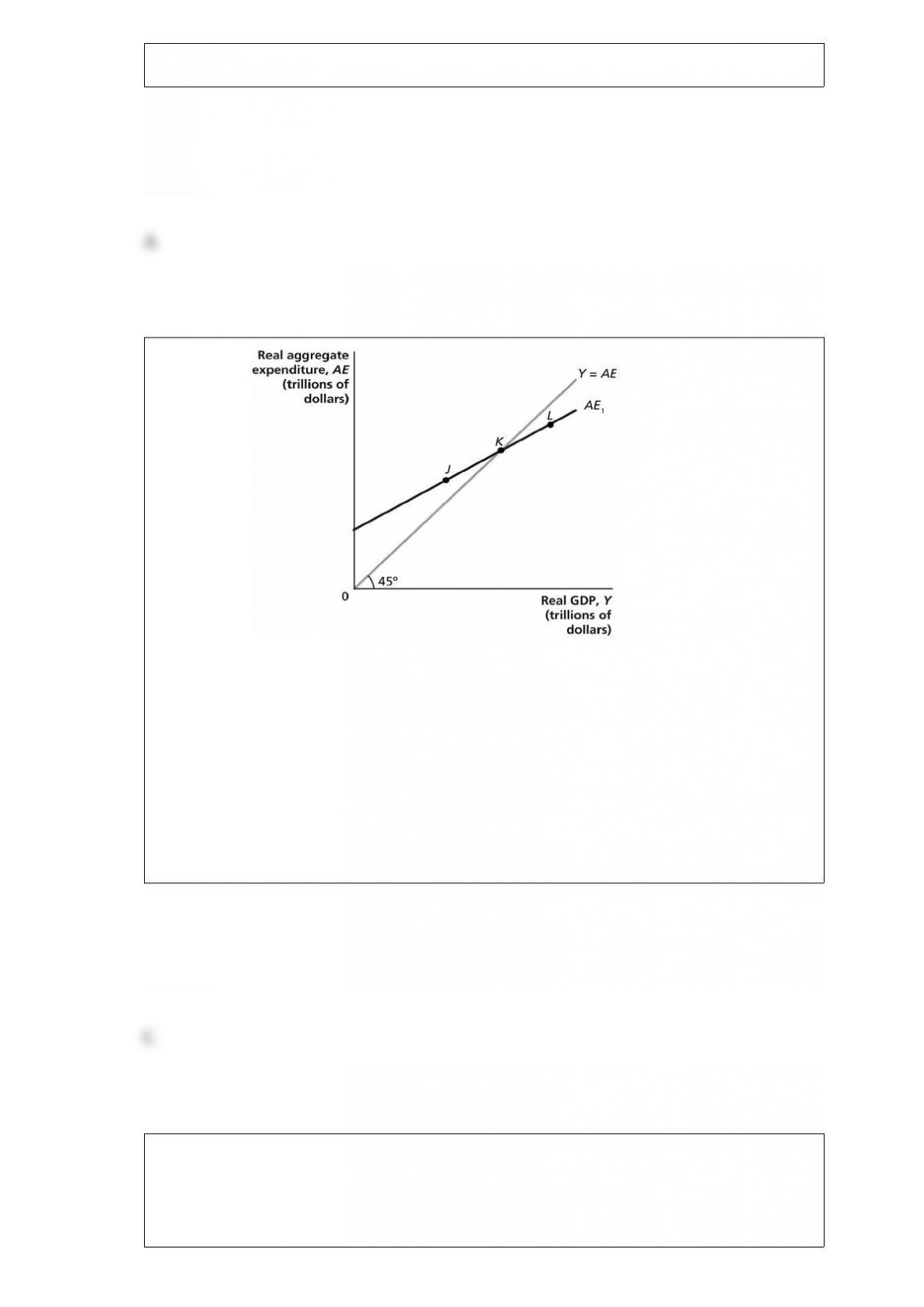
Figure 23-1
At point J in the figure above, which of the following is true?
A) Aggregate expenditure is less than GDP.
B) The economy has achieved macroeconomic equilibrium.
C) Actual inventories are less than planned inventories.
D) GDP will be decreasing.
Answer:
For the federal deficit to be lowered,
A) the federal government must decrease its spending and increase net exports.

B) the federal government’s expenditures must be lower than its tax revenue.
C) the Federal Reserve must raise interest rates and lower the required reserve ratio.
D) the Federal Reserve must reduce the money supply.
Answer:
Use the money demand and money supply model to show the money market in
equilibrium with an interest rate of 5 percent and the quantity of money of $800 billion.
Suppose the Federal Reserve increases the money supply to $850 billion. At the
previous equilibrium interest rate of 5 percent, will households and firms now be
holding more money or less money than they want to hold, and will they be buying or
selling short-term financial assets? At the new equilibrium interest rate, households and
firms will desire to hold the entire $850 billion of the money supply. What causes
households and firms to want to hold the additional $50 billion of the money supply?
Answer:

Explain why market power leads to a deadweight loss. Is the total deadweight loss from
market power in the United States large or small?
Answer:
What is meant by “tax incidence”?
Answer:
If the unemployment rate in the economy is steady at 4 percent per year, how does the
short-run Phillips curve predict that the inflation rate will be changing, if at all? What
will happen if the unemployment rate now rises to 7 percent per year? Assume there are
no changes to inflation expectations. Provide an appropriate graph to support your
discussion.
Answer:
Your friend owns a snow cone stand that he works by himself. He produces about 25
snow cones per hour. He wants to be able to produce twice as many snow cones per
hour so he buys a second machine. He notices that he can only produce 10 more snow
cones an hour. He jokes that he could have doubled his output with the second machine
if he only had four hands. Using your knowledge of the production process, explain to
your friend what you think has happened when he added more capital to his production
process.
Answer:

Most economists are concerned about entry barriers. Why is this so important to them?
Answer: