
The U.S. government’s fiscal year runs from
a. January 1 to December 31.
b. April 15 to April 14.
c. June 1 to May 31.
d. October 1 to September 30.
e. December 1 to November 30.
A market consisting of many firms producing a homogeneous product, having complete
knowledge of relevant information, having no power over the product’s market price,
and having low barriers to entry is characteristic of
a. perfect competition.
b. monopoly.
c. monopolistic competition.
d. oligopoly.
e. a Robinson Crusoe economy.
Tonight, after grading this economics exam, your instructor plans to spend $6 at a local
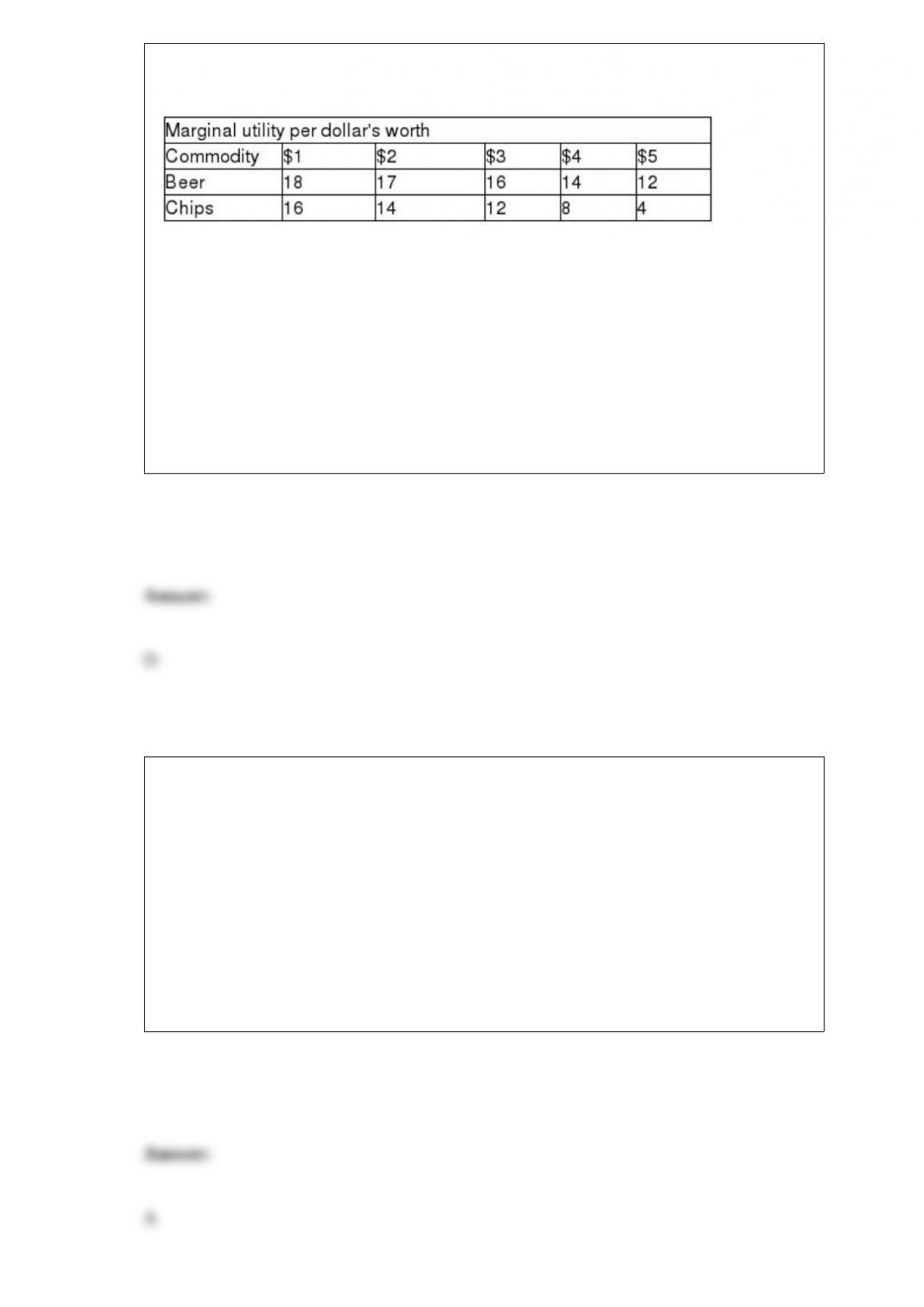
pub. From the information in the table, how many dollars will your instructor spend on
beer and how many on chips?
a. $1 on beer, $5 on chips
b. $2 on beer, $4 on chips
c. $3 on beer, $3 on chips
d. $4 on beer, $2 on chips
e. $5 on beer, $1 on chips
Virtually all economists agree that the key to the Fed’s power lies in its ability to
a. control the reserves of the banking system.
b. change the discount rate whenever it wants to.
c. issue Federal Reserve notes.
d. persuade Congress to change fiscal policy.
e. raise or lower taxes.

In general, the discount rate is kept close to short-term market interest rates to
a. enable commercial banks to operate profitably.
b. reduce the government cost to borrow money.
c. discourage commercial banks from excessive use of the borrowing privilege.
d. avoid the possibility that monetary actions affect financial market expectations.
e. keep interest rates stable over long periods of time.
Shortages typically arise when there are
a. price floors.
b. equilibrium prices.
c. price ceilings.
d. fair prices.
e. scientific prices.
If a firm borrows money at the rate of 11 percent per year and the rate of inflation is 4

percent, the real rate of interest on the loan is ________ percent.
a. 4
b. 7
c. 11
d. 15
e. 18
Fixed-weight price indexes are less reliable when there have been changes in
a. relative prices.
b. current dollar output.
c. the amount of nonproductive transactions.
d. the date of the base year.
e. population.
Although a cartel may readily agree on a uniform price, problems nevertheless arise
because

a. marginal cost is the same as marginal revenue.
b. consumer demand will increase as a result.
c. decisions must be made as to how to allocate production among cartel members.
d. the product is either homogeneous or differentiated.
e. all cartels are illegal.
Available studies show that if the largest firms in a market of a given size were replaced
by a larger number of smaller firms
a. the rate of technological change would decline substantially.
b. total research and development expenditures would decrease.
c. the commercial introduction of innovation that requires a large amount of capital
might slow down.
d. there would be a noticeable decline in the riskiness of research and development
activities.
e. federal funding for research and development would automatically increase.
Assets a government says are money and are accepted by the public as money are called
________ money.
a. near
b. funny
c. sophisticated
d. nominal
e. fiat
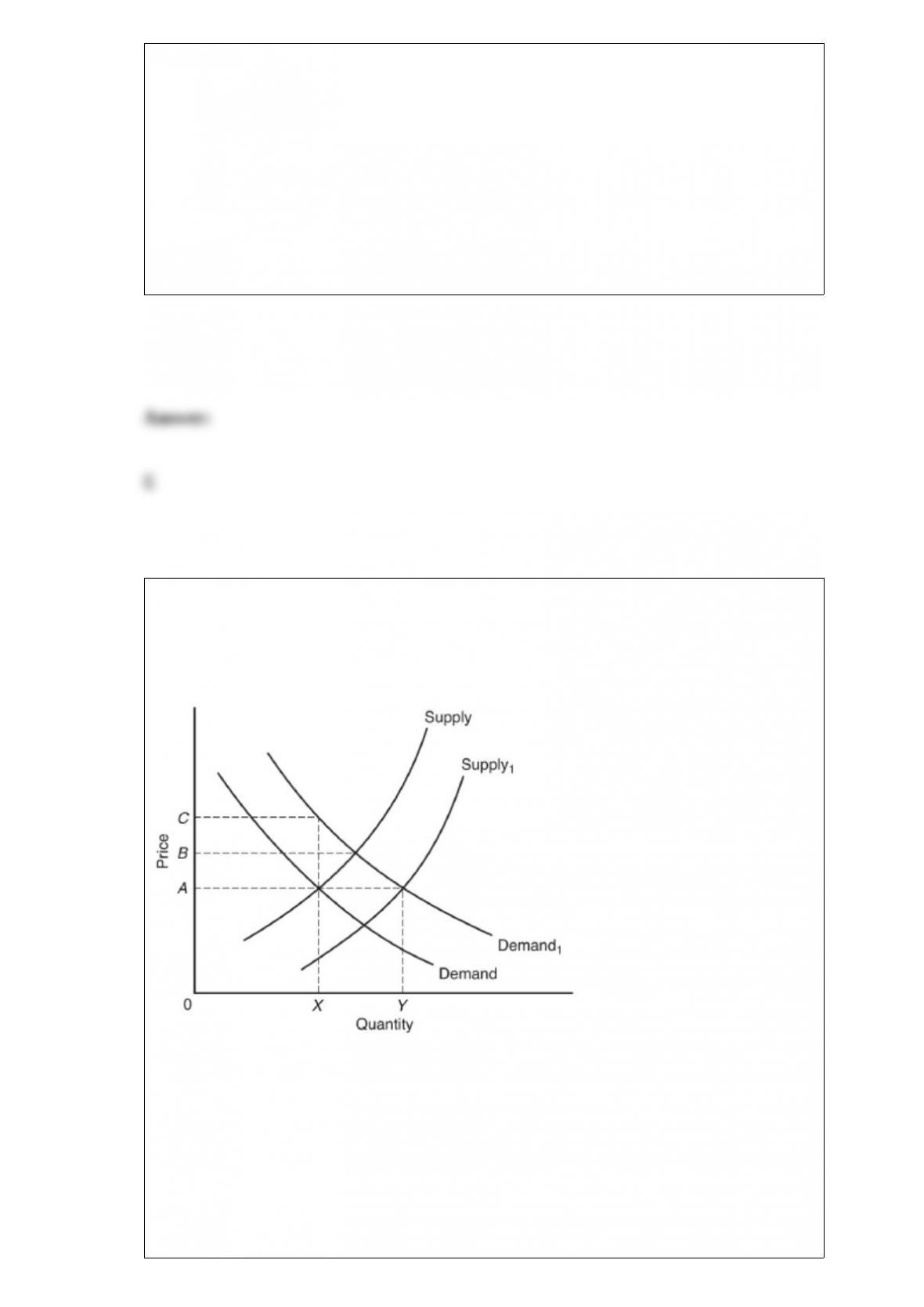
The following questions are based on the following graph, showing short-run supply
and demand curves for a perfectly competitive market. The initial supply curve is
labeled “Supply” and the initial demand curve is labeled “Demand.” Price 0A and
output rate 0X represent the initial equilibrium price and output.
Compared to its initial
position, a typical firm in new short-run equilibrium
a. finds its average fixed cost higher.
b. increases its plant size.
c. finds its marginal cost higher.
d. makes less profit.

e. reduces average variable cost.
If monetary authorities tighten credit or money, ________ will rise.
a. the price level
b. interest rates
c. the money supply
d. aggregate demand
e. excess reserves
If a 1 percent increase in price causes a firm’s sales to decline by one-half of 1 percent,
the price elasticity of demand is
a. 0.005.
b. 0.05.
c. 0.5.
d. 2.0.
e. 5.

The United States could expand output of both civilian and military goods during the
period from 1939 through the early part of World War II because
a. output per worker fell as more men were drafted by the military.
b. it captured large amounts of new resources from enemy territory.
c. military goods are produced using different resources than consumer goods.
d. during the 1930s it was operating well inside its production possibilities curve.
e. its production possibilities curve was bowed out during World War II.
If disposable income rises by $100 billion and personal consumption expenditure rises
by $60 billion, what is the average propensity to consume?
a. 0.60
b. 0.40
c. “0.40
d. “1.00
e. impossible to calculate from these figures

Which sequence correctly ranks (from highest to lowest) the average weekly earnings
of workers in the industries listed?
a. services, construction, manufacturing
b. construction, services, manufacturing
c. manufacturing, services, construction
d. construction, manufacturing, services
e. services, manufacturing, construction
Country A can produce either 1,000 tons of food or 800 tractors in a given month.
Country B can produce either 1,500 tons of food or 1,000 tractors in the same time
period. In this situation, it is clear that trade would occur if the terms of trade were
a. 1 unit of food equals 1 tractor.
b. 1 unit of food equals 0.7 tractor.
c. 0.67 unit of food equals 0.8 tractor.
d. 0.5 unit of food equals 0.5 tractor.
e. 0.1 unit of food equals 10 tractors.

The following questions are based on the following information: The marginal product
of an additional unit of labor is 100 units per day and the market price of this output is
$0.75 per unit.
What is the value of labor’s marginal product?
a. 75 units
b. 100 units
c. $0.75
d. $75
e. $133
The Federal Reserve System was established by Congress in
a. 1887.
b. 1907.
c. 1913.
d. 1929.
e. 1934.

Measurement is necessary in economics to
a. construct diagrams depicting economic models.
b. evaluate the predictions of economic models.
c. help distinguish positive from normative statements.
d. identify the tasks an economy must perform.
e. construct mathematical models of the economy.
The concept that those people who receive more from a certain government service
should pay more in taxes to support it is known as the ________ principle.
a. benefit
b. ethical
c. ability-to-pay
d. confiscatory tax
e. tax reform

Holding money because of uncertainty concerning the future is called the ________
demand for money.
a. precautionary
b. speculative
c. transactions
d. aggregate
e. penultimate
Over the 2001″03 period, the Fed steadily reduced the discount rate to 2 percent. These
moves suggest that monetary policy was
a. selective.
b. redundant.
c. tight.
d. autonomous.
e. easy.

The labor force consists of
a. those who are employed or actively seeking employment.
b. the entire population over 16 years of age.
c. only those who have full-time military or civilian jobs.
d. both those who have given up looking for work and those actively seeking work.
e. the difference between the total population and those who are unemployed.
Suppose your employer agrees to increase your wage for next year at the same rate as
the increase in the consumer price index for this year over last year. If the consumer
price index for last year was 179.9 and the consumer price index for this year is 184.0
(1982″84 = 100), then your wage will go up by ________ percent.
a. 2.3
b. 4.1
c. 9.7
d. 84
e. 100
In general, commercial banks receive their higher interest rates from

a. service charges on demand deposits.
b. loans that have a greater degree of risk.
c. the federal funds market.
d. foreclosures.
e. capital gains in the stock market.
When significant changes in the output of a single firm have no perceptible effect on
the industry price or output, the demand curve facing the firm is
a. of unitary elasticity.
b. horizontal.
c. perfectly price inelastic.
d. downward sloping.
e. subelastic.
The United States’ national debt
a. is approximately $100 billion.

b. is the amount the government owes foreign nations.
c. has been declining in absolute terms since World War II.
d. is composed of bonds, notes, and other government I.O.U.s of various kinds.
e. has been steadily increasing in relation to national output since World War II.
An equilibrium market basket is one that
a. gives the consumer the greatest amount of utility from a given income.
b. does not change even if consumer income changes.
c. does not change even if prices of the commodities purchased change.
d. ensures the consumer a level of satisfaction equal to all other possible consumption
alternatives.
e. equalizes the marginal and total utilities for each commodity.
The effects of inflation are less severe when the inflation is ________ inflation.
a. runaway
b. supply-side

c. anticipated
d. sedentary
e. accelerating