If the price of hotdogs are expected to decrease in the future, then:
A) the current demand for hotdogs will increase.
B) the current demand for hotdogs will decrease.
C) the current quantity demanded for hotdogs will decrease.
D) the current quantity demanded for hotdogs will increase.
Table 14.5
Table 14.5 contains data on the marginal benefit of searching for a lower price for a
digital camera.
The price of the camera ranges from $100 at the lowest price store to $140 at the
highest price store.
For any randomly selected store, any price from the low price to the high price is
equally likely.
The marginal cost of visiting each store is constant at $1.50 per visit.
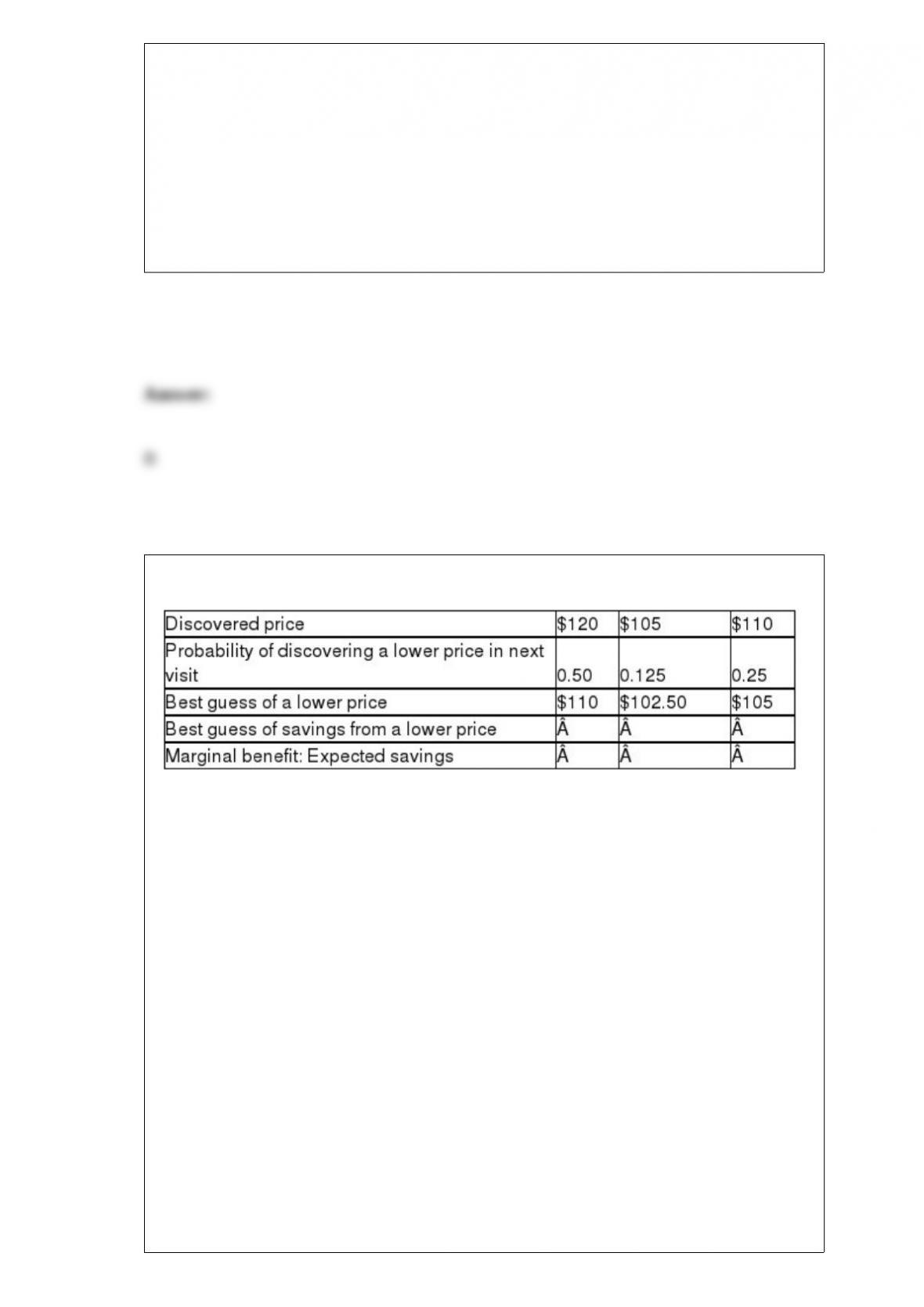
Refer to Table 14.5. At the discovered price of $120, the best guess of savings from a
lower price is:
A) $2.50.
B) $5.

C) $10.
D) $20.
Which of the following statements about a market for used cars is INCORRECT?
A) The presence of low-quality cars decreases consumers’ willingness to pay.
B) An increase in price increases the quantity of high-quality cars supplied.
C) An increase in price decreases the quantity of low-quality cars supplied.
D) The decrease in the quantity of high-quality cars lowers consumers’ willingness to
pay.
In a competitive labor market:
A) the firm can hire all the labor it wants at the going market wage rate.
B) the market wage rate is the marginal revenue product of labor.
C) firms will hire as long as the marginal revenue product of labor is less than or equal
to the market wage.
D) all of the above
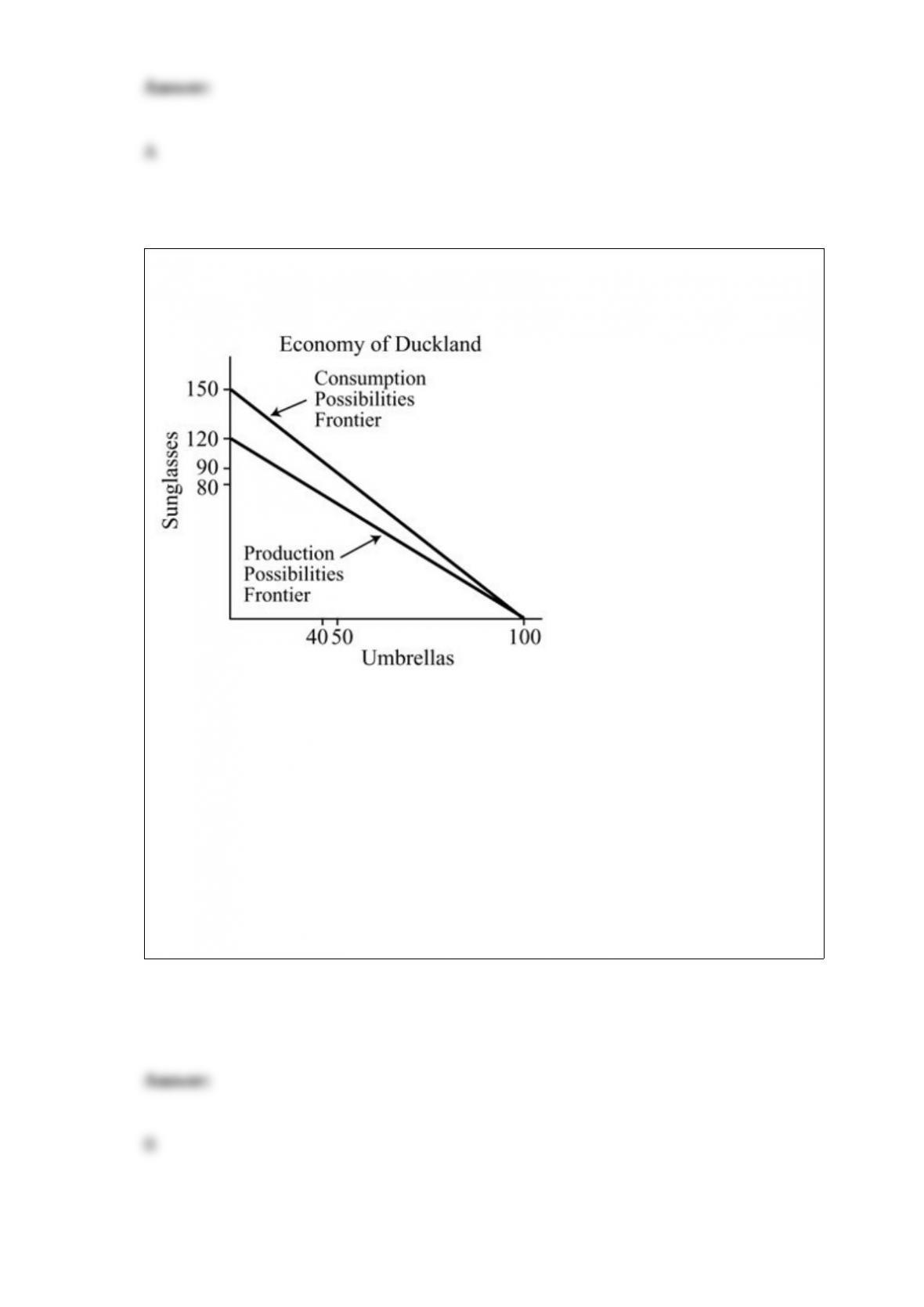
Figure 18.1
Refer to Figure 18.1. In autarky, the maximum amount of umbrellas that Duckland can
produce is:
A) 50.
B) 100.
C) 150.
D) 40.

Refer to Table 17.2. The marginal product of the third unit of labor is:
Table 17.2
A) 25.
B) 50.
C) 60.
D) 160.
In the market for insurance, sellers have:
A) perfect information.
B) less information than buyers.
C) more information than buyers.
D) none of the above.

Refer to Figure 10.3. The profit-maximizing price for this firm is:
A) $5.
B) $7.
C) $9.
D) $11.
If a firm is taxed for each unit of waste it produces, the firm will decrease the amount of
waste produced until:
A) there is no waste produced.
B) the marginal cost from decreasing waste is zero.
C) the marginal cost of decreasing waste is equal to the marginal benefit from
decreasing waste.
D) the marginal benefit from decreasing waste is equal to zero.
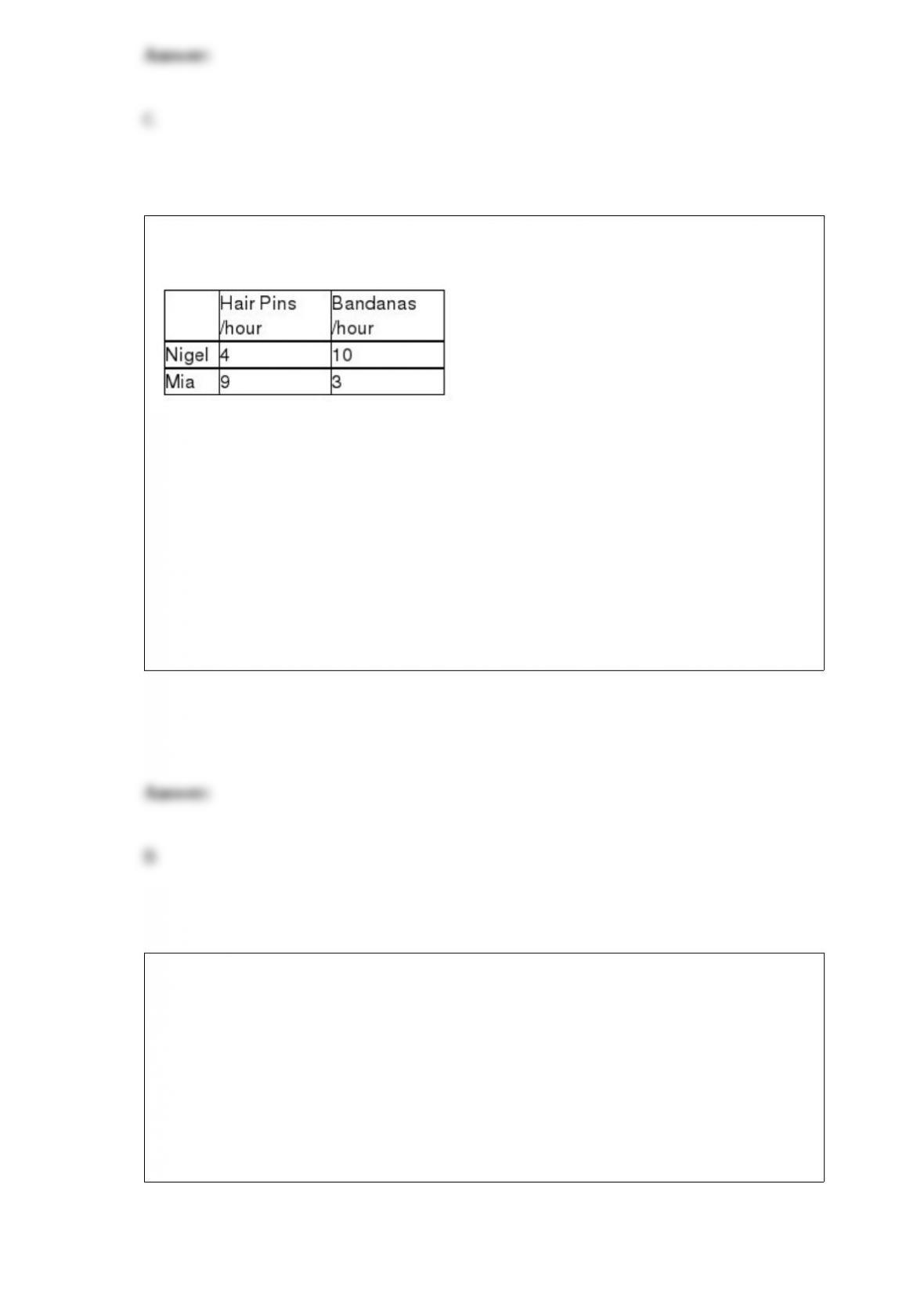
Consider two individuals, Nigel and Mia, who produce hair pins and bandanas. Nigel’s
and Mia’s hourly productivity are shown in Table 3.3.
Table 3.3
Which of the following is true?
A) Nigel has a comparative advantage in producing hair pins but not bandanas.
B) Nigel has a comparative advantage in producing bandanas but not hair pins.
C) Nigel has a comparative advantage in producing both goods.
D) Nigel does not have a comparative advantage in producing either good.
Undesirable job features lead to a ________ labor ________.
A) lower; demand
B) higher; demand
C) lower; supply
D) higher; supply
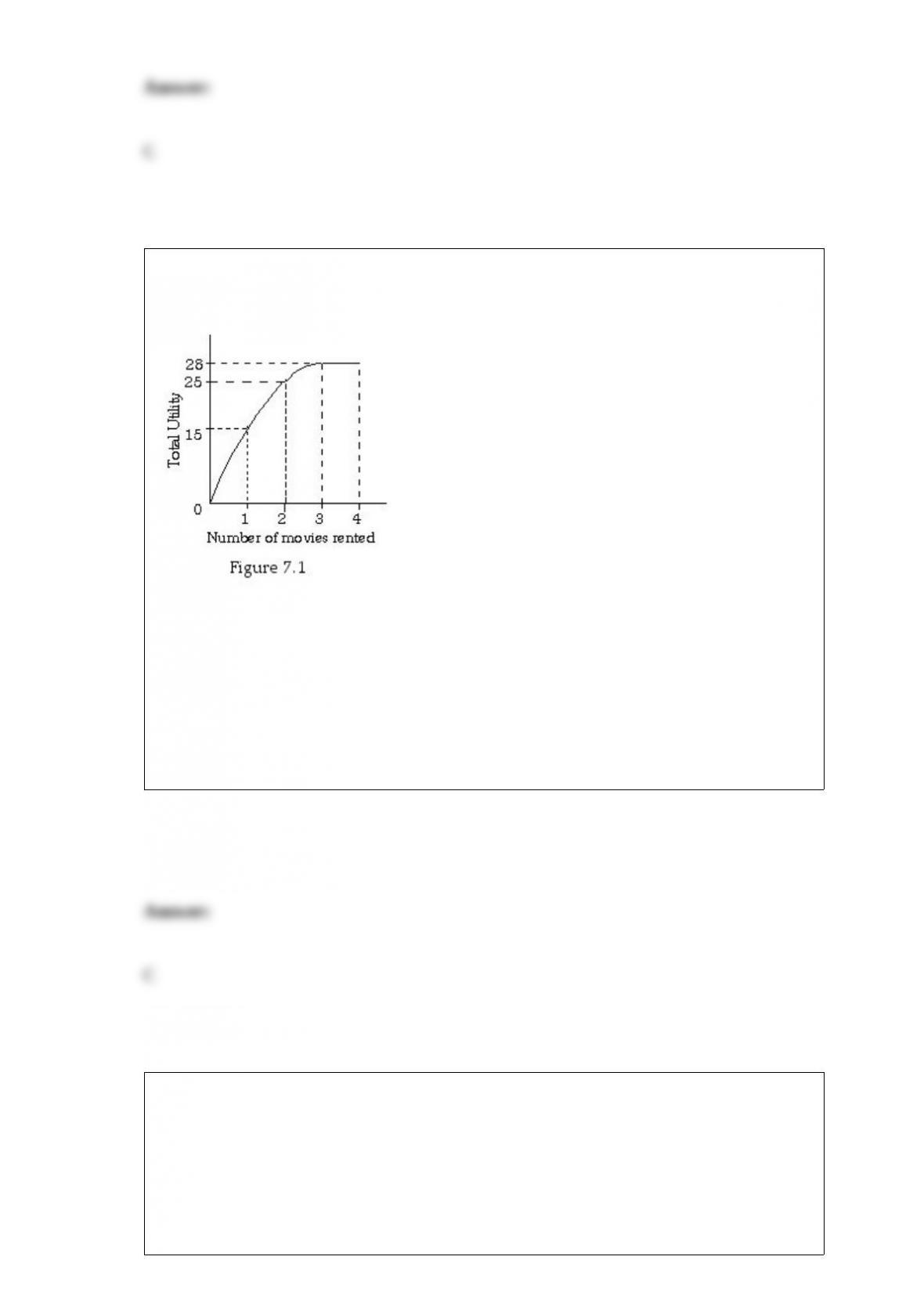
Refer to Figure 7.1. Increasing the number of movies rented from 3 to 4 will cause total
utility to:
A) increase.
B) decrease.
C) stay the same.
D) none of these.
Assume soybeans are produced in a perfectly competitive industry. A soybean farmer is
currently maximizing his profits. If the market price of soybeans falls, after the farmer
adjusts to the new price, he will be producing ________ bushels of soybeans and his
profit will be ________.
A) fewer; the same
B) fewer; lower
C) more units of output; the same
D) the same number of; the same
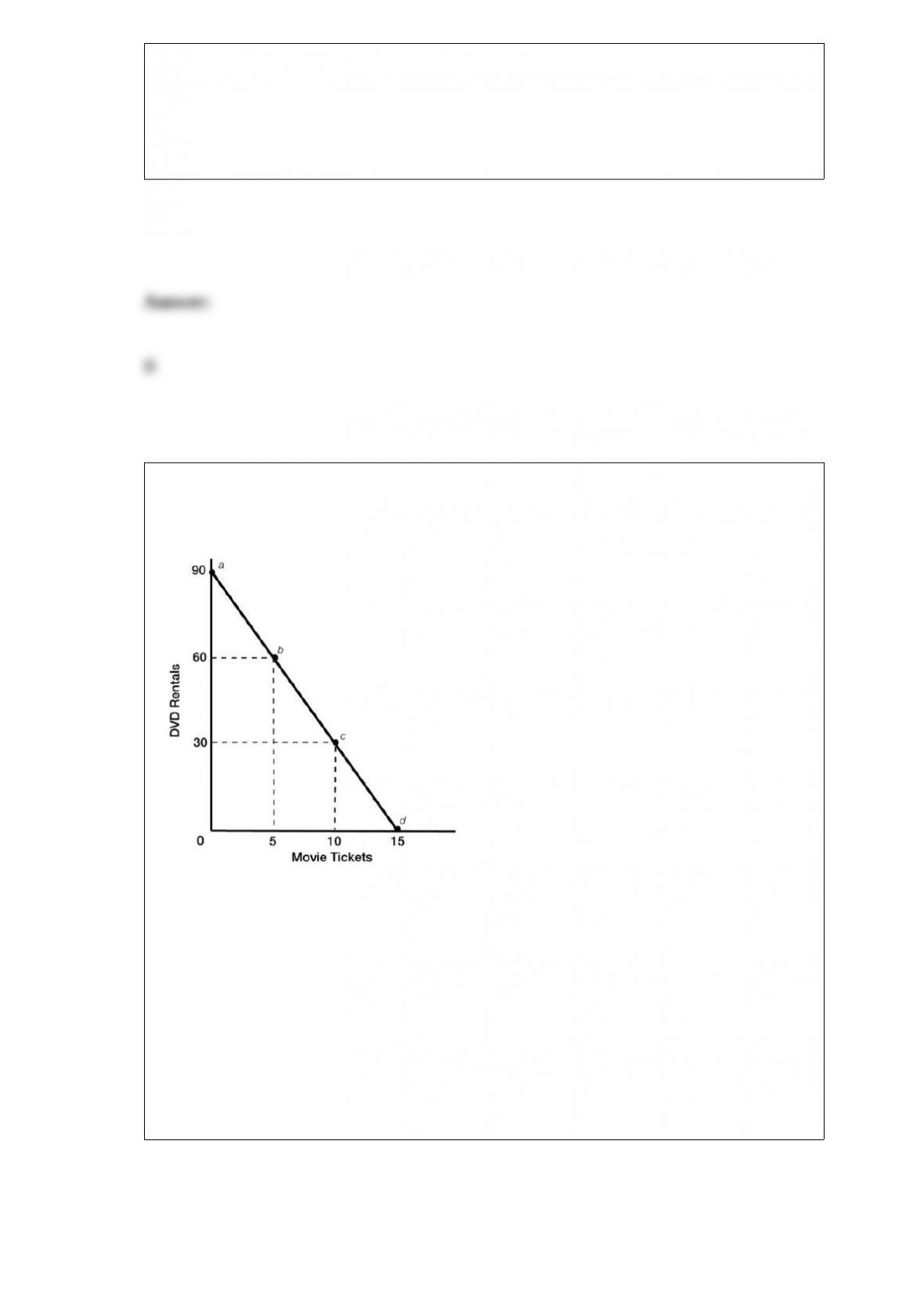
Figure 1A.2
The slope between points a and c is:
A) -5.
B) -6.
C) 10.
D) 30.

Recall the application of a casino monopoly in Creswell, Oregon, the developers
interested in building the casino offered $2 million per year to the citizens. This is
another example of:
A) a deadweight loss.
B) rent seeking.
C) high-cost industry.
D) trade-offs.
A monopolistically competitive market is characterized by:
A) many firms that sell slightly different products.
B) many barriers to entry and few firms.
C) many firms that sell the same products.
D) few firms that sell the same products.

In the Application, what should we observe before we can undoubtedly attribute the
lower drug prices to a decrease in demand?
A) an increase in the equilibrium quantity
B) a shortage
C) a decrease in the equilibrium quantity
D) a surplus
According to the Application the role of government in promoting civil liberties,
there is a ________ relationship between the strength of civil liberties and the economic
rate of return on government investment projects, which tends to lead to ________
government projects.
A) positive; less efficient
B) negative; less efficient
C) positive; more efficient
D) negative; more efficient
The principle of diminishing returns implies that as one input increases while the other
inputs are held fixed, output:

A) increases at an increasing rate.
B) increases at a decreasing rate.
C) decreases at a decreasing rate.
D) decreases at an increasing rate.
The trade-offs made by the U.S. government to fund the war in Iraq:
A) prove that the government is spending too much on the war.
B) show that the government is justified in its war spending.
C) exceed the benefits derived from the war.
D) represent what was potentially sacrificed to engage in the war.
The ________ in the present cost of smoking ________ the likelihood that a smoker
will quit.
A) increase; increases
B) increase; decreases
C) increase; does not change

D) decrease; increases
The principle of opportunity cost:
A) is more relevant for firms than for individuals.
B) only refers to monetary payments.
C) is only relevant in economics.
D) is applicable to all decision-making.
If the price a firm charges in a perfectly competitive industry is greater than average
total cost:
A) the firm is earning an economic profit equal to zero.
B) the firm is earning an economic profit greater than zero.
C) the firm is earning an economic profit less than zero.
D) it is not possible to determine anything about profits.
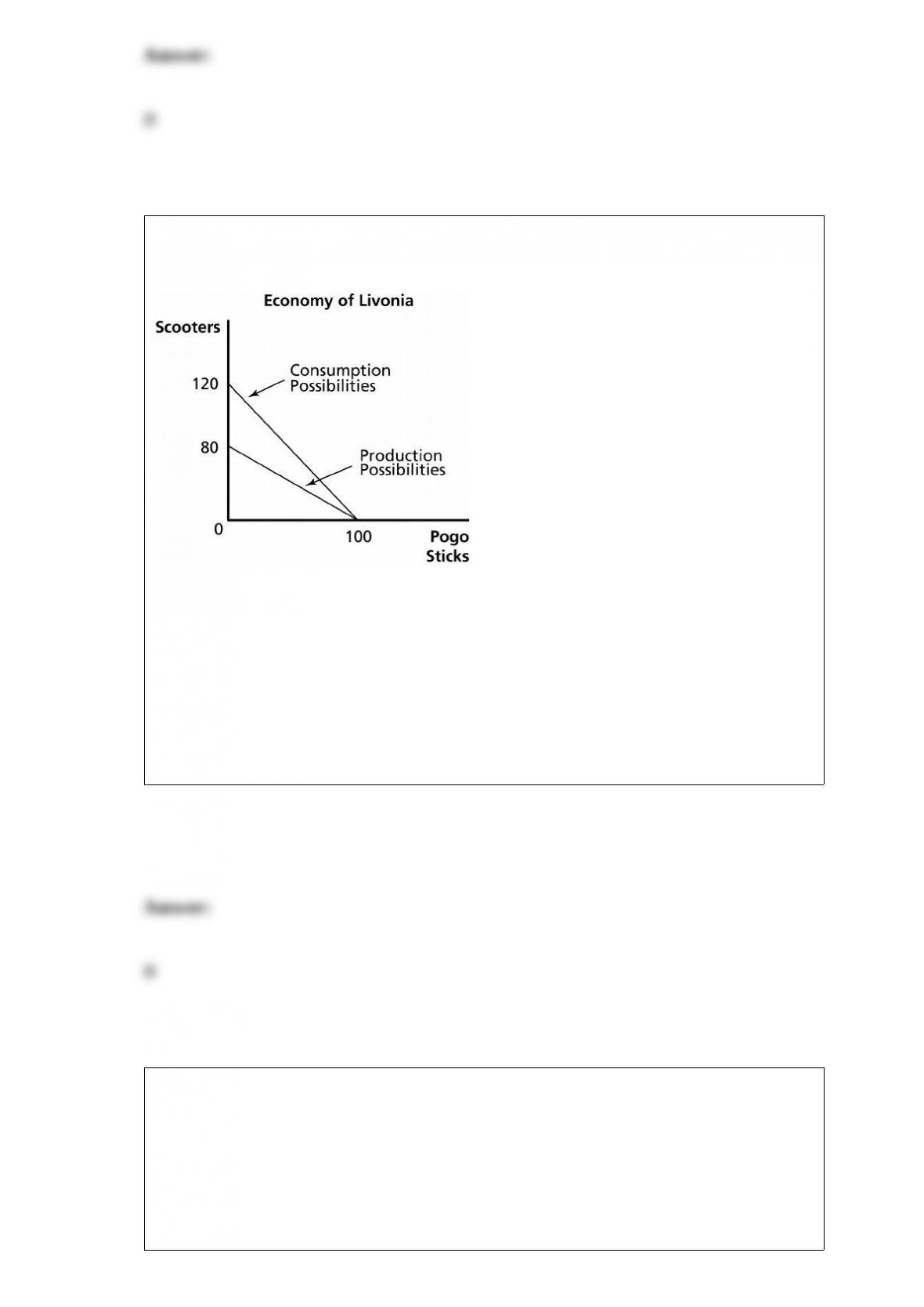
Refer to Figure 18.3. In autarky, the maximum amount of pogo sticks that Livonia can
produce is:
Figure 18.3
A) 120.
B) 100.
C) 80.
D) 40.
Prisoners in World War II POW camps traded products for other products, a process
referred to as:
A) barter.
B) rationing.

C) central planning.
D) advantage exchange.
Suppose that in October the price of a cup of cafe latte was $1.50 and 400 lattes were
consumed. In November the price of a latte was $2.00 and 600 lattes were consumed.
What might have caused this change?
A) The price of tea (a substitute for cafe lattes) fell.
B) The price of tea (a substitute for cafe lattes) rose.
C) The price of coffee beans (an input of production of cafe lattes) rose.
D) The price of coffee beans (an input of production of cafe lattes) fell.
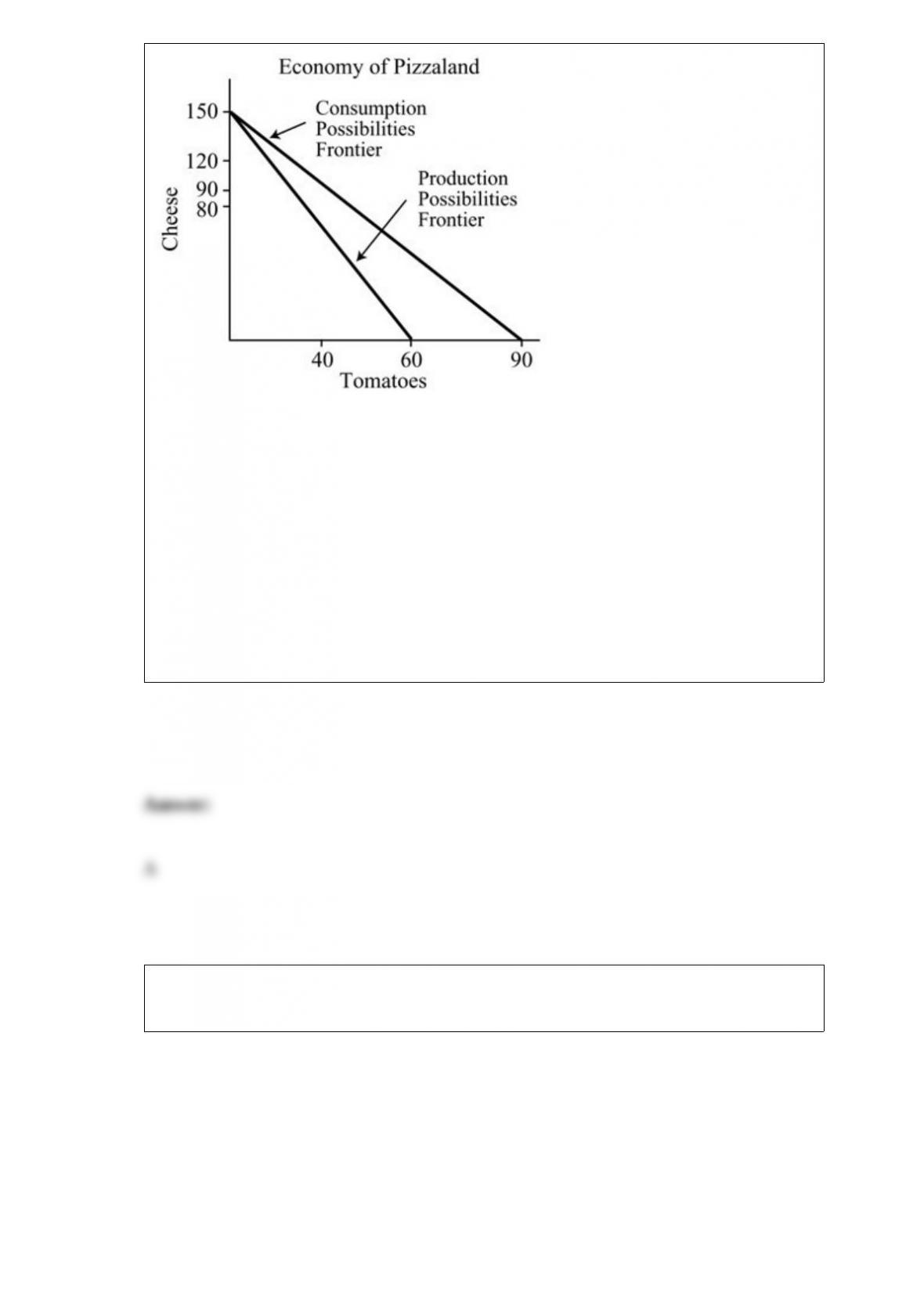
Figure 18.2
Refer to Figure 18.2. After trade and specialization begin, the maximum amount of
cheese that Pizzaland can consume is:
A) 150.
B) 90.
C) 120.
D) 60.
Refer to Figure 18.2. In autarky, the maximum amount of fishing poles that Macadamia
can produce is:

Figure 18.2
A) 40.
B) 100.
C) 120.
D) 160.
Additional Application
PAYING LANDOWNERS TO HOST WOLVES
We can apply the concepts of public goods and free riding to the issue of preserving
wildlife. There are some tradeoffs associated with preserving wolves and other wildlife
in Yellowstone Park. To environmentalists, wolves are a part of the natural ecosystem.
To ranchers, wolves are predators that eat livestock. In other words, there are costs as
well as benefits associated with the preservation of wolves, just as there are costs and
benefits associated with other public goods such as dams, fireworks, national defense,
and space exploration.
One response to the wolf-preservation problem comes from Defenders of Wildlife, an
environmental group in Montana. The organization collects money from its members
and uses the money to reward landowners who allow wolves to live on their properties.
The host landowner receives a payment of $5,000 for each litter of wolf pups reared on
the property. In addition, the organization compensates ranchers for livestock killed by
wolves.

As a result of these programs, ranchers in the Yellowstone area are more likely to
support efforts to maintain the wolves as part of Yellowstone Park’s ecosystem. The
programs treat preservation as a public good, one that is supported by money
contributed by people who benefit from preservation. The organization has collected
contributions from thousands of people despite the free-rider problem. The success of
Defenders of Wildlife illustrates one of the key principles of economics.
SOURCE: Terry L. Anderson, “A Carrot to Save the Wolf,” The Margin, Spring 1992,
p. 28.
Recall the application on “Paying Landowners to Host Wolves.” Wolves in the west:
A) by their existence provide some people with a benefit.
B) impose private costs on owners of livestock.
C) can be preserved with voluntary exchange.
D) all of the above
A carbon tax placed on coal will:
A) shift the supply curve for coal to the right.
B) shift the supply curve for coal to the left.
C) not affect the supply curve for coal.
D) decrease the demand for coal.

Refer to Table 18.1. After trade begins, ________ will specialize in the production of
hats and ________ will specialize in the production of gloves.
Daily Output of Russia and Panama
Table 18.1
A) Russia; Panama
B) Panama; Russia
C) Panama; Panama
D) Russia; Russia
What assumption was used by the authors of the book when analyzing the traffic
congestion problem in London?
A) They assumed that all cars are of the same make and model.
B) They assumed that traffic congestion is the same during daytime and during
nighttime.
C) They assumed that every car has the same effect on the travel time of other cars.
D) They assumed that travel via public transportation is less costly that travel by car.