
If there are two large firms, each with one-quarter of the market, and 10 firms, each
with one-twentieth of the market, in an industry, the market four-firm concentration
ratio will be:
a. 40
b. 50
c. 60
d. 10
e. 12
The long-run supply curve for a product is horizontal with ATC = 200. Market demand
is defined as P = 1,000 ” 4Q. The market is competitive and is in long-run equilibrium
with 50 firms in the industry. If demand increases to P = 1,240 ” 4Q, how many firms
will be in the industry at the new long-run equilibrium?
a. 45
b. 55
c. 65
d. 75
e. 85

Which pair of strategies would competing firms A and B choose given this payoff
matrix?
a. W, Y.
b. W, Z.
c. X, Y.
d. X, Z.
e. Either X, Y or W, Z.
The long-run average cost curve slopes downward if there are:
a. some factors without diminishing marginal returns.
b. economies of scope in the management of multiplant operations.
c. economies of scale.
d. diseconomies of scope in the management of multiplant operations.
e. no factors without diminishing marginal returns.

The XYZ Steel Company produces its own coal for use in its production facility. The
demand for steel is given by Ps = 500 ” 2Qs and the total cost of producing steel is
given by TCs = 175Qs, where Qs is tons of steel per week. The price of coal in a
perfectly competitive market outside the firm is $250 per ton, and the total cost of
producing coal is given by TCc = 40 + 5Qc
2, where Qc is tons of coal per week. How
much should XYZ steel charge itself for coal?
a. $250 per ton.
b. $350 per ton.
c. $500 per ton.
d. $750 per ton.
e. $1,000 per ton.
If Y = (X ” 3)2/ (9 + 12X ” X4), then dY/dX is:
a. [2(9 + 12X ” X4)(X ” 3) + (12 ” 4X3)(X ” 3)2] / (9 + 12X ” X4)2.
b. [2(9 + 12X ” X4)(X ” 3) ” (12 ” 4X3)(X ” 3)2] / (9 + 12X ” X4)2.
c. [2(9 + 12X ” X4)(X ” 3) + (12 ” 4X3)(X ” 3)2](9 + 12X ” X4)2.
d. [2(9 + 12X ” X4)(X ” 3) ” (12 ” 4X3)(X ” 3)2](9 + 12X ” X4)2.
e. [2(9 + 12X ” X4)(X ” 3) ” (12 ” 4X3)(X ” 3)2] / (9 + 12X ” X4).
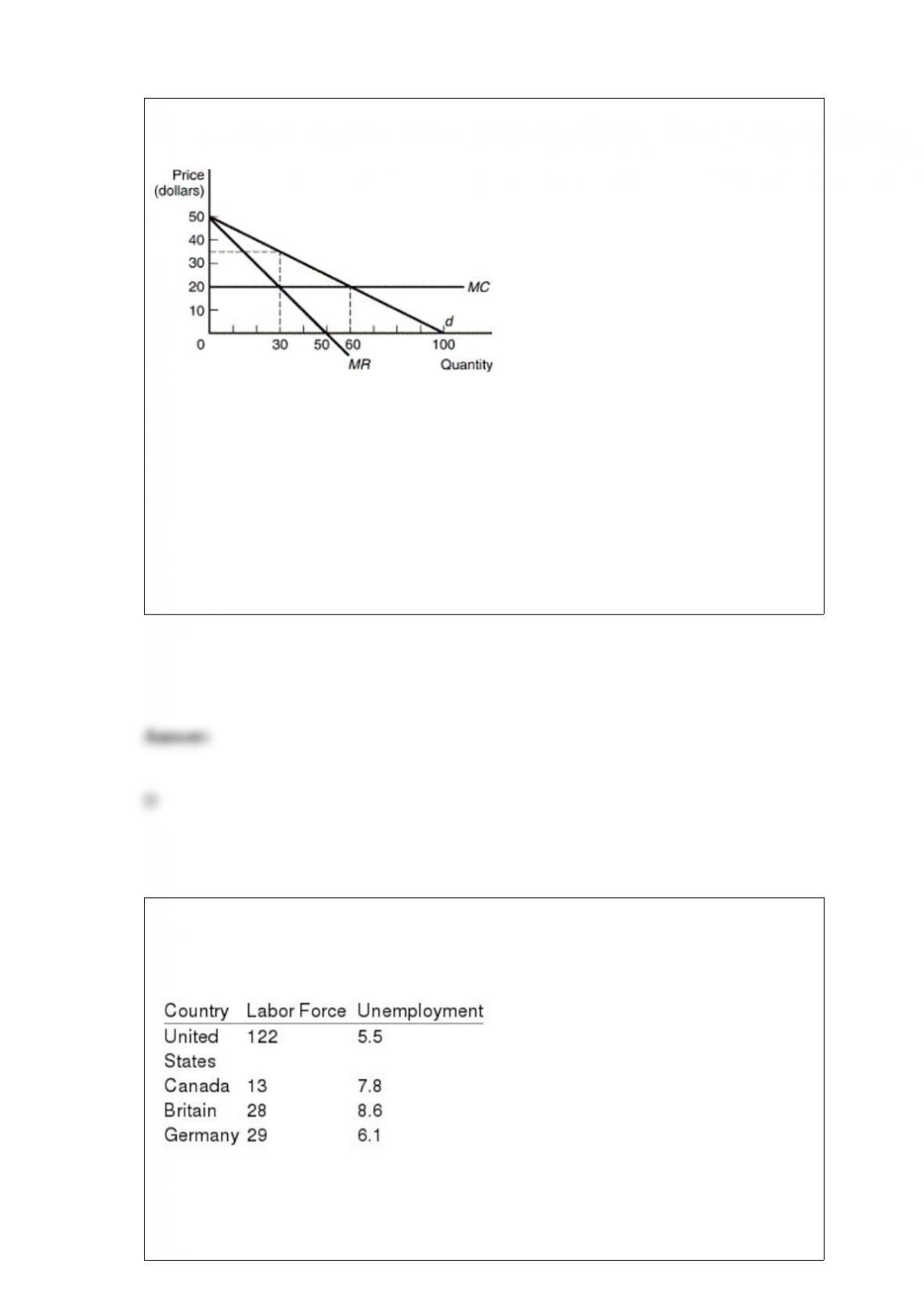
If the monopolist shown in the following figure could implement a two-part tariff, the
entry fee would be:
a. $0.
b. $225.
c. $450.
d. $900.
e. $1,200.
Suppose the size of the labor force and unemployment rate across countries in 2001 are
given in the following table. What is the intercept coefficient estimate a of the
regression of the unemployment rate as a function of the labor force?
a. 6.
b. 8.

c. 10.
d. 12.
e. 14.
Whenever average product is declining with increases in input usage:
a. marginal product is less than average product.
b. total product is declining with increases in input.
c. total product is increasing with increases in input.
d. marginal product is greater than average product.
e. total product is at a maximum.
The rule of reason, which states that only unreasonable combinations in restraint of
trade are illegal, was enunciated in the:
a. Alcoa case.
b. Standard Oil case.
c. Von’s Grocery case.

d. Brown Shoe case.
e. IBM case.
The price of computers has fallen, while the quantity purchased has remained constant.
This implies that the demand for computers has:
a. decreased, while the supply of computers has increased.
b. increased.
c. decreased, while the supply of computers has decreased.
d. increased, while the supply of computers has increased.
e. become more volatile.
Your mortgage requires that you pay $12,000 at the end of each of the next 30 years. If
the annual interest rate is 12%, then you must have borrowed approximately:
a. $117,660.
b. $96,660.
c. $78,660.
d. $63,660.
e. $133,660.
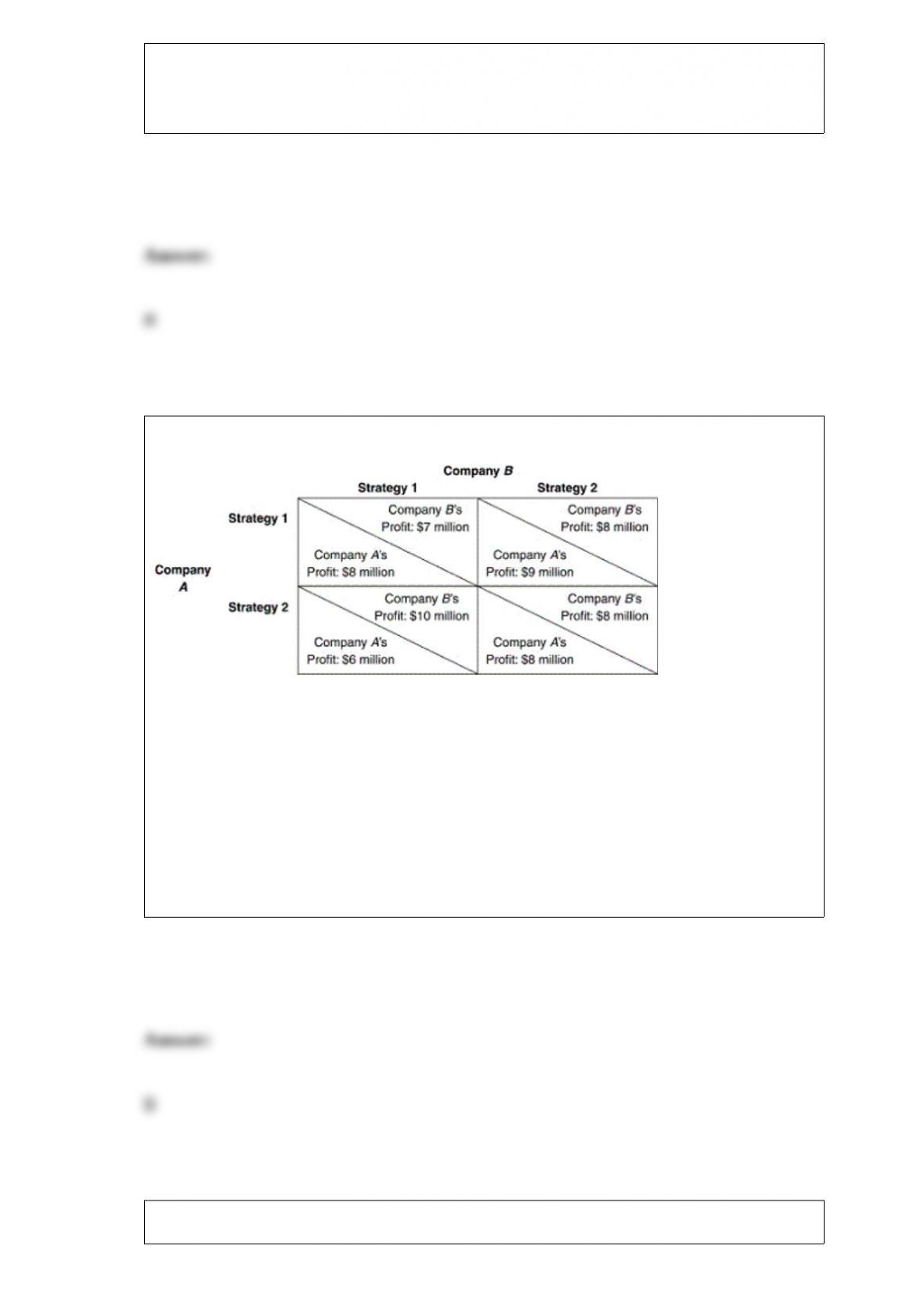
Refer to the accompanying matrix. Which of the following is a Nash equilibrium?
a. Company A chooses Strategy 1 and Company B chooses Strategy 1.
b. Company A chooses Strategy 1 and Company B chooses Strategy 2.
c. Company A chooses Strategy 2 and Company B chooses Strategy 2.
d. Company A chooses Strategy 2 and Company B chooses Strategy 1.
e. None of the above.
A function of one argument is minimized when the first derivative is:

a. zero and the second derivative is positive.
b. positive and the second derivative is negative.
c. zero and the second derivative is negative.
d. negative and the second derivative is positive.
e. zero and the second derivative is zero.
Marginal revenue can be defined as the:
a. percent increase in total revenue resulting from a 1% increase in output.
b. increase in total revenue resulting from a 1-unit increase in output.
c. total revenue divided by output.
d. average revenue multiplied by output.
e. average revenue multiplied by output divided by 4.
The moral-hazard problem occurs when:
a. a consumer of insurance changes his or her behavior in such a way as to decrease the
probability of a payoff.

b. a consumer of insurance changes his or her behavior in such a way as to increase the
probability of a payoff.
c. insurance companies change their behaviors in such a way as to increase the
probabilities of a payoff.
d. insurance companies change their behaviors in such a way as to decrease the
probabilities of a payoff.
e. none of the above.
Suppose that Wilma’s utility function is given by
U(E) = 100 ” 2E2,
where E = Wilma’s work effort in producing homemade dinners, measured in hours per
day. If Wilma is forced to work an 8-hour day producing homemade dinners, her total
utility will be:
a. 100.
b. “28.
c. “128.
d. 228.
e. none of the above.

Owner-supplied labor is a cost that is usually:
a. included in both accounting costs and economic costs.
b. included in accounting costs but not in economic costs.
c. included in economic costs but not in accounting costs.
d. not included in either accounting costs or economic costs.
e. ignored because it is impossible to place a value on it.
If bidders are likely to be risk-averse:
a. sellers should use a first-price auction.
b. sellers should use a second-price auction.
c. auctions will not provide surplus for sellers.
d. sellers should use a posted-price strategy.
e. Dutch auction rules will yield the greatest profit to sellers.
Jack O. Trades produces joint products A and B with linear demands DA > DB. Given
MRB is marginal revenue for B and MCB is marginal cost of B, Jack’s total marginal

revenue curve changes slope at the quantity where:
a. MRB = MCB.
b. DB = MCB.
c. MRB = DB.
d. MRB = 0.
e. DB = 0.
John spends his budget on food and clothing each month. His utility function is given
by
TU = 100C0.25F 0.75. The marginal rate of substitution of clothing for food is:
a. 0.33F/C.
b. 0.25FC.
c. 0.33F2C.
d. 25F/C.
e. 0.66C/F.
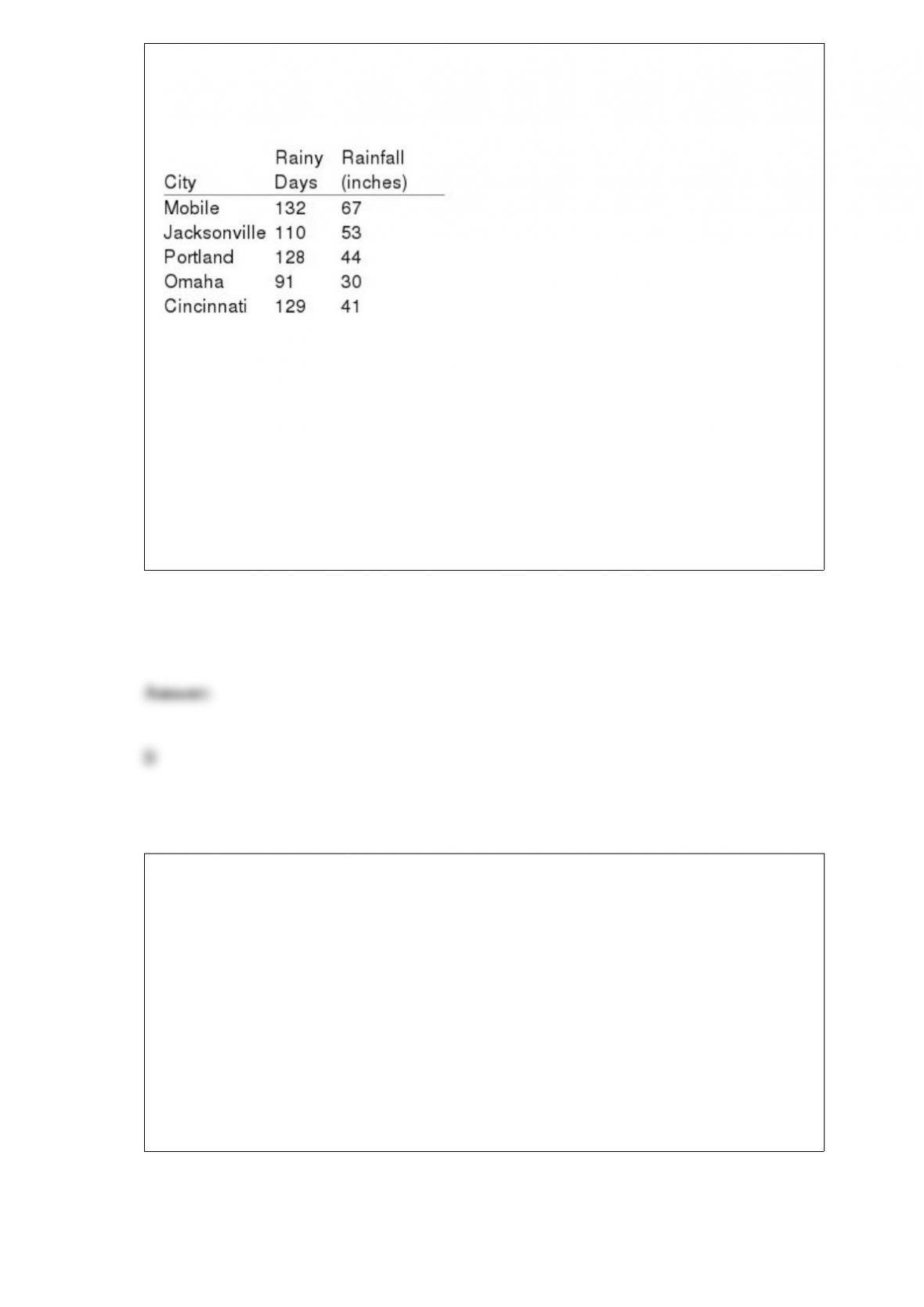
The mean annual precipitation in inches and number of days per year with measurable
precipitation by selected cities are given in the following table. What is the R-squared
of the regression of the mean annual rainfall as a function of the number of rainy days?
a. 0.28.
b. 0.38.
c. 0.48.
d. 0.58.
e. 0.68.
Transfer prices are needed when:
a. firms purchase raw materials from other firms.
b. consumers sell goods and services to one another.
c. markets must be simulated within firms.
d. products are bundled and sold as a package.
e. firms charge different prices to customers where there are no differences in
production costs.

California imposes strict new regulations on the blending of gasoline that increase
production costs. As a result, the:
a. demand for gasoline will increase.
b. demand for gasoline will decrease.
c. supply of gasoline will increase.
d. supply of gasoline will decrease.
e. demand for and supply of gasoline will not change.
The consumer’s optimal consumption of X and Y is characterized by:
a. (MUX)(MUY) = PXPY .
b. MUX = PX.
c. MUX / MUY = PY / PX .
d. MUX / PY = MUX / PX .
e. MUX / MUY = PX / PY .

Susan is indifferent between $500 for sure and a bet with a 60% chance of $400 and a
40% chance of $700. Susan is:
a. risk-averse.
b. risk loving.
c. risk-neutral.
d. a profit maximizer.
e. irrational.
Pace’s total cost of producing CO2 cartridges is given by TC = 0.5X 3 ” 24X 2 + 144X.
The level of output that minimizes average total cost is:
a. 12 cartridges.
b. 10 cartridges.
c. 18 cartridges.
d. 20 cartridges.
e. 24 cartridges.

The statistic used to test for serial correlation is the:
a. R-squared statistic.
b. t-statistic.
c. Durbin-Watson statistic.
d. F-test statistic.
e. standard error of the estimate.
Harold is indifferent between $2,500 for sure and a bet with a 60% chance of $2,400
and a 40% chance of $2,600. Harold is:
a. risk-averse.
b. risk loving.
c. risk-neutral.
d. a profit maximizer.
e. irrational.

In the model of perfect competition, firms maximize profits by producing where:
a. the difference between marginal revenue and marginal cost is maximized.
b. marginal revenue equals price.
c. the difference between price and marginal cost is maximized.
d. price equals marginal cost.
e. the difference between price and marginal revenue is maximized.
Gibbon’s Restaurant finds that it sells more pizzas when it advertises according to S =
20 + 4A ” 0.5A2, where S is sales and A is advertising expenditure. The
sales-maximizing level of advertising is:
a. A = $2.
b. A = $4.
c. A = $6.
d. A = $8.
e. A = $12.