1) in drawing a production possibilities curve we hold constant:
a.the money supply.
b.the consumer price index.
c.both technology and resource supplies.
d.resource supplies only.
2) Which among the following is the strongest determinant of an industry’s
technological progressiveness?
A.the scientific character of its industry and the number of technological opportunities
available.
B.the size of the industry concentration ratio; the lower the ratio, the greater the firm’s
technological progressiveness.
C.the Herfindahl index in the firm’s industry; the higher the index value, the greater the
firm’s technological progressiveness.
D.the amount of retained earnings in the industry.
3) A union might increase the demand for the labor services of its members by:
A.decreasing the demand for the product it is producing.
B.decreasing the prices of complementary inputs.
C.decreasing the prices of substitute inputs.
D.increasing the prices of complementary inputs.
4) the amount of pizzas that consumers want to buy per week is reflected in the
equation p = 15 – .02qd, where qd is the amount of pizzas purchased per week and p is
the price of pizzas. on the basis of this information we can say that:
a.if pizzas were free, people would consume 800 per week.
b.more pizzas will be purchased at a high price than at a low price.
c.if the price of pizzas is $6, then 150 will be purchased.
d.50 fewer pizzas will be purchased per week for every $1 increase in price.
5)
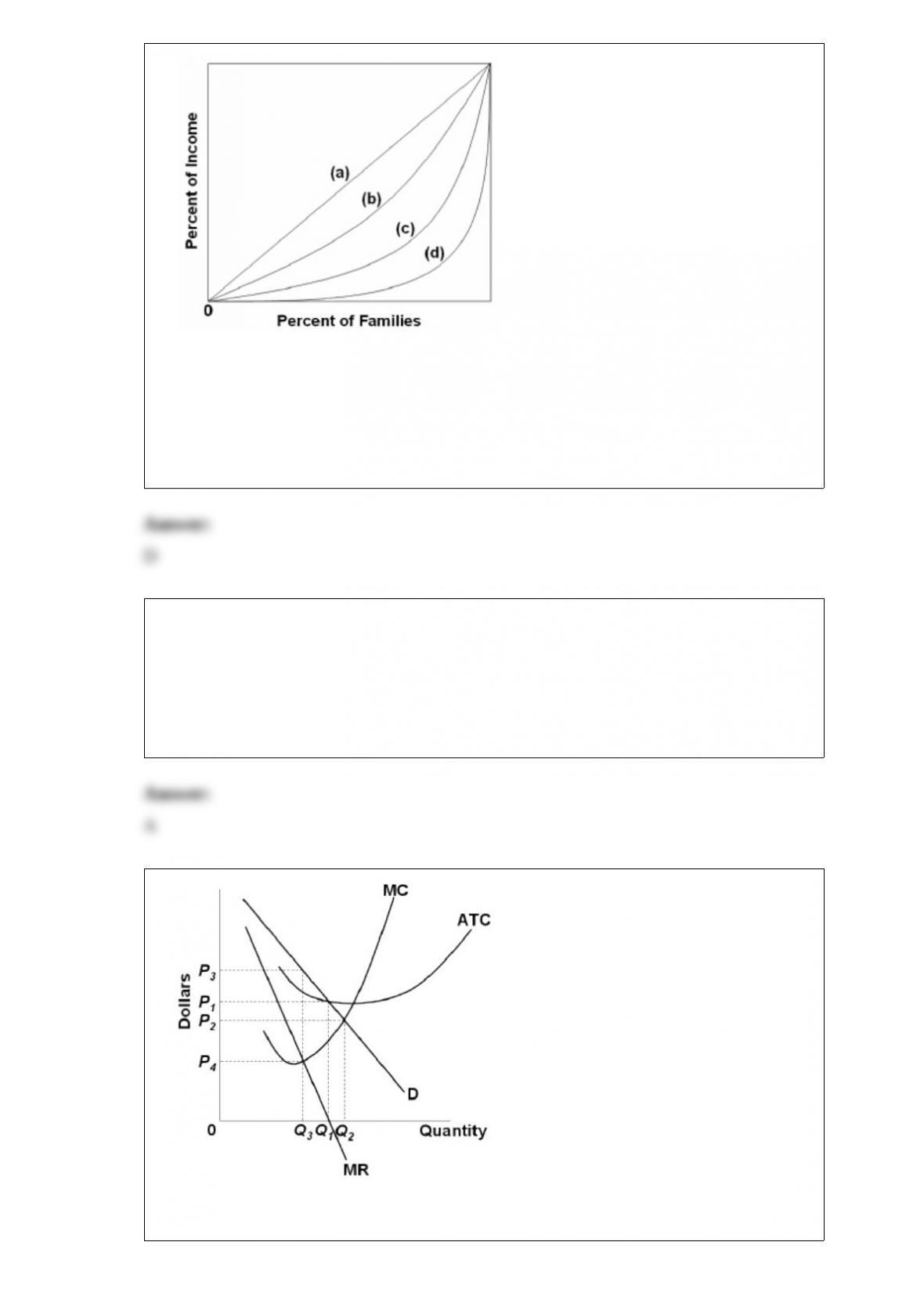
Refer to the above diagram. If line c represents the distribution of income in 1970 in the
United States, we would expect the distribution of income for 2006 to be:
A.line a.
B.line b.
C.line c.
D.line d.
6) Which of the following is not a condition of the international gold standard?
A.a nation must be willing to accept very wide fluctuations in its exchange rate
B.a nation must allow gold to be freely exported and imported
C.a nation must be willing to convert gold into paper money and vice versa at a
stipulated rate
D.a nation must define its monetary unit in terms of a certain quantity of gold
7)
refer to the above diagram for a pure monopolist. suppose a regulatory commission is
created to determine a legal price for the monopoly. if the commission seeks to provide
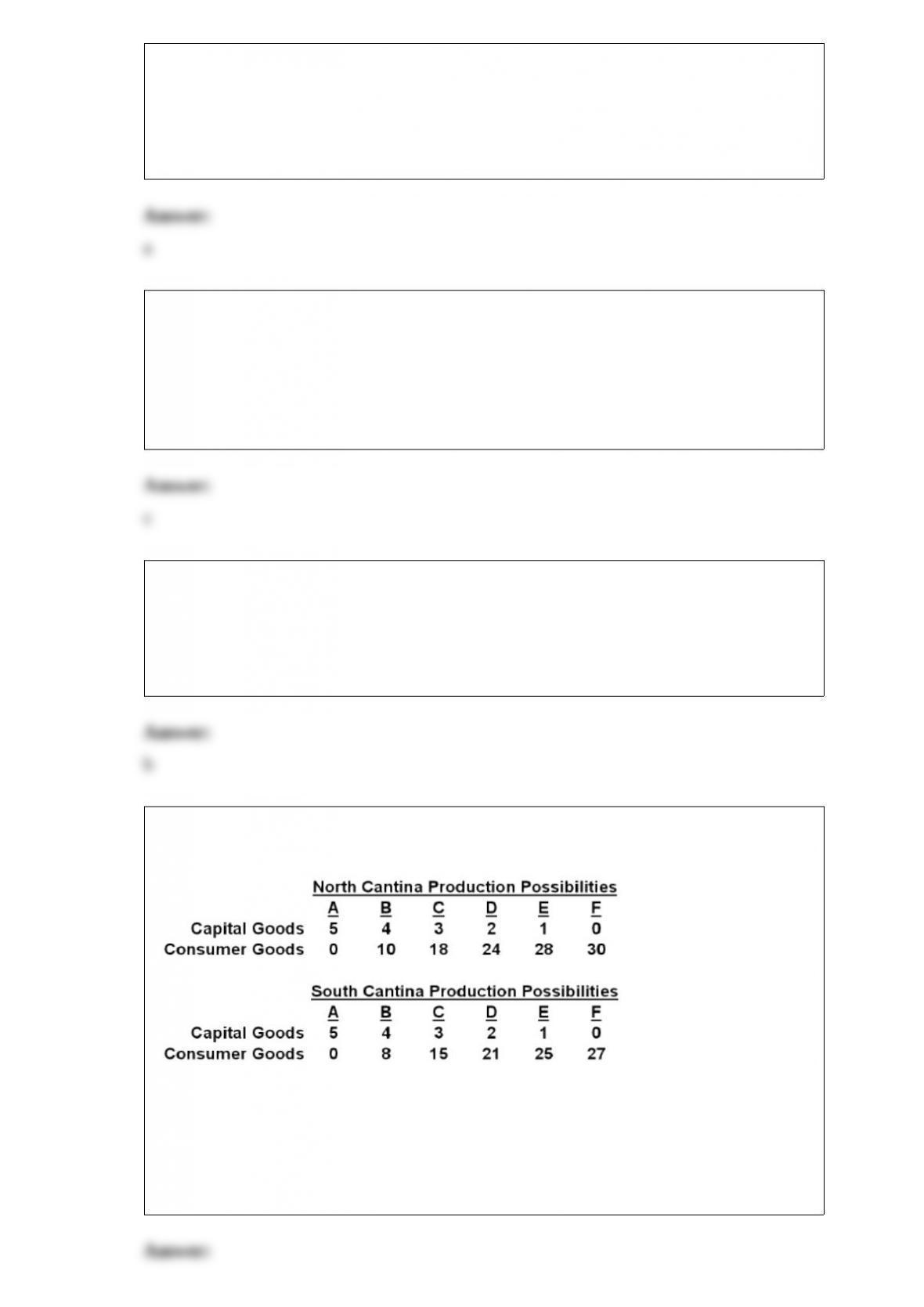
the monopolist with a “fair return,” it will set price at:
a.p1.
b.p3.
c.p2.
d.p4.
8) which of the following would not be appropriate if government were attempting to
restrain a dramatic rise in the general price level?
a.an increase in tax rates
b.a decrease in subsidies to businesses
c.an increase in transfer payments to households
d.a decrease in government spending
9) if a product is in surplus supply, its price:
a.is below the equilibrium level.
b.is above the equilibrium level.
c.will rise in the near future.
d.is in equilibrium.
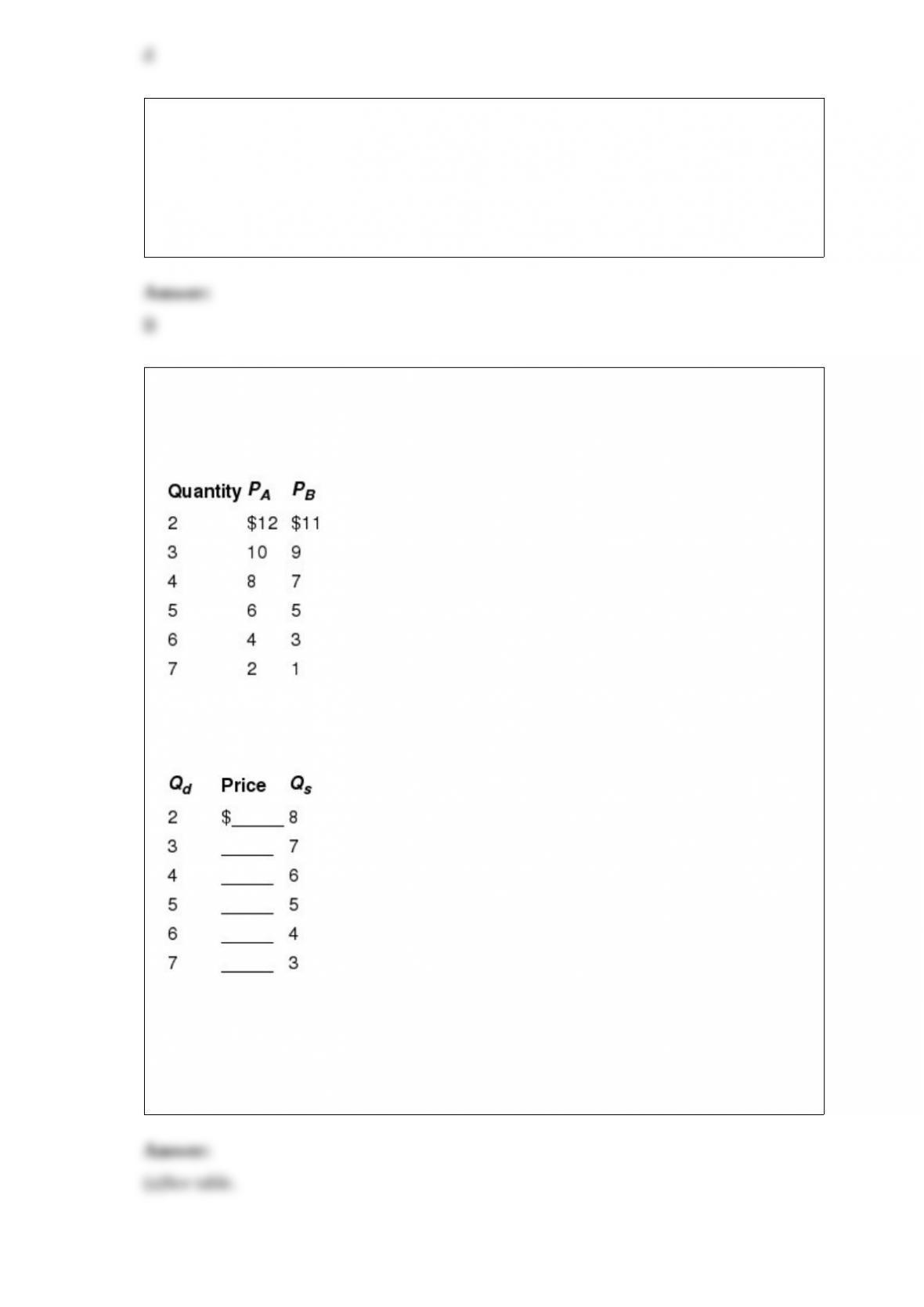
10) answer the next question(s) on the basis of the following production possibilities
tables for two countries, north cantina and south cantina:
refer to the above tables. if north cantina is producing at production alternative b, the
opportunity cost of the eleventh unit of consumer goods will be:
a.10 units of capital goods.
b.1/4 of a unit of capital goods.
c.8 units of capital goods.
d.1/8 of a unit of capital goods.
11) A merger of several firms operating in different industries-for example, a trucking
company, a fast-food chain, and a brokerage house-is called:
A.an integrated merger.
B.a conglomerate merger.
C.a vertical merger.
D.a horizontal merger.
12) Data on two individuals preferences for a public good are reflected in the table
below. PA and PB represent the prices individuals A and B, the only two people in the
society, are willing to pay for the last unit of a public good, rather than do without.
(a)Complete the table below showing the collective willingness to pay for the public
good in this society.
(b)Given the supply schedule for this public good as shown by the Qs column, what is
the optimal quantity of this public good and what is the optimal price?
(c)What is the perceived marginal benefit and perceived marginal cost when 4 units of
the public good are supplied? What does this indicate about the allocation of resources
to this public good?